
Safety
General information, not medical advice
Your prescriber and the leaflet in your pack know your situation. This page does not.
- Follow your prescriber and the leaflet
- Don't start, stop, or change a dose on your own
- Doses and warnings differ by country and product
Deltyba Tablet: Uses, Dosage, Side Effects, Precautions and Alternates
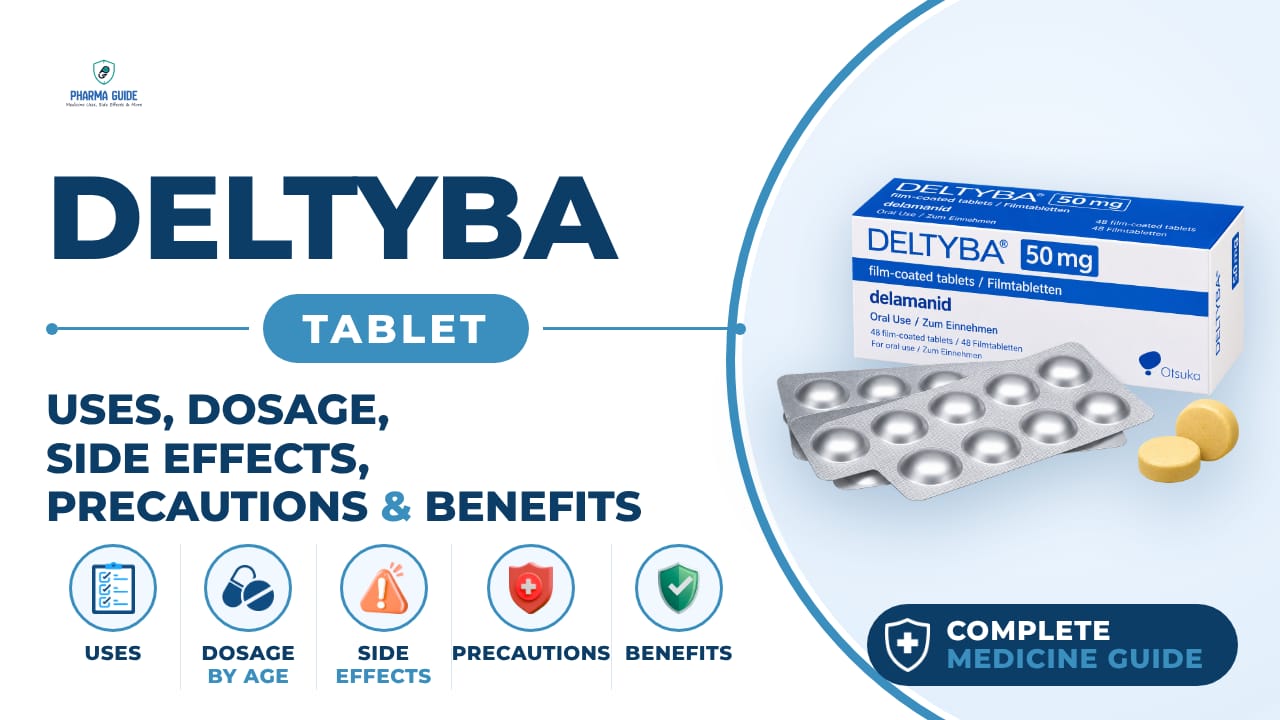
| Generic name | delamanid |
|---|---|
| Drug class | Antimycobacterial (antituberculosis antibiotic) |
| Forms | Film-coated tablet (50 mg), Dispersible tablet (25 mg) |

Quick overview
Deltyba Tablet contains delamanid, an antimycobacterial antibiotic used together with other medicines to treat tuberculosis in the lungs caused by bacteria resistant to the most commonly used TB antibiotics. It works by stopping TB bacteria from building part of their cell wall, which prevents them from growing. Deltyba is available as a film-coated tablet and a dispersible tablet, and must always be used as part of a combination treatment plan prescribed by a doctor.
What is Deltyba Tablet
Deltyba contains the active substance delamanid, an antibiotic used to treat tuberculosis in the lungs caused by bacteria that are not killed by the most commonly used TB antibiotics.
Deltyba Tablet uses
- Treatment of pulmonary multi-drug resistant tuberculosis (MDR-TB) in adults, adolescents, children and infants weighing at least 10 kg, used together with other TB medicines, when an effective treatment plan cannot otherwise be made because of resistance or tolerability problems
Benefits of Deltyba Tablet
- Helps clear tuberculosis bacteria from the sputum (sputum culture conversion) when added to other TB medicines
- Can work against TB bacteria that have become resistant to other common TB antibiotics
How Deltyba Tablet works
Delamanid works by blocking the TB bacteria from building parts of their cell wall (certain mycolic acids), which stops the bacteria from growing.
Deltyba Tablet dosage
Deltyba must always be taken together with other medicines for treating tuberculosis. It is recommended that the medicine is given under direct observation by a healthcare worker. Take the tablets during or just after a meal and swallow the film-coated tablets with water. Dispersible tablets must be mixed in water until dissolved and the resulting suspension drunk right away, then the glass rinsed with more water and that also drunk.
If you forget a dose, take it as soon as you remember, but if it is nearly time for the next dose just skip the missed one and do not double up. Do not stop taking the medicine early unless your doctor tells you to, since stopping too soon could let the bacteria recover and become resistant.
| Age group | Dose |
|---|---|
| Infants/young children weighing 10 to <20 kg | 25 mg once daily using the pediatric dispersible formulation |
| Children weighing 20 to <30 kg | 25 mg twice daily using the pediatric dispersible formulation |
| Adolescents weighing ≥50 kg | 100 mg twice daily |
| Adults 18–64 years | 100 mg twice daily |
Available forms and strengths
- Film-coated tablet (50 mg)
- Dispersible tablet (25 mg)
Side effects of Deltyba Tablet
Common
- Nausea
- Vomiting
- Headache
- Insomnia (difficulty sleeping)
- Dizziness
- Tinnitus (ringing in the ears)
- Low blood potassium (hypokalaemia)
- Gastritis
- Decreased appetite
- Weakness or lack of energy (asthenia)
- Diarrhoea
- Stomach pain
- Tingling, burning or numbness of the skin (paraesthesia)
- Shaking (tremor)
- Joint or muscle pain
- Sensations of irregular or forceful heartbeat (palpitations)
- Coughing up blood
Serious
- Changes seen on heart ECG tests, such as QT interval prolongation
- Psychotic disorder, agitation, anxiety, depression, restlessness
- Severe allergic reaction with swelling of the hands, feet, ankles, face, lips, mouth or throat, causing difficulty swallowing or breathing
- Serious liver problems (yellowing of skin/eyes, dark urine, pale stools, nausea, stomach pain)
- Fainting or seizures
- Hallucinations
Warnings and precautions
- This medicine can affect the heart's electrical rhythm (QT interval prolongation), so your doctor will check your heart with ECG tests before and regularly during treatment.
- Do not take this medicine if you have very low blood albumin levels, as this increases the risk of dangerous heart rhythm changes.
- Do not take this medicine together with strong inducers of a liver enzyme called CYP3A4, such as carbamazepine, as this reduces the medicine's effectiveness.
- This medicine must always be used together with other TB medicines and never alone, to prevent the TB bacteria from becoming resistant to it.
- There is limited safety information because this medicine is under additional, ongoing monitoring by health authorities.
- Taking certain other medicines together with this one, including some heart rhythm medicines, antipsychotics, certain antibiotics, antifungals, antihistamines, antimalarials and some HIV medicines, can increase the risk of dangerous heart rhythm changes.
- Deltyba may harm an unborn baby and is not usually recommended during pregnancy. Tell your doctor if you are pregnant, think you might be, or are planning to become pregnant.
- It is not known if delamanid passes into breast milk in humans, so breastfeeding is not recommended during treatment.
- No dose change is needed for mild or moderate kidney problems, but the medicine is not recommended for people with severe kidney impairment because there is no data on its use in that group.
- No dose change is needed for mild liver problems, but the medicine is not recommended for people with moderate to severe liver impairment.
- Alcohol should be avoided or minimized because it can complicate liver health and TB treatment.
- This medicine can have a moderate effect on your ability to drive or use machines. Do not drive or use machines if you get side effects such as headache, tremor, or dizziness that could affect your concentration or reactions.
Storage
- Store in the original package in order to protect from moisture.
- Keep out of the sight and reach of children.
- Do not use this medicine after the expiry date which is stated on the carton or blister.
- Do not throw away any medicines via wastewater or household waste. Ask your pharmacist how to throw away medicines you no longer use.
When to see a doctor
- Get medical help right away if you notice swelling of your hands, feet, ankles, face, lips, mouth or throat, or have trouble swallowing or breathing, or develop a rash or itching, or faint — these can be signs of a serious allergic reaction.
- Get medical help right away if you notice yellowing of the skin or eyes, dark urine, pale stools, nausea, or stomach pain — these can be signs of serious liver problems.
- Get medical help right away if you notice your heart beating faster or irregularly, unexplained fainting, seizures, fluttering feelings in the chest, or hallucinations.
- If you take more than your prescribed dose, contact your doctor or local hospital right away and bring the medicine pack with you.
Alternatives
- Bedaquiline
- Linezolid
- Clofazimine
Watch the video
FAQs
What is Deltyba Tablet used for?
Deltyba is used to treat pulmonary multi-drug resistant tuberculosis (MDR-TB) in adults, adolescents, children and infants weighing at least 10 kg, given together with other TB medicines when an effective treatment plan cannot otherwise be made due to resistance or tolerability problems.
How does Deltyba Tablet work?
Delamanid works by blocking TB bacteria from building parts of their cell wall (certain mycolic acids), which stops the bacteria from growing.
What are the common side effects of Deltyba Tablet?
Common side effects include nausea, vomiting, headache, insomnia, dizziness, tinnitus, low blood potassium, gastritis, decreased appetite, weakness, diarrhoea, stomach pain, tingling or numbness of the skin, tremor, joint or muscle pain, palpitations, and coughing up blood.
Can Deltyba Tablet be taken alone for TB?
No, Deltyba must always be used together with other TB medicines and never alone, to prevent the TB bacteria from becoming resistant to it.
Is Deltyba Tablet safe during pregnancy and breastfeeding?
Deltyba may harm an unborn baby and is not usually recommended during pregnancy. It is also not known if delamanid passes into breast milk, so breastfeeding is not recommended during treatment.
General information, not medical advice
Your prescriber and the leaflet in your pack know your situation. This page does not.
- Follow your prescriber and the leaflet
- Don't start, stop, or change a dose on your own
- Doses and warnings differ by country and product
Sources
Video
Related medicines

Injectafer Injection: Uses, Dosage, Side Effects, Precautions and Alternates
Iron products
Injectafer (ferric carboxymaltose) treats iron deficiency anemia and heart failure-related iron deficiency via IV. Learn uses, dosage, side effects, and

Gliclazide Tablet: Uses, Dosage, Side Effects, Precautions and Alternates
Sulfonylurea (hypoglycemic/antidiabetic agent)
Gliclazide Tablet is a sulfonylurea for type 2 diabetes that boosts insulin release. Learn about dosage, side effects, warnings, and precautions.