
Safety
General information, not medical advice
Your prescriber and the leaflet in your pack know your situation. This page does not.
- Follow your prescriber and the leaflet
- Don't start, stop, or change a dose on your own
- Doses and warnings differ by country and product
Deriphyllin Retard Tablet: Uses, Dosage, Side Effects, Precautions and Alternates
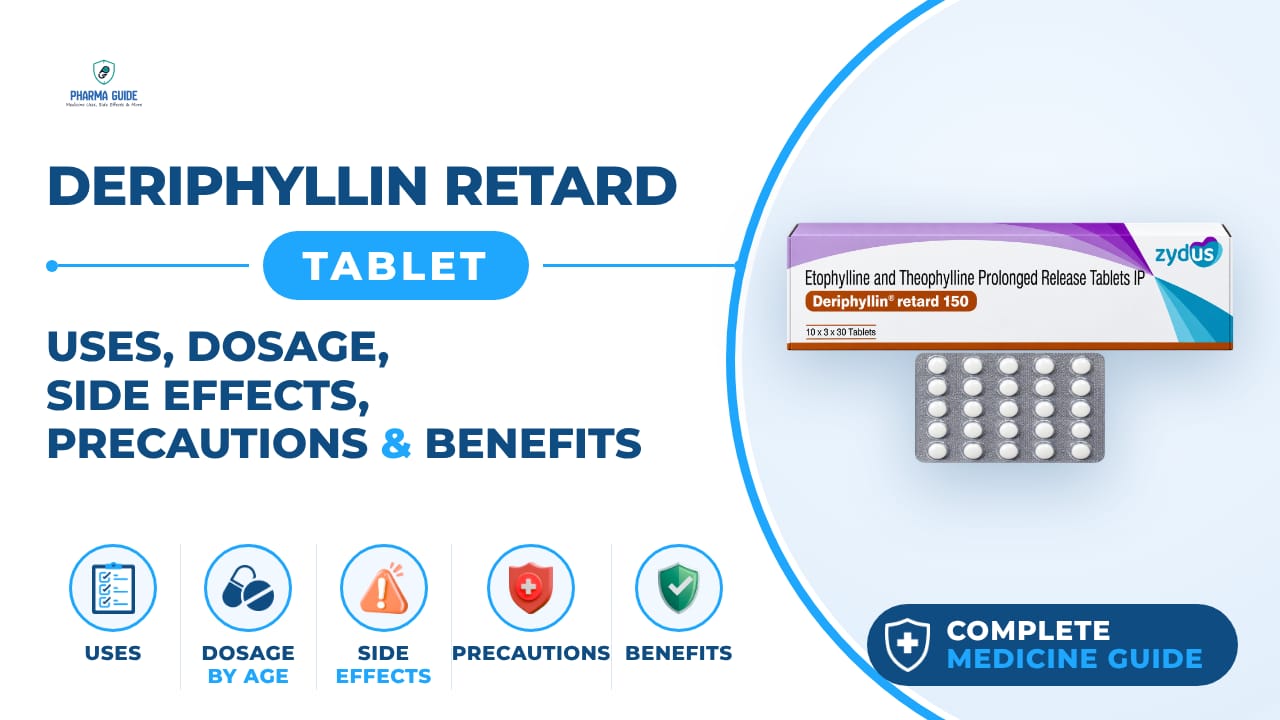
| Generic name | Etofylline (Etophylline) + Theophylline |
|---|---|
| Drug class | Bronchodilator (Methylxanthines, Antiasthmatic combination) |
| Forms | Tablet |
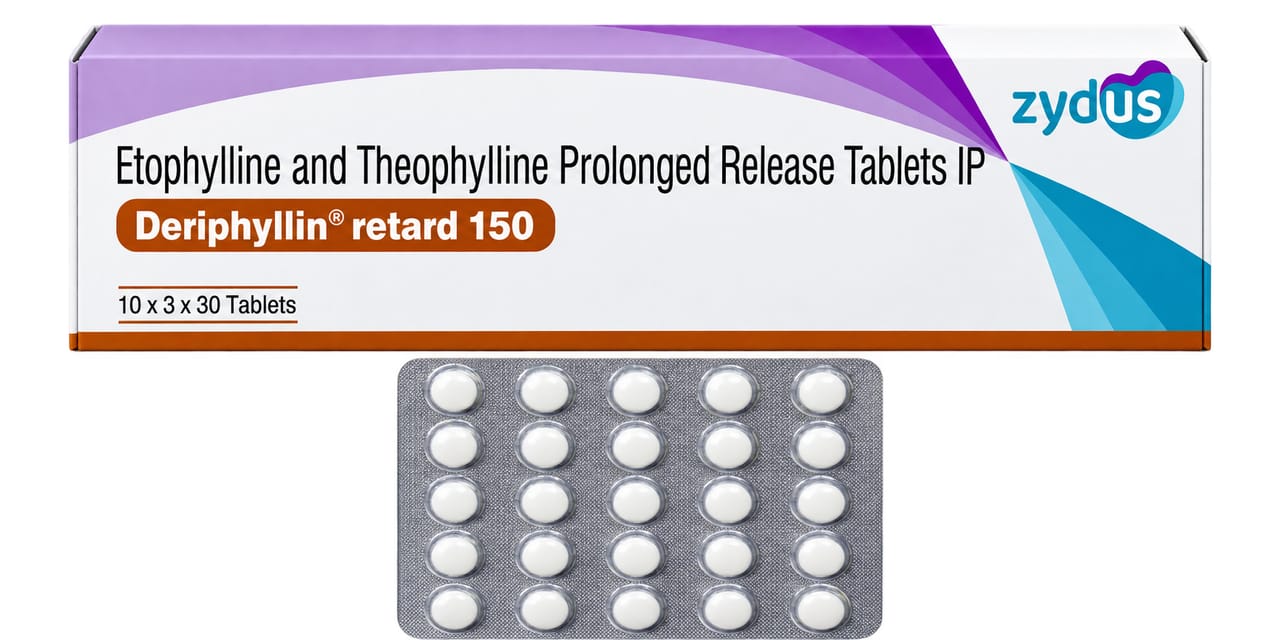
Quick overview
Deriphyllin Retard 150 Tablet is a combination medicine containing etofylline and theophylline, used for the long-term management of asthma, COPD and bronchitis in adults. It helps relax the airway muscles and relieve wheezing, chest tightness and breathlessness. This is a sustained-release tablet that must be swallowed whole and used exactly as prescribed by your doctor.
What is Deriphyllin Retard Tablet
Deriphyllin Retard 150 Tablet is a combination medicine containing etofylline and theophylline, used for the long-term management of asthma, COPD and bronchitis in adults. It helps relax the airway muscles and relieve wheezing, chest tightness and breathlessness.
Deriphyllin Retard Tablet uses
- Asthma and COPD: Helps manage and relieve airway tightening.
- Bronchitis: Reduces wheezing, chest tightness and breathlessness.
- Long-Term Control: Used regularly to keep the airways open.
- Prevents and treats wheezing, shortness of breath, and chest tightness associated with lung diseases like asthma, chronic bronchitis, emphysema, and COPD.
Benefits of Deriphyllin Retard Tablet
- Airway Relaxation: Helps relax bronchial muscles and improve airflow.
- Breathing Support: May help reduce symptoms such as wheezing and shortness of breath.
- Bronchodilator Action: Helps widen narrowed airways in certain respiratory conditions.
- Asthma Support: May be prescribed as part of treatment for asthma.
- COPD Support: Can be used in selected patients with chronic obstructive pulmonary disease.
- Prolonged Action: The sustained-release formulation is designed to provide longer-lasting bronchodilator effects.
How Deriphyllin Retard Tablet works
The medicine contains etofylline and theophylline, which relax the muscles around the airways in the lungs. They work by increasing a substance called cAMP, which activates proteins that signal the muscle cells to relax. This lets the airways expand and open up, making breathing easier. It also reduces how sensitive the lungs are to allergens that cause irritation and tightening.
Deriphyllin Retard Tablet dosage
Take it precisely as prescribed by your doctor. Swallow the tablet whole with a glass of water; do not crush, chew, or break it, since this is a slow-release formulation. Ideally, take it on an empty stomach, at least one hour before or two hours after a meal. Consult your doctor before giving this medicine to children. Older patients may need special monitoring while using this medicine.
Avoid large amounts of caffeine (coffee, chocolate, tea) while taking this medicine, as it may increase side effects. Avoid alcohol during treatment unless your doctor advises otherwise.
If you miss a dose, take it as soon as you remember; if it is almost time for your next dose, skip the missed dose and continue your regular schedule. Do not double the dose.
| Age group | Dose |
|---|---|
| 12–17 Years | Dose individualized according to body weight and response |
| Adults (18–64 Years) | Commonly 1 tablet once or twice daily, depending on tablet strength and condition |
| Older Adults (65+ years) | Dose individualized; lower doses may be required |
Available forms and strengths
- Tablet
Side effects of Deriphyllin Retard Tablet
Common
- Stomach pain
- Nausea
- Diarrhoea
- Headache
- Difficulty sleeping (restlessness or trouble sleeping)
- Faster heartbeat
- Vomiting
- Stomach upset
Serious
- Increased or irregular heart rate (palpitations)
- Convulsions (seizures)
- Allergic skin reaction
- Swelling of ankles or feet
- Yellowing of skin and eyes
- Increased urination frequency
- Twitching and unusual movement of muscles
- Elevated liver enzymes
- Tremors
Warnings and precautions
- If you are pregnant or planning a pregnancy, tell your doctor before using this medicine. It is not recommended in pregnancy unless absolutely necessary, and the risks and benefits should be discussed with your doctor.
- Consult your doctor before taking this medicine if you are breastfeeding. It is not recommended unless absolutely necessary.
- If you have kidney problems, talk to your doctor before starting this medicine, as it should be used with caution due to a higher risk of side effects.
- If you have liver problems, consult your doctor before using this medicine.
- Discuss safe alcohol use with your doctor before starting this medication, as the interaction with alcohol is not well known.
- Be careful while driving or operating machinery, as this medicine may cause dizziness or blurred vision in some people.
- Tell your doctor about any heart conditions, liver problems, seizures, ulcers, thyroid problems, high blood pressure, or history of alcohol abuse before starting this medicine.
- This medicine should not be used in people with a known allergy to theophylline, etofylline, or other xanthine-type medicines.
- Long-term use of high doses can cause the medicine to build up in the body and lead to toxicity; blood levels may need to be checked and the dose stopped if toxicity symptoms appear.
- Older adults should use this medicine with caution because they have a higher risk of side effects.
- Smoking and tobacco use can make this medicine less effective, so it's best to avoid or limit tobacco products while taking it.
- Use with caution if you have a high fever along with headache, chills, and joint pain, and report this to your doctor.
Storage
- Store Deriphyllin Retard 150 Tablet at room temperature.
- Keep the medicine in a dry place, away from moisture, sunlight, and heat.
- Store the medicine out of reach and sight of children.
- Make sure to check the expiry date before using the product.
When to see a doctor
- Report a fast or irregular heartbeat, severe nausea, or restlessness to your doctor right away.
- If side effects do not improve or become serious, speak to your doctor right away.
- If you or someone else takes too much of this medicine, seek immediate medical attention by contacting your doctor or visiting the nearest hospital.
Alternatives
- Theophylline
- Doxofylline
- Salbutamol
Watch the video
FAQs
What is Deriphyllin Retard Tablet used for?
It is used for the long-term management of asthma, COPD and bronchitis in adults, helping relax airway muscles and relieve wheezing, chest tightness and breathlessness.
How should I take Deriphyllin Retard Tablet?
Swallow the tablet whole with a glass of water without crushing, chewing, or breaking it, as it is a slow-release formulation. Ideally, take it on an empty stomach, at least one hour before or two hours after a meal.
What are the common side effects of Deriphyllin Retard Tablet?
Common side effects include stomach pain, nausea, diarrhoea, headache, difficulty sleeping, faster heartbeat, vomiting, and stomach upset.
Can I drink coffee or alcohol while taking Deriphyllin Retard Tablet?
Avoid large amounts of caffeine, like coffee, chocolate, or tea, as it may increase side effects. Avoid alcohol during treatment unless your doctor advises otherwise.
What should I do if I miss a dose of Deriphyllin Retard Tablet?
Take the missed dose as soon as you remember; if it is almost time for your next dose, skip the missed dose and continue your regular schedule without doubling the dose.
General information, not medical advice
Your prescriber and the leaflet in your pack know your situation. This page does not.
- Follow your prescriber and the leaflet
- Don't start, stop, or change a dose on your own
- Doses and warnings differ by country and product
Sources
- Asthma: MedlinePlus Medical Encyclopedia. https://medlineplus.gov/ency/article/000141.html
- Theophylline - LiverTox - NCBI Bookshelf. https://www.ncbi.nlm.nih.gov/books/NBK548479/
- Bronchodilators. nhs.uk. https://www.nhs.uk/conditions/bronchodilators/
- Theophylline: MedlinePlus Drug Information. https://medlineplus.gov/druginfo/meds/a681006.html
- Hospira, Inc. THEOPHYLLINE 200, 400 AND 800 mg in 5% Dextrose Injection. https://www.accessdata.fda.gov/drugsatfda_docs/label/2009/019211s042lbl.pdf
- Theophylline - DrugBank. https://www.drugbank.ca/drugs/DB00277
- DailyMed - Theophylline tablet, extended release. https://dailymed.nlm.nih.gov/dailymed/drugInfo.cfm?setid=1f2a4716-34fe-4a2c-8bbf-5ed16772a967
- Theophylline | C7H8N4O2 - PubChem. https://pubchem.ncbi.nlm.nih.gov/compound/2153#section=Top
- Etofylline - PubChem. https://pubchem.ncbi.nlm.nih.gov/compound/etofylline#
Video
Related medicines

Injectafer Injection: Uses, Dosage, Side Effects, Precautions and Alternates
Iron products
Injectafer (ferric carboxymaltose) treats iron deficiency anemia and heart failure-related iron deficiency via IV. Learn uses, dosage, side effects, and

Gliclazide Tablet: Uses, Dosage, Side Effects, Precautions and Alternates
Sulfonylurea (hypoglycemic/antidiabetic agent)
Gliclazide Tablet is a sulfonylurea for type 2 diabetes that boosts insulin release. Learn about dosage, side effects, warnings, and precautions.