
Safety
General information, not medical advice
Your prescriber and the leaflet in your pack know your situation. This page does not.
- Follow your prescriber and the leaflet
- Don't start, stop, or change a dose on your own
- Doses and warnings differ by country and product
Dihydroergotamine Injection: Uses, Dosage, Side Effects, Precautions and Alternates
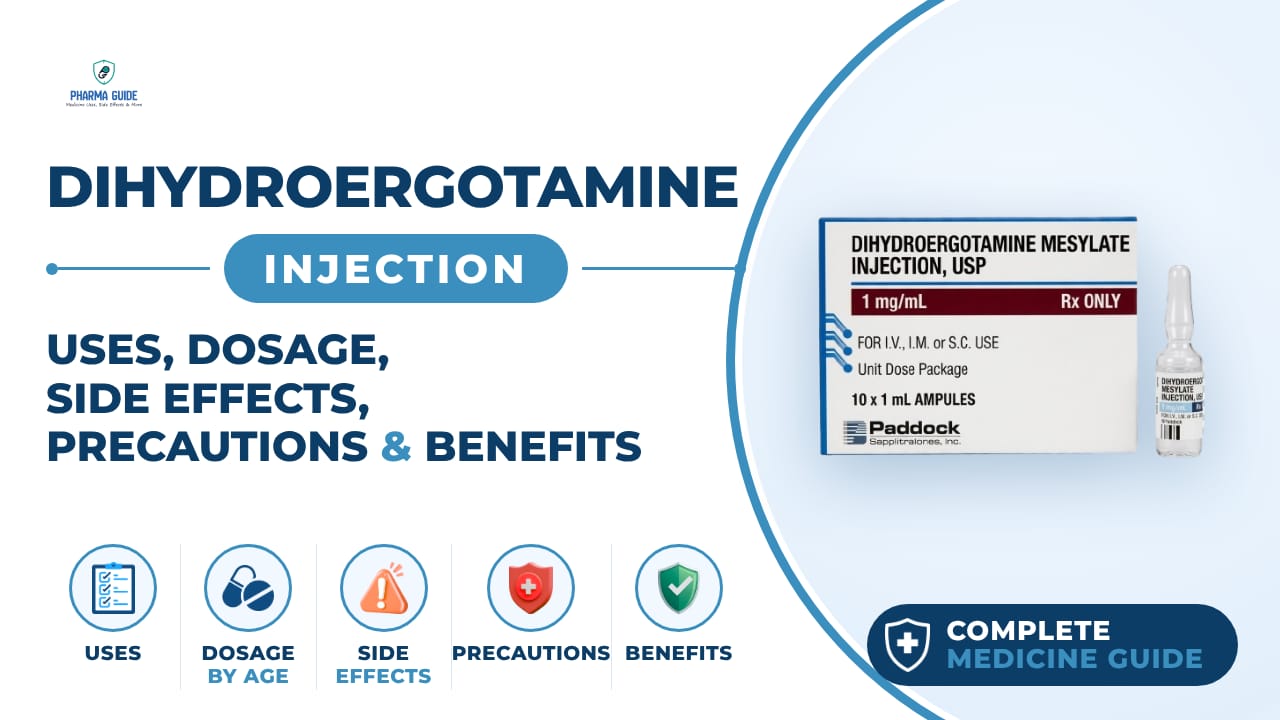
| Generic name | Dihydroergotamine mesylate |
|---|---|
| Drug class | Ergot alkaloid (ergot derivative) |
| Forms | Injection |
Quick overview
Dihydroergotamine Injection (dihydroergotamine mesylate) is an ergot alkaloid given by injection to stop an active migraine with or without aura, severe migraine attacks, or acute cluster headache episodes. It works by narrowing blood vessels in the brain and blocking substances that cause pain and swelling. It is used only to treat an attack that has already started, not to prevent one, and carries important warnings about blood flow and heart-related risks.
What is Dihydroergotamine Injection
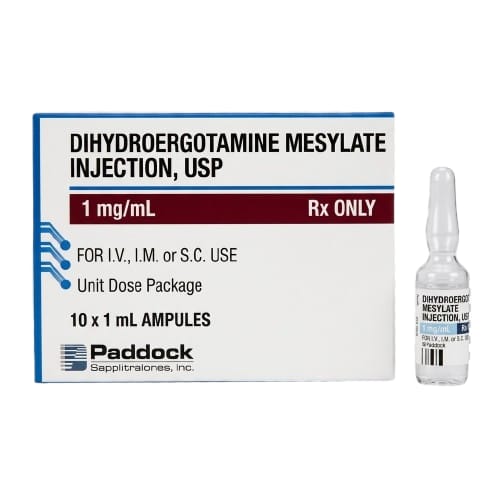
Dihydroergotamine Mesylate Injection is a clear, colorless prescription solution given into a vein, muscle, or under the skin to stop an active migraine or cluster headache attack. It belongs to a group of medicines called ergot alkaloids.
Dihydroergotamine Injection uses
- Acute migraine with aura
- Acute migraine without aura
- Severe migraine attacks
- Acute cluster headache episodes
Benefits of Dihydroergotamine Injection
- Helps relieve migraine pain
- Reduces headache severity
- Helps control acute migraine symptoms
- May reduce migraine-related discomfort
- Can help restore daily functioning after relief
How Dihydroergotamine Injection works
The medicine works by tightening (narrowing) blood vessels in the brain and by blocking the release of natural substances in the brain that cause swelling and pain signals, which helps relieve the headache.
Dihydroergotamine Injection dosage
Use this medicine at the first sign of a migraine or cluster headache attack, not to prevent a headache before symptoms start. Do not use it for a common tension headache or for a headache that does not feel like your usual migraine. If the headache comes back after at least one hour, you may give up to two more doses, spaced at least one hour apart. Do not exceed the maximum number of doses in a 24-hour period or in a 7-day period that your doctor has told you.
Your doctor may give you your first dose in the office so your reaction can be monitored; after that you may inject it yourself at home if trained to do so. This medicine is not meant for long-term daily use.
Examine the ampule before use; if it is cracked, or the liquid is discolored, cloudy, or has particles, do not use it and get a new one. Once an ampule is opened, throw away any unused portion if it is not used within an hour. For self-injection, the subcutaneous dose is typically given in the middle of the thigh, well above the knee. Use each injection only once and inject all of the solution in the syringe or autoinjector.
| Age group | Dose |
|---|---|
| Under 18 years | Not recommended |
| 18–64 years | 1 mg, once/day |
| 65+ years | 1 mg, once/day |
Available forms and strengths
- Injection
Side effects of Dihydroergotamine Injection
Common
- Dizziness
- Anxiety
- Flushing
- Headache
- Diarrhea
- Rash
- Increased sweating
- Burning or tingling sensation in the nose (nasal forms)
Serious
- Color changes, numbness, or tingling in fingers and toes
- Muscle pain or cramps in arms and legs
- Sudden weakness in an arm or leg, drooping of one side of the face, or difficulty speaking or understanding (signs of stroke)
- Pain, tightness, pressure, discomfort, or heaviness in the chest, stomach, throat, neck, or jaw; shortness of breath; rapid, pounding, or irregular heartbeat; cold sweat; nausea; vomiting; or lightheadedness (signs of heart attack)
- Swelling or itching
- Sudden or severe stomach pain, constipation, nausea, or vomiting; bloody diarrhea; weight loss; or fever
- Shortness of breath, cough, extreme tiredness, unusual weight loss, or muscle or joint pain (possible signs of fibrosis)
- Temporary speeding or slowing of the heart rate
Warnings and precautions
- This medicine should be avoided during pregnancy because it may cause preterm labor and can harm an unborn baby. Tell your doctor right away if you are or might be pregnant.
- Do not breastfeed while using this medicine and for 3 days after your last dose, because it may lower your milk supply and could cause harm, such as vomiting, diarrhea, weak pulse, and unstable blood pressure, in a breastfed infant.
- This medicine should not be used by people with severely impaired kidney function or severely impaired liver function.
- This medicine may cause dizziness, drowsiness, or make you less alert than usual. Do not drive or do anything that could be dangerous until you know how this medicine affects you.
- Taking this medicine with certain drugs, such as protease inhibitors or macrolide antibiotics (like erythromycin, clarithromycin, or troleandomycin), can cause serious and even life-threatening reduction of blood flow, which can lead to stroke or loss of blood flow to the hands and feet. These combinations must be avoided.
- This medicine should not be used by people with heart disease, including angina, a history of heart attack, or coronary artery spasm, because it can cause dangerous narrowing of heart blood vessels.
- Serious and sometimes fatal heart problems, including heart attack and dangerous abnormal heart rhythms, have occurred after this medicine was given, although this is very rare.
- Stroke, bleeding in the brain, and other serious brain blood vessel problems have been reported with this medicine, sometimes because the symptoms were mistakenly thought to be a migraine.
- This medicine should not be used with certain other migraine medicines, such as triptans or other ergot-type drugs, within 24 hours of each other, since this can raise the risk of dangerous blood vessel narrowing.
- Using this or other migraine medicines too often (10 or more days a month) can actually cause more frequent or worse headaches, known as medication overuse headache.
- Long-term daily use of this injectable medicine has been linked to scarring (fibrosis) of the tissue around the lungs or kidneys, and rarely of the heart valves.
- This medicine can raise blood pressure and should not be used by people whose high blood pressure is not under control.
- Smoking cigarettes while using this medicine increases the risk of serious side effects, since nicotine can cause additional narrowing of blood vessels.
Storage
- Store at room temperature, away from light, excess heat, and moisture (not in the bathroom)
- Do not refrigerate or freeze
- Use the carton to protect the ampules from light until they are used
- Keep the medication in the container it came in, tightly closed, and out of reach of children
- Dispose of unneeded medication through a medicine take-back program rather than flushing it down the toilet
- Dispose of syringes or autoinjectors in a puncture-resistant container
When to see a doctor
- Get emergency help right away if you have symptoms of a stroke, such as sudden weakness in an arm or leg, drooping of one side of the face, trouble speaking or understanding, confusion, or loss of balance.
- Get emergency help right away if you have signs of a possible heart attack, such as chest, stomach, throat, neck, or jaw pain or tightness, shortness of breath, a racing or irregular heartbeat, cold sweat, nausea, vomiting, or lightheadedness.
- Stop using the medicine and call your doctor immediately if you notice color changes, numbness, or tingling in your fingers and toes, or muscle pain or cramps in your arms and legs — these can be signs of poor blood flow.
- Call your doctor right away if you have swelling or itching after a dose.
- Call your doctor right away if you have sudden or severe stomach pain, constipation, nausea or vomiting, bloody diarrhea, weight loss, or fever, which may indicate scarring in the abdomen.
- Call your doctor right away if you have shortness of breath, cough, extreme tiredness, unusual weight loss, or muscle or joint pain, which may be signs of a lung problem.
- If you think you or someone else has taken too much of this medicine, contact your doctor, go to the emergency department, or call your local poison control center immediately.
Alternatives
- Naratriptan
- Zolmitriptan
- Sumatriptan
Watch the video
FAQs
What is Dihydroergotamine Injection used for?
It is used to stop an active migraine with or without aura, severe migraine attacks, or acute cluster headache episodes. It treats an attack that has already started and is not used to prevent one.
How does Dihydroergotamine Injection work?
It works by narrowing blood vessels in the brain and blocking the release of natural substances that cause swelling and pain signals, which helps relieve the headache.
How is Dihydroergotamine Injection used?
It is used at the first sign of a migraine or cluster headache attack. If the headache returns after at least one hour, up to two more doses may be given, spaced at least one hour apart, without exceeding the maximum doses allowed in 24 hours or 7 days as directed by your doctor.
What are the serious risks of Dihydroergotamine Injection?
Serious risks include signs of stroke or heart attack, poor blood flow causing color changes or numbness in fingers and toes, muscle pain or cramps, and rarely fibrosis affecting the lungs, kidneys, or heart valves with long-term use.
Can Dihydroergotamine Injection be used with other migraine medicines?
No, it should not be used with other migraine medicines such as triptans or other ergot-type drugs within 24 hours of each other, since this can raise the risk of dangerous blood vessel narrowing.
General information, not medical advice
Your prescriber and the leaflet in your pack know your situation. This page does not.
- Follow your prescriber and the leaflet
- Don't start, stop, or change a dose on your own
- Doses and warnings differ by country and product
Sources
Video
Related medicines

Injectafer Injection: Uses, Dosage, Side Effects, Precautions and Alternates
Iron products
Injectafer (ferric carboxymaltose) treats iron deficiency anemia and heart failure-related iron deficiency via IV. Learn uses, dosage, side effects, and

Gliclazide Tablet: Uses, Dosage, Side Effects, Precautions and Alternates
Sulfonylurea (hypoglycemic/antidiabetic agent)
Gliclazide Tablet is a sulfonylurea for type 2 diabetes that boosts insulin release. Learn about dosage, side effects, warnings, and precautions.