
Safety
General information, not medical advice
Your prescriber and the leaflet in your pack know your situation. This page does not.
- Follow your prescriber and the leaflet
- Don't start, stop, or change a dose on your own
- Doses and warnings differ by country and product
Diprosalic Ointment: Uses, Dosage, Side Effects, Precautions and Alternates
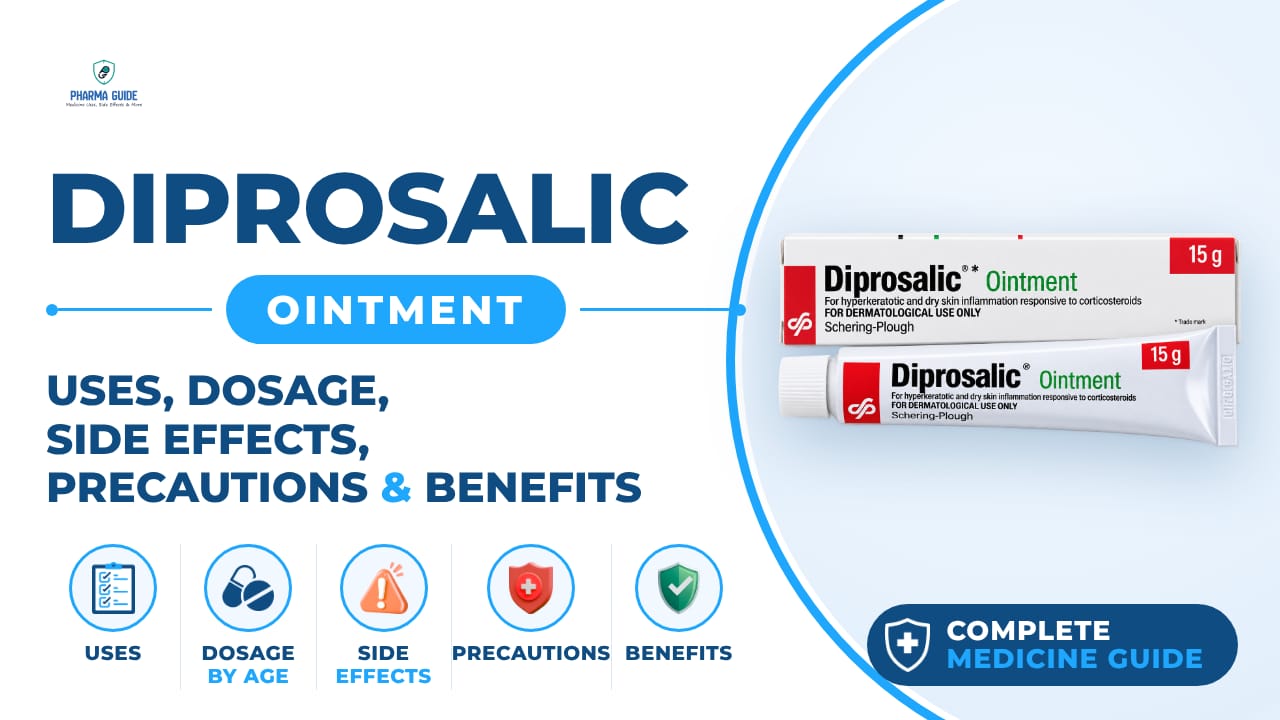
| Generic name | Betamethasone dipropionate + Salicylic Acid |
|---|---|
| Drug class | Topical corticosteroid combined with keratolytic (Topical keratolytics, Topical Corticosteroids) |
| Forms | Ointment |
Quick overview
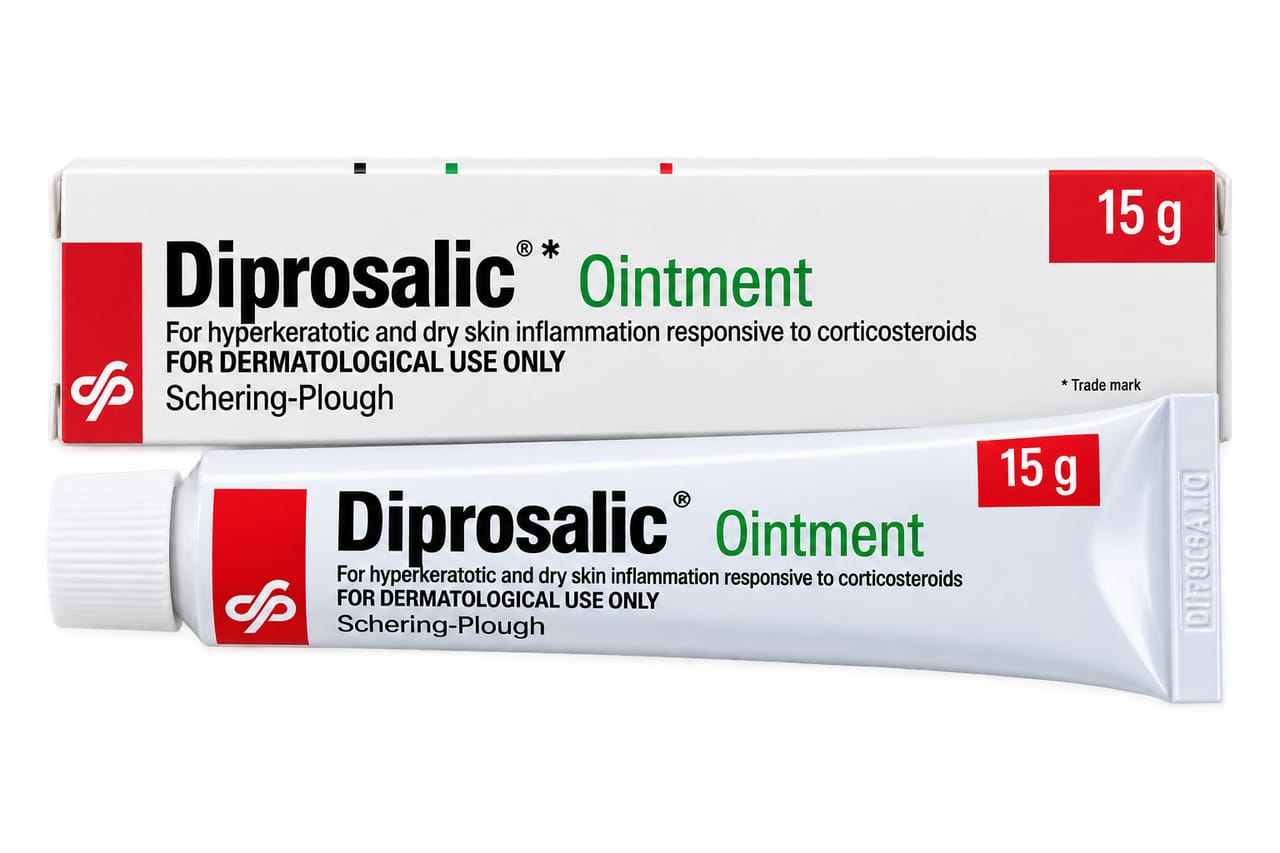
Diprosalic Ointment is a combination medicine containing betamethasone dipropionate, a potent topical corticosteroid, and salicylic acid, a keratolytic agent. It is used to treat red, itchy and scaly skin caused by conditions such as psoriasis and eczema. It is applied to the skin and is available on prescription.
What is Diprosalic Ointment
Diprosalic Ointment is a combination medicine containing a potent steroid (betamethasone) and salicylic acid, used to treat red, itchy and scaly skin caused by conditions such as psoriasis and eczema. It is applied to the skin and is available on prescription.
Diprosalic Ointment uses
- Inflammatory skin conditions such as psoriasis and eczema
- Red, itchy, dry and scaly skin
Benefits of Diprosalic Ointment
- Helps reduce redness, itching, and inflammation in certain skin conditions.
- Helps treat thick, scaly patches, especially in psoriasis and chronic eczema.
- Betamethasone reduces inflammation and allergic skin reactions.
- Salicylic acid softens and removes excess scales and dead skin.
- Helps the corticosteroid penetrate thickened skin more effectively.
- Can improve scaling, roughness, and discomfort when used as prescribed.
How Diprosalic Ointment works
The ointment contains two ingredients that work together. Salicylic acid softens and loosens dry, flaky or thickened skin so it sheds more easily, revealing healthy skin underneath. Betamethasone, a potent steroid, reduces redness, itching and swelling by blocking the chemicals in the body that cause inflammation.
Diprosalic Ointment dosage
For external use only; apply only to affected areas of skin. Wash your hands before and after use, and wash and dry the affected area before applying. Apply a thin layer to all affected areas twice a day. Do not use on the face or on children for more than 5 days. Do not cover the treated area with bandages or dressings unless told to by your doctor. Avoid contact with eyes, mouth, and any open areas of skin, and do not apply more than the recommended amount.
If you forget to apply a dose, apply it as soon as you remember; if it is nearly time for your next dose, skip the missed one and do not double up. Usage does not depend on food timings. Contact your doctor if symptoms do not improve after two weeks of use.
| Age group | Dose |
|---|---|
| Under 2 years | Generally not recommended unless specifically prescribed |
| 2–11 years | Apply a small amount once or twice daily only when prescribed; treatment should usually be brief |
| 12–17 years | Apply a thin layer once or twice daily to affected skin |
| 18–64 years | Apply a thin layer twice daily, usually morning and evening; frequency may be reduced as symptoms improve |
| 65+ years | Use the smallest effective amount, particularly on thin or fragile skin |
Available forms and strengths
- Ointment
Side effects of Diprosalic Ointment
Common
- Burning, itching, and irritation of the skin at the application site
- Stinging
- Rash
- Redness of the skin
- Change in color and texture of the skin
- Dryness of the skin
- Blistering, peeling, swelling
Serious
- Thinning of the skin
- Inflammation of the hair follicles
- Excessive hair growth
- Reduced skin pigmentation
- Blurred vision
- Salicylism (ringing in the ears, nausea, and vomiting) if used for a long time, over a large area, or in children
Warnings and precautions
- Do not use this ointment if you are allergic to any of its ingredients, or if you have rosacea, acne, dermatitis around the mouth, genital itching, nappy rash, cold sores, or chickenpox.
- Avoid smoking or being near naked flames while using this product, as it contains flammable ingredients and could cause severe burns.
- Do not use this ointment under bandages or dressings.
- Using more than the recommended amount can affect your hormone levels, leading to thinning of the skin, a rounder face, weakness, tiredness or dizziness.
- Do not use this ointment if you have an active, untreated skin infection, as it may make the condition worse.
- Use with caution if applying for a long period, over a large area, or in children, because of the risk of a toxic condition called salicylism.
- There is limited information on using this medicine during pregnancy. Talk to your doctor before using it if you are pregnant, think you might be, or are planning to have a baby.
- It is not known whether this medicine passes into breast milk. Talk to your doctor before using it if you are breastfeeding.
- No specific dose adjustment is normally required with limited topical use in those with kidney conditions. Avoid excessive or prolonged application because salicylic acid can be absorbed through the skin.
- No specific liver-related adjustment is usually required with normal topical use; use cautiously over large areas or for prolonged periods.
- The effect of alcohol with this medicine is not known. It is best to check with your doctor before drinking alcohol while using it.
- No expected effect on the ability to drive or operate machinery.
Storage
- Store below 25°C (77°F) or according to the product label.
- Keep in a cool, dry place away from excessive heat.
- Protect from direct sunlight and extreme temperatures.
- Keep the tube tightly closed after each use.
- Do not freeze and avoid storing in hot or humid areas.
- Keep out of reach of children and pets.
When to see a doctor
- Contact your doctor if you notice signs of an allergic reaction such as skin rash, itching or hives, and seek immediate medical attention.
- Contact your doctor if your symptoms do not improve or resolve after two weeks of use.
- If this medicine is swallowed, it may cause harm and immediate medical help may be needed.
Alternatives
- Betamethasone Ointment
- Mometasone Ointment
- Hydrocortisone Ointment
- Clobetasol Ointment
- Calcipotriol + Betamethasone
Watch the video
FAQs
What is Diprosalic Ointment used for?
It is used to treat red, itchy and scaly skin caused by conditions such as psoriasis and eczema.
How does Diprosalic Ointment work?
Salicylic acid softens and loosens dry, flaky or thickened skin so it sheds more easily, while betamethasone, a potent steroid, reduces redness, itching and swelling by blocking inflammation-causing chemicals in the body.
How should I apply Diprosalic Ointment?
Apply a thin layer to all affected areas twice a day for external use only. Do not use on the face or on children for more than 5 days, and do not cover the treated area with bandages or dressings unless told to by your doctor.
What are the side effects of Diprosalic Ointment?
Common side effects include burning, itching, irritation, stinging, rash, redness, changes in skin color and texture, dryness, blistering, peeling and swelling. Serious effects can include skin thinning, inflamed hair follicles, excessive hair growth, reduced pigmentation, blurred vision, and salicylism if used long-term or over large areas.
When should I see a doctor while using Diprosalic Ointment?
Contact your doctor if you notice signs of an allergic reaction, if symptoms do not improve after two weeks of use, or if the ointment is accidentally swallowed.
General information, not medical advice
Your prescriber and the leaflet in your pack know your situation. This page does not.
- Follow your prescriber and the leaflet
- Don't start, stop, or change a dose on your own
- Doses and warnings differ by country and product
Sources
- Diprosalic Ointment, Patient Information Leaflet: https://www.medicines.org.uk/emc/product/1450/pil
- DailyMed - Betamethasone dipropionate cream/ointment/lotion
- Medicines.org.uk. 2021. Diprosalic Ointment - Summary of Product Characteristics (SmPC) - (emc).
Video
Related medicines

Injectafer Injection: Uses, Dosage, Side Effects, Precautions and Alternates
Iron products
Injectafer (ferric carboxymaltose) treats iron deficiency anemia and heart failure-related iron deficiency via IV. Learn uses, dosage, side effects, and

Gliclazide Tablet: Uses, Dosage, Side Effects, Precautions and Alternates
Sulfonylurea (hypoglycemic/antidiabetic agent)
Gliclazide Tablet is a sulfonylurea for type 2 diabetes that boosts insulin release. Learn about dosage, side effects, warnings, and precautions.