
Safety
General information, not medical advice
Your prescriber and the leaflet in your pack know your situation. This page does not.
- Follow your prescriber and the leaflet
- Don't start, stop, or change a dose on your own
- Doses and warnings differ by country and product
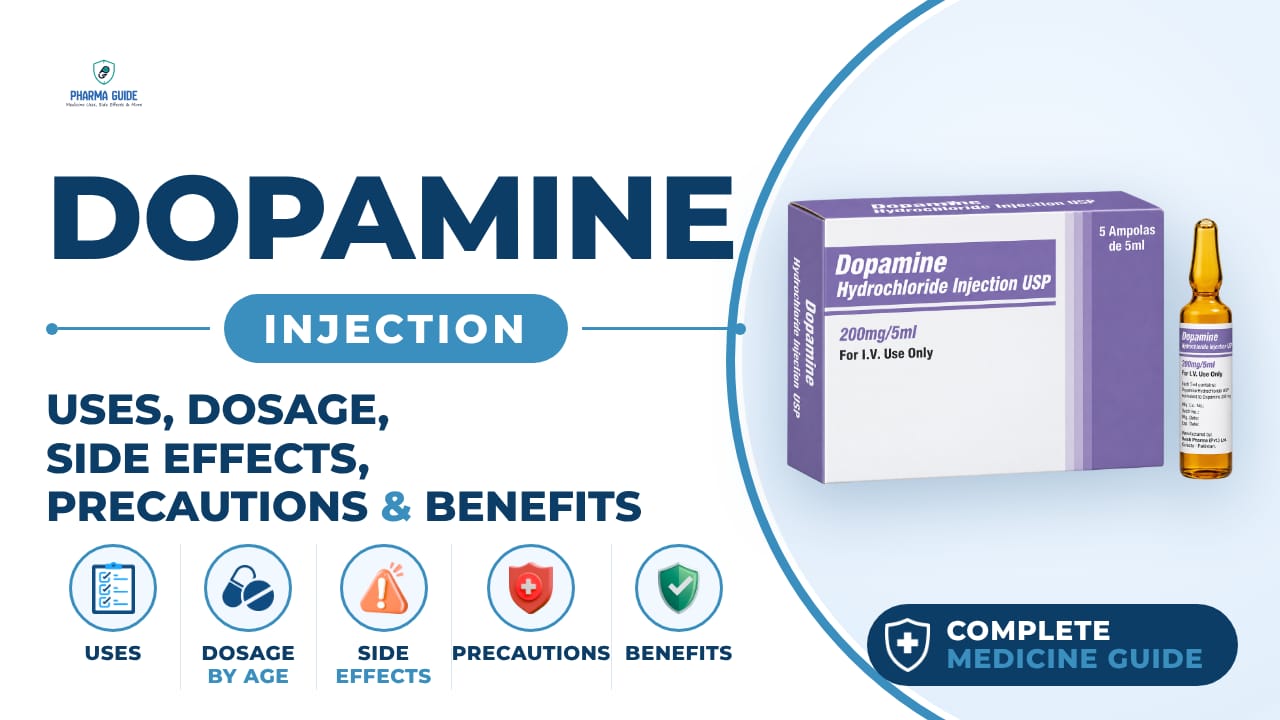
Dopamine Injection: Uses, Dosage, Side Effects, Precautions and Alternates
| Generic name | Dopamine hydrochloride |
|---|---|
| Drug class | Catecholamine / inotropic agent / vasopressor |
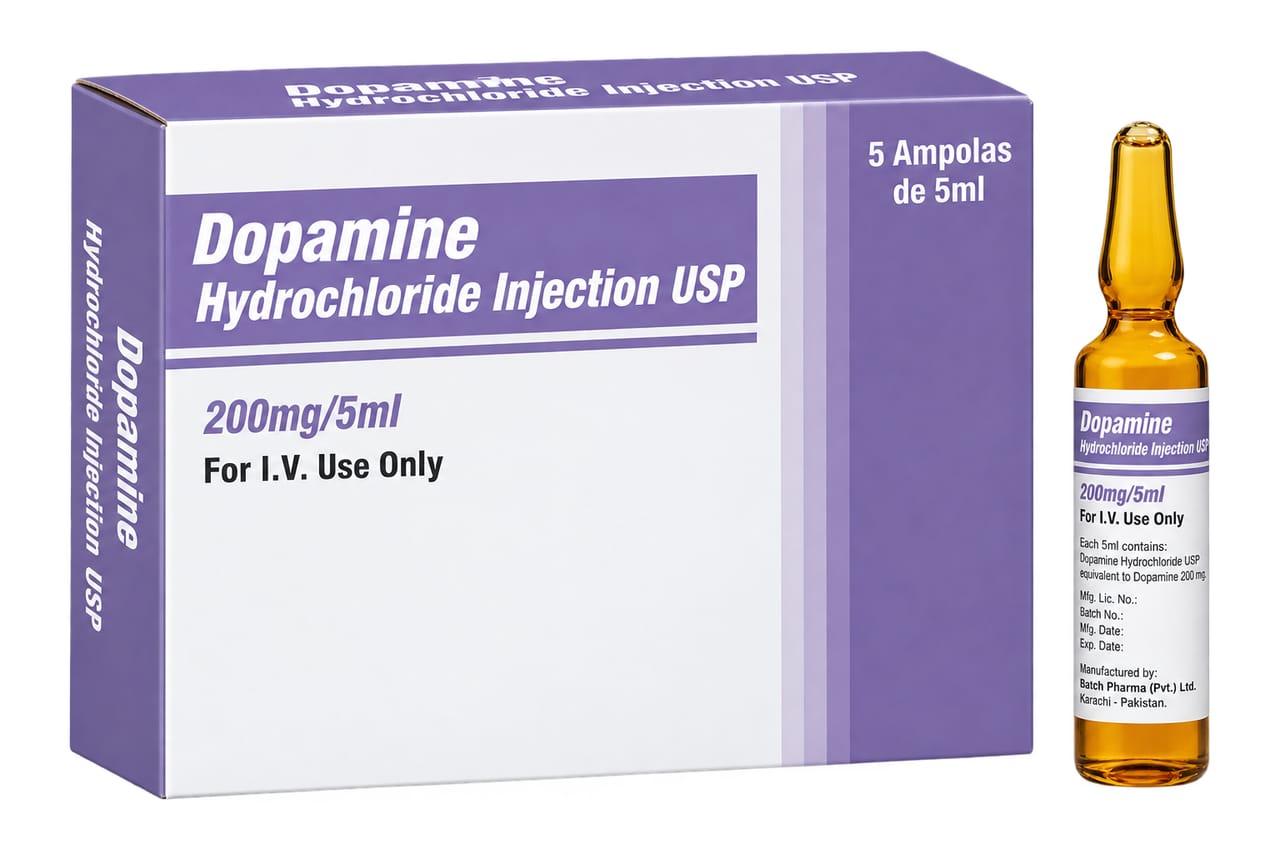
| Forms | Injection |
Quick overview
Dopamine Injection (dopamine hydrochloride) is a catecholamine used as an inotropic agent and vasopressor. It is given through an IV in a hospital, usually in an intensive care setting, to treat shock and improve blood flow, blood pressure, and heart function. It is also used for poor kidney function with low urine output.
What is Dopamine Injection
Dopamine Injection is a medicine given through an IV that contains a man-made version of a substance your body naturally makes. It is used in hospitals, usually in an intensive care setting, to treat shock and help improve blood flow and heart function.
Dopamine Injection uses
- Improving blood flow and blood pressure status in patients in shock
- Shock caused by reduced heart output (e.g., after a heart attack)
- Shock from blood infection (septicemia), injury, heart failure, or open heart surgery
- Low blood pressure
- Poor kidney function and low urine output
Benefits of Dopamine Injection
- Helps increase the strength of heart muscle contractions
- Improves blood flow and oxygen supply to the kidneys, brain, gut, and heart
- Can increase urine production and help protect the kidneys
- Improves blood pressure in patients in shock
How Dopamine Injection works
Dopamine acts on different receptors in the body depending on the dose. At low doses it widens blood vessels in the kidneys and gut, increasing blood flow and urine output. At medium doses it makes the heart beat stronger and faster. At high doses it narrows blood vessels and raises blood pressure.
Dopamine Injection dosage
This medicine is given only by a healthcare provider as a continuous drip into a vein, never by mouth or injection into muscle. It must be diluted before it is given to you. It is usually given into a large vein using a pump, preferably in an intensive care unit.
Your doctor will check the IV site often and will want to know right away if you feel any burning, pain, or swelling where the needle enters your skin. Your breathing, blood pressure, oxygen levels, kidney function, and other vital signs will be watched closely while you receive this medicine.
If the medicine needs to be stopped, your doctor will lower the dose gradually rather than stopping it suddenly, and will give you extra fluids to prevent a sudden drop in blood pressure. This product is not recommended for use in children, according to one source, although another source notes it has been used in children from birth through the teenage years.
| Age group | Dose |
|---|---|
| Under 18 years | Not established |
| 18–60 years | 200–500 mg/day |
| 60+ years | 200–500 mg/day |
Available forms and strengths
- Injection
Side effects of Dopamine Injection
Common
- Headache
- Fast, slow, or pounding heartbeat
- Chest pain and awareness of an irregular pulse
- Difficulty breathing
- Low blood pressure (may cause faintness or dizziness)
- Narrowing of blood vessels (skin may turn cold, pale, or bluish)
- Nausea and vomiting
- Feeling anxious
- Chills, goosebumps
- Hot flushes - a sensation of warmth on the face, ears, neck, and chest
Serious
- Serious allergic reaction: sudden wheezing, difficulty breathing, swelling of the eyelids, face, lips, rash, or itching over the whole body
- Pain in the fingers or toes, which at higher doses can lead to gangrene, especially in people with circulation problems
- Severe irregular heartbeat
- Tissue damage if the medicine leaks out of the vein into surrounding tissue (pain or swelling at the injection site)
Warnings and precautions
- This medicine should not be given to people with a tumor of the adrenal gland called pheochromocytoma.
- This medicine can cause severe narrowing of blood vessels and reduced blood flow to tissues, especially if low blood volume is not corrected first. Your doctor will monitor your arms and legs for any changes.
- If the medicine leaks out of the vein into the surrounding tissue, it can cause tissue damage and tissue death. Tell your doctor right away if you notice pain or swelling where the IV is placed.
- This medicine can cause irregular heartbeats, so your heart rhythm will be monitored closely during treatment.
- Stopping this medicine suddenly can cause a sharp drop in blood pressure, so your doctor will lower the dose gradually.
- This medicine contains a preservative called sodium metabisulfite, which can rarely cause severe allergic reactions, including breathing difficulties, especially in people with asthma.
- If you have recently taken medicines for depression called MAO inhibitors (within the last two to three weeks), tell your doctor, as your dose will need to be greatly reduced to avoid dangerously high blood pressure.
- This medicine should only be used in pregnancy if it is absolutely necessary, as its effects on the fetus are not fully known. However, treating shock in a pregnant woman is considered a medical emergency, and treatment should not be withheld because of pregnancy concerns.
- It is not known whether this medicine passes into breast milk or what effect it may have on a nursing infant. It should only be used while breastfeeding if truly necessary.
- Tell your doctor if you have any kidney disease before receiving this medicine. Your kidney function will be closely monitored during treatment.
- Tell your doctor if you have any liver disease before receiving this medicine.
- Driving does not apply because of how the medicine is used (given only in a hospital setting) and its very short duration of action in the body.
Storage
- Do not use this medicine after the expiry date which is stated on the ampoule label and carton after EXP
- Do not store above 25°C
- Keep the ampoule in the outer carton in order to protect from light
- If only part used, discard the remaining solution
- If the solution appears darker than slightly yellow or discoloured in any other way, it should be returned unused to the pharmacist
- Keep this medicine out of the sight and reach of children
When to see a doctor
- Get emergency help right away if you have signs of a serious allergic reaction, such as hives, difficulty breathing, or swelling of your face, lips, tongue, or throat.
- Tell your caregivers immediately if you feel light-headed like you might pass out, have chest pain, a fast, slow, or pounding heartbeat, shortness of breath, or your hands or feet feel cold, numb, or look blue or darkened.
- Tell your doctor right away if you notice any pain or swelling where the IV is placed, as this could mean the medicine has leaked into the surrounding tissue.
Alternatives
- Adrenaline Injection
- Vasopressin Injection
- Phenylephrine Injection
Watch the video
FAQs
What is Dopamine Injection used for?
It is used to treat shock caused by reduced heart output, blood infection, injury, heart failure, or surgery, to improve blood flow and blood pressure, and to treat poor kidney function with low urine output.
How is Dopamine Injection given?
It is given only by a healthcare provider as a continuous IV drip into a large vein, usually in an intensive care unit, after being diluted. It is never given by mouth or injected into muscle.
What are the common side effects of Dopamine Injection?
Common side effects include headache, fast, slow, or pounding heartbeat, chest pain, difficulty breathing, low blood pressure, cold or pale skin, nausea and vomiting, anxiety, chills, and hot flushes.
What happens if Dopamine Injection leaks from the vein?
If the medicine leaks out of the vein into surrounding tissue, it can cause tissue damage and tissue death, so you should tell your doctor right away if you notice pain or swelling at the IV site.
Can Dopamine Injection be stopped suddenly?
No, stopping this medicine suddenly can cause a sharp drop in blood pressure, so the doctor will lower the dose gradually and give extra fluids to prevent this.
General information, not medical advice
Your prescriber and the leaflet in your pack know your situation. This page does not.
- Follow your prescriber and the leaflet
- Don't start, stop, or change a dose on your own
- Doses and warnings differ by country and product
Sources
Video
Related medicines

Injectafer Injection: Uses, Dosage, Side Effects, Precautions and Alternates
Iron products
Injectafer (ferric carboxymaltose) treats iron deficiency anemia and heart failure-related iron deficiency via IV. Learn uses, dosage, side effects, and

Gliclazide Tablet: Uses, Dosage, Side Effects, Precautions and Alternates
Sulfonylurea (hypoglycemic/antidiabetic agent)
Gliclazide Tablet is a sulfonylurea for type 2 diabetes that boosts insulin release. Learn about dosage, side effects, warnings, and precautions.