
Safety
General information, not medical advice
Your prescriber and the leaflet in your pack know your situation. This page does not.
- Follow your prescriber and the leaflet
- Don't start, stop, or change a dose on your own
- Doses and warnings differ by country and product
Dornase Alfa Inhaler: Uses, Dosage, Side Effects, Precautions and Alternates
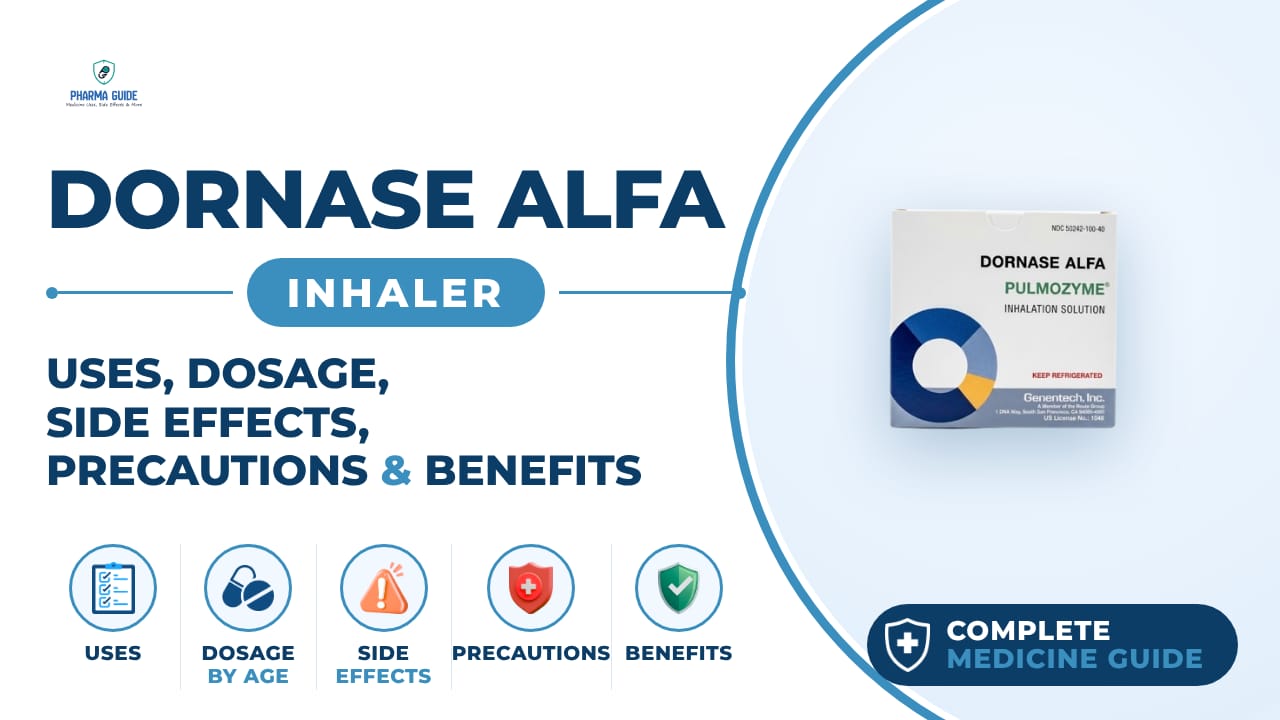
| Generic name | dornase alfa |
|---|---|
| Drug class | Mucolytic (an enzyme that cleaves DNA) |
| Forms | Inhaler |
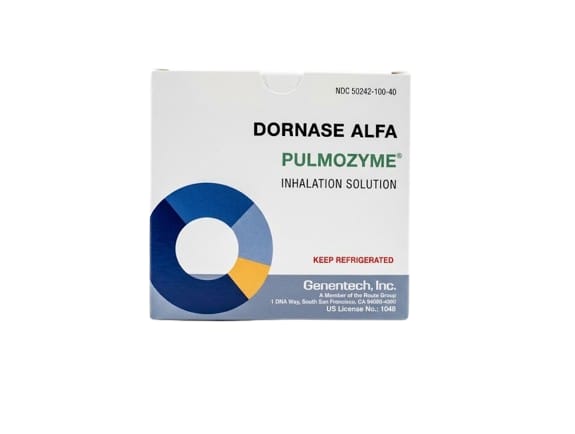
Quick overview
Dornase Alfa Inhaler (dornase alfa) is a mucolytic enzyme medicine given by inhalation to help manage cystic fibrosis. It is used alongside standard cystic fibrosis therapies to help break down thick mucus in the airways, reduce the frequency of respiratory infections requiring injectable antibiotics, and improve lung function. It is given only through specific tested nebulizer and compressor systems, with a typical adult dose of 2.5 mg once daily.
What is Dornase Alfa Inhaler
Pulmozyme contains dornase alfa, a man-made protein similar to a natural enzyme in your body called DNase. It is given by inhalation to help manage cystic fibrosis.
Dornase Alfa Inhaler uses
- Used to treat patients with cystic fibrosis, along with standard cystic fibrosis therapies
- Helps break down thick mucus in the airways
- Used to reduce the frequency of respiratory infections that require antibiotics given by injection
- Used to improve lung function in cystic fibrosis patients
Benefits of Dornase Alfa Inhaler
- Improves lung function
- Reduces the risk of respiratory tract infections requiring antibiotics given by injection
- Helps break down thick mucus so it can be cleared from the lungs more easily
How Dornase Alfa Inhaler works
The medicine contains an enzyme that breaks down extra DNA released by dying white blood cells in the thick mucus of the lungs. This DNA makes mucus very sticky; breaking it down makes the mucus thinner so it can be hydrolyzed and cleared more easily. The medicine works mainly inside the lungs and very little gets into the bloodstream.
Dornase Alfa Inhaler dosage
Use only with the specific nebulizer and compressor systems that have been tested with this medicine. Do not inhale this medicine until a doctor has thoroughly trained you in the proper technique. Do not dilute or mix this medicine with other drugs in the nebulizer. Keep all other inhaled medication systems completely separate from this medicine; do not use other inhaled medicines in the nebulizer at the same time.
Use the mouthpiece provided with the nebulizer kit; do not use a mask unless using the recommended face-mask nebulizer for young children. Children under 5 years of age are recommended to use the PARI BABY nebulizer with a tight-fitting facemask. Breathe normally in and out through the mouth during treatment; do not breathe through the nose (use a nose clip if needed).
If you are interrupted or begin coughing during treatment, turn off the compressor, then resume treatment afterward. It is important to inhale the full dose each time.
If a dose is missed, take it as soon as you remember, then continue the regular schedule; do not take two doses at the same time. Follow your standard cystic fibrosis treatments and chest physiotherapy regimen while using this medicine.
| Age group | Dose |
|---|---|
| Under 18 years | Not recommended |
| 18–64 years | 2.5 mg, once/day |
| 65+ years | 2.5 mg, once/day |
Available forms and strengths
Inhaler
Side effects of Dornase Alfa Inhaler
Common
- Voice alteration (hoarseness)
- Sore throat (pharyngitis)
- Laryngitis
- Cough
- Rash
- Chest pain
- Conjunctivitis
- Rhinitis
- Fever
Serious
- Voice changes or hoarseness
- Sore throat
- Runny nose
- Skin rash
- Chest pain
- Eye redness (conjunctivitis)
- Fever
Warnings and precautions
- Do not use this medicine if you are allergic to dornase alfa, Chinese Hamster Ovary cell products, or any ingredient in the product.
- There is limited experience using this medicine in children under 5 years of age, and its effectiveness has not been established in this age group.
- Safety and effectiveness have not been shown in patients with very low lung capacity (FVC less than 40% of predicted) or for use longer than twelve months.
- Do not mix this medicine with other drugs in the nebulizer, as this could change how well either medicine works.
- Only use the nebulizer and compressor systems that have been tested with this medicine; other systems have not been proven safe or effective for use with it.
- Safety has not been established in pregnant women. Animal studies did not show harm to pregnancy or the developing baby, but caution should still be used.
- It is not known whether this medicine passes into human breast milk, so caution should be used if taking it while breastfeeding.
- No routine kidney-specific dose adjustment is established. No routine liver-specific dose adjustment is established.
- No major direct interaction with alcohol is established. No effects on the ability to drive or use machines have been reported with this medicine.
Storage
- Refrigerate in its foil pouch at 2-8ºC (36-46ºF)
- Store away from heat and direct light
- Do not use the medicine if it has been exposed to room temperature for more than 24 hours
- Do not use this medicine if it becomes cloudy or discoloured
- Do not use this medicine after the expiry date on the package
- Keep out of reach of young children
- Once opened, the entire ampoule must be used or discarded because it has no preservative
When to see a doctor
- If you take more than the prescribed amount, contact your doctor right away.
- In case of a suspected overdose, contact a health care provider, hospital emergency department, or your regional poison control center right away, even if you do not have symptoms.
- Contact your doctor or pharmacist if you experience any unexpected side effects while taking this medicine.
Alternatives
- Hypertonic saline inhalation
- Inhaled bronchodilators when indicated
- CFTR-modulator therapy for eligible patients
Watch the video
FAQs
What is Dornase Alfa Inhaler used for?
It is used to treat cystic fibrosis alongside standard therapies, helping break down thick mucus in the airways, reduce respiratory infections requiring injectable antibiotics, and improve lung function.
What is the typical dose of Dornase Alfa Inhaler?
The typical dose for adults aged 18 and older is 2.5 mg once daily, given only through specific tested nebulizer and compressor systems. It is not recommended for those under 18 years of age.
How does Dornase Alfa Inhaler work?
It contains an enzyme that breaks down extra DNA released by dying white blood cells in thick lung mucus, making the mucus thinner so it can be cleared more easily. It works mainly inside the lungs with very little entering the bloodstream.
What are the common side effects of Dornase Alfa Inhaler?
Common side effects include voice alteration, sore throat, laryngitis, cough, rash, chest pain, conjunctivitis, rhinitis, and fever.
How should Dornase Alfa Inhaler be stored?
It should be refrigerated in its foil pouch at 2-8ºC (36-46ºF), kept away from heat and direct light, and not used if exposed to room temperature for more than 24 hours or if it becomes cloudy or discoloured.
General information, not medical advice
Your prescriber and the leaflet in your pack know your situation. This page does not.
- Follow your prescriber and the leaflet
- Don't start, stop, or change a dose on your own
- Doses and warnings differ by country and product
Sources
Video
Related medicines

Injectafer Injection: Uses, Dosage, Side Effects, Precautions and Alternates
Iron products
Injectafer (ferric carboxymaltose) treats iron deficiency anemia and heart failure-related iron deficiency via IV. Learn uses, dosage, side effects, and

Gliclazide Tablet: Uses, Dosage, Side Effects, Precautions and Alternates
Sulfonylurea (hypoglycemic/antidiabetic agent)
Gliclazide Tablet is a sulfonylurea for type 2 diabetes that boosts insulin release. Learn about dosage, side effects, warnings, and precautions.