
Safety
General information, not medical advice
Your prescriber and the leaflet in your pack know your situation. This page does not.
- Follow your prescriber and the leaflet
- Don't start, stop, or change a dose on your own
- Doses and warnings differ by country and product
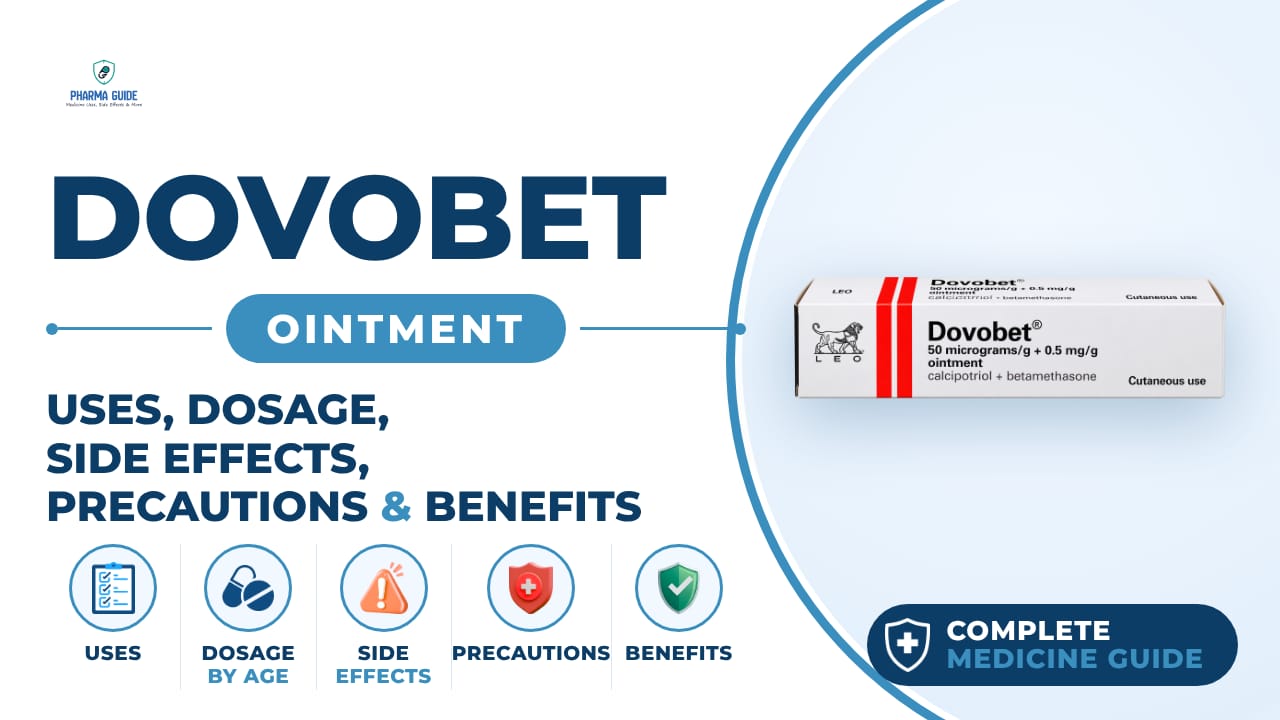
Dovobet Ointment: Uses, Dosage, Side Effects, Precautions and Alternates
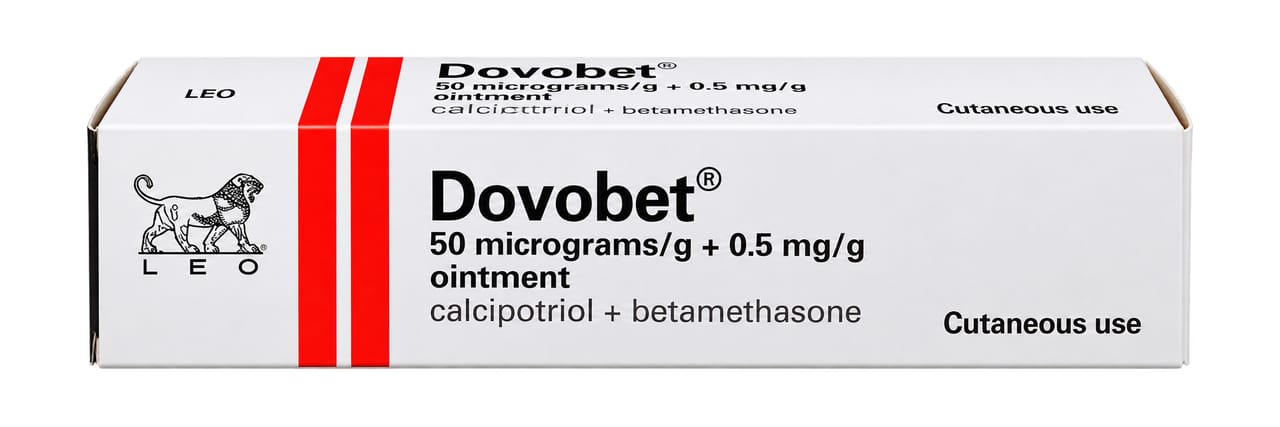
| Generic name | calcipotriol and betamethasone dipropionate |
|---|---|
| Drug class | Topical Antipsoriatic Agent / Vitamin D Analogue / Corticosteroid |
| Forms | Ointment |
Quick overview
Dovobet Ointment combines calcipotriol, a vitamin D-like substance, and betamethasone dipropionate, a corticosteroid, to treat plaque psoriasis on the body. It is applied once daily for up to 4 weeks to reduce redness, scaling, and skin inflammation. Common side effects include itching, peeling, and skin irritation, while serious effects may involve worsening psoriasis or high calcium levels. It should not be used by children or adolescents under 18 years of age.
What is Dovobet Ointment
Dovobet is an ointment that combines two medicines, calcipotriol (a vitamin D-like substance) and betamethasone dipropionate (a corticosteroid), used together to control psoriasis on the body.
Dovobet Ointment uses
- Topical treatment of plaque psoriasis (psoriasis vulgaris) on the body for up to 4 weeks
- Treats plaque psoriasis
- Reduces skin inflammation
- Reduces redness
- Reduces scaling
Benefits of Dovobet Ointment
- Reduces redness, scaling and thickness of psoriasis plaques
- Helps control itching
- Provides faster onset of action than either ingredient used alone
- A significant proportion of patients achieve marked improvement or clearance within 4 weeks
How Dovobet Ointment works
Calcipotriol slows down the overly rapid growth of skin cells that causes psoriasis plaques, while betamethasone dipropionate, a corticosteroid, reduces inflammation such as redness, swelling and itching.
Dovobet Ointment dosage
Apply once daily to the affected skin areas for up to 4 weeks; treatment can be stopped after satisfactory improvement and restarted if psoriasis comes back. Gently rub the ointment into the areas of skin affected by psoriasis until it has mostly absorbed. Wash your hands after applying, unless you are treating your hands, to avoid spreading it to your face or other sensitive areas.
Do not apply to the face, eyes, mouth, skin folds (such as armpits, groin, under the breasts), genitals, or broken skin. Do not cover the treated area with a bandage, dressing, or airtight wrap unless told to by your doctor. Allow the ointment time to absorb before showering or bathing. If you accidentally get it on healthy skin or your face, wash it off right away.
Not recommended for use in children or adolescents under 18 years of age. If you miss a dose, apply it as soon as you remember, then continue as before.
| Age group | Dose |
|---|---|
| Under 17 years | Safety and effectiveness are not established; no recommended dosage |
| 18–39 years | Apply a thin layer to affected skin once daily |
| 40–64 years | Apply a thin layer once daily |
Available forms and strengths
- Ointment
Side effects of Dovobet Ointment
Common
- Itching (pruritus), usually mild
- Peeling or flaking skin
- Skin irritation or discomfort
- Burning or stinging sensation
- Redness at the application site
- Dryness
- Skin rashes/dermatitis
- Red and swollen hair follicles (folliculitis)
- Lightening of skin colour
Serious
- Worsening of psoriasis
- Pustular psoriasis (headache, fever, chills, joint pain, feeling unwell, loss of appetite, nausea)
- Adrenal gland problems (weakness, increased urination/thirst, fatigue, weight loss)
- Skin thinning (visible veins, stretch marks, easy bruising)
- Allergic reaction (rash, itching, swelling, trouble breathing, dizziness)
- High blood calcium levels (fatigue, depression, confusion, loss of appetite, nausea, vomiting, constipation, increased urination, and in some patients irregular heartbeat)
- Eye irritation or changes in vision
Warnings and precautions
- Do not use on the face, armpits, skin folds, groin, or genitals.
- This medicine can cause high calcium levels in the blood or urine, and can suppress the body's own adrenal hormone production.
- Using this medicine together with sunlight or UV treatments may increase the risk of skin cancer, so excessive sun exposure, tanning beds, sunlamps, and phototherapy should be avoided.
- Do not use under airtight dressings or bandages, as this increases the amount of medicine absorbed into the body and the risk of side effects.
- Long-term use increases the risk of local and whole-body steroid-related side effects, and stopping treatment suddenly after long-term use may cause a flare of psoriasis.
- This medicine should not be used by children or teenagers under 18 years old.
- Do not use on skin with viral infections (such as cold sores or chickenpox), fungal or bacterial infections, parasitic infections, or on skin showing signs of tuberculosis or syphilis.
- The ointment can make fabric more flammable, so care should be taken around open flames or when smoking if it has touched clothing, bedding, or dressings.
- The safety of this medicine in pregnancy has not been established, and it is not recommended for use in pregnant women.
- Caution should be used when prescribing this medicine to breastfeeding women, and it should not be applied to the breast area while breastfeeding.
- Safety has not been evaluated in severe renal impairment.
- Use in patients with liver failure is a factor that increases the risk of the body absorbing too much corticosteroid from the skin.
Storage
- Store at 5 to 25°C
- Use within 12 months of first opening the tube
- For easy application/spreading do not refrigerate, to prevent pulling of delicate skin
- Keep out of the sight and reach of children
- Keep away from pets, as the medicine can be fatal to dogs if eaten; contact a veterinarian immediately if a dog eats it
- Do not use past the expiry date marked on the tube
When to see a doctor
- Stop using the ointment and get medical advice right away if your psoriasis gets much worse or you develop red, painful skin with pus-filled spots.
- Get medical help immediately if you have symptoms of high calcium levels such as excessive urination, constipation, muscle weakness, confusion, or if you become unusually drowsy.
- Contact a doctor, hospital emergency department, or your local poison control center right away if you think you have used too much of this medicine, even if you don't have symptoms.
- Seek prompt medical attention if you notice blurred vision, trouble reading, or any other changes to your eyesight while using this medicine.
- Check with your doctor right away if you develop blistering, burning, crusting, dryness, flaking, itching, scaling, severe redness, soreness, or swelling of the skin.
Alternatives
- Calcipotriol ointment
- Enstilar foam
Watch the video
FAQs
What is Dovobet Ointment used for?
Dovobet Ointment is used for topical treatment of plaque psoriasis (psoriasis vulgaris) on the body for up to 4 weeks, reducing redness, scaling, and skin inflammation.
How do you apply Dovobet Ointment?
Apply once daily to the affected skin areas for up to 4 weeks, gently rubbing it in until mostly absorbed. Wash your hands after applying, unless treating your hands, and avoid applying to the face, eyes, mouth, skin folds, genitals, or broken skin.
Can children use Dovobet Ointment?
No, Dovobet Ointment is not recommended for use in children or adolescents under 18 years of age, as safety and effectiveness have not been established.
What are the common side effects of Dovobet Ointment?
Common side effects include itching, peeling or flaking skin, skin irritation, burning or stinging, redness at the application site, dryness, rashes, folliculitis, and lightening of skin colour.
Is it safe to use Dovobet Ointment during pregnancy?
The safety of Dovobet Ointment in pregnancy has not been established, and it is not recommended for use in pregnant women.
General information, not medical advice
Your prescriber and the leaflet in your pack know your situation. This page does not.
- Follow your prescriber and the leaflet
- Don't start, stop, or change a dose on your own
- Doses and warnings differ by country and product
Sources
Video
Related medicines

Injectafer Injection: Uses, Dosage, Side Effects, Precautions and Alternates
Iron products
Injectafer (ferric carboxymaltose) treats iron deficiency anemia and heart failure-related iron deficiency via IV. Learn uses, dosage, side effects, and

Gliclazide Tablet: Uses, Dosage, Side Effects, Precautions and Alternates
Sulfonylurea (hypoglycemic/antidiabetic agent)
Gliclazide Tablet is a sulfonylurea for type 2 diabetes that boosts insulin release. Learn about dosage, side effects, warnings, and precautions.