
Safety
General information, not medical advice
Your prescriber and the leaflet in your pack know your situation. This page does not.
- Follow your prescriber and the leaflet
- Don't start, stop, or change a dose on your own
- Doses and warnings differ by country and product
Dronedarone Tablet: Uses, Dosage, Side Effects, Precautions and Alternates
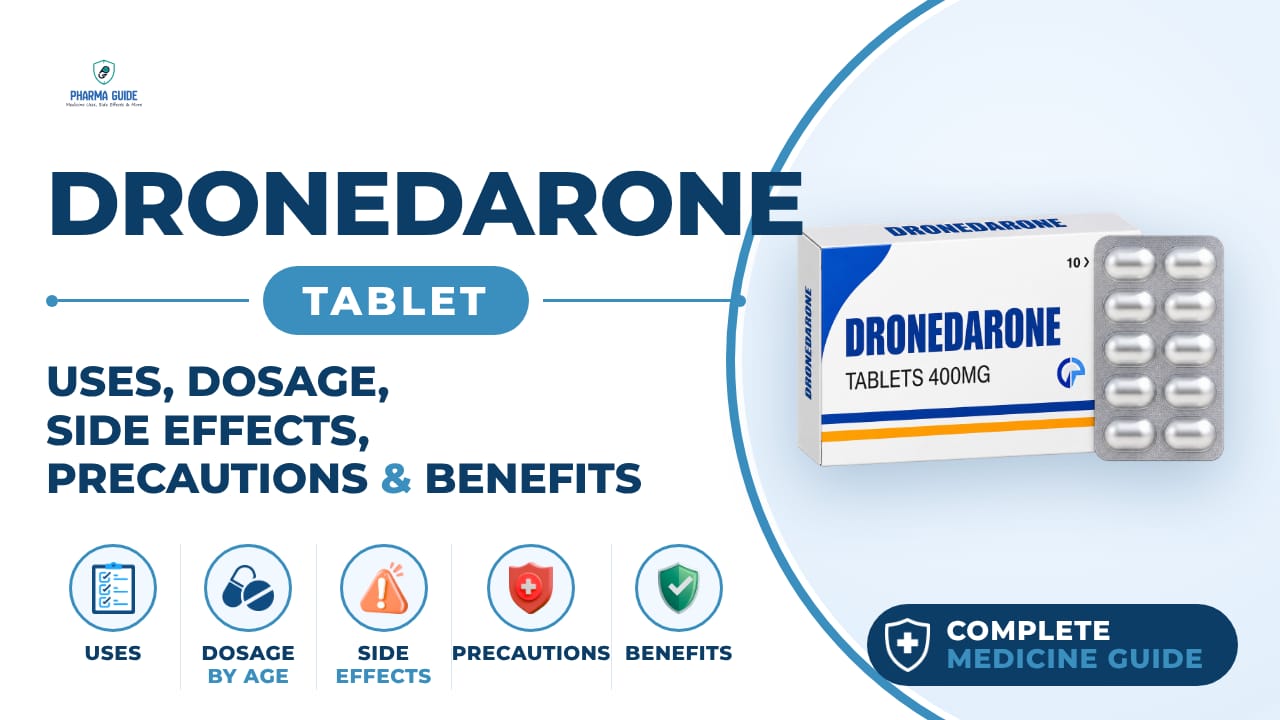
| Generic name | dronedarone, dronedarone HCl, dronedarone hydrochloride |
|---|---|
| Drug class | antiarrhythmic agent |
| Forms | Tablet |
Quick overview
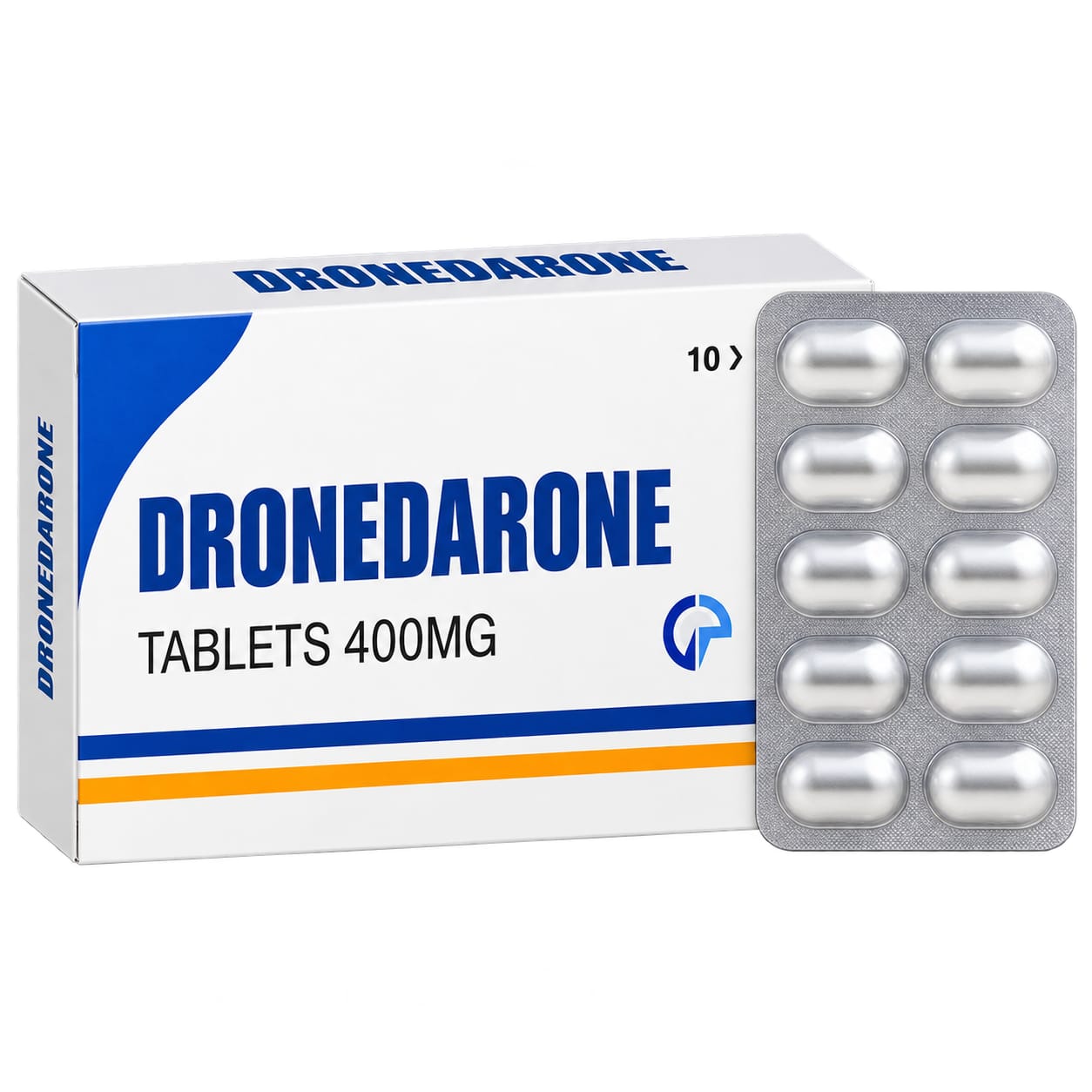
Dronedarone Tablet, also known as dronedarone or dronedarone hydrochloride, is a prescription antiarrhythmic medicine. It is used to reduce the risk of hospitalization in adults who currently have a normal heart rhythm but have had past episodes of atrial fibrillation or atrial flutter. It works directly on heart tissue to help keep the heartbeat steady. It is taken as a tablet, typically twice daily with meals, exactly as prescribed by a doctor.
What is Dronedarone Tablet
Dronedarone is a prescription medicine taken to reduce the risk of hospitalization for certain abnormal heart rhythms, including atrial fibrillation and atrial flutter. It is used for adults who currently have a normal heart rhythm but have had episodes of abnormal rhythm in the past.
Dronedarone Tablet uses
- Reduce your risk of going to the hospital if you have an abnormal heart rhythm (atrial fibrillation) that lasts less than a week or longer than a week
- Treatment of atrial fibrillation (AF)
- Management of atrial flutter
- Prevention of recurrence of abnormal heart rhythms
- Reduction of hospitalization due to cardiac events
Benefits of Dronedarone Tablet
- Helps maintain normal heart rhythm
- Reduces frequency of atrial fibrillation episodes
- Minimizes need for hospitalization due to heart rhythm problems
- Fewer long-term side effects compared to amiodarone
- Improves overall heart function and stability
How Dronedarone Tablet works
This medicine works directly on heart tissue to slow down the nerve signals in the heart, which helps keep the heartbeat in a normal rhythm. It does this by blocking several electrical signals in the heart that can cause irregular heartbeats.
Dronedarone Tablet dosage
Take this medicine exactly as directed by your doctor, in the morning and evening. Take this medicine with food. Swallow the tablet whole with water; do not crush or chew it. Do not eat grapefruit or drink grapefruit juice while using this medicine. If you miss a dose, skip it and go back to your regular dosing schedule; do not double doses. Use and dose for children must be determined by your doctor. No specific dose adjustment for elderly patients has been identified as needed.
| Age group | Dose |
|---|---|
| Under 18 years | Safety and effectiveness have not been established |
| 18–64 years | 400 mg twice daily with meals |
| 65–74 years | 400 mg twice daily with meals |
Available forms and strengths
- Tablet
Side effects of Dronedarone Tablet
Common
- Diarrhea
- Nausea
- Stomach pain
- Vomiting
- Upset stomach
- Slow heartbeat
- Skin problems such as redness, rash, or itching
- Feeling unusually weak or tired
- Acid or sour stomach
- Belching
- Heartburn
- Indigestion
- Itching skin
- Change in taste
- Increased sensitivity of the skin to sunlight
- Loss of taste
- Severe sunburn
Serious
- Severe allergic reactions, including breathing problems, wheezing, racing heart, fever, swollen lymph nodes, swelling of the face, lips, mouth, tongue, or throat, trouble swallowing, hives, dizziness, or fainting
- Heart failure, with shortness of breath, trouble breathing (especially lying down), swelling in feet, ankles, or legs, fast weight gain, and unusual tiredness
- Liver damage (hepatotoxicity), with nausea, vomiting, stomach pain, fever, weakness, itching, loss of appetite, weight loss, light-colored stool, dark urine, and yellowing of skin or eyes
- Lung damage, including lung inflammation (pneumonitis) and lung scarring (pulmonary fibrosis), with shortness of breath or cough
- Electrolyte imbalances (low potassium or low magnesium)
- Dangerous heart rhythm changes, including QT prolongation and torsade de pointes, with fainting or changes in heart rate or rhythm
Warnings and precautions
- Do not take this medicine if you have heart failure with symptoms that required hospital care, such as shortness of breath or trouble breathing (especially lying down), swelling in the feet, ankles, or legs, fast weight gain, or unusual tiredness, as it can increase your risk of death.
- Do not take this medicine if you have a type of abnormal heart rhythm that cannot be corrected by treatment (permanent atrial fibrillation), as it can increase your risk of stroke and death.
- Do not take this medicine if you have severe liver problems, or if you had liver or lung problems after using a medicine called amiodarone.
- Do not take this medicine if your heart beats less than 50 times a minute, or if you have certain heart block or sick sinus syndrome conditions without a pacemaker.
- Taking this medicine together with certain other medicines, such as cyclosporine, ritonavir, nefazodone, certain other heart rhythm medicines, certain antibiotics or antifungals, or phenothiazine medicines, may cause serious side effects and is not recommended.
- Do not eat grapefruit or drink grapefruit juice while using this medicine, as it can increase the medicine's levels in your blood and raise the risk of side effects.
- This medicine may increase the risk for heart attack, stroke, or other serious side effects; talk to your doctor about whether you should keep taking it.
- Using this medicine while pregnant can harm your unborn baby. Your doctor may test to confirm you are not pregnant before starting treatment, and you should use effective birth control during treatment and for 5 days after the last dose.
- Do not take this medicine while breastfeeding, and avoid it for 5 days after your last dose, since it is not known if it passes into breast milk.
- Tell your doctor if you have any kidney problems, since this medicine may cause changes in kidney function, especially if you also have heart failure.
- This medicine can cause liver damage. Tell your doctor right away if you have nausea, vomiting, stomach pain, fever, weakness, itching, loss of appetite, weight loss, pale stools, dark urine, or yellowing of your skin or eyes. It should not be used if you have severe liver problems.
- It is not known whether drinking alcohol will affect this medicine.
- Dizziness or weakness may affect driving.
Storage
- Store the medicine in a closed container at room temperature, away from heat, moisture, and direct light.
- Keep from freezing.
- Keep out of the reach of children.
- Do not keep outdated medicine or medicine no longer needed.
- Ask your healthcare professional how you should dispose of any medicine you do not use.
- Multaq should be stored at room temperature, between 68 F and 77 F (20 C and 25 C). It can be exposed to temperatures between 59 F and 86 F (15 C and 30 C), for shorter periods of time, such as when transporting it. Store in a cool, dry place.
When to see a doctor
- Stop taking this medicine and get help right away if you have signs of a serious allergic reaction, such as breathing problems or wheezing, racing heart, fever, swollen lymph nodes, swelling of the face, lips, mouth, tongue, or throat, trouble swallowing, hives, dizziness, or fainting.
- Tell your health care provider right away if you have shortness of breath, trouble breathing (especially lying down), swelling in your feet, ankles, or legs, fast weight gain, or unusual tiredness, as these can be signs of heart failure.
- Call your health care provider right away if you have nausea, vomiting, stomach or belly pain, fever, weakness, itching, loss of appetite, weight loss, light-colored stool, dark urine, or yellowing of your skin or eyes, as these can be signs of liver damage.
- Call your health care provider right away if you have symptoms of lung damage, such as shortness of breath or cough.
- Tell your health care provider right away if you faint or notice changes in your heart rate or rhythm, such as a fast or skipping heartbeat.
- Check with your doctor right away if you have chest pain, swelling of your hands, ankles, or feet, trouble breathing, or weight gain, as these may be symptoms of heart failure.
- Check with your doctor right away if you have decreased urine, drowsiness, dry mouth, irregular heartbeat, increased thirst, loss of appetite, mood changes, muscle pain, cramps, spasms or twitching, nausea or vomiting, numbness or tingling in the hands, feet, or lips, seizures, trembling, trouble breathing, or unusual tiredness or weakness, as these may be signs of low potassium or low magnesium.
Alternatives
- Amiodarone
- Sotalol
- Flecainide
Watch the video
FAQs
What is Dronedarone Tablet used for?
It is used to reduce the risk of hospitalization in adults who currently have a normal heart rhythm but have had past episodes of atrial fibrillation or atrial flutter.
How should I take Dronedarone Tablet?
Take it exactly as directed by your doctor, in the morning and evening, with food. Swallow the tablet whole with water; do not crush or chew it. Avoid grapefruit or grapefruit juice while using this medicine.
What should I avoid while taking Dronedarone Tablet?
Avoid grapefruit and grapefruit juice, as it can increase the medicine's levels in your blood and raise the risk of side effects. Certain other medicines like cyclosporine, ritonavir, nefazodone, and some antibiotics or antifungals are also not recommended.
What are the serious side effects of Dronedarone Tablet?
Serious side effects include severe allergic reactions, heart failure, liver damage, lung damage (pneumonitis or pulmonary fibrosis), electrolyte imbalances, and dangerous heart rhythm changes like QT prolongation and torsade de pointes.
Can I take Dronedarone Tablet if I have heart failure?
No, you should not take this medicine if you have heart failure with symptoms that required hospital care, as it can increase your risk of death.
General information, not medical advice
Your prescriber and the leaflet in your pack know your situation. This page does not.
- Follow your prescriber and the leaflet
- Don't start, stop, or change a dose on your own
- Doses and warnings differ by country and product
Sources
Video
Related medicines

Flecainide Tablet: Uses, Dosage, Side Effects, Precautions and Alternates
Antiarrhythmic Agent
Flecainide Tablet helps control serious irregular heartbeats like PSVT, atrial fibrillation, and ventricular tachycardia. Learn uses, dosage, side effects, and
Multaq Tablet: Uses, Dosage, Side Effects, Precautions and Alternates
antiarrhythmic agent
Multaq Tablet (dronedarone) helps reduce hospitalization risk from atrial fibrillation. Learn about its uses, dosage, side effects, and precautions.