
Safety
General information, not medical advice
Your prescriber and the leaflet in your pack know your situation. This page does not.
- Follow your prescriber and the leaflet
- Don't start, stop, or change a dose on your own
- Doses and warnings differ by country and product
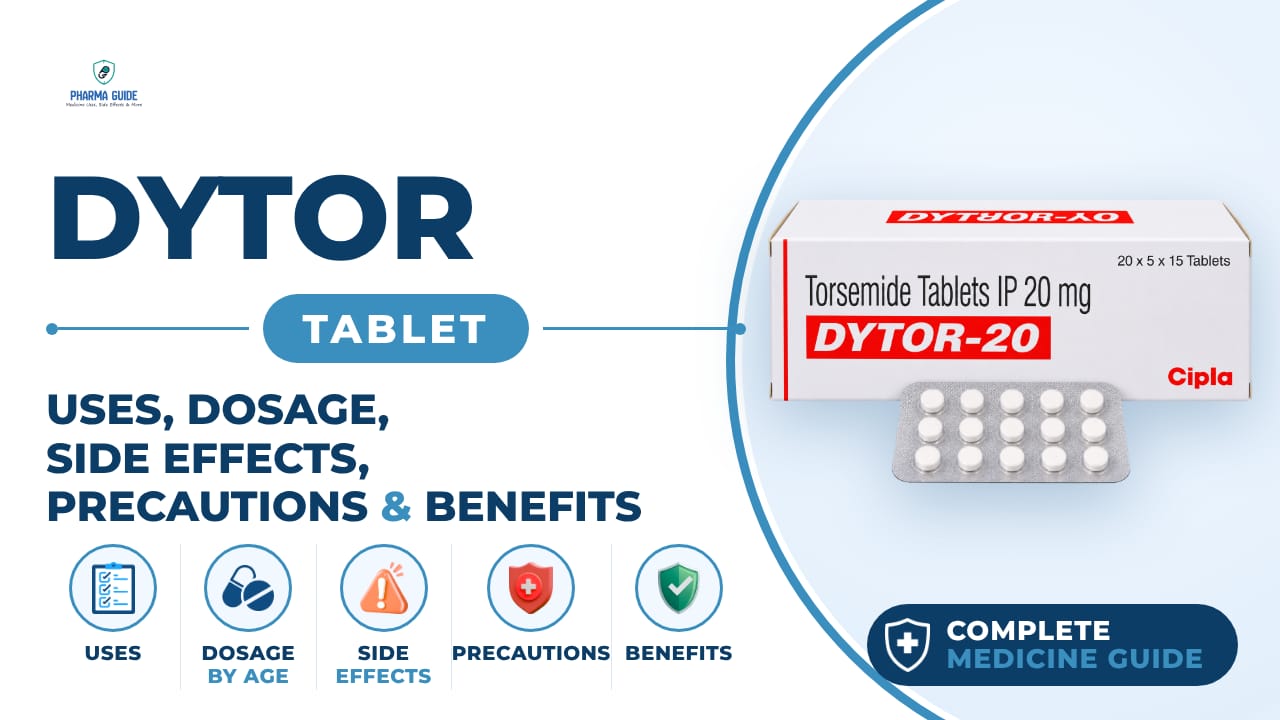
Dytor Tablet: Uses, Dosage, Side Effects, Precautions and Alternates
| Generic name | Torsemide |
|---|---|
| Drug class | Loop diuretic (Pyridine-sulfonylurea diuretic) |
| Forms | Tablet, Injection |
Quick overview
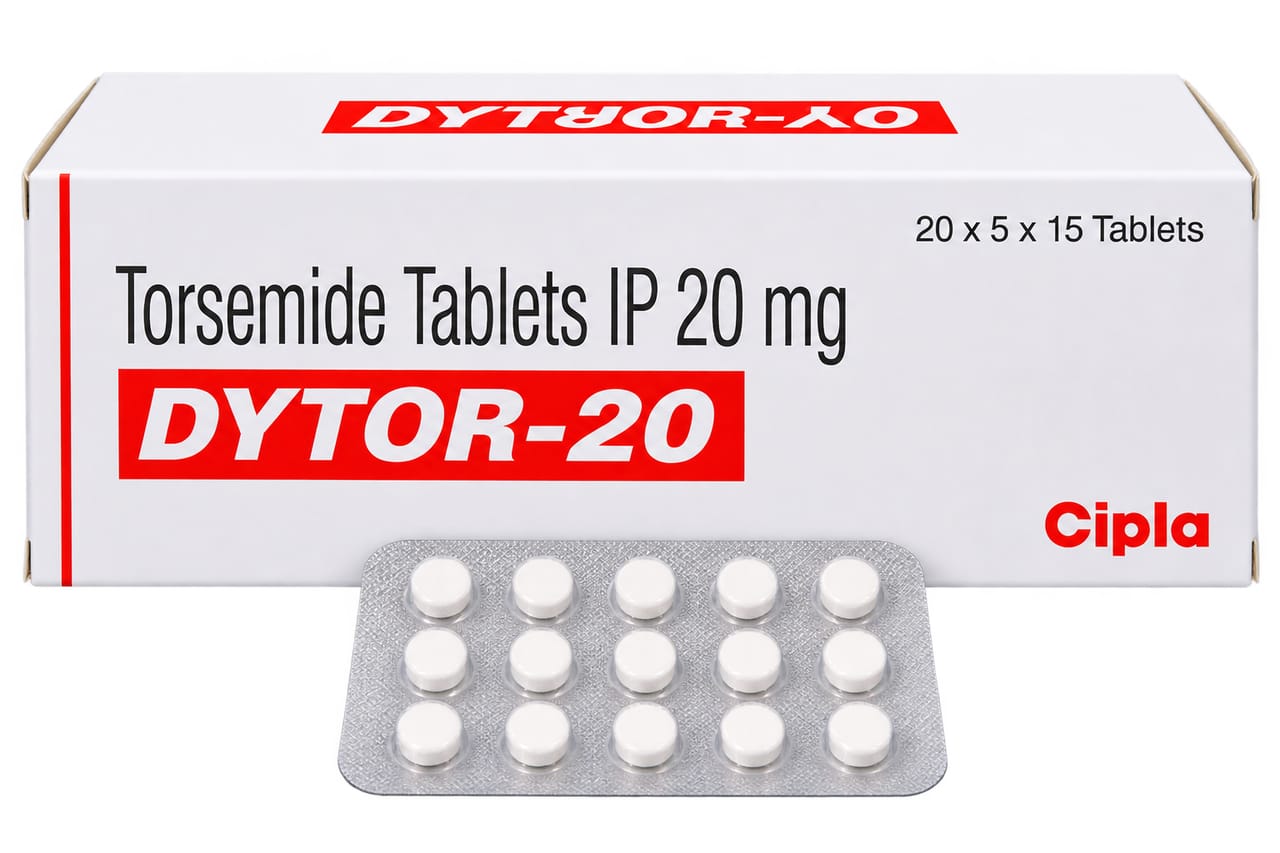
Dytor Tablet contains Torsemide, a loop diuretic that belongs to the pyridine-sulfonylurea class. It is a water pill that helps the body remove extra water and salt through urine. It is used to treat fluid buildup (oedema) caused by heart, kidney, or liver conditions, and to manage high blood pressure.
What is Dytor Tablet
Dytor Tablet is a water pill (diuretic) that contains Torsemide. It helps the body remove extra water and salt through urine and is used to treat fluid buildup and high blood pressure.
Dytor Tablet uses
- Swelling (oedema) caused by congestive heart failure, kidney disease, or liver disease
- High blood pressure (essential hypertension)
Benefits of Dytor Tablet
- Fluid Removal: Helps remove excess fluid from the body.
- Edema Relief: Helps reduce swelling caused by fluid retention.
- Heart Failure Support: Helps manage fluid overload in heart failure.
- Blood Pressure Control: Helps lower blood pressure in some patients.
How Dytor Tablet works
The medicine stops the kidneys from reabsorbing salt and water, so more salt, water, and chloride leave the body in urine. This removes extra fluid from the body.
Dytor Tablet dosage
Take this medicine exactly as your doctor tells you to. Swallow the tablet whole with a glass of water. Do not crush, chew, or break the tablet. It can be taken with or without food. Try to take it at the same time every day so you don't forget. Some sources suggest taking it in the morning to avoid needing to urinate frequently at night. Keep taking it even if you feel well; do not stop unless your doctor tells you to.
| Age group | Dose |
|---|---|
| Children | Dose based on body weight and medical condition (only if prescribed) |
| Adults (18–64 Years) | 5–20 mg once daily, adjusted according to response |
| Older Adults (65+ Years) | 5–10 mg once daily initially, adjusted based on kidney function and response |
Available forms and strengths
- Tablet
- Injection
Side effects of Dytor Tablet
Common
- Muscle cramps
- Headache
- Dizziness
- Tiredness, weakness
- Loss of appetite
- Stomach pain
- Nausea, vomiting
- Diarrhea
- Constipation
- Dry mouth
- Increased urination
- Increased cough
- Skin rash
- Chest pain
- Muscle pain
- Tingling or creeping sensation in arms and legs
- Changes in body water and mineral levels
- Increased blood levels of uric acid, sugar, and fats
- Reduced potassium and sodium levels in blood
- Reduced blood volume
- Increase in certain liver enzyme levels
Serious
- Ringing in the ears (tinnitus) or hearing loss
- Signs of severe fluid or electrolyte loss such as headache, dizziness, low blood pressure, weakness, drowsiness, confusion, loss of appetite, or cramps
- Low blood pressure
- Worsening kidney function
- Severe allergic reactions such as swelling of the face, lips, or tongue, or difficulty breathing
Warnings and precautions
- Do not take this medicine if you are allergic to Torsemide or any other ingredient in it.
- This medicine should be used carefully if you have heart failure.
- This medicine is not recommended for children, since there isn't enough safety information for that age group.
- This medicine should not be used if you have low blood volume or low blood pressure.
- Use with caution and strict medical supervision if you have severe liver problems such as cirrhosis and ascites, as this medicine may worsen the condition.
- This medicine can change your body's fluid and mineral (electrolyte) balance, and the risk is higher if you have kidney problems.
- This medicine has not been proven safe in pregnant women. It should only be used during pregnancy if your doctor decides it is clearly needed, and you should talk with your doctor first.
- It isn't known if this medicine passes into breast milk, so it should be used carefully in breastfeeding mothers and only after talking to a doctor.
- This medicine should not be used if your kidneys cannot make urine at all. It should be used carefully in people with kidney failure or severe urine flow problems, and your doctor may need to adjust your dose.
- This medicine should not be used in people with severe liver-related loss of brain function (hepatic coma or pre-coma). It should be used carefully in people with liver diseases like cirrhosis and ascites.
- Avoid drinking alcohol while taking this medicine, since it can make you feel dizzy or drowsy.
- Do not drive or use machinery if this medicine makes you feel dizzy.
Storage
- Store away from light and moisture and maintain the temperature below 30ºc
- Keep Dytor 10mg Tablet out of sight and reach of children.
- Stored at 10-30°C room temperature.
- Protect from light and heat.
- Keep away from children and pets. Otherwise, it becomes toxic to them.
- Disposed of properly in a suitable bag.
When to see a doctor
- Stop taking this medicine and contact your doctor right away if you notice ringing in the ears or hearing loss.
- Get medical help immediately if you have signs of fluid or electrolyte loss, such as headache, dizziness, low blood pressure, weakness, drowsiness, confusion, loss of appetite, or cramps.
- Contact your doctor if you notice signs of a severe allergic reaction such as skin rash, itching or swelling of the face, tongue, or throat, severe dizziness, or difficulty breathing.
- Contact your doctor immediately if you or someone else has taken too much of this medicine, especially if you notice excessive urination, sleepiness, confusion, weakness, dizziness, low blood pressure, circulatory collapse, or upset stomach.
Alternatives
- Lasix (Furosemide)
- Bumetanide
- Metolazone
Watch the video
FAQs
What is Dytor Tablet used for?
It is used to treat swelling (oedema) caused by congestive heart failure, kidney disease, or liver disease, and to manage high blood pressure.
How does Dytor Tablet work?
It stops the kidneys from reabsorbing salt and water, so more salt, water, and chloride leave the body in urine, removing extra fluid from the body.
What is the dosage of Dytor Tablet for adults?
Adults aged 18–64 years typically take 5–20 mg once daily, adjusted according to response, while older adults start with 5–10 mg once daily based on kidney function and response.
What are the common side effects of Dytor Tablet?
Common side effects include muscle cramps, headache, dizziness, tiredness, loss of appetite, stomach pain, nausea, vomiting, diarrhea, constipation, dry mouth, and increased urination.
Can Dytor Tablet be taken during pregnancy?
It has not been proven safe in pregnant women and should only be used during pregnancy if a doctor decides it is clearly needed.
General information, not medical advice
Your prescriber and the leaflet in your pack know your situation. This page does not.
- Follow your prescriber and the leaflet
- Don't start, stop, or change a dose on your own
- Doses and warnings differ by country and product
Sources
- Barbara G. Wells, Joseph T. DiPiro, Terry L. Shwinghammer, Cecily V. DiPiro. Hypertension. Pharmacotherapy Handbook. Ninth edition. Page-87.
- Tejaswi Kanderi; Pradeep Vaitla. Torsemide. National library of Medicine. National center for Biotechnology information. StatPearls Publishing. [Revised on July 2021]
- H A Friedel, M. M Buckley. Torasemide. A review of its pharmacological properties and therapeutic potential. National library of Medicine. National center for Biotechnology information. Pubmed.gov. 1991
- Cipla House. Dytor tablet (Torsemide). [Revised in January 2021]
- M/s Swiss Garnier Genexiaa Sciences Pvt. Ltd. Torsemide. [Revised in April 2021]
- Torsemide. [Revised in June 2017]
- DEMADEX (torsemide) tablets (Revised on August 8, 2022)
- Bioequivalence Study of Two Formulations of Torasemide Tablet 10 mg. (Revised on June 10, 2021)
Video
Related medicines

Injectafer Injection: Uses, Dosage, Side Effects, Precautions and Alternates
Iron products
Injectafer (ferric carboxymaltose) treats iron deficiency anemia and heart failure-related iron deficiency via IV. Learn uses, dosage, side effects, and

Gliclazide Tablet: Uses, Dosage, Side Effects, Precautions and Alternates
Sulfonylurea (hypoglycemic/antidiabetic agent)
Gliclazide Tablet is a sulfonylurea for type 2 diabetes that boosts insulin release. Learn about dosage, side effects, warnings, and precautions.