
Safety
General information, not medical advice
Your prescriber and the leaflet in your pack know your situation. This page does not.
- Follow your prescriber and the leaflet
- Don't start, stop, or change a dose on your own
- Doses and warnings differ by country and product
Eliquis Tablet: Uses, Dosage, Side Effects, Precautions and Alternates
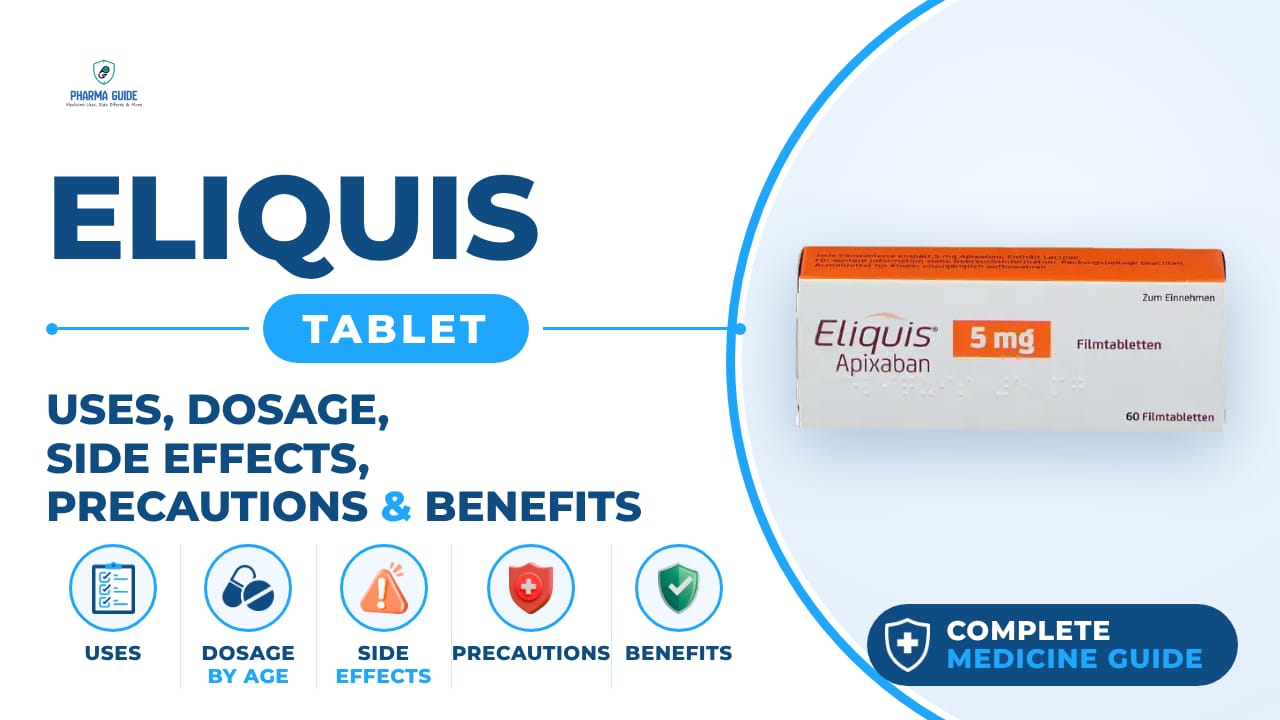
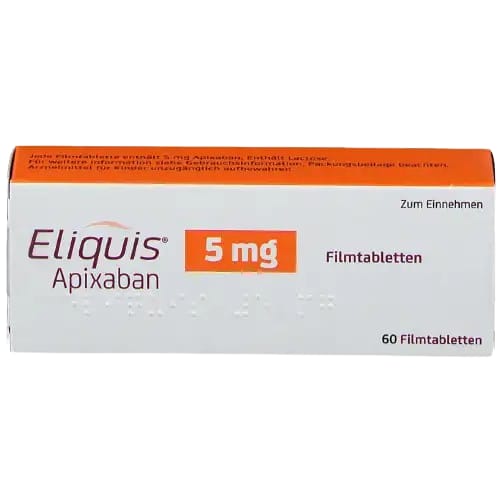
| Generic name | Apixaban |
|---|---|
| Drug class | Anticoagulant (Factor Xa inhibitor) |
| Forms | Film-coated tablets (2.5 mg and 5 mg), Tablet for oral suspension (0.5 mg), Sprinkle capsule for oral suspension (0.15 mg), Oral solution (0.4 mg/mL, used in some paediatric studies) |
Quick overview
Eliquis Tablet contains apixaban, an anticoagulant (blood thinner) that works by blocking Factor Xa, a key substance involved in blood clotting. It is used to prevent stroke and blood clots in adults with certain irregular heartbeats, to treat and prevent blood clots in the legs and lungs, and to prevent clots after hip or knee replacement surgery. It is also used in children after at least 5 days of initial anticoagulant treatment. Common risks include bleeding, and it should be used exactly as directed by a doctor.
What is Eliquis Tablet
Eliquis contains the active substance apixaban and belongs to a group of medicines called anticoagulants (blood thinners). It works by blocking Factor Xa, which is an important component of blood clotting.
Eliquis Tablet uses
- Prevent stroke and blood clots (systemic embolism) in adults with an irregular heartbeat (atrial fibrillation) not caused by a heart valve problem
- Treat blood clots in the veins of the legs (deep vein thrombosis, DVT) and in the blood vessels of the lungs (pulmonary embolism, PE)
- Prevent DVT and PE from happening again after treatment for blood clots
- Prevent blood clots (DVT) forming after hip or knee replacement surgery
- Treat blood clots in the veins of the legs and lungs (venous thromboembolism) in children after at least 5 days of initial anticoagulant treatment, and to reduce the risk of them happening again
Benefits of Eliquis Tablet
- Lowers the chance of having a stroke or systemic embolism in people with atrial fibrillation
- Reduces the risk of blood clots forming in the legs and lungs after hip or knee replacement surgery
- Effectively treats existing blood clots (DVT and PE)
- Reduces the risk of blood clots happening again after initial treatment
How Eliquis Tablet works
Apixaban blocks a clotting substance in the blood called Factor Xa. By stopping Factor Xa from working, it prevents the blood from forming clots as easily.
Eliquis Tablet dosage
Swallow the tablet with a drink of water. It can be taken with or without food. Try to take the tablets at the same times every day to have the best treatment effect, two times every day. Do not change your dose or stop taking the medicine unless your doctor tells you to.
If you have difficulty swallowing the tablet whole, talk to your doctor about other ways to take it; the tablet may be crushed and mixed with water, glucose/dextrose solution, apple juice, or apple puree immediately before taking it.
If you miss a dose, take it as soon as you remember on the same day, then continue with your usual twice-daily schedule; do not take two doses at the same time to make up for a missed dose.
Do not stop taking this medicine without talking to your doctor first, because stopping treatment too early can increase the risk of a blood clot or stroke.
For children who cannot swallow tablets, special oral suspension forms are used according to the child's body weight, and doses should be given exactly as instructed by the child's healthcare provider. If a child vomits or spits up within 30 minutes after taking a dose, repeat the dose; if this happens more than 30 minutes after the dose, do not repeat it and continue with the next scheduled dose.
Tell all your healthcare providers and dentists that you are taking this medicine before any surgery, medical, or dental procedure, as it may need to be temporarily stopped.
| Age group | Dose |
|---|---|
| Under 18 years | Specialist-directed dosing required |
| 18–79 years | 5 mg twice daily for atrial fibrillation in most patients |
| 80 years & older | 5 mg twice daily unless dose-reduction criteria apply |
| Adults | 5 mg twice daily for atrial fibrillation in most patients |
Available forms and strengths
- Film-coated tablets (2.5 mg and 5 mg)
- Tablet for oral suspension (0.5 mg)
- Sprinkle capsule for oral suspension (0.15 mg)
- Oral solution (0.4 mg/mL, used in some paediatric studies)
Side effects of Eliquis Tablet
Common
- Bleeding (including in the eyes, stomach, bowel, from the rectum, nose, gums, and in the urine)
- Bruising and swelling
- Anaemia (which may cause tiredness or paleness)
- Low blood pressure (which may make you feel faint or have a quickened heartbeat)
- Nausea (feeling sick)
- Increase in a liver enzyme called gamma-glutamyltransferase (GGT) shown on blood tests
Serious
- Bleeding in the brain or spinal column
- Bleeding into the abdomen or from the vagina
- Bright red blood in the stools
- Reduced number of platelets in the blood (which can affect clotting)
- Abnormal liver function or increased liver enzymes
- Yellowing of the skin and eyes from increased bilirubin
- Allergic reactions (hypersensitivity) causing swelling of the face, lips, mouth, tongue and/or throat and difficulty breathing
- Skin rash that may form blisters and look like small targets (erythema multiforme)
- Blood vessel inflammation (vasculitis)
- Bleeding in the kidney with blood in the urine, sometimes affecting kidney function
Warnings and precautions
- Stopping this medicine increases the risk of stroke or blood clots forming. Do not stop taking it without talking to your doctor first.
- This medicine can cause serious or life-threatening bleeding, especially when combined with other medicines that increase bleeding risk such as aspirin, NSAIDs, warfarin, heparin, clopidogrel, or certain antidepressants.
- People who receive spinal injections or spinal taps while taking this medicine have a risk of a blood clot forming around the spinal cord, which can cause long-term or permanent paralysis.
- This medicine should not be used by people with artificial (prosthetic) heart valves.
- This medicine should not be used by people with antiphospholipid syndrome, especially those with a positive triple antibody test.
- This medicine may need to be stopped before surgery or an invasive procedure because of bleeding risk; timing should be decided by your doctor.
- This medicine is not recommended for people with severe pulmonary embolism who are unstable or may need clot-dissolving treatment or surgery to remove the clot.
- It is not known if this medicine will harm an unborn baby. It should generally be avoided during pregnancy, and you should contact your doctor immediately if you become pregnant while taking it.
- It is not known if this medicine passes into breast milk. A decision must be made whether to stop breastfeeding or stop the medicine, considering the benefits of each.
- Caution or dose changes may be needed for people with kidney problems, and the medicine is not recommended for those with very severe kidney disease or on dialysis.
- This medicine should not be used in people with liver disease that causes bleeding problems, and should be used with caution in those with mild or moderate liver impairment. It is not recommended for those with severe liver impairment.
- This medicine has not been shown to affect your ability to drive or use machines.
Storage
- Store at or below 30°C (or per US labeling, at room temperature between 68°F to 77°F / 20°C to 25°C).
- Keep out of the sight and reach of children.
- Do not use after the expiry date stated on the carton and blister.
- Do not throw away any medicines via wastewater or household waste; ask your pharmacist how to dispose of medicines you no longer use.
When to see a doctor
- Get medical help right away if you notice unusual or heavy bleeding, bruising that lasts a long time, or bleeding that will not stop.
- Get medical help right away if your urine turns red, pink, or brown, or if your stools are red or black and tarry.
- Get medical help right away if you cough up blood or blood clots, or if you vomit blood or vomit that looks like coffee grounds.
- Get medical help right away if you have sudden back pain, tingling, numbness, or muscle weakness, especially in the legs and feet, or loss of bowel or bladder control, as these may be signs of a spinal blood clot.
- Contact your doctor immediately if you experience swelling of the face, lips, mouth, tongue, or throat, or difficulty breathing, as these may be signs of a serious allergic reaction.
- Call your healthcare provider right away if you fall or injure yourself, especially if you hit your head, as you may need to be checked for internal bleeding.
- Tell your doctor immediately if you have taken more than the prescribed dose.
Alternatives
Patients may be switched between Eliquis and other anticoagulants such as heparin or vitamin K antagonists like warfarin, under medical supervision. Switching from a vitamin K antagonist such as warfarin to Eliquis is described as a specific procedure.
- Rivaroxaban
- Dabigatran
Watch the video
FAQs
What is Eliquis Tablet used for?
Eliquis is used to prevent stroke and blood clots in adults with certain irregular heartbeats, to treat and prevent blood clots in the legs (DVT) and lungs (PE), to prevent clots after hip or knee replacement surgery, and in children after at least 5 days of initial anticoagulant treatment.
How does Eliquis Tablet work?
Eliquis contains apixaban, which blocks Factor Xa, a key clotting substance in the blood, preventing clots from forming as easily.
What is the dosage for Eliquis Tablet?
Eliquis is taken twice daily, swallowed with water, with or without food, at the same times each day. For adults 18-79 years, the typical dose is 5 mg twice daily for atrial fibrillation, and the same applies for those 80 and older unless dose-reduction criteria apply. Do not change your dose or stop without consulting your doctor.
What are the common side effects of Eliquis Tablet?
Common side effects include bleeding (such as in the eyes, stomach, nose, or gums), bruising and swelling, anaemia, low blood pressure, nausea, and increased liver enzyme (GGT) levels.
Can I stop taking Eliquis Tablet suddenly?
No, stopping Eliquis without talking to your doctor increases the risk of stroke or blood clots. Any decision to stop should be made by your doctor, including before surgery or dental procedures.
General information, not medical advice
Your prescriber and the leaflet in your pack know your situation. This page does not.
- Follow your prescriber and the leaflet
- Don't start, stop, or change a dose on your own
- Doses and warnings differ by country and product
Sources
Video
Related medicines
Fondaparinux Injection: Uses, Dosage, Side Effects, Precautions and Alternates
anticoagulant, factor Xa inhibitor
Fondaparinux Injection is an anticoagulant used to prevent and treat blood clots like DVT and pulmonary embolism. Learn uses, dosage, and side effects.

Injectafer Injection: Uses, Dosage, Side Effects, Precautions and Alternates
Iron products
Injectafer (ferric carboxymaltose) treats iron deficiency anemia and heart failure-related iron deficiency via IV. Learn uses, dosage, side effects, and