
Safety
General information, not medical advice
Your prescriber and the leaflet in your pack know your situation. This page does not.
- Follow your prescriber and the leaflet
- Don't start, stop, or change a dose on your own
- Doses and warnings differ by country and product
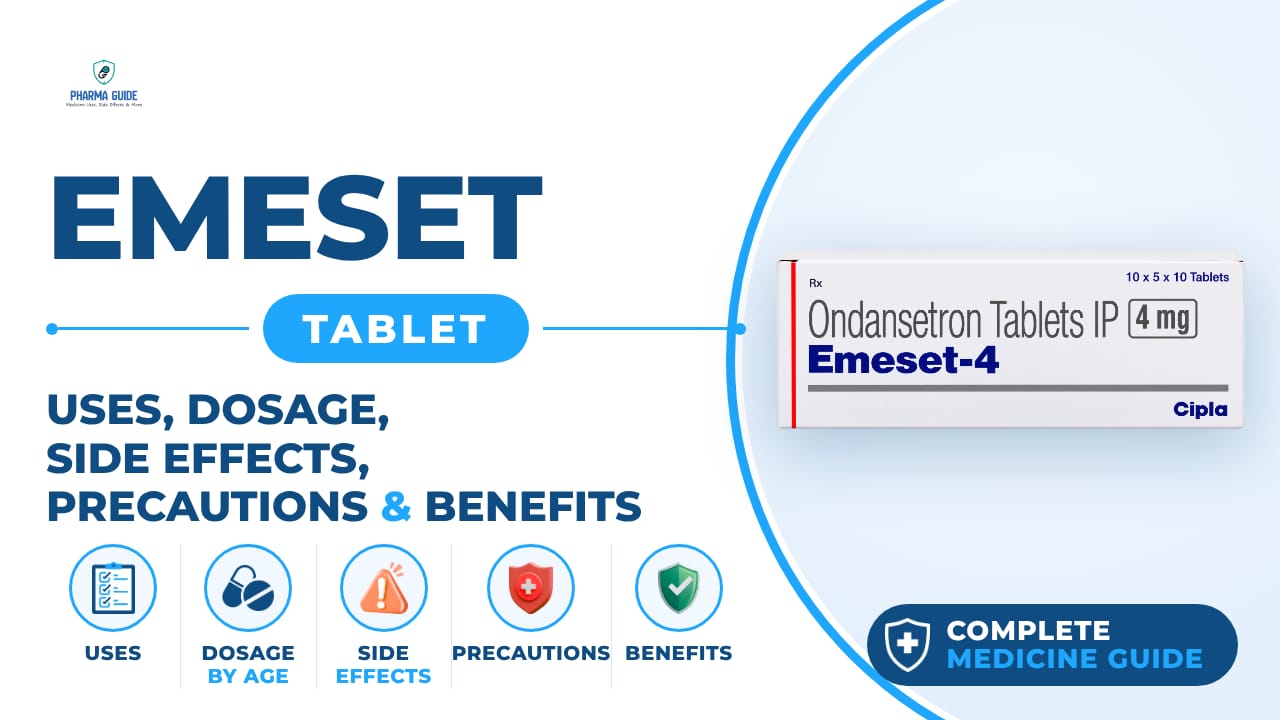
Emeset Tablet: Uses, Dosage, Side Effects, Precautions and Alternates
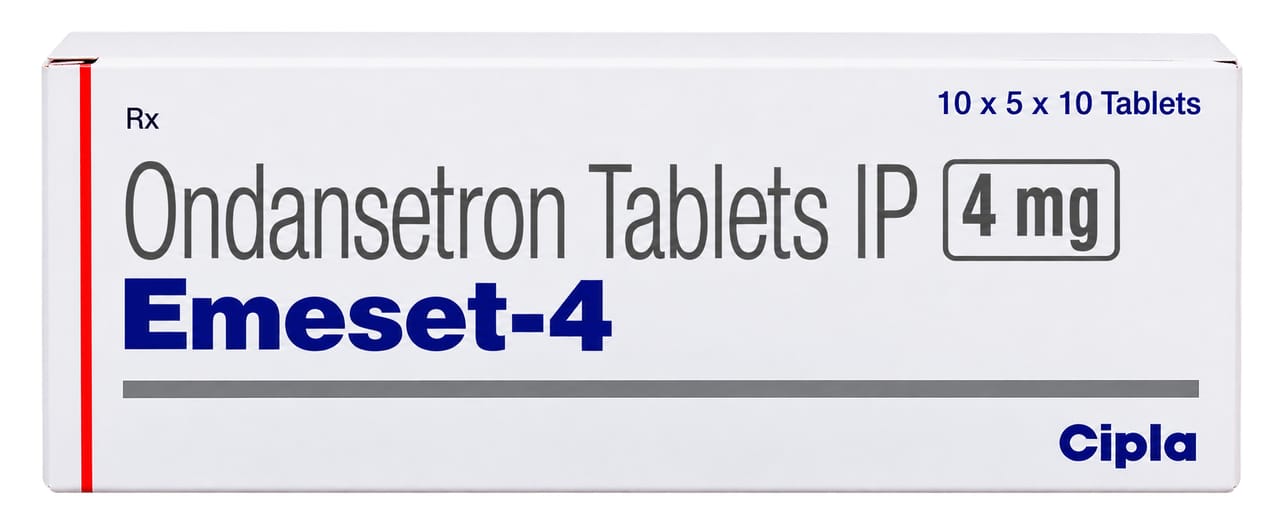
| Generic name | Ondansetron |
|---|---|
| Drug class | Antiemetics, 5HT3 receptor antagonists (selective 5-HT3 antagonist) |
| Forms | Tablet, Syrup, Injection |
Quick overview
Emeset Tablet contains ondansetron, an antiemetic medicine belonging to the selective 5-HT3 receptor antagonist class. It is used to prevent and treat nausea and vomiting caused by chemotherapy, radiotherapy, surgery, or stomach illnesses. It works by blocking serotonin activity on 5-HT3 receptors in the brain and gut. It is available as a tablet, syrup, and injection.
What is Emeset Tablet
Emeset Tablet is an antiemetic medicine containing ondansetron. It is used to prevent and treat nausea and vomiting caused by chemotherapy, radiotherapy, surgery, or stomach illnesses.
Emeset Tablet uses
- Radiation induced nausea and vomiting
- Chemotherapy induced nausea and vomiting
- Post operative nausea and vomiting
- Helps control vomiting from stomach infections
Benefits of Emeset Tablet
- Nausea Relief: Helps prevent and control nausea.
- Vomiting Control: Helps reduce vomiting caused by certain medical treatments or conditions.
- Post-Surgery Support: Helps prevent nausea and vomiting after surgery.
- Chemotherapy Support: Commonly used to prevent treatment-related nausea and vomiting.
- Radiotherapy Support: Helps control nausea associated with radiation treatment.
How Emeset Tablet works
The medicine blocks serotonin, a natural chemical in the brain and gut that triggers nausea and vomiting, by acting on 5-HT3 receptors both in the brain and in the gut.
Emeset Tablet dosage
Emeset Tablet should be taken 30 minutes before the start of chemotherapy, 1-2 hours before the start of radiation therapy, or 1 hour before surgery, if used for those purposes. It can be taken with or without food, as advised by your doctor. If using the mouth-dissolving tablet, keep it in the mouth; it will dissolve within seconds, then swallow with saliva and drink water afterward. For the regular tablet, swallow it whole with a glass of water; do not break, crush, or chew it. Try to take the medicine at the same time each day. If you vomit within one hour of taking the mouth-dissolving tablet, take the same dose again. Avoid eating heavy meals before taking this medicine; eat small snacks or light foods and drink water to avoid dehydration. Continue taking it for as long as your doctor advises, even if you start to feel better. It is not recommended for children below 4 years of age unless prescribed by a paediatrician.
Use exactly as prescribed by your doctor or pharmacist.
Available forms and strengths
- Tablet
- Syrup
- Injection
Side effects of Emeset Tablet
Common
- Headache
- Constipation
- Fatigue/general weakness or tiredness
- Chills
- Dry mouth
- Anxiety
- Dizziness
- Excessive sweating
- Diarrhoea
- Hypoxia
- Stomach discomfort
- Mild drowsiness
Serious
- Fast or slow or irregular heartbeat
- Allergic reactions such as skin rash, itching/swelling, breathing difficulty
- Sudden loss of vision for a short time
Warnings and precautions
- Use with caution if you have low potassium or magnesium levels in the blood, as this may cause serious side effects.
- Use with caution if you have a bowel blockage caused by conditions like colon cancer, Crohn's disease, or diverticulitis, as the medicine can slow movement of food through the gut.
- Taking it with other similar medicines (like granisetron or dolasetron) may increase the risk of serotonin syndrome, a condition of too much serotonin activity in the body.
- Combining this medicine with apomorphine (used for Parkinson's disease) is not recommended due to risk of lightheadedness, loss of consciousness, and low blood pressure.
- May cause a heart rhythm problem called prolonged QT interval, which can lead to fast or irregular heartbeats, especially in people with heart problems.
- Not recommended for children below 4 years of age because there is no data on how well it works in that age group.
- Pregnancy: Sources differ: one says it is relatively safe and sometimes used for nausea and vomiting in the first trimester, while another warns not to use it in pregnancy because it can cause severe birth defects. Talk to your doctor before use if you are pregnant or planning pregnancy.
- Breastfeeding: Not recommended during breastfeeding as it may pass into breast milk and harm the baby.
- Kidney: Considered safe for use in patients with kidney disease.
- Liver: Should be used with caution in liver disease since the medicine is converted to its active form in the liver; your doctor may order liver function tests.
- Alcohol: The interaction with alcohol is unknown, so ask your doctor before drinking alcohol while on this medicine.
- Driving: The medicine does not usually cause sleepiness, but if you feel dizzy or drowsy you should avoid driving or operating machinery.
Storage
- Store this medicine at room temperature away from sunlight.
- Keep the medicine out of reach of children.
- Discard the medicine if the strip of the medicine is open.
- Ensure that unused medicine is disposed of properly.
- Store Emeset tablet between 2°C and 30°C.
- Protect the medicines from direct light.
- Keep the tablets away from the reach of children and pets.
- Store this medicine at room temperature (15-25ºC).
- Protect it from light and moisture.
- Do not use this medicine after the expiry date has passed.
When to see a doctor
- Seek immediate medical attention if you notice signs of an allergic reaction such as skin rash, itching or swelling anywhere on the body, dizziness, or difficulty breathing.
- Get emergency medical help if you think you have taken too much of this medicine.
- Tell your doctor immediately about allergic reactions such as sudden wheezing, chest pain or tightness, swelling of the eyelids, face, lips, mouth or tongue, difficulty breathing, skin rashes, or temporary loss of vision.
- Tell your doctor about any heart rhythm problems, liver disease, or family history of heart conditions before use, and report a fast or irregular heartbeat or persistent constipation.
Alternatives
- Domperidone
- Metoclopramide
- Promethazine
Watch the video
FAQs
What is Emeset Tablet used for?
Emeset Tablet is used to prevent and treat nausea and vomiting caused by chemotherapy, radiotherapy, surgery, or stomach illnesses.
How does Emeset Tablet work?
It blocks serotonin, a natural chemical in the brain and gut that triggers nausea and vomiting, by acting on 5-HT3 receptors both in the brain and in the gut.
When should I take Emeset Tablet?
It should be taken 30 minutes before chemotherapy, 1-2 hours before radiation therapy, or 1 hour before surgery, as advised by your doctor, and can be taken with or without food.
What are the common side effects of Emeset Tablet?
Common side effects include headache, constipation, fatigue, chills, dry mouth, anxiety, dizziness, excessive sweating, diarrhoea, hypoxia, stomach discomfort, and mild drowsiness.
Is Emeset Tablet safe during pregnancy?
Sources differ: one says it is relatively safe and sometimes used for nausea and vomiting in the first trimester, while another warns against use due to risk of severe birth defects, so you should talk to your doctor before use.
General information, not medical advice
Your prescriber and the leaflet in your pack know your situation. This page does not.
- Follow your prescriber and the leaflet
- Don't start, stop, or change a dose on your own
- Doses and warnings differ by country and product
Sources
- https://pubchem.ncbi.nlm.nih.gov/compound/Ondansetron
- https://medlineplus.gov/druginfo/meds/a601209.html
- https://www.medicines.org.uk/emc/product/10165
- https://www.medicines.org.uk/emc/files/pil.5222.pdf
- https://www.accessdata.fda.gov/drugsatfda_docs/label/2016/020103s035_020605s019_020781s019lbl.pdf
- https://www.accessdata.fda.gov/drugsatfda_docs/label/2010/022524s000lbl.pdf
- https://www.medicines.org.uk/emc/product/10159/smpc
- https://dailymed.nlm.nih.gov/dailymed/lookup.cfm?setid=834bc56a-657d-4733-9a60-47040cb5c7bf
- https://go.drugbank.com/salts/DBSALT000921
- https://www.drugs.com/ondansetron.html
Video
Related medicines

Injectafer Injection: Uses, Dosage, Side Effects, Precautions and Alternates
Iron products
Injectafer (ferric carboxymaltose) treats iron deficiency anemia and heart failure-related iron deficiency via IV. Learn uses, dosage, side effects, and

Gliclazide Tablet: Uses, Dosage, Side Effects, Precautions and Alternates
Sulfonylurea (hypoglycemic/antidiabetic agent)
Gliclazide Tablet is a sulfonylurea for type 2 diabetes that boosts insulin release. Learn about dosage, side effects, warnings, and precautions.