
Safety
General information, not medical advice
Your prescriber and the leaflet in your pack know your situation. This page does not.
- Follow your prescriber and the leaflet
- Don't start, stop, or change a dose on your own
- Doses and warnings differ by country and product
Enhertu Injection: Uses, Dosage, Side Effects, Precautions and Alternates
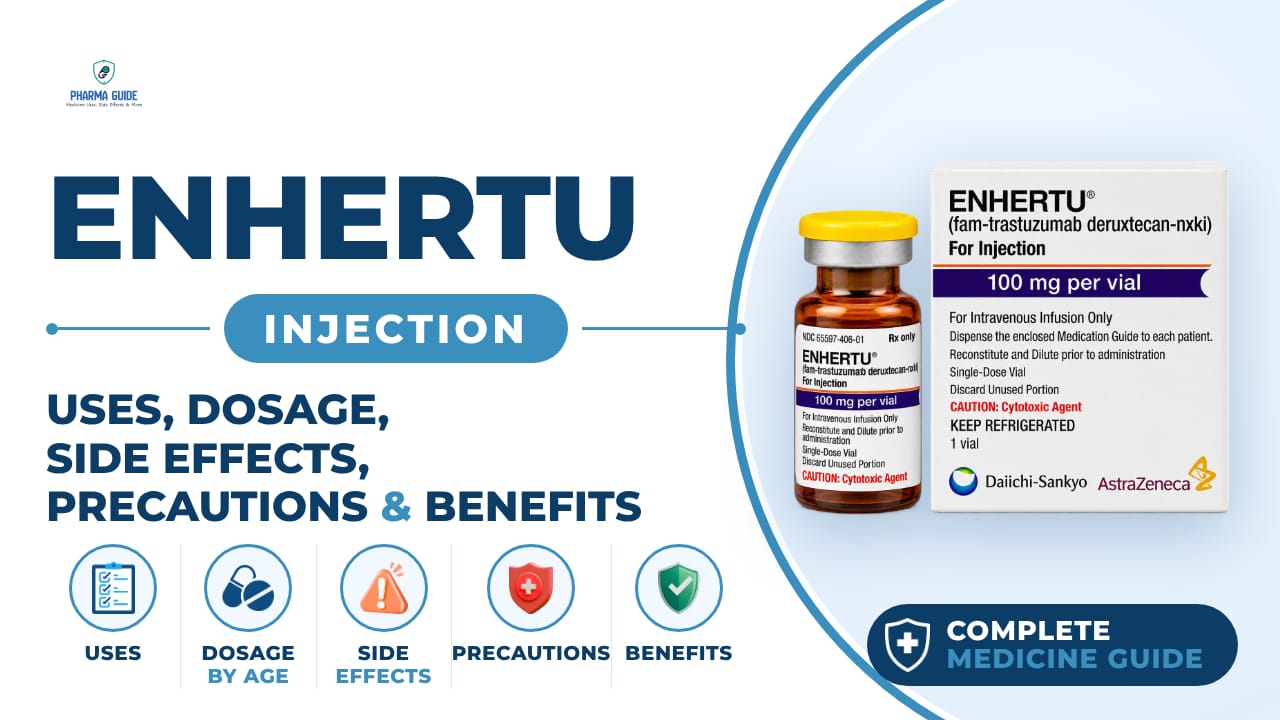
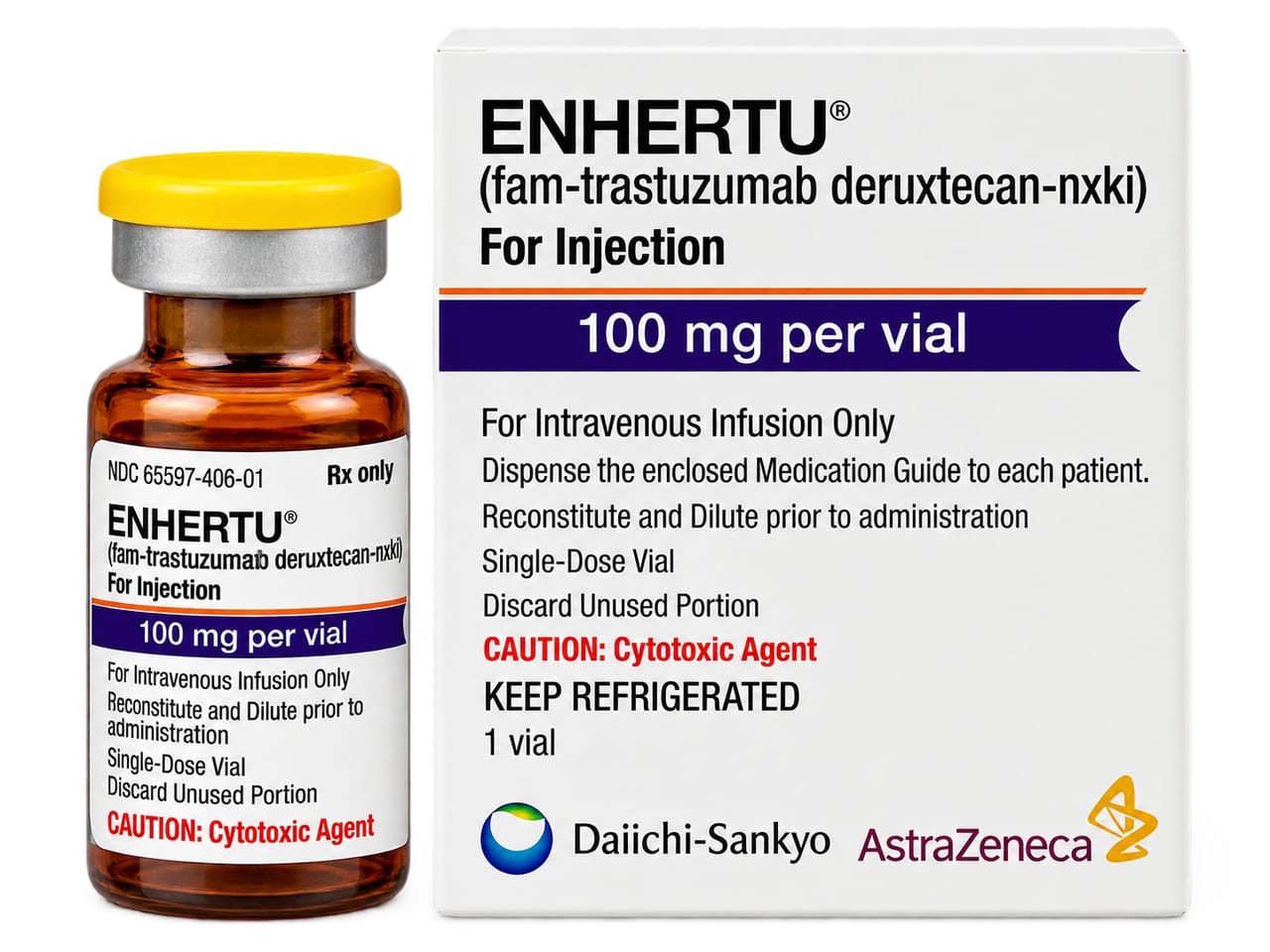
| Generic name | fam-trastuzumab deruxtecan-nxki |
|---|---|
| Drug class | HER2-directed antibody and topoisomerase inhibitor conjugate (antibody-drug conjugate) |
| Forms | Lyophilized powder for injection (100 mg in a single-dose vial, reconstituted and diluted before use as an intravenous infusion) |
Quick overview
Enhertu Injection (fam-trastuzumab deruxtecan-nxki) is a HER2-directed antibody and topoisomerase inhibitor conjugate used to treat several HER2-positive, HER2-low, and HER2-ultralow cancers. It is given as an intravenous infusion once every three weeks by a healthcare provider. Enhertu carries serious warnings related to lung disease, heart function, low blood cell counts, and pregnancy risk.
What is Enhertu Injection
Enhertu is a prescription cancer medicine that combines a targeted antibody with a chemotherapy-type drug. It attaches to cancer cells that have a protein called HER2 and delivers a cell-killing substance directly into those cells.
Enhertu Injection uses
- HER2-positive stage II or III early breast cancer, used before surgery followed by a taxane, trastuzumab and pertuzumab (THP)
- HER2-positive early breast cancer with residual disease after neoadjuvant trastuzumab-based treatment and surgery
- HER2-positive breast cancer that cannot be removed by surgery or that has spread (metastatic), given with pertuzumab as first treatment
- HER2-positive breast cancer that cannot be removed by surgery or has spread, after prior anti-HER2 treatment
- HER2-low or HER2-ultralow breast cancer that cannot be removed by surgery or has spread, after prior endocrine or chemotherapy treatment
- Non-small cell lung cancer with a certain HER2 gene mutation that has spread or cannot be removed by surgery, after prior treatment
- HER2-positive stomach (gastric) or gastroesophageal junction cancer that is locally advanced or has spread, after prior trastuzumab-based treatment
- HER2-positive solid tumors that cannot be removed by surgery or have spread, after prior treatment with no other satisfactory options
Benefits of Enhertu Injection
- Treats several HER2-positive cancers
- Treats certain HER2-low and HER2-ultralow breast cancers
- Treats certain HER2-mutant non-small-cell lung cancers
- Delivers chemotherapy directly through a HER2-targeted antibody-drug conjugate
- Can help shrink tumors and slow cancer progression in eligible patients
- Used in several breast-cancer settings under current FDA indications
How Enhertu Injection works
Enhertu is made of an antibody that targets the HER2 protein on cancer cells attached to a chemotherapy-type drug. Once the antibody attaches to HER2 on the tumor cell, the whole drug is taken inside the cell, where the chemotherapy component is released. This released substance damages the cell's DNA and causes the cancer cell to die.
Enhertu Injection dosage
Enhertu is given only as an infusion into a vein by a healthcare provider; it is not given as a quick injection or push. Your doctor will give you medicines beforehand to help prevent nausea and vomiting. Treatment is given once every three weeks in a 21-day cycle.
Your first infusion will be given slowly over a longer time; later infusions may be given faster if you tolerated earlier ones well. If you have an infusion reaction, your provider may slow, pause, or permanently stop the infusion depending on severity. If you miss a planned dose, contact your healthcare provider right away to reschedule rather than waiting for the next planned cycle.
Women who can become pregnant should have a pregnancy test before starting treatment and use effective birth control during and for 7 months after treatment. Men with partners who can become pregnant should use effective birth control during and for 4 months after treatment. Do not breastfeed during treatment and for 7 months after the last dose.
| Age group | Dose |
|---|---|
| 18–64 years – most approved indications | 5.4 mg/kg IV once every 3 weeks |
| 18–64 years – HER2-positive gastric/GEJ cancer | 6.4 mg/kg IV once every 3 weeks |
Available forms and strengths
- Lyophilized powder for injection (100 mg in a single-dose vial, reconstituted and diluted before use as an intravenous infusion)
Side effects of Enhertu Injection
Common
- Low white blood cell count
- Nausea
- Low red blood cell count (low hemoglobin)
- Low neutrophil count
- Low lymphocyte count
- Fatigue
- Low platelet count
- Increased liver enzymes (AST, ALT)
- Increased blood alkaline phosphatase
- Vomiting
- Hair loss (alopecia)
- Constipation
- Low blood potassium
- Decreased appetite
- Diarrhea
- Muscle or bone pain
- Stomach-area (abdominal) pain
- Upper respiratory tract infection
- Rash
- Cough
- Headache
- Nerve-related numbness, tingling, or weakness in arms/legs (peripheral neuropathy)
- Mouth sores (stomatitis)
Serious
- Severe or fatal interstitial lung disease (ILD)/pneumonitis
- Severe neutropenia, including febrile neutropenia
- Left ventricular dysfunction (heart problems affecting the heart's ability to pump blood), including symptomatic congestive heart failure
- Severe infusion-related reactions
- Harm to an unborn baby (embryo-fetal toxicity)
- Thrombocytopenia (low platelets) of severe grade
- Serious infections including pneumonia and sepsis
Warnings and precautions
- Enhertu can cause serious lung disease (interstitial lung disease/pneumonitis), which can be severe, life-threatening, or fatal. Patients must be monitored closely, and the drug must be permanently stopped if moderate or worse lung inflammation occurs.
- Exposure to this medicine during pregnancy can seriously harm an unborn baby, so effective birth control is required during and after treatment.
- Low white blood cell counts (neutropenia), including severe and feverish forms, can occur and require blood count monitoring before and during treatment.
- This medicine may weaken the heart's pumping ability. Heart function should be checked before starting and during treatment, and the drug must be permanently stopped for symptomatic heart failure.
- Enhertu must never be substituted for or with trastuzumab or ado-trastuzumab emtansine, as these are different medicines.
- This medicine can cause severe nausea and vomiting, so preventive anti-nausea medicine is given before each infusion.
- Enhertu can cause serious harm to an unborn baby. Women who can become pregnant should have a pregnancy test before starting treatment and should use effective birth control during treatment and for 7 months after the last dose. Tell your healthcare provider right away if you become pregnant or think you might be pregnant.
- Breastfeeding is not recommended during treatment and for 7 months after the last dose because it is not known whether the drug passes into breast milk and could harm a nursing baby.
- No dose change is needed for mild or moderate kidney problems, but people with moderate kidney impairment may have a higher chance of lung problems (ILD) and should be monitored more closely. Dosing has not been established for severe kidney impairment.
- No dose change is needed for mild or moderate liver problems, but patients with moderate liver impairment should be watched more closely for side effects from the chemotherapy component of the drug. Dosing has not been established for severe liver impairment.
- Discuss alcohol use with the oncology team, particularly if liver function is abnormal or treatment causes nausea.
- Fatigue, nausea, or dizziness may affect driving; avoid driving if affected.
Storage
- Store vials in a refrigerator at 2°C to 8°C (36°F to 46°F) in the original carton to protect from light until time of reconstitution
- Do not freeze
- Do not shake the reconstituted or diluted solution
- This is a hazardous drug; follow applicable special handling and disposal procedures
When to see a doctor
- Get medical help right away if you have cough, trouble breathing or shortness of breath, fever, or other new or worsening breathing symptoms such as chest tightness or wheezing — these can be signs of serious lung problems.
- Contact your healthcare provider immediately if you develop signs of infection, fever, or chills, which could indicate a dangerously low white blood cell count.
- Seek medical help right away for new or worsening shortness of breath, cough, feeling tired, swelling of ankles or legs, irregular heartbeat, sudden weight gain, dizziness or feeling light-headed, or loss of consciousness, as these may signal heart problems.
- Tell your healthcare provider immediately if you become pregnant or think you might be pregnant while taking this medicine.
Alternatives
- Herceptin (trastuzumab)
- Perjeta (pertuzumab)
- Tukysa (tucatinib)
Watch the video
FAQs
How often is Enhertu Injection given?
Enhertu is given as an intravenous infusion once every three weeks in a 21-day cycle by a healthcare provider.
What cancers does Enhertu Injection treat?
Enhertu treats several HER2-positive, HER2-low, and HER2-ultralow breast cancers, HER2-mutant non-small cell lung cancer, HER2-positive gastric or gastroesophageal junction cancer, and certain HER2-positive solid tumors after prior treatment.
What are the serious risks of Enhertu Injection?
Enhertu can cause severe or fatal interstitial lung disease, severe neutropenia, left ventricular dysfunction including heart failure, severe infusion reactions, and harm to an unborn baby.
Can Enhertu Injection be used during pregnancy?
No, Enhertu can seriously harm an unborn baby. Effective birth control is required during treatment and for 7 months after the last dose for women and 4 months for men with partners who can become pregnant.
What are the common side effects of Enhertu Injection?
Common side effects include low blood cell counts, nausea, fatigue, hair loss, decreased appetite, diarrhea, vomiting, constipation, and mouth sores.
General information, not medical advice
Your prescriber and the leaflet in your pack know your situation. This page does not.
- Follow your prescriber and the leaflet
- Don't start, stop, or change a dose on your own
- Doses and warnings differ by country and product
Sources
Video
Related medicines

Injectafer Injection: Uses, Dosage, Side Effects, Precautions and Alternates
Iron products
Injectafer (ferric carboxymaltose) treats iron deficiency anemia and heart failure-related iron deficiency via IV. Learn uses, dosage, side effects, and

Gliclazide Tablet: Uses, Dosage, Side Effects, Precautions and Alternates
Sulfonylurea (hypoglycemic/antidiabetic agent)
Gliclazide Tablet is a sulfonylurea for type 2 diabetes that boosts insulin release. Learn about dosage, side effects, warnings, and precautions.