
Safety
General information, not medical advice
Your prescriber and the leaflet in your pack know your situation. This page does not.
- Follow your prescriber and the leaflet
- Don't start, stop, or change a dose on your own
- Doses and warnings differ by country and product
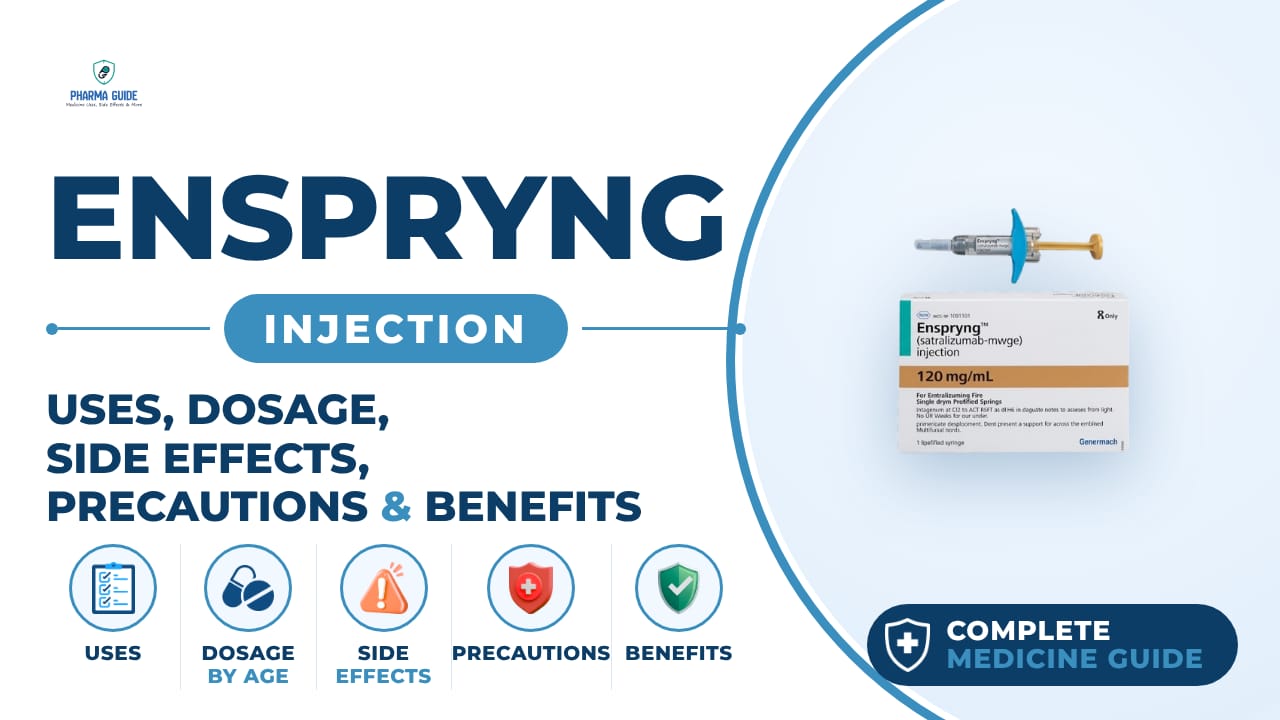
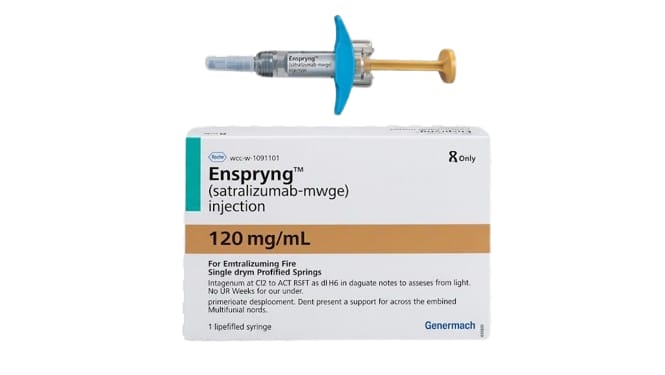
Enspryng Injection: Uses, Dosage, Side Effects, Precautions and Alternates
| Generic name | satralizumab-mwge |
|---|---|
| Drug class | Interleukin-6 (IL-6) receptor antagonist/inhibitor |
| Forms | Injection |
Quick overview
Enspryng Injection (satralizumab-mwge) is an interleukin-6 (IL-6) receptor antagonist given by injection under the skin to treat neuromyelitis optica spectrum disorder (NMOSD) in people who test positive for AQP4-IgG antibodies. It may be used alone or alongside other immune-suppressing medicines and has been shown to reduce relapse rates in clinical studies. It is given on a loading schedule followed by a maintenance schedule, and requires regular monitoring for infections and liver function.
What is Enspryng Injection
Enspryng is an injectable medicine that contains the active ingredient satralizumab. It is a type of lab-made antibody (monoclonal antibody/biologic) given by injection under the skin.
Enspryng Injection uses
- Treats neuromyelitis optica spectrum disorder (NMOSD) in adults who test positive for an antibody called AQP4-IgG (aquaporin-4 immunoglobulin G)
- Used in the EU for patients aged 12 and above with NMOSD who have antibodies against aquaporin-4 (AQP4)
- May be used alone or together with other immune-suppressing medicines for NMOSD
Benefits of Enspryng Injection
- Helps reduce the risk of relapses or attacks of NMOSD
- In one study, people who added Enspryng to their existing immune-suppressing medicines had 62% fewer relapses compared to placebo
- In another study, adults who took Enspryng alone had 55% fewer relapses compared to placebo
How Enspryng Injection works
Enspryng blocks a protein in the body called interleukin-6 (IL-6), which plays a role in inflammation. In NMOSD, IL-6 levels are high and contribute to immune attacks on the nervous system. By blocking IL-6 receptors, Enspryng helps reduce harmful inflammation and may help protect the optic nerves and spinal cord from damage, lowering the chance of relapses.
Enspryng Injection dosage
Enspryng is given by injection under the skin (subcutaneously) into the lower stomach area or the front and middle of the thighs. Inject the entire contents of the syringe each time. The first injection is given under the supervision of a doctor or nurse; after training, a caregiver or the patient may be able to give later injections. The first three injections are given once every two weeks (loading period), then injections continue once every four weeks (maintenance period). Do not stop using this medicine or change how much you use without checking with your doctor first.
After removing the cap, start the injection within 5 minutes, or the syringe must be thrown away and a new one used. Let the syringe warm up to room temperature on a flat surface before injecting, as cold medicine can be uncomfortable to inject. Do not shake the syringe. Choose a different injection site each time, at least some distance from the last injection site, and avoid the area around the belly button, moles, scars, bruises, or skin that is tender, red, hard, or broken. If you miss a dose, talk to your doctor about how to continue treatment; do not take a double dose to make up for a missed one.
| Age group | Dose |
|---|---|
| Under 18 years | Not recommended |
| 18–64 years | 120 mg, once every 4 weeks |
| 65+ years | 120 mg, once every 4 weeks |
Available forms and strengths
- Injection
Side effects of Enspryng Injection
Common
- Headache
- Migraine
- Difficulty sleeping (insomnia)
- Local injection site reactions (hot flushes, skin reddening, itching, rash and pain)
- Joint pain
- Muscle stiffness
- Rash
- Itching
- Runny or stuffy nose, sneezing
- Sore throat, runny nose (nasopharyngitis)
- Fatigue
- Pain in arms or legs
- Upper respiratory tract infection
- Nausea
- Inflammation of the stomach lining (gastritis)
- High cholesterol or triglyceride levels
- Weight gain
- Fluid retention causing swelling in the lower legs or hands
- Low fibrinogen levels in the blood
Serious
- Serious infections (fever or chills, ongoing cough, sore throat, skin redness or sores, diarrhea or belly pain, burning when urinating)
- Increased liver enzymes (yellowing of skin or eyes, dark urine, feeling or being sick)
- Low neutrophil counts (a type of white blood cell that fights infection)
- Serious allergic reactions (shortness of breath or trouble breathing, swelling of face, lips, tongue, throat, dizziness or fainting, chest pain, hives, rash, or flushing after injection)
Warnings and precautions
- Do not use this medicine if you are allergic to satralizumab or any of its ingredients, or if you have had an allergic reaction to other medicines made from hamster-origin proteins.
- Do not use this medicine if you have an active hepatitis B infection or active or untreated latent tuberculosis.
- You cannot receive 'live' or 'live-attenuated' vaccines while being treated with this medicine. These vaccines should be given at least 4 weeks before starting treatment.
- This medicine can increase the risk of serious infections, some of which can be life-threatening. Your doctor should test you for hepatitis and tuberculosis before starting treatment.
- This medicine may lower your neutrophil count, a type of white blood cell that helps fight bacterial infections. Your doctor should check this with blood tests while you are on treatment.
- Do not stop using this medicine or lower the dose without checking with your doctor first.
- It is not known if this medicine will harm an unborn baby. Tell your doctor if you are pregnant or planning to become pregnant.
- Women who can become pregnant should use effective birth control during treatment and for at least three months after the last injection.
- There is a pregnancy registry you can join if you become pregnant while using this medicine.
- It is not known if this medicine passes into breast milk. Talk to your doctor if you are breastfeeding or planning to breastfeed, as they may advise you to stop breastfeeding during treatment.
- This medicine can affect liver function and raise certain liver enzyme levels. Your doctor will do blood tests before and during treatment to check your liver, and may delay treatment if your levels are too high.
- There are no known interactions between this medicine and alcohol.
- Be careful before you drive or use machines or tools until you know how this medicine affects you. This medicine is not expected to affect your ability to drive a car or operate machinery.
Storage
- Refrigerate, do not freeze. Store between 2°C and 8°C.
- Do not shake it.
- Keep your Enspryng pre-filled syringe in the carton until it is time to use it to protect it from light.
- If stored at room temperature, the total time out of refrigeration should not be longer than 8 days at a temperature that does not exceed 30°C.
- Store it away from moisture, heat or sunlight; do not store it in the bathroom, near a sink, in the car, or on window sills.
- Keep it where young children cannot reach it.
- If you no longer need to use this medicine or it is out of date, take it to any pharmacy for safe disposal.
- Do not use this medicine after the expiry date.
- Put your used syringe in a sharps container immediately after use. Do not throw it away in household waste and do not recycle it.
When to see a doctor
- Call your doctor straight away if you develop a serious infection while using this medicine.
- Get medical help right away if you notice signs of a serious allergic reaction, such as shortness of breath, trouble breathing, dizziness or feeling faint, swelling of the lips, face, or tongue, moderate or severe stomach pain or vomiting, or chest pain.
- Call your doctor right away if you notice signs of increased liver enzymes, such as yellowing of the skin or eyes, dark-colored urine, or feeling or being sick.
- If you think you have used too much of this medicine, seek urgent medical attention right away, even if you feel fine.
Alternatives
- Ultomiris
- Soliris
- Uplizna
Watch the video
FAQs
What is Enspryng Injection used for?
Enspryng treats neuromyelitis optica spectrum disorder (NMOSD) in adults who test positive for AQP4-IgG antibodies. It may be used alone or with other immune-suppressing medicines.
How does Enspryng Injection work?
Enspryng blocks interleukin-6 (IL-6) receptors, which helps reduce harmful inflammation that contributes to immune attacks on the optic nerves and spinal cord in NMOSD, lowering the chance of relapses.
What is the dosage schedule for Enspryng Injection?
Enspryng is given subcutaneously, with the first three injections given once every two weeks (loading period), followed by injections once every four weeks (maintenance period) at a dose of 120 mg.
What are the common side effects of Enspryng Injection?
Common side effects include headache, migraine, insomnia, injection site reactions, joint pain, muscle stiffness, rash, nasopharyngitis, fatigue, and nausea, among others.
What precautions should be taken with Enspryng Injection?
Avoid use if allergic to satralizumab, or if you have active hepatitis B or untreated tuberculosis. Live vaccines should not be given during treatment, and liver function and neutrophil counts should be monitored regularly.
General information, not medical advice
Your prescriber and the leaflet in your pack know your situation. This page does not.
- Follow your prescriber and the leaflet
- Don't start, stop, or change a dose on your own
- Doses and warnings differ by country and product
Sources
Video
Related medicines

Injectafer Injection: Uses, Dosage, Side Effects, Precautions and Alternates
Iron products
Injectafer (ferric carboxymaltose) treats iron deficiency anemia and heart failure-related iron deficiency via IV. Learn uses, dosage, side effects, and

Gliclazide Tablet: Uses, Dosage, Side Effects, Precautions and Alternates
Sulfonylurea (hypoglycemic/antidiabetic agent)
Gliclazide Tablet is a sulfonylurea for type 2 diabetes that boosts insulin release. Learn about dosage, side effects, warnings, and precautions.