
Safety
General information, not medical advice
Your prescriber and the leaflet in your pack know your situation. This page does not.
- Follow your prescriber and the leaflet
- Don't start, stop, or change a dose on your own
- Doses and warnings differ by country and product
Entyvio Injection: Uses, Dosage, Side Effects, Precautions and Alternates
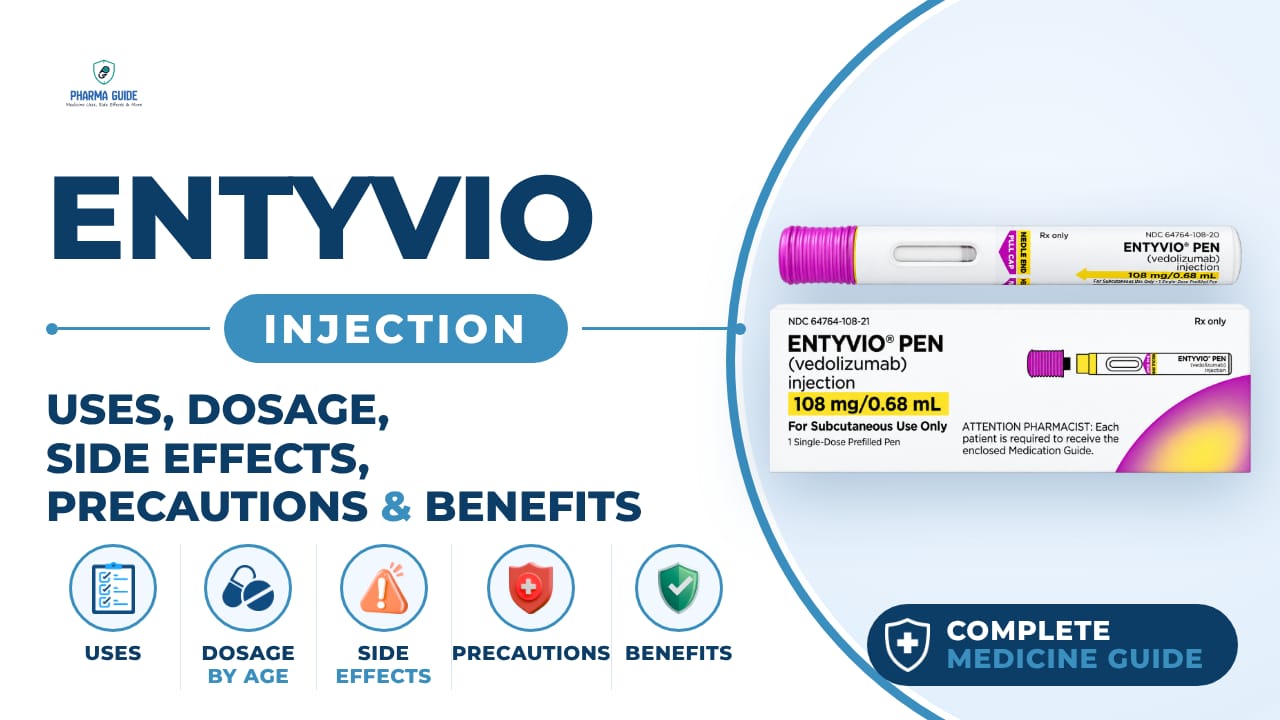
| Generic name | vedolizumab |
|---|---|
| Drug class | integrin receptor antagonist |
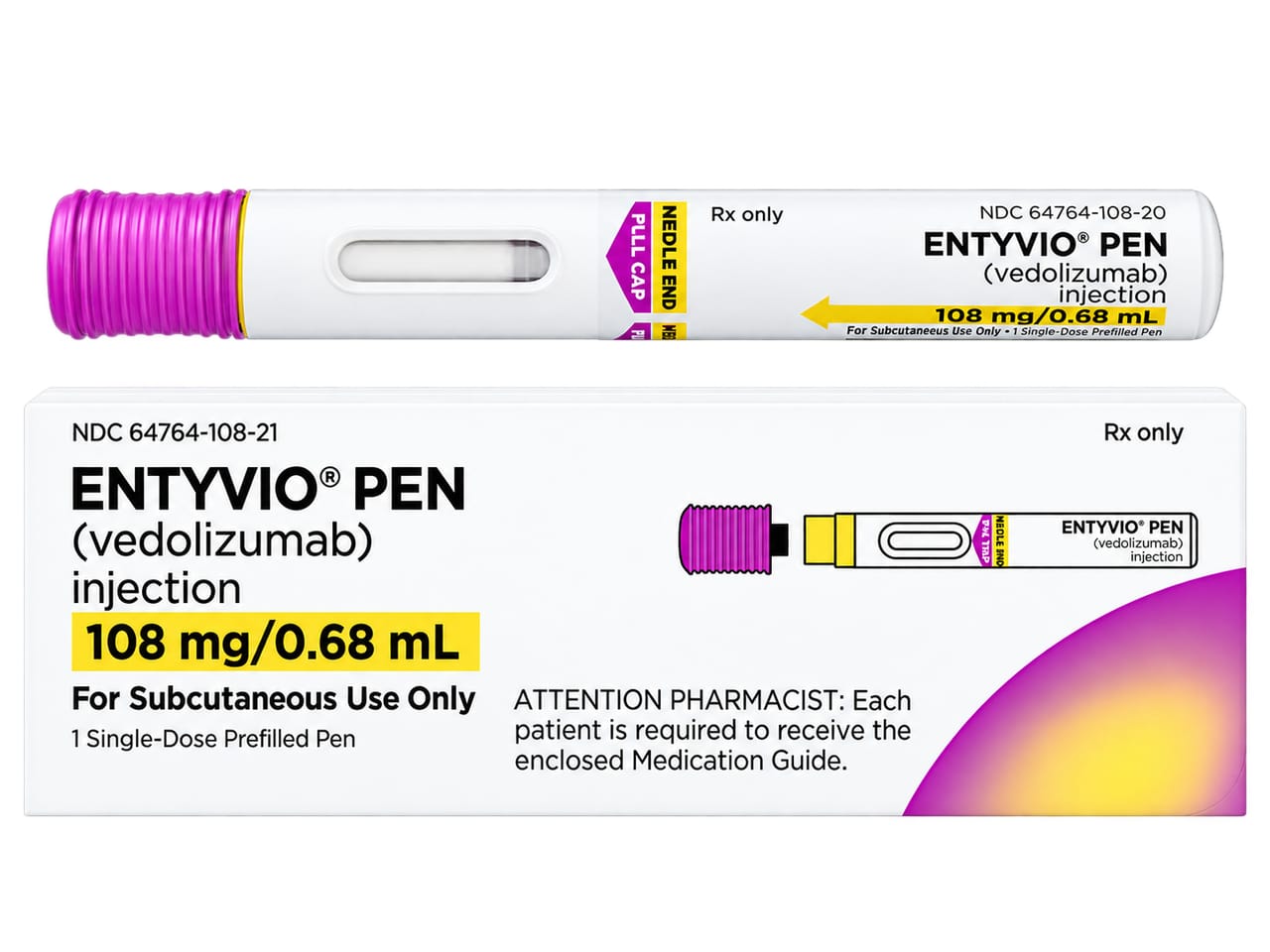
| Forms | Intravenous (IV) infusion, 300 mg single-dose vial of lyophilized powder for reconstitution, Subcutaneous injection, 108 mg/0.68 mL single-dose prefilled pen |
Quick overview
Entyvio Injection (vedolizumab) is a prescription biologic medicine given by IV infusion or injection under the skin. It is an integrin receptor antagonist used in adults to treat moderate to severe ulcerative colitis and Crohn's disease by reducing gut inflammation. It works by blocking certain white blood cells from entering the gut lining, which helps lower inflammation. It can help bring on and maintain remission, with some people noticing relief as early as 6 weeks.
What is Entyvio Injection
Entyvio is a prescription biologic medicine given by IV infusion or injection under the skin. It is used in adults to treat moderate to severe ulcerative colitis and Crohn's disease by reducing gut inflammation.
Entyvio Injection uses
- Moderately to severely active ulcerative colitis in adults
- Moderately to severely active Crohn's disease in adults
Benefits of Entyvio Injection
- Can help bring on and maintain clinical remission in ulcerative colitis and Crohn's disease
- Some people experience rapid symptom relief as early as 6 weeks
- Can help some people stop needing steroids while staying in remission
How Entyvio Injection works
Entyvio is an antibody that attaches to a specific protein on certain white blood cells. This stops those cells from moving into the gut lining, which helps reduce the inflammation that causes ulcerative colitis and Crohn's disease symptoms.
Entyvio Injection dosage
Entyvio is given as an intravenous infusion over about 30 minutes; it should not be given as a quick injection into the vein. Before starting treatment, patients should be brought up to date with all recommended immunizations. Treatment starts with infusions at the beginning, then two weeks later, then at six weeks, followed by infusions every eight weeks afterward. If there is no improvement in symptoms by week 14, the doctor will likely stop treatment. A healthcare professional should be present and ready to manage allergic reactions during and after the infusion.
If using the self-injection pen, the medicine is injected under the skin of the abdomen or thigh (caregivers may use the upper arm) every two weeks, and this is only started after at least two IV doses. If a scheduled dose is missed, contact the clinic to reschedule as soon as possible; for self-injection, inject the missed dose as soon as remembered and then resume the normal two-week schedule.
| Age group | Dose |
|---|---|
| 18–39 years | 300 mg IV at Weeks 0, 2, and 6, then every 8 weeks |
| 40–64 years | 300 mg IV at Weeks 0, 2, and 6, then every 8 weeks |
| 65–74 years | 300 mg IV at Weeks 0, 2, and 6, then every 8 weeks |
Available forms and strengths
- Intravenous (IV) infusion, 300 mg single-dose vial of lyophilized powder for reconstitution
- Subcutaneous injection, 108 mg/0.68 mL single-dose prefilled pen
Side effects of Entyvio Injection
Common
- Common cold/nasal and throat infections
- Headache
- Joint pain
- Nausea
- Fever
- Fatigue
- Cough
- Bronchitis
- Flu
- Back pain
- Rash or itching
- Sinus infection
- Throat pain
- Pain in extremities
- Injection site reactions (with the under-the-skin injection)
Serious
- Infusion-related reactions and serious allergic reactions, including anaphylaxis
- Serious infections, including tuberculosis, sepsis, and other opportunistic infections
- Progressive multifocal leukoencephalopathy (PML), a rare brain infection
- Liver injury, including elevated liver enzymes and jaundice
Warnings and precautions
- Entyvio can cause infusion-related reactions and serious allergic reactions, including anaphylaxis, which can happen during the infusion or several hours afterward. Tell a healthcare provider right away about symptoms like rash, swelling of the lips, tongue, throat, or face, trouble breathing, wheezing, dizziness, feeling hot, or a racing heart.
- Entyvio can raise the risk of serious infections, including tuberculosis, sepsis (sometimes fatal), and other infections. It should not be used in people with active, severe infections until they are controlled.
- A rare and serious brain infection called progressive multifocal leukoencephalopathy (PML) cannot be ruled out with this medicine, even though it is unlikely.
- Entyvio can cause liver injury, shown by elevated liver enzymes and bilirubin, which in some cases can be serious.
- People taking Entyvio should not receive live or oral vaccines unless the benefits outweigh the risks, and should be up to date on vaccinations before starting treatment.
- Using Entyvio together with natalizumab or TNF blocker medicines should be avoided because of an increased risk of infections, including PML.
- Available data have not shown that Entyvio increases the risk of major birth defects, miscarriage, or harm to the mother or baby, but there is a pregnancy registry to monitor outcomes for women exposed to the drug during pregnancy.
- Entyvio passes into human breast milk in small amounts. Because antibodies are mostly broken down in a baby's digestive system, exposure to the breastfed infant is expected to be low, but there is no data on effects on the baby or on milk production.
- The effect of kidney problems on how the body processes Entyvio has not been studied.
- The effect of liver problems on how the body processes Entyvio has not been studied, and Entyvio itself can sometimes cause liver injury, so people with liver problems should discuss this with their doctor.
- Entyvio does not directly interact with alcohol, but drinking alcohol may worsen some side effects like nausea and headache, and heavy drinking may increase the risk of liver damage from the drug. Alcohol can also worsen symptoms of ulcerative colitis or Crohn's disease.
- Entyvio usually does not directly impair driving, but infusion reactions, dizziness, or fatigue may temporarily make driving unsafe.
Storage
- Refrigerate unopened vials at 2°C to 8°C (36°F to 46°F)
- Retain in original package to protect from light
- Do not freeze the reconstituted solution in the vial or the diluted solution in the infusion bag
- Once reconstituted and diluted, use the infusion solution as soon as possible and discard any unused portion
When to see a doctor
- Get medical help right away if you have signs of an allergic reaction during or after an infusion, such as rash, itching, swelling of the lips, tongue, throat, or face, trouble breathing, wheezing, dizziness, feeling hot, or a racing heart.
- Tell your healthcare provider if you have signs of an infection such as fever, chills, muscle aches, cough, shortness of breath, runny nose, sore throat, red or painful skin or sores, tiredness, or pain during urination.
- Tell your healthcare provider right away if you notice confusion, trouble thinking, loss of balance, changes in walking or talking, weakness on one side of the body, blurred vision, or loss of vision, as these could be signs of a rare brain infection (PML).
- Tell your healthcare provider right away if you have signs of liver problems, such as tiredness, loss of appetite, pain on the right side of your abdomen, dark urine, or yellowing of the skin and eyes.
Alternatives
- Infliximab
- Adalimumab
- Ustekinumab
Watch the video
FAQs
What is Entyvio Injection used for?
Entyvio is used in adults to treat moderately to severely active ulcerative colitis and Crohn's disease by reducing gut inflammation.
How does Entyvio work?
Entyvio is an antibody that attaches to a specific protein on certain white blood cells, stopping those cells from moving into the gut lining and helping reduce the inflammation that causes ulcerative colitis and Crohn's disease symptoms.
How long does it take for Entyvio to work?
Entyvio can help bring on and maintain remission, with some people noticing symptom relief as early as 6 weeks.
What is the dosing schedule for Entyvio?
Entyvio IV infusions are given at the start, two weeks later, at six weeks, and then every eight weeks afterward. If using the self-injection pen, it is given under the skin every two weeks, starting only after at least two IV doses.
What are the serious side effects of Entyvio?
Serious side effects include infusion-related reactions and allergic reactions including anaphylaxis, serious infections such as tuberculosis and sepsis, a rare brain infection called PML, and liver injury.
General information, not medical advice
Your prescriber and the leaflet in your pack know your situation. This page does not.
- Follow your prescriber and the leaflet
- Don't start, stop, or change a dose on your own
- Doses and warnings differ by country and product
Sources
Video
Related medicines

Injectafer Injection: Uses, Dosage, Side Effects, Precautions and Alternates
Iron products
Injectafer (ferric carboxymaltose) treats iron deficiency anemia and heart failure-related iron deficiency via IV. Learn uses, dosage, side effects, and

Gliclazide Tablet: Uses, Dosage, Side Effects, Precautions and Alternates
Sulfonylurea (hypoglycemic/antidiabetic agent)
Gliclazide Tablet is a sulfonylurea for type 2 diabetes that boosts insulin release. Learn about dosage, side effects, warnings, and precautions.