
Safety
General information, not medical advice
Your prescriber and the leaflet in your pack know your situation. This page does not.
- Follow your prescriber and the leaflet
- Don't start, stop, or change a dose on your own
- Doses and warnings differ by country and product
Esomeprazole Tablet: Uses, Dosage, Side Effects, Precautions and Alternates
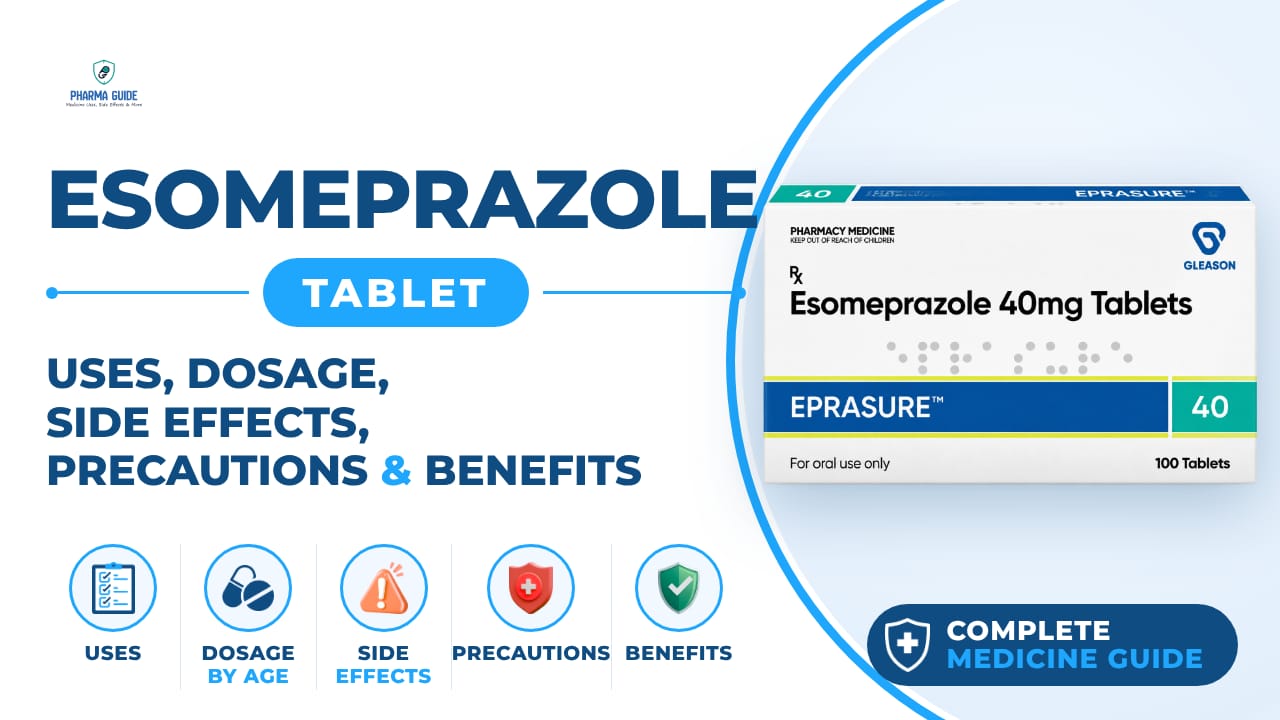
| Generic name | Esomeprazole (as esomeprazole magnesium) |
|---|---|
| Drug class | Proton pump inhibitor (H+, K+-ATPase Inhibitor) |
| Forms | Delayed release tablets (20 mg and 40 mg) |
Quick overview
Esomeprazole Tablet is a proton pump inhibitor that reduces the amount of acid the stomach makes. It is used to treat conditions caused by too much stomach acid, such as heartburn, reflux esophagitis, and stomach ulcers. It works by blocking the proton pump in acid-producing stomach cells, allowing irritated tissue to heal and reducing symptoms. It is available as delayed release tablets in 20 mg and 40 mg strengths.
What is Esomeprazole Tablet
Esomeprazole is a proton pump inhibitor (H+, K+-ATPase inhibitor), given as esomeprazole magnesium. It reduces the amount of acid made in the stomach and is used to treat conditions caused by too much stomach acid, such as heartburn, reflux esophagitis, and stomach ulcers.
Esomeprazole Tablet uses
- Reflux esophagitis (tissue damage caused by stomach acid moving up the food tube)
- Maintenance treatment of patients with reflux esophagitis
- Nonerosive reflux disease (NERD), including heartburn and regurgitation
- Healing of NSAID-associated gastric ulcers
- Reduction of risk of NSAID-associated gastric ulcers
- Treatment of pathological hypersecretory conditions, including Zollinger-Ellison syndrome
- Helicobacter pylori (H. pylori) eradication, in combination with antibiotics, to treat duodenal ulcer disease and reduce risk of ulcer recurrence
Benefits of Esomeprazole Tablet
- Healing was observed in over 93% of patients following 8 weeks of treatment for reflux esophagitis, associated with symptom relief
- Esomeprazole magnesium 20 mg once daily maintained healing of reflux esophagitis and provided symptom relief in the majority of patients (79 to 93%) over a 6 month period
- Provided patients with significantly more heartburn-free days and nights than placebo in nonerosive reflux disease
- Higher gastric ulcer healing rates compared to ranitidine in patients on NSAID therapy
- Significantly higher estimated ulcer-free rates compared to placebo for risk reduction of NSAID-associated gastric ulcers
- High eradication rates of H. pylori and ulcer healing when combined with antibiotics
How Esomeprazole Tablet works
Esomeprazole works by blocking the proton pump in the stomach's acid-producing cells, which is the final step in making stomach acid. This lowers the amount of acid produced, allowing irritated tissue to heal and reducing symptoms like heartburn.
Esomeprazole Tablet dosage
Take all doses that your healthcare professional prescribes even when you feel well. If taken with antibiotics, take all medications twice each day, at the right time each day, for one week. Continue taking the medicine until your healthcare professional tells you to stop, even if you feel better in a few days.
The tablet may be taken with food or on an empty stomach. It can be swallowed whole with water, or put in half a glass of water where it will break apart to make it easier to swallow; swallow all the tiny pellets without chewing them, and don't let the pellets sit in water for more than 30 minutes before drinking; rinse the glass with water and drink this as well. Do not administer via naso-gastric feeding tubes. Not recommended for use in children under 12 years of age.
| Age group | Dose |
|---|---|
| Under 1 year | Doctor's advice required |
| 1–11 years | 10–20 mg once daily* |
| 12–17 years | 20–40 mg once daily* |
| 18 years & older | 20–40 mg once daily* |
Available forms and strengths
- Delayed release tablets (20 mg and 40 mg)
Side effects of Esomeprazole Tablet
Common
- Nausea
- Stomach upset/abdominal pain
- Diarrhea
- Headache
- Gas (flatulence)
- Constipation
- Dry mouth
Serious
- Severe or persistent diarrhea (possible bowel infection)
- Serious skin reactions including Stevens-Johnson Syndrome, toxic epidermal necrolysis, DRESS, erythema multiforme, and acute generalized exanthematous pustulosis
- Signs of stomach or intestine problems: trouble swallowing, unplanned weight loss, vomiting blood or food, black or bloody stools
- Low magnesium, calcium, or potassium levels: dizziness, fast or irregular heart rate, tremors, jerking muscle movements, muscle cramps or spasms, feeling jittery
- Kidney problems: fever, rash, nausea, loss of appetite, joint pain, urinating less than usual, blood in urine, weight gain
- New or worsening lupus symptoms: joint pain and a skin rash on cheeks or arms that worsens in sunlight
- Blood disorders: feeling tired or weak, pale skin, bruising or bleeding for longer than usual, fever, chills
- Liver problems: yellowing of skin or eyes, bleeding easily, confusion
- Severe allergic reaction: shortness of breath, chest pain, swelling, hives
- Bone fractures of the hip, wrist, or spine with long-term use
- Stomach growths (fundic gland polyps) with long-term use
- Vitamin B12 deficiency with long-term use
Warnings and precautions
- If you have alarm symptoms like unexplained weight loss, repeated vomiting, trouble swallowing, or vomiting/passing blood, or if a stomach ulcer is suspected, cancer needs to be ruled out before starting treatment, since this medicine can hide symptoms and delay diagnosis.
- Do not take this medicine together with rilpivirine (an HIV medicine), as it significantly reduces the effectiveness of rilpivirine.
- Taking this medicine with antibiotics can lead to a serious bowel infection with symptoms of severe or bloody diarrhea; stop the medicine and contact your healthcare professional immediately if this occurs.
- Long-term use should be avoided when possible, and the lowest effective dose for the shortest necessary time should be used because of increased risks of certain bone fractures, infections, and nutrient deficiencies.
- Concomitant use of esomeprazole with clopidogrel should be avoided, as esomeprazole can decrease the effectiveness of clopidogrel.
- This medicine should not be used with the HIV medicines atazanavir or nelfinavir, as it reduces their effectiveness.
- Stopping long-term treatment suddenly can cause acid-related symptoms to become worse due to rebound acid production.
- There is not enough information to know if esomeprazole is safe during pregnancy. It should only be used if the benefits outweigh the risks, and you should discuss this with your healthcare professional.
- It is not known whether esomeprazole passes into breast milk in humans. It should not be given to nursing mothers unless considered essential by a healthcare professional.
- No dose adjustment is required for people with kidney problems, since esomeprazole's metabolism is not expected to change with impaired kidney function.
- No dose adjustment is needed for mild to moderate liver problems. For people with severe liver disease, the daily dose should generally not exceed 20 mg.
Storage
- Keep all tablets sealed in the blister strips until it is time for a dose, as moisture from the air may damage the drug
- Keep at controlled room temperature (15°C - 30°C)
- Do not keep in the bathroom medicine cabinet or other warm, moist places
- Do not use after the expiry date marked on the pack
- Keep out of reach and sight of children
- Any unused medicinal product or waste material should be disposed of in accordance with local requirements
When to see a doctor
- Get immediate medical help if you notice signs of a severe allergic reaction, such as swelling of the face, lips, tongue or throat, difficulty breathing, or hives.
- Call your doctor right away if you have severe or watery/bloody diarrhea, as this could be a sign of a serious bowel infection.
- Seek medical help if you develop signs of low magnesium, such as dizziness, irregular heartbeat, tremors, jerking movements, jitteriness, muscle cramps or spasms, or a cough/choking feeling.
- Contact your doctor if you develop signs of kidney problems, including fever, rash, nausea, loss of appetite, joint pain, urinating less than usual, blood in urine, or weight gain.
- Tell your doctor if you notice new or worsening joint pain along with a skin rash on your cheeks or arms that gets worse in sunlight, as this may be a sign of lupus.
- If you think you have taken too much of this medicine, contact a healthcare professional, hospital emergency department, or your local poison control center immediately, even if you have no symptoms.
- Seek medical help for signs of a serious skin reaction, such as skin peeling, blistering, severe rash, or swelling and redness of the eyes or face along with fever and body aches.
Alternatives
- Nexium
- Nexium 24HR
- Nexium IV
- Vimovo
Watch the video
FAQs
What is Esomeprazole Tablet used for?
It is used to treat reflux esophagitis, nonerosive reflux disease (heartburn and regurgitation), NSAID-associated gastric ulcers, pathological hypersecretory conditions like Zollinger-Ellison syndrome, and H. pylori eradication in combination with antibiotics for duodenal ulcer disease.
How should Esomeprazole Tablet be taken?
It may be taken with food or on an empty stomach, swallowed whole with water, or dispersed in half a glass of water and swallowed without chewing the pellets; it should not be given via naso-gastric feeding tubes and is not recommended for children under 12 years.
What are the common side effects of Esomeprazole Tablet?
Common side effects include nausea, stomach upset or abdominal pain, diarrhea, headache, gas, constipation, and dry mouth.
Can Esomeprazole Tablet be taken with other medicines?
It should not be taken with rilpivirine, atazanavir, or nelfinavir as it reduces their effectiveness, and concomitant use with clopidogrel should be avoided since esomeprazole can decrease clopidogrel's effectiveness.
Is long-term use of Esomeprazole Tablet safe?
Long-term use should be avoided when possible and the lowest effective dose for the shortest time used, due to increased risks of bone fractures, infections, nutrient deficiencies like vitamin B12 deficiency, and stomach growths called fundic gland polyps.
General information, not medical advice
Your prescriber and the leaflet in your pack know your situation. This page does not.
- Follow your prescriber and the leaflet
- Don't start, stop, or change a dose on your own
- Doses and warnings differ by country and product
Sources
Video
Related medicines

Injectafer Injection: Uses, Dosage, Side Effects, Precautions and Alternates
Iron products
Injectafer (ferric carboxymaltose) treats iron deficiency anemia and heart failure-related iron deficiency via IV. Learn uses, dosage, side effects, and

Gliclazide Tablet: Uses, Dosage, Side Effects, Precautions and Alternates
Sulfonylurea (hypoglycemic/antidiabetic agent)
Gliclazide Tablet is a sulfonylurea for type 2 diabetes that boosts insulin release. Learn about dosage, side effects, warnings, and precautions.