
Safety
General information, not medical advice
Your prescriber and the leaflet in your pack know your situation. This page does not.
- Follow your prescriber and the leaflet
- Don't start, stop, or change a dose on your own
- Doses and warnings differ by country and product
Eumovate Cream: Uses, Dosage, Side Effects, Precautions and Alternates
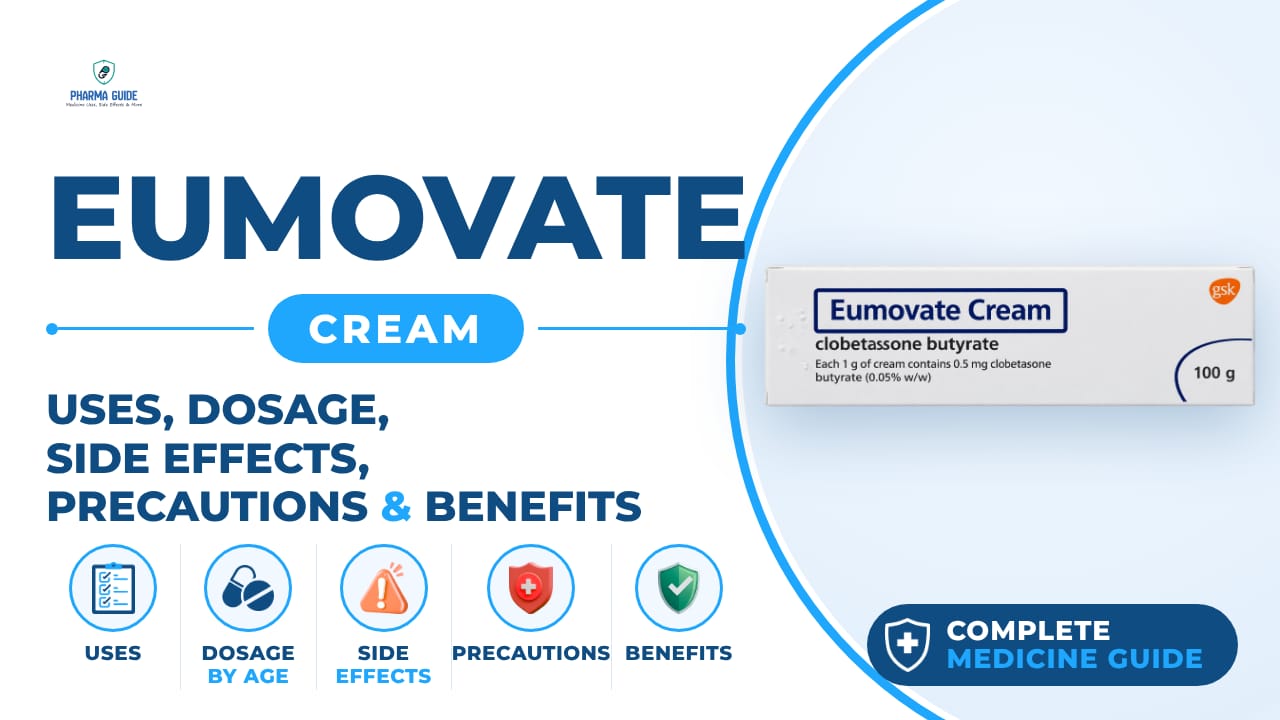
| Generic name | Clobetasone butyrate |
|---|---|
| Drug class | Topical corticosteroid |
| Forms | Cream, Ointment |
Quick overview
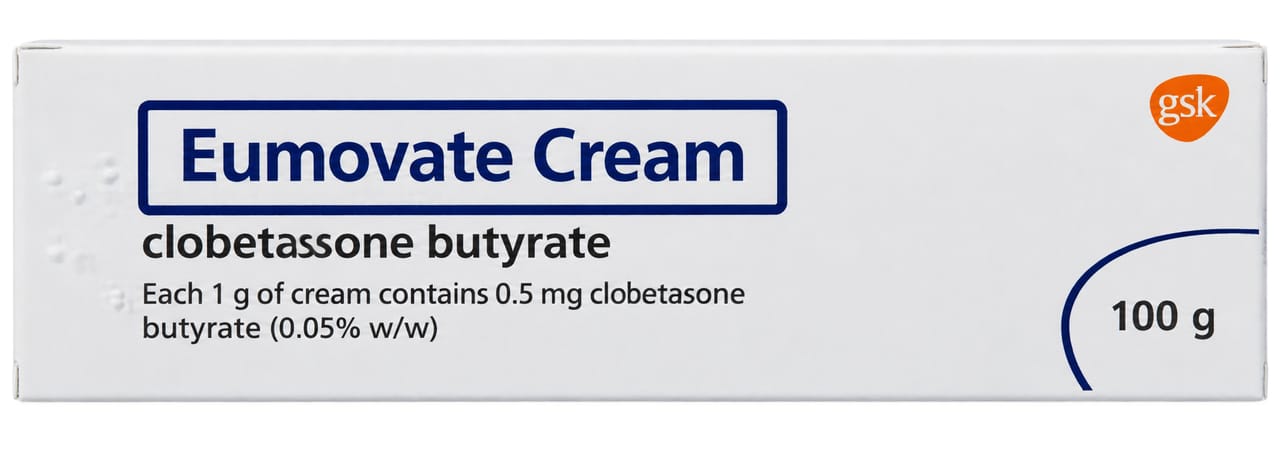
Eumovate Cream contains the active ingredient clobetasone butyrate 0.05% w/w, a topical corticosteroid. It is used to treat eczema and dermatitis by controlling inflammation on the skin. The cream is applied directly to the affected area and should not be used for more than 7 days without medical advice.
What is Eumovate Cream
Eumovate Cream is a topical corticosteroid cream used to control inflammation on the skin. It contains the active ingredient clobetasone butyrate 0.05% w/w and is used to treat eczema and dermatitis.
Eumovate Cream uses
- Eczema (allergic, atopic, irritant, photo or seborrheic)
- Dermatitis
- Skin rash due to allergy or an irritant substance (irritant and allergic contact dermatitis)
- Prurigo nodularis (itchy nodules on the arms or legs)
- Inflammation of the outer ear
- Insect bite reactions
- Nappy rash
Benefits of Eumovate Cream
- Helps control patches of dry, red, itchy, flaky or inflamed skin caused by eczema and dermatitis
- Cream base also has moisturising properties
How Eumovate Cream works
Eumovate works by stopping the skin's over-reaction to triggers that cause flare-ups. It calms down the inflammation that causes eczema or dermatitis.
Eumovate Cream dosage
For external use on the skin only. Wash your hands and dry them before applying. Squeeze the cream onto your index finger using the fingertip unit as a guide to know how much to use, using a smaller amount for smaller areas. Gently rub the cream onto the patch of skin being treated. Wash your hands again afterwards, unless it is your hands being treated.
Do not cover the treated area with bandages, dressings, gloves or plastic wrap, as this can increase how much medicine passes through the skin. Be careful not to get the cream in your eyes. Apply at about the same time each day for the best effect and to help you remember.
Adults and children over 12 years can use this cream; children under 12 should only use it on a doctor's advice. Avoid use on the face, broken skin, genital areas, or infected skin unless a doctor says otherwise.
If you forget an application, use it when you remember, but do not use it more often to make up for a missed dose. Do not use for more than 7 days without speaking to a doctor or pharmacist.
| Age group | Dose |
|---|---|
| Under 1 year | Doctor-directed use only |
| 1–11 years | Apply a thin layer 1–2 times daily, as prescribed |
| 12–64 years | Apply a thin layer 1–2 times daily |
| 65 years & older | Apply a thin layer 1–2 times daily, using the lowest effective amount |
Available forms and strengths
- Cream (clobetasone butyrate 0.05% w/w)
- Ointment
Side effects of Eumovate Cream
Common
- Rash
- Itch
- Local skin burning
- Skin thinning
- Skin bleaching or increased skin pigmentation
- Hair disorders
- Worsening of eczema or dermatitis symptoms
Serious
- Allergic reaction (shortness of breath, wheezing, swelling of face/lips/tongue/throat, rash, itching, redness or hives)
- Infection (heat and/or redness at the site, fever)
- High blood pressure
- Glaucoma (increased pressure in the eye)
- Cataract (cloudy lens in the eye)
- Decrease in the level of the hormone cortisol in the blood
- Increased blood sugar levels
- Weakening of the bones through gradual loss of mineral (osteoporosis)
- Glucose in the urine
- Increased weight, moon face or rounding of the face, obesity, increased body hair (very rare, with overuse)
- Delayed weight gain and slow growth in children (very rare, with overuse)
Warnings and precautions
- Do not use unless a doctor advises it if you are pregnant or may be pregnant. Your doctor will discuss the risks and benefits with you.
- Talk to your doctor before using this cream if you are breastfeeding. If you do use it, avoid applying it to the breast area so your baby does not accidentally get it in their mouth.
- Check with your doctor or pharmacist before use if you have kidney problems or liver problems.
- Be careful before you drive or use machines or tools until you know how this cream affects you.
- Do not use on cuts, open wounds, infected skin, or inflamed skin near ulcers.
- Do not use on delicate skin areas such as the face, groin, genitals or between the toes.
- Do not use to treat rosacea, acne, itching without rash, perioral dermatitis, untreated bacterial infections, fungal infections, viral infections, parasitic infestations, or psoriasis unless recommended by a doctor.
- Do not use for more than 7 days without medical advice, and do not treat the same patch of skin more than twice without your doctor's advice.
- Do not use other corticosteroids on the skin at the same time as this cream, as this would double the dose.
- Certain medicines, including other corticosteroids, ritonavir, and itraconazole, may interfere with how this cream works.
- Do not use in children under 12 years except on the advice of a doctor.
Storage
- Keep the cream in its pack until it is time to use it
- Keep in a cool, dry place where the temperature stays below 25°C
- Do not store in the bathroom, near a sink, in the car, or on window sills
- Keep out of the sight and reach of children; a locked cupboard at least one-and-a-half metres above the ground is a good place to store medicines
- Do not use after the expiry date
- Do not use if the packaging is torn or shows signs of tampering
- Take unwanted or expired medicine to any pharmacy for safe disposal
When to see a doctor
- See a doctor straight away if you become pregnant while using this cream.
- See a doctor straight away if you experience blurred vision or other visual disturbances.
- See a doctor if your rash or irritation gets better but then comes back, or if your skin gets worse or does not improve within a week.
- Stop using the cream and see a doctor or pharmacist as soon as possible if your skin gets worse during treatment, as this could mean infection, an unrecognised trigger, or an allergy to the cream.
- Call your doctor straight away, or go to the Emergency Department, if you notice serious side effects such as allergic reaction, eye problems, high blood pressure, or signs of infection.
- If you or anyone else swallows this medicine, seek urgent medical attention right away, even if there are no signs of discomfort or poisoning, by contacting your doctor, calling your local poison control center, or going to the nearest hospital emergency department.
Alternatives
- Eumovate ointment
- Hydrocortisone
- Kloxema Cream
Watch the video
FAQs
What is Eumovate Cream used for?
Eumovate Cream is used to treat eczema, dermatitis, allergic or irritant skin rashes, prurigo nodularis, inflammation of the outer ear, insect bite reactions, and nappy rash.
How long can I use Eumovate Cream?
Do not use Eumovate Cream for more than 7 days without speaking to a doctor or pharmacist, and do not treat the same patch of skin more than twice without medical advice.
Can children use Eumovate Cream?
Adults and children over 12 years can use this cream. Children under 12 should only use it on a doctor's advice, and those under 1 year should only use it as directed by a doctor.
What are the side effects of Eumovate Cream?
Common side effects include rash, itch, local skin burning, skin thinning, skin bleaching or pigmentation changes, hair disorders, and worsening of eczema or dermatitis symptoms.
Can I use Eumovate Cream on my face?
No, you should avoid using Eumovate Cream on the face, broken skin, genital areas, or infected skin unless a doctor says otherwise.
General information, not medical advice
Your prescriber and the leaflet in your pack know your situation. This page does not.
- Follow your prescriber and the leaflet
- Don't start, stop, or change a dose on your own
- Doses and warnings differ by country and product
Sources
Video
Related medicines
Amcinonide Lotion: Uses, Dosage, Side Effects, Precautions and Alternates
Topical corticosteroid
Amcinonide Lotion is a high-potency corticosteroid for eczema, dermatitis, and psoriasis. Learn uses, dosage, side effects, and precautions.
Amcinonide Cream: Uses, Dosage, Side Effects, Precautions and Alternates
Topical corticosteroid
Amcinonide Cream is a high-potency corticosteroid that relieves itching, redness, and inflammation from eczema, dermatitis, and psoriasis.