
Safety
General information, not medical advice
Your prescriber and the leaflet in your pack know your situation. This page does not.
- Follow your prescriber and the leaflet
- Don't start, stop, or change a dose on your own
- Doses and warnings differ by country and product
Eurartesim Tablet: Uses, Dosage, Side Effects, Precautions and Alternates
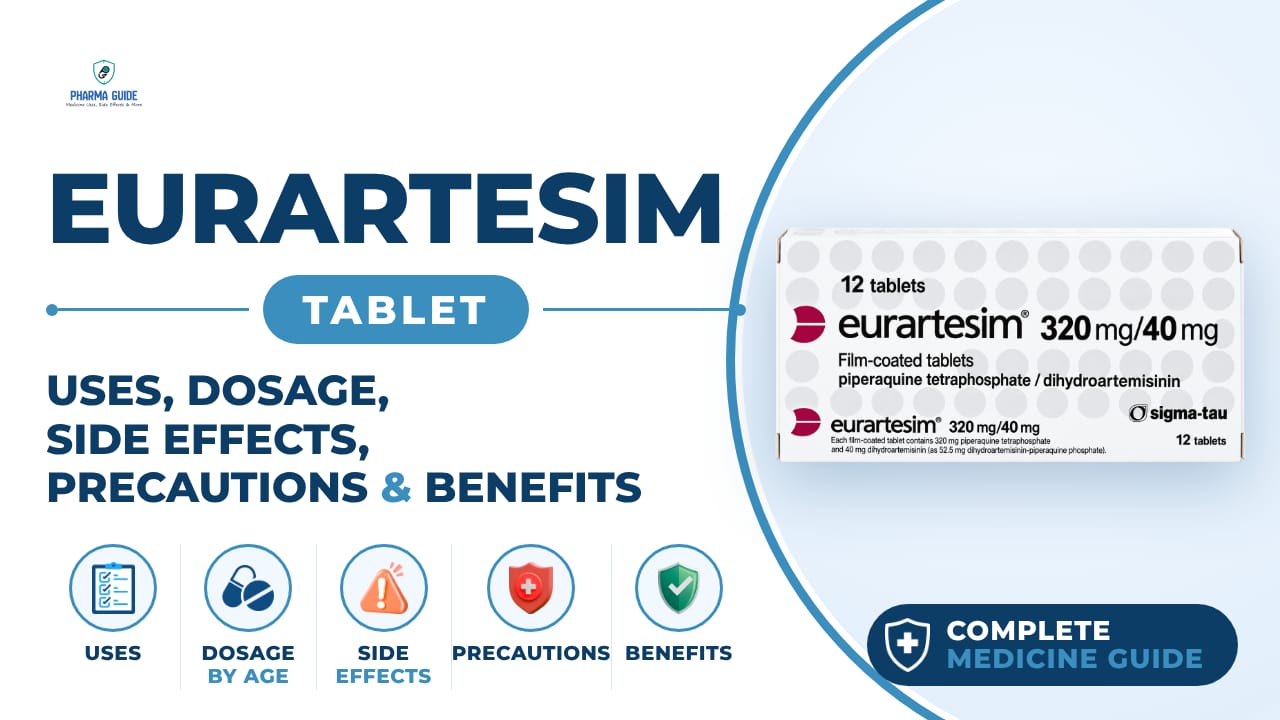
| Generic name | piperaquine tetraphosphate / artenimol (dihydroartemisinin) |
|---|---|
| Drug class | Antiprotozoal / antimalarial (artemisinin and derivatives, combinations) |
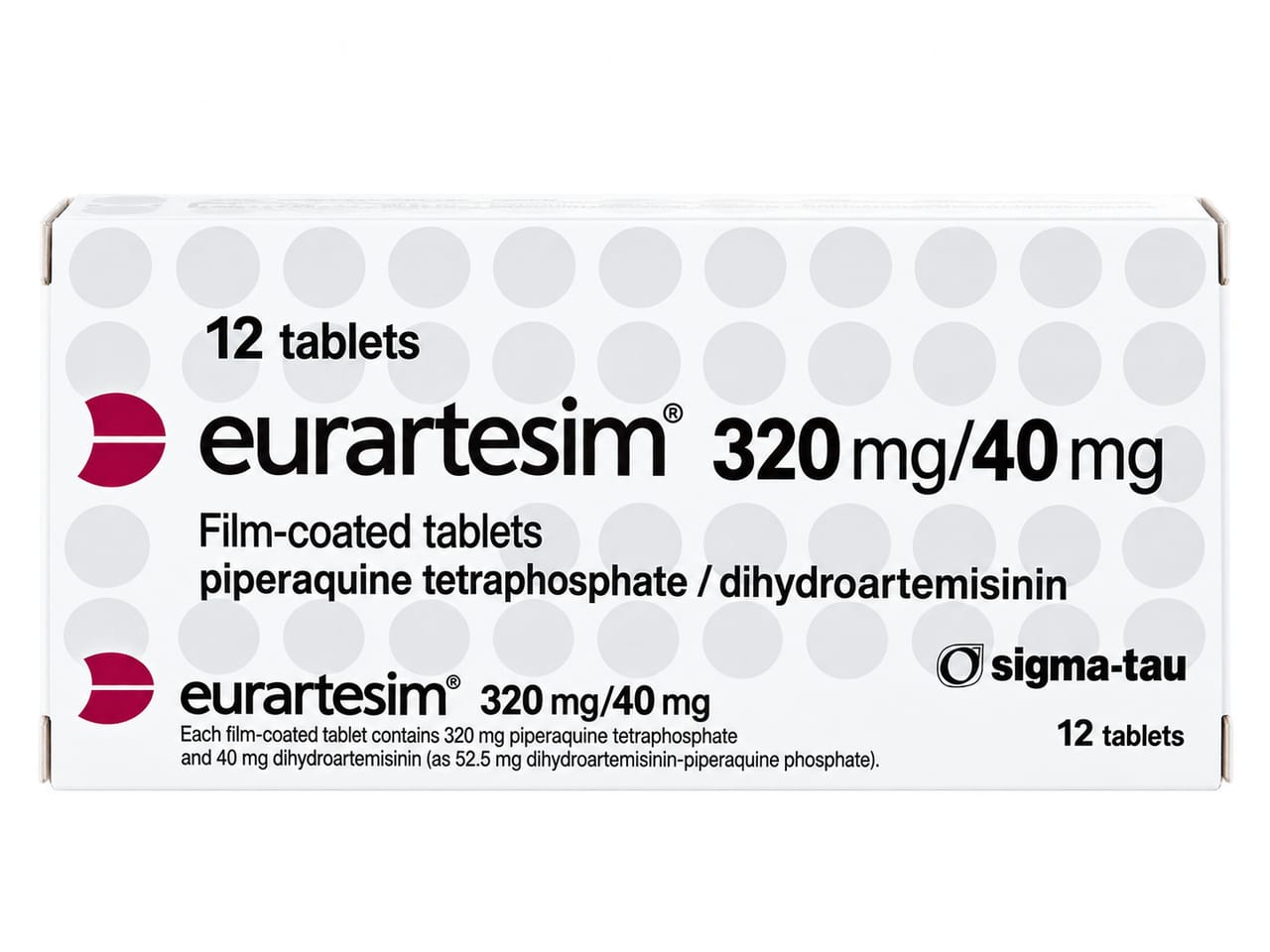
| Forms | Film-coated tablet (160 mg/20 mg), Film-coated tablet (320 mg/40 mg) |
Quick overview
Eurartesim Tablet is a prescription-only combination antimalarial medicine containing artenimol (dihydroartemisinin) and piperaquine tetraphosphate. It is used to treat acute uncomplicated malaria caused by the Plasmodium falciparum parasite. The tablets are taken once daily for three days, on an empty stomach, and are available in two strengths for weight-based dosing.
What is Eurartesim Tablet
Eurartesim is a prescription-only combination antimalarial medicine containing two active substances, artenimol (dihydroartemisinin) and piperaquine tetraphosphate. It is given as tablets to treat malaria caused by the Plasmodium falciparum parasite.
Eurartesim Tablet uses
- Treats acute uncomplicated Plasmodium falciparum malaria.
- Helps eliminate susceptible malaria parasites from the bloodstream.
- Supports recovery from malaria-related fever and chills.
- Reduces parasite multiplication during treatment.
- Provides combination therapy using two antimalarial mechanisms.
Benefits of Eurartesim Tablet
- Combines rapid antimalarial activity with longer-lasting parasite suppression.
- Provides an established three-day treatment course.
- Can achieve high treatment success rates where parasite susceptibility is preserved.
- Offers an oral alternative to certain other antimalarial combinations.
- Provides two tablet strengths for weight-based prescribing.
How Eurartesim Tablet works
Artenimol works by releasing free radicals inside the malaria parasite that damage its membranes and internal structures, helping to kill it quickly. Piperaquine is chemically related to other antimalarial medicines and is thought to block a process the parasite needs to survive, giving longer-lasting protection against the infection.
Eurartesim Tablet dosage
Take this medicine once a day for three consecutive days, trying to take each dose at about the same time each day. Take on an empty stomach: each dose should be taken no less than 3 hours after the last food intake, and no food should be eaten within 3 hours after each dose. Swallow the tablets with water; water can be drunk at any time.
If tablets are hard to swallow, such as for infants and young children, they may be crushed and mixed with water, and the mixture should be drunk right away after preparing it. Do not take with grapefruit juice.
If a dose is vomited within 30 minutes of taking it, the whole dose should be taken again; if vomited between 30 and 60 minutes after taking it, half the dose should be taken again. This re-dosing should not be attempted more than once — if the second dose is also vomited, contact a doctor for alternative treatment.
If a dose is missed, take it as soon as you remember, then continue the course as normal; never take more than one dose on the same day to make up for a missed dose. Complete the full three-day course of treatment for the medicine to work effectively.
No more than two treatment courses should be taken within a 12-month period, and a second course should not be started within 2 months of the first course. Caution is advised when giving this medicine to elderly patients, due to the possibility of age-related decline in liver and kidney function and potential heart problems.
| Age group | Dose |
|---|---|
| Under 6 months or below 5 kg | Safety and effectiveness not established; no approved dosage |
| 6–11 months (5–under 7 kg) | 10 mg/80 mg once daily for 3 days |
| 1–5 years (13–under 24 kg) | 40 mg/320 mg once daily for 3 days |
| 13–39 years (36–under 75 kg) | 120 mg/960 mg once daily for 3 days |
Available forms and strengths
- Film-coated tablet (160 mg/20 mg)
- Film-coated tablet (320 mg/40 mg)
Side effects of Eurartesim Tablet
Common
- Headache
- Dizziness
- Fast heart rate (tachycardia)
- Weakness (asthenia)
- Fever
- Anaemia (low red blood cell counts)
- Mild stomach symptoms such as nausea, vomiting, diarrhoea, or abdominal pain
- In children: flu-like symptoms, cough, and fever (very common)
Serious
- QTc interval prolongation — a change in the heart's electrical activity that can cause a dangerous or life-threatening abnormal heart rhythm
- Delayed haemolytic anaemia (breakdown of red blood cells) which can occur up to a month after treatment and sometimes needs a blood transfusion
- Irregular or slow heart rate
- Liver problems, including hepatitis, liver cell damage, or abnormal liver function tests
- Convulsions (fits)
Warnings and precautions
- This medicine can cause QTc interval prolongation, a change in the heart's electrical activity that may lead to dangerous or fatal irregular heart rhythms. It should not be used with other medicines that can also affect heart rhythm, or in people with certain heart conditions, family history of sudden cardiac death, or imbalances in blood salts like potassium or magnesium.
- This medicine must not be used to treat severe or complicated malaria.
- This medicine should not be taken with fatty food, as fat increases absorption of piperaquine and can increase the risk of heart rhythm effects. It should always be taken on an empty stomach, with water only, and not with grapefruit juice.
- Children who vomit while on this medicine are more likely to develop salt imbalances, which can increase the risk of heart rhythm problems.
- No more than two courses of this medicine should be given within a 12-month period, and a second course should not be given within 2 months of the first, due to how long piperaquine stays in the body.
- This medicine should not be used during the first three months of pregnancy if another suitable antimalarial is available, because it may harm the unborn baby. It can be considered during the second and third trimester if judged more suitable than other options by a doctor.
- Women should not breastfeed while taking this medicine, because it may pass into breast milk.
- This medicine has not been studied in people with moderate or severe kidney problems, so it should be used with caution and extra monitoring in these patients.
- This medicine has not been studied in people with moderate or severe liver problems, so it should be used with caution and extra monitoring in these patients.
- Alcohol may worsen dizziness and dehydration during malaria illness.
- This medicine does not appear to affect the ability to drive or use machines once a person has recovered from the malaria infection.
Storage
- Do not store above 30°C.
- Store in the original package in order to protect from light and moisture.
- Do not use this medicine if you notice the blister is open.
- Do not throw away any medicines via wastewater or household waste; ask your pharmacist how to dispose of medicines you no longer use.
When to see a doctor
- Contact your doctor immediately if you or your child develop signs of a red blood cell problem after treatment, such as pale skin, general weakness, headache, shortness of breath, rapid heartbeat (especially with exercise), confusion, dizziness, or dark-coloured urine — this may be delayed haemolytic anaemia, which can occur up to a month after treatment.
- Contact your doctor as soon as possible, before the next dose is due, if you notice anything different about your or your child's heart rhythm or symptoms such as palpitations or irregular heartbeat.
- If a second dose is vomited, do not give another dose — contact your doctor urgently for an alternative malaria treatment.
Alternatives
- Artesunate + Mefloquine
- Artesunate + Amodiaquine
- Artemether + Lumefantrine
Watch the video
FAQs
What is Eurartesim Tablet used for?
Eurartesim is a prescription combination antimalarial containing artenimol and piperaquine tetraphosphate, used to treat acute uncomplicated malaria caused by the Plasmodium falciparum parasite.
How should Eurartesim Tablet be taken?
It is taken once daily for three consecutive days on an empty stomach, at least 3 hours after food and with no food for 3 hours after dosing. Tablets should be swallowed with water and not taken with grapefruit juice.
What should I do if I vomit a dose of Eurartesim?
If vomiting occurs within 30 minutes, the full dose should be retaken; if between 30 and 60 minutes, half the dose should be retaken. This should only be attempted once — if the second dose is also vomited, contact a doctor for alternative treatment.
What are the serious side effects of Eurartesim Tablet?
Serious effects include QTc interval prolongation leading to dangerous heart rhythms, delayed haemolytic anaemia (which can occur up to a month after treatment), irregular or slow heart rate, liver problems, and convulsions.
Can Eurartesim Tablet be used during pregnancy or breastfeeding?
It should not be used in the first three months of pregnancy if another suitable antimalarial is available, but may be considered in the second or third trimester if judged necessary by a doctor. Women should not breastfeed while taking this medicine.
General information, not medical advice
Your prescriber and the leaflet in your pack know your situation. This page does not.
- Follow your prescriber and the leaflet
- Don't start, stop, or change a dose on your own
- Doses and warnings differ by country and product
Sources
Video
Related medicines

Injectafer Injection: Uses, Dosage, Side Effects, Precautions and Alternates
Iron products
Injectafer (ferric carboxymaltose) treats iron deficiency anemia and heart failure-related iron deficiency via IV. Learn uses, dosage, side effects, and

Gliclazide Tablet: Uses, Dosage, Side Effects, Precautions and Alternates
Sulfonylurea (hypoglycemic/antidiabetic agent)
Gliclazide Tablet is a sulfonylurea for type 2 diabetes that boosts insulin release. Learn about dosage, side effects, warnings, and precautions.