
Safety
General information, not medical advice
Your prescriber and the leaflet in your pack know your situation. This page does not.
- Follow your prescriber and the leaflet
- Don't start, stop, or change a dose on your own
- Doses and warnings differ by country and product
Eylea Injection: Uses, Dosage, Side Effects, Precautions and Alternates
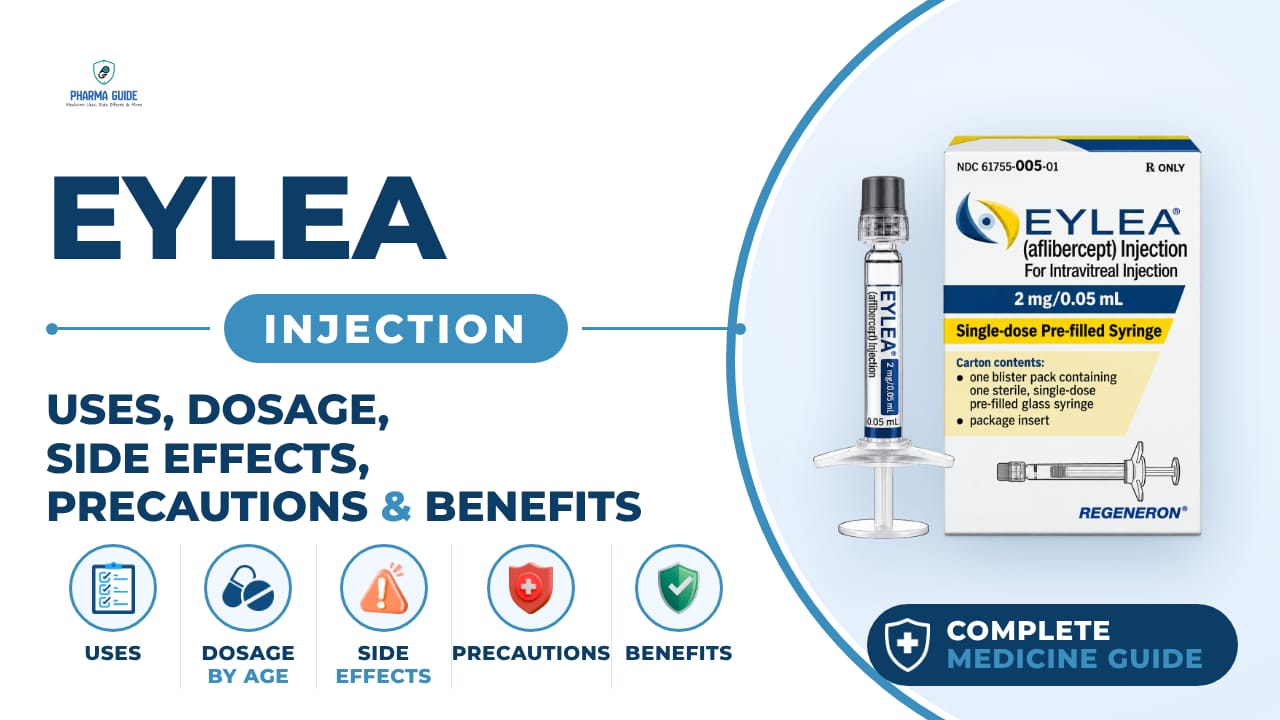
| Generic name | aflibercept ophthalmic |
|---|---|
| Drug class | Anti-angiogenic ophthalmic agents (VEGF inhibitor) |
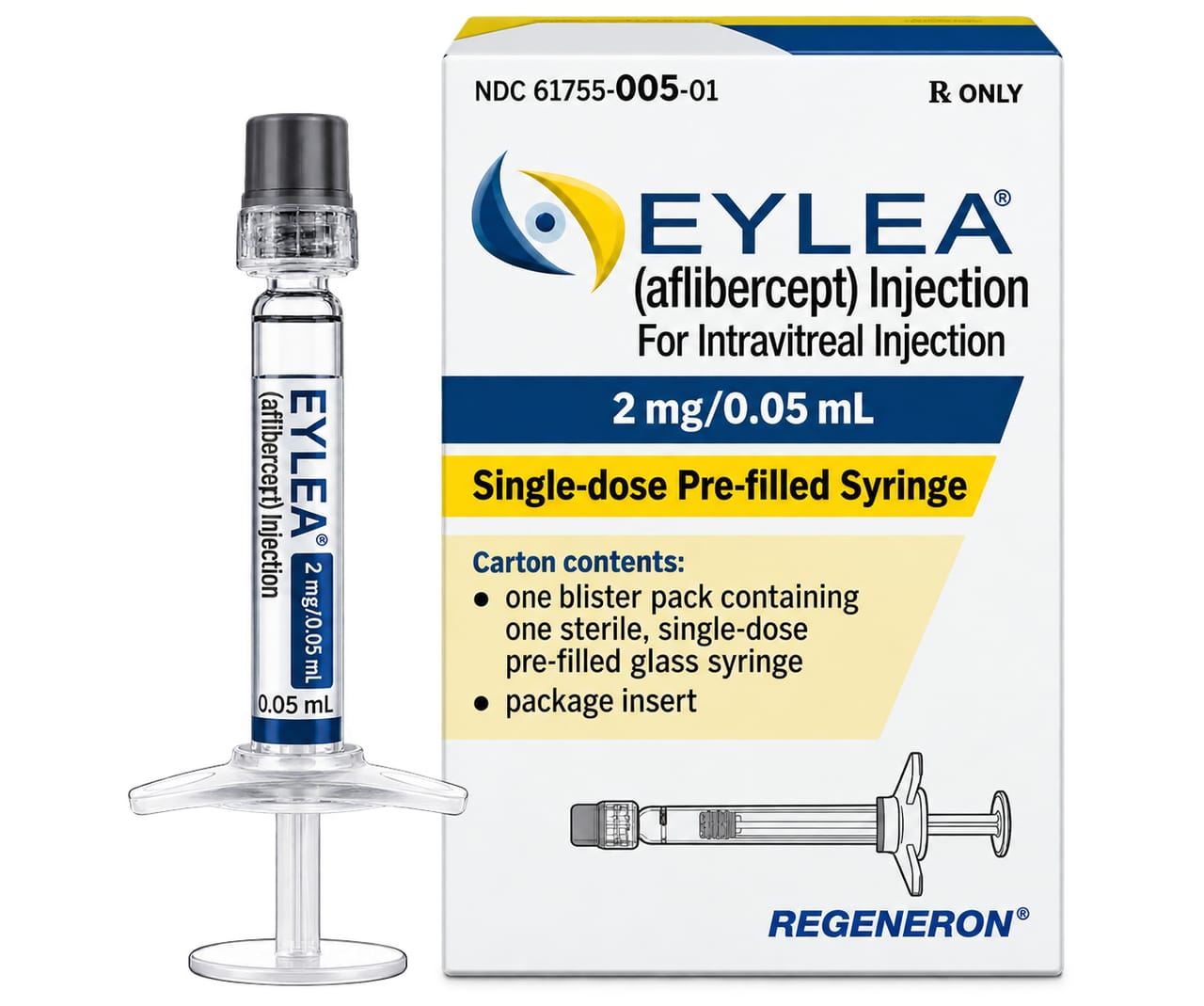
| Forms | Single-dose pre-filled syringe for injection into the eye (2 mg), Single-dose vial for injection into the eye (2 mg) |
Quick overview
Eylea Injection (aflibercept ophthalmic) is an anti-angiogenic ophthalmic agent given directly into the eye to treat several vision-threatening retinal conditions caused by abnormal, leaky blood vessels. It is used for conditions such as wet age-related macular degeneration, diabetic eye disease, and retinal vein occlusion. Eylea works by blocking proteins that trigger abnormal blood vessel growth and leakage. It is given by an eye specialist in a clinical setting, not at home.
What is Eylea Injection
Eylea is an injection given into the eye to treat several vision-threatening retinal conditions caused by abnormal, leaky blood vessels in the eye.
Eylea Injection uses
- Neovascular (wet) age-related macular degeneration (nAMD)
- Macular edema following retinal vein occlusion (RVO)
- Diabetic macular edema (DME)
- Diabetic retinopathy (DR)
- Retinopathy of prematurity (ROP), in premature infants
- Visual impairment due to myopic choroidal neovascularisation (myopic CNV)
Benefits of Eylea Injection
- Macular Edema Treatment: Helps reduce abnormal fluid accumulation in the retina.
- Wet AMD Support: Used to treat neovascular (wet) age-related macular degeneration.
- Diabetic Eye Disease: Used for diabetic macular edema and diabetic retinopathy.
- Retinal Vein Occlusion: Helps treat macular edema following retinal vein occlusion.
- Retinal Protection: Blocking VEGF can reduce abnormal blood-vessel growth and leakage.
How Eylea Injection works
Eylea works like a decoy. It attaches to two proteins in the eye (VEGF-A and PlGF) that normally cause new, leaky blood vessels to grow. By soaking up these proteins, Eylea stops them from acting, which reduces abnormal blood vessel growth and leakage in the retina.
Eylea Injection dosage
Eylea is given as an injection into the eye (intravitreal injection) by an eye specialist, not something you take at home. Your eye will be numbed with medicine before the injection is given, and you will receive the injection at your doctor's office or clinic. After the injection, your eyes will be checked for a short time to look for any side effects.
Each pre-filled syringe or vial is for use in one eye only, for adults. For infants being treated for retinopathy of prematurity, both eyes may be treated on the same day, using a separate vial for each eye.
If you miss an appointment for your injection, call your doctor to reschedule. Avoid driving or operating machinery after your injection until your vision has recovered, since temporary blurred vision is common.
| Age group | Dose |
|---|---|
| Under 18 years | Not established; specialist-directed |
| 18–64 years | 2 mg (0.05 mL) by intravitreal injection |
| 65+ years | 2 mg (0.05 mL) by intravitreal injection |
Available forms and strengths
- Single-dose pre-filled syringe for injection into the eye (2 mg)
- Single-dose vial for injection into the eye (2 mg)
Side effects of Eylea Injection
Common
- Bleeding in the white of the eye (conjunctival hemorrhage)
- Eye pain
- Cataract (clouding of the lens)
- Vitreous detachment (gel inside the eye pulling away from the retina)
- Vitreous floaters (specks, threads, or cobwebs in your vision)
- Increased pressure inside the eye
- Eye redness
- Surface scratch on the cornea
- Feeling of something in the eye
- Watery eyes
- Blurred vision
- Eyelid swelling
Serious
- Endophthalmitis (serious eye infection)
- Retinal detachment
- Retinal vasculitis (inflammation of blood vessels in the retina)
- Increased eye pressure that may need monitoring
- Blood clots that could cause stroke or heart attack
- Allergic reaction, including hives, difficulty breathing, or swelling of the eyes, face, lips, tongue, or throat
- Temporary rise in blood pressure after the injection
Warnings and precautions
- The injection can cause serious eye problems, including a serious eye infection, retinal detachment, and inflammation of blood vessels in the retina.
- Eylea can raise the pressure inside the eye, usually within 60 minutes of the injection. Many people have no symptoms, so your doctor will monitor you.
- Eylea may raise the risk of blood clots, which can lead to a life-threatening stroke or heart attack.
- Eylea can cause an allergic reaction, which may include hives, trouble breathing, or swelling of the eyes, face, lips, tongue, or throat.
- Do not use Eylea if you have active inflammation inside the eye or an infection in or around the eyes.
- Infants treated for retinopathy of prematurity will need extended monitoring, as abnormal blood vessel growth may come back and further treatment may be needed.
- Tell your doctor if you are pregnant or planning to become pregnant. You may need a pregnancy test before your first injection, and you should use effective birth control before starting treatment, during treatment, and for at least 3 months after your last injection.
- Do not breastfeed while using Eylea, as it is not known if it passes into breast milk.
- No dose change is needed for people with mild, moderate, or severe kidney problems.
- It isn't known whether alcohol is safe during Eylea treatment. Both alcohol and Eylea can cause blurry vision, red eyes, and raise stroke risk, so drinking alcohol may add to these risks. Ask your doctor how much, if any, is safe for you.
- You may have temporary vision changes after an injection. Do not drive or use machinery until your vision has recovered.
Storage
- Eylea is stored and handled by your eye clinic, not at home
- It is refrigerated at 2°C to 8°C (36°F to 46°F) and must not be frozen
- It is kept in the original carton until use to protect it from light, and the sealed blister tray is not opened until the injection is about to be given
- It is not used beyond the date stamped on the carton and container label
- Each pre-filled syringe or vial is for single use in one eye only; any unused portion is discarded
When to see a doctor
- Get medical help right away if you have sudden loss of vision, blurred or hazy vision, eye pain, increased redness or swelling, new floaters, flashes of light, a shadow or curtain blocking part of your vision, sensitivity to light, discharge from the eye, headache with eye symptoms, nausea or vomiting, or seeing halos around lights.
- Call your doctor right away if you have chest pain, sudden numbness or weakness (especially on one side of the body), or a sudden severe headache, confusion, or problems with speech or balance after an injection.
- Get emergency help for signs of an allergic reaction such as hives, difficulty breathing, or swelling of the eyes, face, lips, tongue, or throat.
- Tell your doctor right away if you notice signs of eye infection or inflammation, such as eye redness, eye pain, light sensitivity, vision changes, flashes of light with moving spots or floaters, loss of sight, or blurred vision.
Alternatives
- Ranibizumab
- Bevacizumab
- Aflibercept biosimilars
Watch the video
FAQs
What is Eylea Injection used for?
Eylea is used to treat wet age-related macular degeneration, diabetic macular edema, diabetic retinopathy, macular edema following retinal vein occlusion, retinopathy of prematurity in infants, and myopic choroidal neovascularisation.
How is Eylea Injection given?
Eylea is given as an injection into the eye (intravitreal injection) by an eye specialist at a doctor's office or clinic, not something you take at home. Your eye is numbed before the injection, and you are monitored briefly afterward for side effects.
What is the dosage of Eylea Injection?
The standard dose for adults is 2 mg (0.05 mL) given by intravitreal injection. Each pre-filled syringe or vial is for use in one eye only, except in infants treated for retinopathy of prematurity, where both eyes may be treated the same day using separate vials.
What are the common side effects of Eylea Injection?
Common side effects include bleeding in the white of the eye, eye pain, cataract, vitreous detachment, floaters, increased eye pressure, eye redness, corneal scratch, watery eyes, blurred vision, and eyelid swelling.
Can I drive after receiving an Eylea Injection?
No, you should avoid driving or operating machinery after your injection until your vision has recovered, since temporary blurred vision is common.
General information, not medical advice
Your prescriber and the leaflet in your pack know your situation. This page does not.
- Follow your prescriber and the leaflet
- Don't start, stop, or change a dose on your own
- Doses and warnings differ by country and product
Sources
Video
Related medicines

Injectafer Injection: Uses, Dosage, Side Effects, Precautions and Alternates
Iron products
Injectafer (ferric carboxymaltose) treats iron deficiency anemia and heart failure-related iron deficiency via IV. Learn uses, dosage, side effects, and

Gliclazide Tablet: Uses, Dosage, Side Effects, Precautions and Alternates
Sulfonylurea (hypoglycemic/antidiabetic agent)
Gliclazide Tablet is a sulfonylurea for type 2 diabetes that boosts insulin release. Learn about dosage, side effects, warnings, and precautions.