
Safety
General information, not medical advice
Your prescriber and the leaflet in your pack know your situation. This page does not.
- Follow your prescriber and the leaflet
- Don't start, stop, or change a dose on your own
- Doses and warnings differ by country and product
Fasenra Injection: Uses, Dosage, Side Effects, Precautions and Alternates
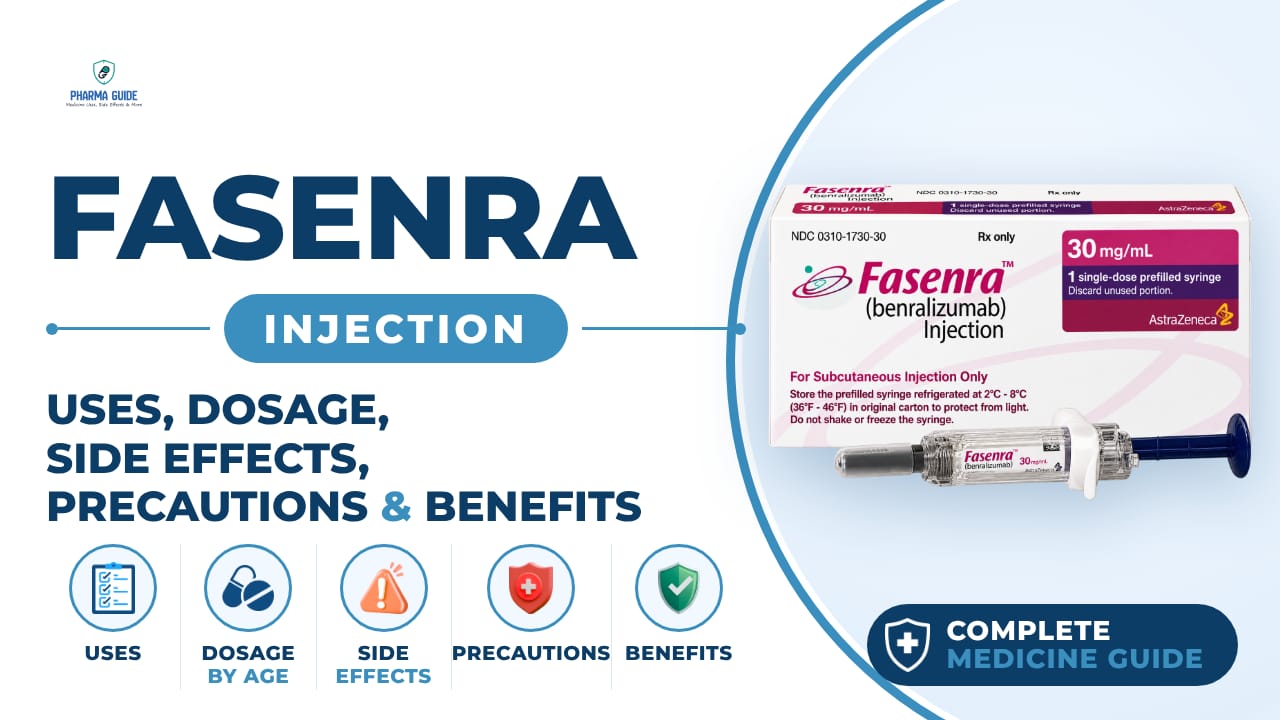
| Generic name | benralizumab |
|---|---|
| Drug class | interleukin inhibitor, monoclonal antibody |
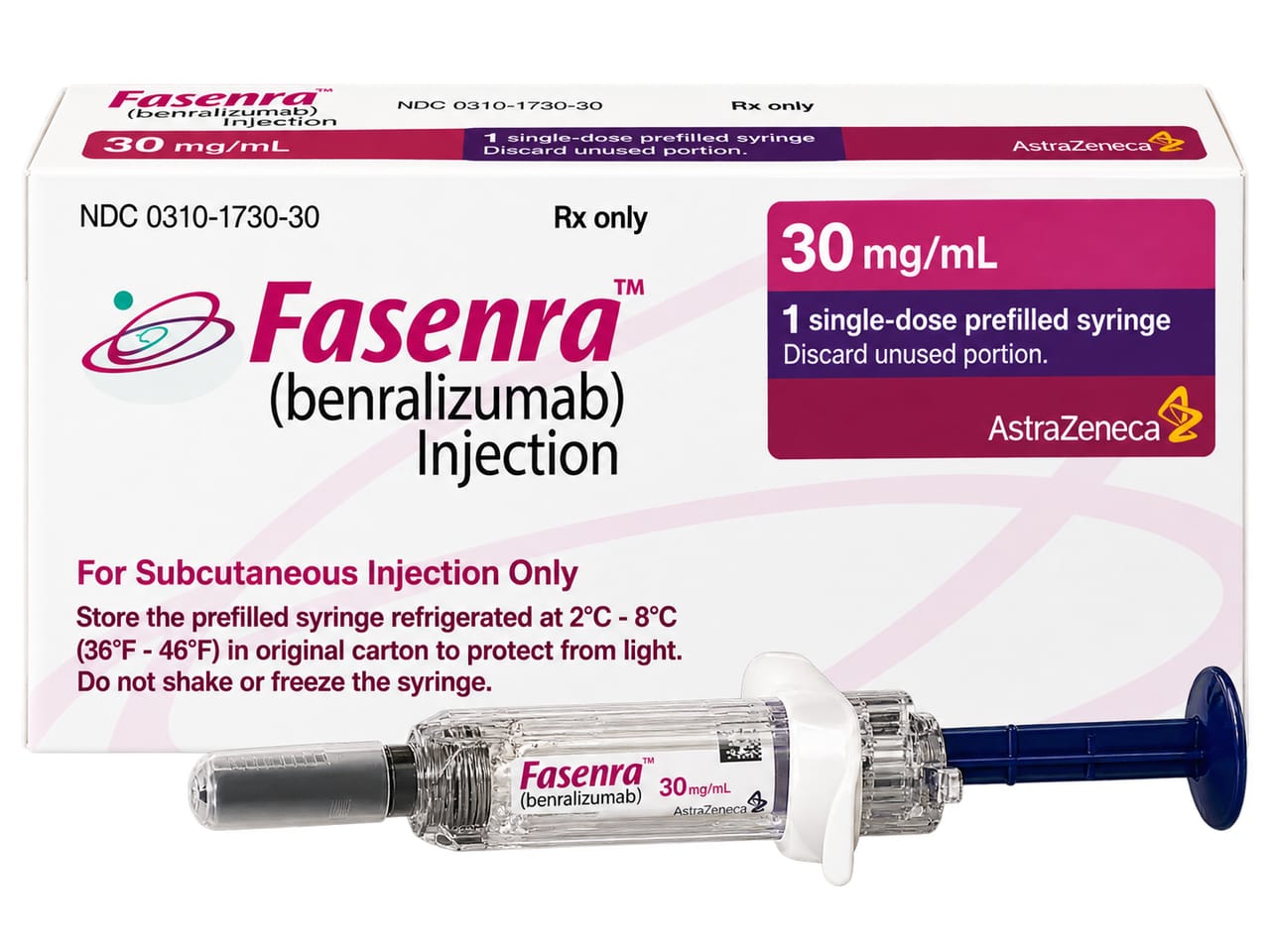
| Forms | Prefilled pen (autoinjector), Prefilled syringe, Solution for injection |
Quick overview
Fasenra Injection contains benralizumab, a monoclonal antibody belonging to the interleukin inhibitor class. It is used to treat severe eosinophilic asthma, eosinophilic granulomatosis with polyangiitis (EGPA), and hypereosinophilic syndrome (HES) by reducing eosinophil levels in the body. It is given as an injection under the skin, typically by a doctor, nurse, or trained caregiver, on a regular dosing schedule. It is not a treatment for sudden asthma attacks.
What is Fasenra Injection
Fasenra is an injectable medicine containing benralizumab, a monoclonal antibody (a type of protein). It is used for conditions involving high levels of eosinophils, a type of white blood cell.
Fasenra Injection uses
- Treats a type of severe asthma called eosinophilic asthma in adults and children aged 12 years and over
- Treats eosinophilic granulomatosis with polyangiitis (EGPA) in adults (18 years and over)
- Treats hypereosinophilic syndrome (HES) in adults and adolescents 12 years and older
Benefits of Fasenra Injection
- Helps control severe eosinophilic asthma
- Reduces asthma exacerbations
- Lowers eosinophil levels
- May reduce the need for oral corticosteroids in some patients
- Helps improve long-term asthma control
How Fasenra Injection works
Fasenra is a monoclonal antibody that attaches to a receptor on eosinophils (a type of white blood cell involved in inflammation). By binding to this receptor, it reduces the number of eosinophils in the blood and lungs, which helps lower inflammation linked to asthma, EGPA, and HES.
Fasenra Injection dosage
This medicine is not for treating a sudden asthma attack — you will still need your reliever puffer/inhaler. Keep using your other asthma or condition medicines as regularly prescribed; do not stop or reduce them unless your doctor tells you to. Continue using this medicine for as long as your doctor tells you, even if you feel well, since it controls but does not cure the condition.
A doctor, nurse, or trained caregiver can give the injection under the skin, usually in the thigh or abdomen; if someone else gives it, the upper arm may also be used, but do not inject yourself in the arm. Let the pen or syringe warm up at room temperature for about 30 minutes before injecting, and do not warm it in a microwave, hot water, or sunlight. Check that the liquid is clear and colorless to yellow before use; do not use it if it looks cloudy, discolored, or has large particles.
Choose a different injection site each time, at least a few centimeters from the last injection site, and avoid the area around the belly button, scars, or damaged skin. If you miss a dose, contact your doctor, nurse, or pharmacist as soon as possible for instructions.
| Age group | Dose |
|---|---|
| 12–17 years | 30 mg subcutaneously every 4 weeks for the first 3 doses, then every 8 weeks |
| 18–64 years | 30 mg subcutaneously every 4 weeks for the first 3 doses, then every 8 weeks |
Available forms and strengths
- Prefilled pen (autoinjector)
- Prefilled syringe
- Solution for injection
Side effects of Fasenra Injection
Common
- Headache
- Sore throat
- Fever/high temperature
- Injection site reactions (eg pain, redness, itching, swelling near where the injection was given)
- Flu-like illness
Serious
- Allergic reaction symptoms: rash, itching or hives on the skin
- Swelling of the face, lips, tongue or other parts of the body
- Shortness of breath, wheezing or difficulty breathing
- Fainting, dizziness, feeling lightheaded (due to a drop in blood pressure)
- Trouble swallowing or throat tightness
- Racing heart, swollen lymph nodes, nausea or vomiting, stomach cramps, joint pain
Warnings and precautions
- Do not use this medicine to treat a sudden asthma attack — you still need your reliever inhaler for that.
- Tell your doctor if you have or have had a parasitic infection, or live in or are travelling to an area where these infections are common, since this medicine may weaken your ability to fight them.
- Do not stop using this medicine unless your doctor tells you to, as stopping can cause symptoms or flare-ups to return or worsen.
- Do not stop or change the dose of your other medicines, especially corticosteroids, without your doctor's guidance, since these often need to be reduced gradually.
- Tell any doctor, dentist, or pharmacist you see that you're using this medicine, including before surgery, since it may affect other medicines used during surgery or interfere with some blood test results.
- Tell your doctor if you are pregnant or planning to become pregnant. It's not known whether this medicine can harm an unborn baby, and it's generally preferred to avoid using it during pregnancy.
- Tell your doctor if you are breastfeeding or plan to breastfeed, since it's not known whether this medicine passes into breast milk.
- It isn't known whether drinking alcohol affects this medicine.
- This medicine is not expected to affect your ability to drive a car or operate machinery.
Storage
- Keep FASENRA PEN in the refrigerator (2°C to 8°C). Do not freeze, shake or expose to heat. Protect from light.
- FASENRA PEN may be kept at room temperature up to 25°C for no more than 14 days.
- Keep it where young children cannot reach it.
- If you no longer need to use this medicine or it is out of date, take it to any pharmacy for safe disposal.
- Do not use this medicine after the expiry date.
When to see a doctor
- Call your doctor or nurse right away, or go straight to the Emergency Department, if you have symptoms of an allergic reaction. These can include skin rash, itching or hives, swelling of the face, lips, or tongue, shortness of breath, wheezing, difficulty breathing, fainting, dizziness, or lightheadedness. These reactions can occur minutes, hours, or even days after an injection.
- Stop using the medicine and seek medical attention immediately if you have trouble swallowing, throat tightness, an itchy rash, or trouble breathing.
- If you think you or someone else has been given too much of this medicine, contact your doctor or go to the Emergency Department right away, even if there are no symptoms.
Alternatives
- Nucala (mepolizumab)
- Dupixent (dupilumab)
- Xolair (omalizumab)
Watch the video
FAQs
What is Fasenra Injection used for?
Fasenra treats severe eosinophilic asthma in people 12 and older, eosinophilic granulomatosis with polyangiitis (EGPA) in adults, and hypereosinophilic syndrome (HES) in people 12 and older by reducing eosinophil levels in the body.
Can Fasenra be used for a sudden asthma attack?
No, Fasenra is not for treating sudden asthma attacks. You still need to use your reliever inhaler for sudden symptoms.
How is Fasenra Injection given?
It is given as an injection under the skin, usually in the thigh or abdomen, by a doctor, nurse, or trained caregiver. The dose is 30 mg every 4 weeks for the first 3 doses, then every 8 weeks.
What are the common side effects of Fasenra?
Common side effects include headache, sore throat, fever, injection site reactions like pain or redness, and flu-like illness.
How should Fasenra Pen be stored?
Fasenra Pen should be kept in the refrigerator (2°C to 8°C), protected from light, and not frozen or shaken. It may be kept at room temperature up to 25°C for no more than 14 days.
General information, not medical advice
Your prescriber and the leaflet in your pack know your situation. This page does not.
- Follow your prescriber and the leaflet
- Don't start, stop, or change a dose on your own
- Doses and warnings differ by country and product
Sources
- FASENRA PEN Consumer Medicine Information (Australia/New Zealand), prepared September 2026
- FASENRA/FASENRA PEN Patient Medication Information, AstraZeneca Canada Inc., Date of Authorization 2026-08-05
- WebMD: Fasenra (Benralizumab) - Uses, Side Effects, and More, reviewed May 20, 2026
Video
Related medicines

Injectafer Injection: Uses, Dosage, Side Effects, Precautions and Alternates
Iron products
Injectafer (ferric carboxymaltose) treats iron deficiency anemia and heart failure-related iron deficiency via IV. Learn uses, dosage, side effects, and

Gliclazide Tablet: Uses, Dosage, Side Effects, Precautions and Alternates
Sulfonylurea (hypoglycemic/antidiabetic agent)
Gliclazide Tablet is a sulfonylurea for type 2 diabetes that boosts insulin release. Learn about dosage, side effects, warnings, and precautions.