
Safety
General information, not medical advice
Your prescriber and the leaflet in your pack know your situation. This page does not.
- Follow your prescriber and the leaflet
- Don't start, stop, or change a dose on your own
- Doses and warnings differ by country and product
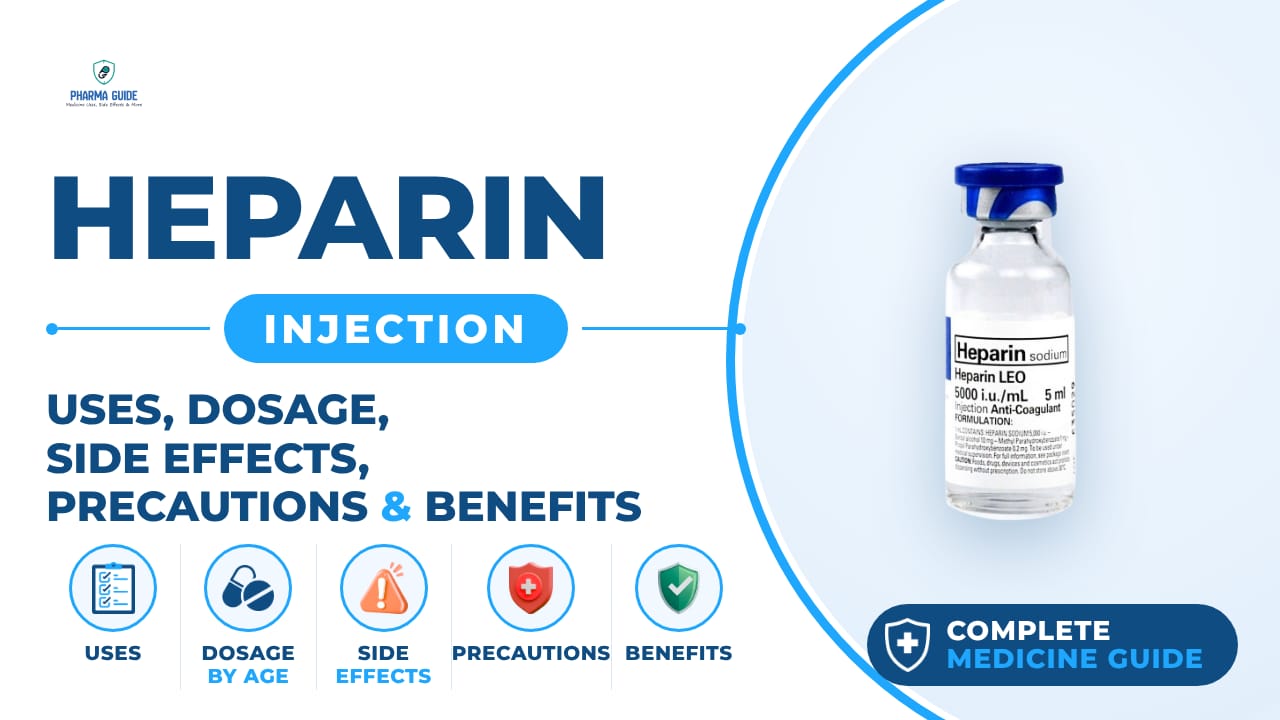
Heparin Injection: Uses, Dosage, Side Effects, Precautions and Alternates
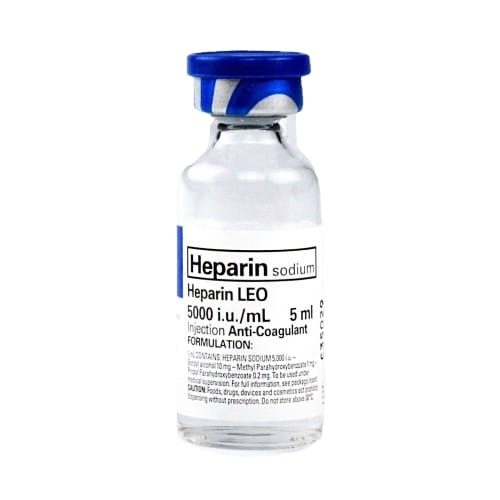
| Generic name | heparin sodium |
|---|---|
| Drug class | Anticoagulant (heparin) |
| Forms | Injection (single-dose vials), Injection (multiple-dose vials), Intravenous solution |
Quick overview
Heparin Injection (heparin sodium) is an anticoagulant, often called a blood thinner, made from porcine intestinal mucosa. It is used to prevent and treat blood clots in veins and lungs, after certain surgeries, and during procedures such as dialysis and heart-lung bypass. Heparin works with a natural blood protein to block clotting factors and stop new clots from forming, but it does not dissolve clots that already exist.
What is Heparin Injection
Heparin is an anticoagulant, often called a blood thinner. It is a sterile injectable solution derived from porcine (pig) intestinal mucosa, used to prevent and treat blood clots.
Heparin Injection uses
- Prevention and treatment of blood clots in veins and lungs (venous thrombosis and pulmonary embolism)
- Prevention of blood clots after major abdominal or chest surgery or in patients at risk of clots
- Treatment of atrial fibrillation with risk of clot embolization
- Treatment of acute and chronic clotting disorders such as disseminated intravascular coagulation
- Prevention of clotting during arterial and heart surgery
- Prevention and treatment of peripheral arterial clots
- Use as an anticoagulant during blood transfusions, dialysis, and heart-lung bypass procedures
- Maintaining catheter patency in some formulations
Benefits of Heparin Injection
- Helps stop new blood clots from forming
- Helps prevent existing clots from getting bigger
- Reduces risk of clots after certain surgeries or during procedures like dialysis
How Heparin Injection works
Heparin works with a natural protein in your blood called antithrombin III to block clotting factors, especially factors Xa and IIa (thrombin), which stops new clots from forming. It does not dissolve clots that already exist.
Heparin Injection dosage
Heparin is given by injection under the skin (deep subcutaneous) or into a vein, never into a muscle. A healthcare provider gives the first dose and may teach you how to inject it yourself if needed at home. Check the medicine before use; do not use it if it has changed color or has particles in it. Use a different injection site each time to prevent bruising or lumps under the skin, and clean the skin with rubbing alcohol before injecting under the skin.
This medicine comes in different strengths, so always check that you have the correct strength and dose before injecting. Regular blood tests are needed to check how well your blood is clotting while you use this medicine. Tell your doctor or dentist that you are using heparin before any surgery or dental work. If switching to a blood thinner taken by mouth, keep using heparin until your doctor tells you to stop, since both may be needed for a short overlap period. Do not use this medicine to flush or clean an IV catheter; a different product is made for that purpose.
| Age group | Dose |
|---|---|
| Newborns/infants | Specialist-directed dosing only |
| Children & adolescents | Weight- and indication-based dosing under specialist supervision |
| Adults | Dose depends on indication and route; commonly requires an initial bolus followed by IV infusion or scheduled injections |
| Older adults | Individualized dosing with close monitoring, especially because bleeding risk may be higher |
Available forms and strengths
- Injection (single-dose vials)
- Injection (multiple-dose vials)
- Intravenous solution
Side effects of Heparin Injection
Common
- Mild pain, redness, or irritation at the injection site
- Unusual bleeding or bruising
- Allergic reactions
- Abnormal liver function test results
- High potassium levels in the blood
Serious
- Unusual or severe bleeding, or bleeding that will not stop
- Severe stomach, back, or groin pain or swelling
- Blood in urine or stool, black or tarry stools, coughing up blood
- Signs of a serious allergic reaction: fever, chills, rash, itching or swelling of face, tongue, or throat, severe dizziness, trouble breathing
- Signs of a serious clotting problem (heparin-induced thrombocytopenia): pain, weakness, or color change in an arm or leg, chest pain, trouble breathing, confusion, weakness on one side of the body, trouble speaking, vision changes
- Skin changes, discoloration, or sores where the medicine was injected
- Bone pain or easily broken bones (with long-term use)
- Signs of a blood clot: sudden numbness or weakness, vision or speech problems, swelling or redness in an arm or leg
Warnings and precautions
- Do not use heparin injection to flush or clean an IV catheter. A separate product made for catheter flushing must be used instead, or fatal bleeding could occur.
- Always double-check that you have the correct strength of heparin before it is given, since mix-ups with other similar-looking vials have caused fatal bleeding, especially in children.
- Heparin can cause serious or life-threatening bleeding at any site in the body.
- Heparin can cause a serious condition called heparin-induced thrombocytopenia (HIT), where the platelet count drops and dangerous blood clots can form; this can happen even weeks after stopping the medicine.
- Heparin products that contain the preservative benzyl alcohol should not be used in newborns or infants, as this can cause a serious and sometimes fatal reaction called 'gasping syndrome'.
- Heparin can raise blood potassium levels (hyperkalemia), especially in people with diabetes, kidney failure, or those taking certain medicines; blood potassium should be checked before and during treatment.
- Older adults, especially women over 60, may have a higher risk of bleeding with heparin and may need lower doses.
- There is limited information about using heparin during pregnancy.
- It should be used only if clearly needed, and a preservative-free version is recommended. Discuss the risks and benefits with your doctor.
- Heparin is unlikely to pass into breast milk because of its large size, but talk to your doctor before breastfeeding while using this medicine.
- Tell your doctor if you have kidney problems before using heparin, as it should be used with caution in these patients.
- Tell your doctor if you have liver disease, since heparin should be used with caution and liver disease can increase bleeding risk.
- Drinking alcohol daily while using heparin can increase your risk of stomach bleeding. Ask your doctor how much alcohol is safe for you.
Storage
- Store at room temperature (20° to 25°C / 68° to 77°F)
- Discard unused portion (for single-dose vials)
- Store away from moisture and heat
- Use a needle and syringe only once and then place them in a puncture-proof sharps container; follow local rules for disposing of the container and keep it away from children and pets
- Do not flush medications down the toilet or drain unless told to do so; properly discard when expired or no longer needed
When to see a doctor
- Get emergency help right away if you have signs of a serious allergic reaction, such as nausea, vomiting, sweating, hives, itching, trouble breathing, or swelling of your face, lips, tongue, or throat.
- Seek emergency medical care for any unusual bleeding or bruising, severe pain or swelling in the stomach, lower back, or groin, dark or blue skin on hands or feet, or bleeding that won't stop.
- Contact your doctor immediately if you notice nosebleeds, blood in urine or stool, black or tarry stools, or coughing up blood or material that looks like coffee grounds.
- Stop the medicine and call your doctor right away if you notice skin changes at the injection site, fever, chills, runny nose or watery eyes, easy bruising, unusual bleeding, or purple/red spots under the skin.
- Get medical help immediately if you notice signs of a blood clot, such as sudden numbness or weakness, vision or speech problems, or swelling and redness in an arm or leg.
- If you think you or someone else has taken too much heparin, seek emergency medical attention or contact your local poison control center right away.
Alternatives
- Warfarin
- Hep-Pak
- Heparin Lock Flush
- Hep-Pak CVC
- Hep-Lock
- Heparin Sodium ADD-Vantage
- Hepalean
Watch the video
FAQs
What is Heparin Injection used for?
It is used to prevent and treat blood clots in veins and lungs, after major surgery, during atrial fibrillation, and as an anticoagulant during dialysis, blood transfusions, and heart-lung bypass procedures.
How does Heparin Injection work?
Heparin works with a natural blood protein called antithrombin III to block clotting factors, especially factors Xa and IIa (thrombin), stopping new clots from forming. It does not dissolve clots that already exist.
How is Heparin Injection given?
It is given by injection under the skin (deep subcutaneous) or into a vein, never into a muscle. A healthcare provider gives the first dose and may teach you how to inject it yourself if needed at home.
What are the serious side effects of Heparin Injection?
Serious side effects include unusual or severe bleeding, severe stomach, back, or groin pain, blood in urine or stool, signs of a serious allergic reaction, and signs of heparin-induced thrombocytopenia such as limb pain, weakness, or color change.
Can Heparin Injection be used to flush an IV catheter?
No, heparin injection should not be used to flush or clean an IV catheter; a separate product made for that purpose must be used instead, since mix-ups have caused fatal bleeding.
General information, not medical advice
Your prescriber and the leaflet in your pack know your situation. This page does not.
- Follow your prescriber and the leaflet
- Don't start, stop, or change a dose on your own
- Doses and warnings differ by country and product
Sources
- FDA prescribing information for Heparin Sodium Injection, Gland Pharma Limited, Revised 11/2024
- Drugs.com Heparin Injection patient information, reviewed August 2026
- MyHealth.Alberta.ca Heparin - Injection patient handout, last revised May 2026
- Health Canada Product Monograph, Heparin Sodium and 0.9% Sodium Chloride Injection, Baxter Corporation, Revised March 22, 2022
Video
Related medicines

Injectafer Injection: Uses, Dosage, Side Effects, Precautions and Alternates
Iron products
Injectafer (ferric carboxymaltose) treats iron deficiency anemia and heart failure-related iron deficiency via IV. Learn uses, dosage, side effects, and

Gliclazide Tablet: Uses, Dosage, Side Effects, Precautions and Alternates
Sulfonylurea (hypoglycemic/antidiabetic agent)
Gliclazide Tablet is a sulfonylurea for type 2 diabetes that boosts insulin release. Learn about dosage, side effects, warnings, and precautions.