
Safety
General information, not medical advice
Your prescriber and the leaflet in your pack know your situation. This page does not.
- Follow your prescriber and the leaflet
- Don't start, stop, or change a dose on your own
- Doses and warnings differ by country and product
Ibutilide Injection: Uses, Dosage, Side Effects, Precautions and Alternates

| Generic name | Ibutilide |
|---|---|
| Drug class | Antiarrhythmic Agent (Group III antiarrhythmic) |
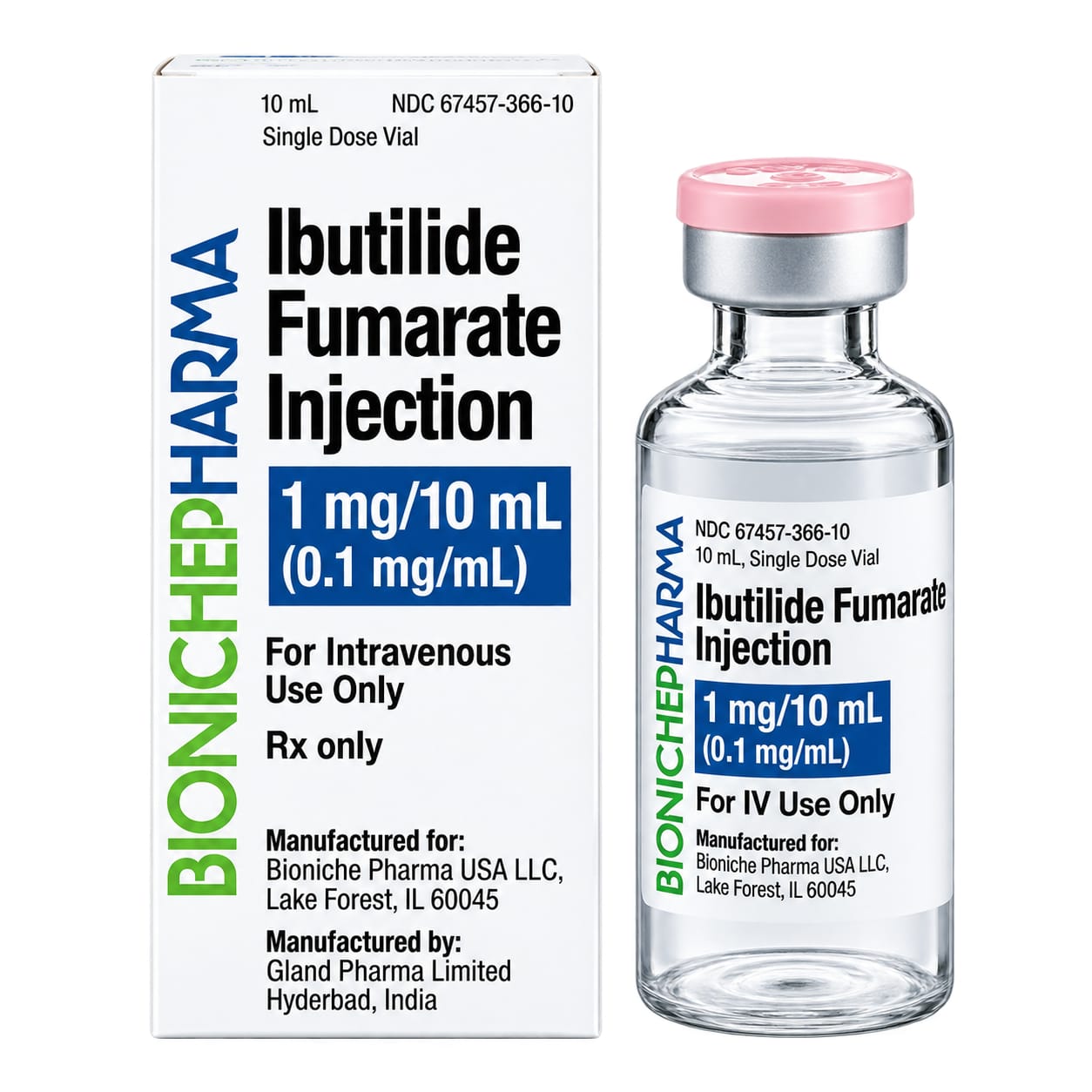
| Forms | Solution for injection (intravenous), 0.1 mg/mL |
Quick overview
Ibutilide Injection (Corvert) is an injectable antiarrhythmic medicine given only by a doctor or nurse in a hospital or clinic setting. It is used in adults with life-threatening irregular heartbeats to help restore normal heart rhythm in atrial fibrillation and atrial flutter. It works by slowing overactive electrical signals in the heart and must be given with continuous heart monitoring and emergency equipment available.
What is Ibutilide Injection
Corvert is an injectable heart rhythm medicine given only by a doctor or nurse in a hospital or clinic setting, used for people with life-threatening irregular heartbeats.
Ibutilide Injection uses
- Restoring normal heart rhythm in adults with atrial fibrillation
- Restoring normal heart rhythm in adults with atrial flutter
Benefits of Ibutilide Injection
- Can convert atrial fibrillation or atrial flutter back to a normal heart rhythm
- Offers an alternative to electric cardioversion for suitable patients
- Helps convert atrial fibrillation to normal rhythm
- Helps terminate atrial flutter
- Has a rapid IV onset
- May restore sinus rhythm without electrical cardioversion in selected patients
How Ibutilide Injection works
Ibutilide works by slowing down overactive electrical signals in the heart. It lengthens the time it takes heart cells to recover between beats, which helps stop abnormal rhythms from continuing, rather than working the way most similar heart medicines do.
Ibutilide Injection dosage
Ibutilide Injection is given only by a doctor or nurse as an infusion into a vein, in a place with continuous heart monitoring (ECG) and emergency equipment available during and after treatment. Your heart rhythm will be watched closely for at least 4 hours after the infusion, or longer if any abnormal heart activity is noticed. If a heart rhythm medicine was taken within 4 hours before this infusion, tell your doctor. The infusion will be stopped right away if the abnormal rhythm goes away, a new rhythm problem starts, or significant changes are seen on the heart monitor. It is not recommended to be given faster than directed.
| Age group | Dose |
|---|---|
| 18–64 years, ≥60 kg | 1 mg IV over 10 minutes |
| 18–64 years, <60 kg | 0.01 mg/kg IV over 10 minutes |
Available forms and strengths
- Solution for injection (intravenous), 0.1 mg/mL
Side effects of Ibutilide Injection
Common
- Headache
- Nausea
- Slow heart beat
- High blood pressure
- Constipation
- Bladder infection
- Fatigue
- Increase in white blood cells
- Leg cramps
- Difficulty sleeping
- Weakness
- Lack of energy
- Joint pain
- Muscle pain
- Itching
- Swelling
- Bruising
- Inflammation of the veins
- Difficulty urinating
- Vomiting
- Diarrhea
- Confusion
- Trouble with vision
- Pain, redness, or irritation at the injection site
Serious
- Allergic reaction: hives, difficulty breathing, swelling of face, lips, tongue, or throat
- Chest pain, palpitations, irregular or fast heartbeat
- Low blood pressure: fainting, dizziness, feeling faint or lightheaded
- Tremor or abnormal involuntary movements
- Shortness of breath
- Heart block
Warnings and precautions
- Corvert can cause dangerous, even life-threatening, abnormal heart rhythms, including a fast irregular heartbeat called polymorphic ventricular tachycardia. Because of this, it must only be given where continuous heart monitoring and emergency equipment and trained staff are available.
- People with atrial fibrillation lasting more than 2 to 3 days need to be on blood thinners for at least 2 weeks before treatment to reduce stroke risk.
- This medicine is not recommended for patients with a certain heart rhythm measurement (QTc interval) that is too long, since this raises the risk of dangerous arrhythmias.
- People with a history of heart failure or a weak heart pumping function have a higher chance of developing dangerous ventricular arrhythmias with this medicine.
- Low potassium or magnesium levels in the blood should be corrected before treatment because they increase the risk of dangerous heart rhythm problems.
- This medicine is not recommended for people who have previously had a type of dangerous rhythm problem called torsades de pointes.
- Taking other heart rhythm medicines or certain other drugs that affect heart rhythm around the same time as Corvert can increase the risk of serious problems.
- Corvert should not be used in pregnancy unless your doctor decides the benefits outweigh the risks to the unborn baby. It caused birth defects and pregnancy loss in animal studies at high doses.
- Breastfeeding is not recommended while receiving Corvert because it is not known whether the drug passes into breast milk in a way that could affect a nursing baby, though the Canadian label states it can pass into breast milk.
- No dose changes are needed for people with kidney problems, since only a small amount of the drug is removed from the body through the kidneys unchanged.
- No dose changes are needed for people with liver problems, but they should be monitored for longer than the usual 4-hour period after the infusion.
- Avoid alcohol around treatment unless the cardiology team approves it.
- Do not drive immediately after treatment; cardiac monitoring is required.
Storage
- Store at room temperature (15 to 30°C)
- Keep in its original carton until used to protect it from light
- Mixtures of the product with compatible fluids should be used right away after mixing
- Keep out of reach and sight of children
When to see a doctor
- Get emergency medical help right away if you have signs of an allergic reaction such as hives, difficulty breathing, or swelling of the face, lips, tongue, or throat.
- Tell your care team right away if you feel short of breath or like you might pass out, or if you have chest pain, palpitations, or an irregular heartbeat.
- Seek medical help immediately for fainting or dizziness suggesting low blood pressure, or for tremor or abnormal involuntary movements.
- If you think too much medicine was given, contact your healthcare professional, hospital emergency department, or regional poison control center immediately, even if you have no symptoms.
Alternatives
- Amiodarone
- Procainamide
- Sotalol
Watch the video
FAQs
What is Ibutilide Injection used for?
It is used in adults to restore normal heart rhythm in atrial fibrillation and atrial flutter.
How is Ibutilide Injection given?
It is given only by a doctor or nurse as an IV infusion in a setting with continuous heart monitoring and emergency equipment available, with heart rhythm watched for at least 4 hours afterward.
What is the dosage of Ibutilide Injection?
Adults 18–64 years weighing 60 kg or more receive 1 mg IV over 10 minutes, while those under 60 kg receive 0.01 mg/kg IV over 10 minutes.
What are the serious side effects of Ibutilide Injection?
Serious side effects include dangerous abnormal heart rhythms like polymorphic ventricular tachycardia, chest pain, palpitations, low blood pressure, tremor, shortness of breath, heart block, and allergic reactions.
Who should not receive Ibutilide Injection?
It is not recommended for people with a prolonged QTc interval or a history of torsades de pointes, and caution is needed in those with heart failure or low potassium or magnesium levels.
General information, not medical advice
Your prescriber and the leaflet in your pack know your situation. This page does not.
- Follow your prescriber and the leaflet
- Don't start, stop, or change a dose on your own
- Doses and warnings differ by country and product
Sources
Video
Related medicines

Injectafer Injection: Uses, Dosage, Side Effects, Precautions and Alternates
Iron products
Injectafer (ferric carboxymaltose) treats iron deficiency anemia and heart failure-related iron deficiency via IV. Learn uses, dosage, side effects, and

Gliclazide Tablet: Uses, Dosage, Side Effects, Precautions and Alternates
Sulfonylurea (hypoglycemic/antidiabetic agent)
Gliclazide Tablet is a sulfonylurea for type 2 diabetes that boosts insulin release. Learn about dosage, side effects, warnings, and precautions.