
Safety
General information, not medical advice
Your prescriber and the leaflet in your pack know your situation. This page does not.
- Follow your prescriber and the leaflet
- Don't start, stop, or change a dose on your own
- Doses and warnings differ by country and product
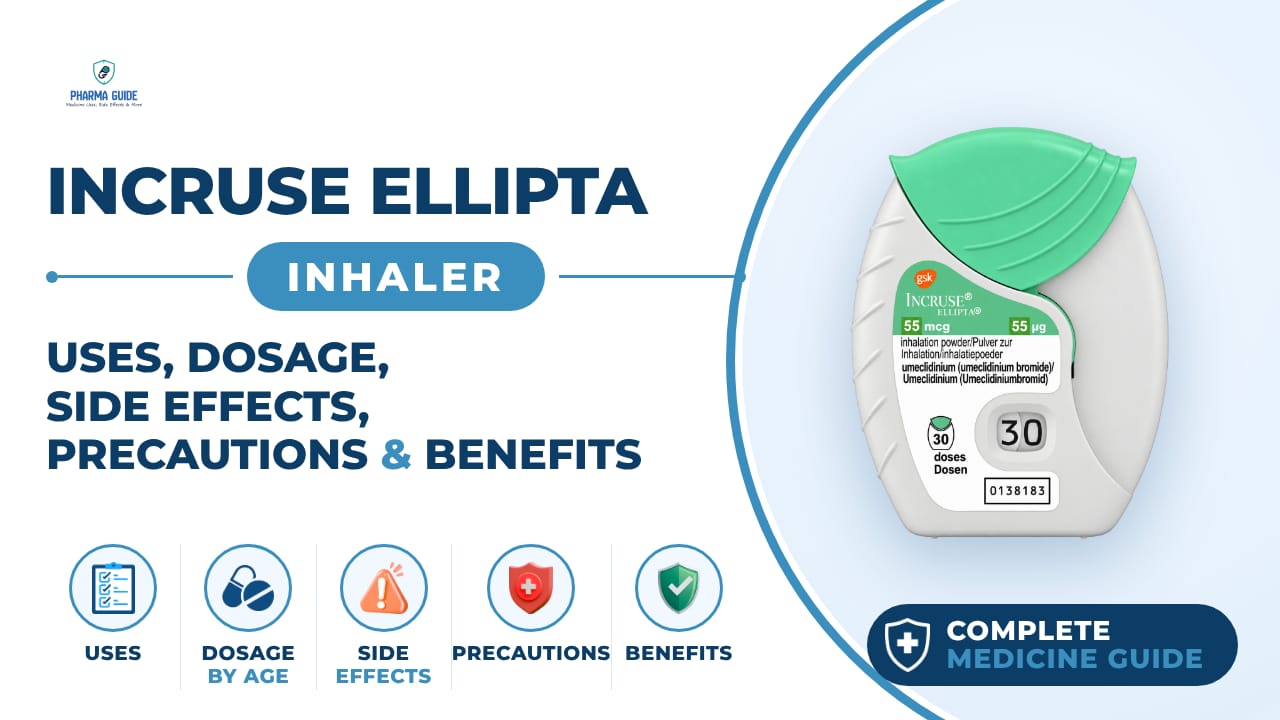
Incruse Ellipta Inhaler: Uses, Dosage, Side Effects, Precautions and Alternates
| Generic name | umeclidinium (as bromide) |
|---|---|
| Drug class | Long-acting muscarinic antagonist (anticholinergic bronchodilator) |
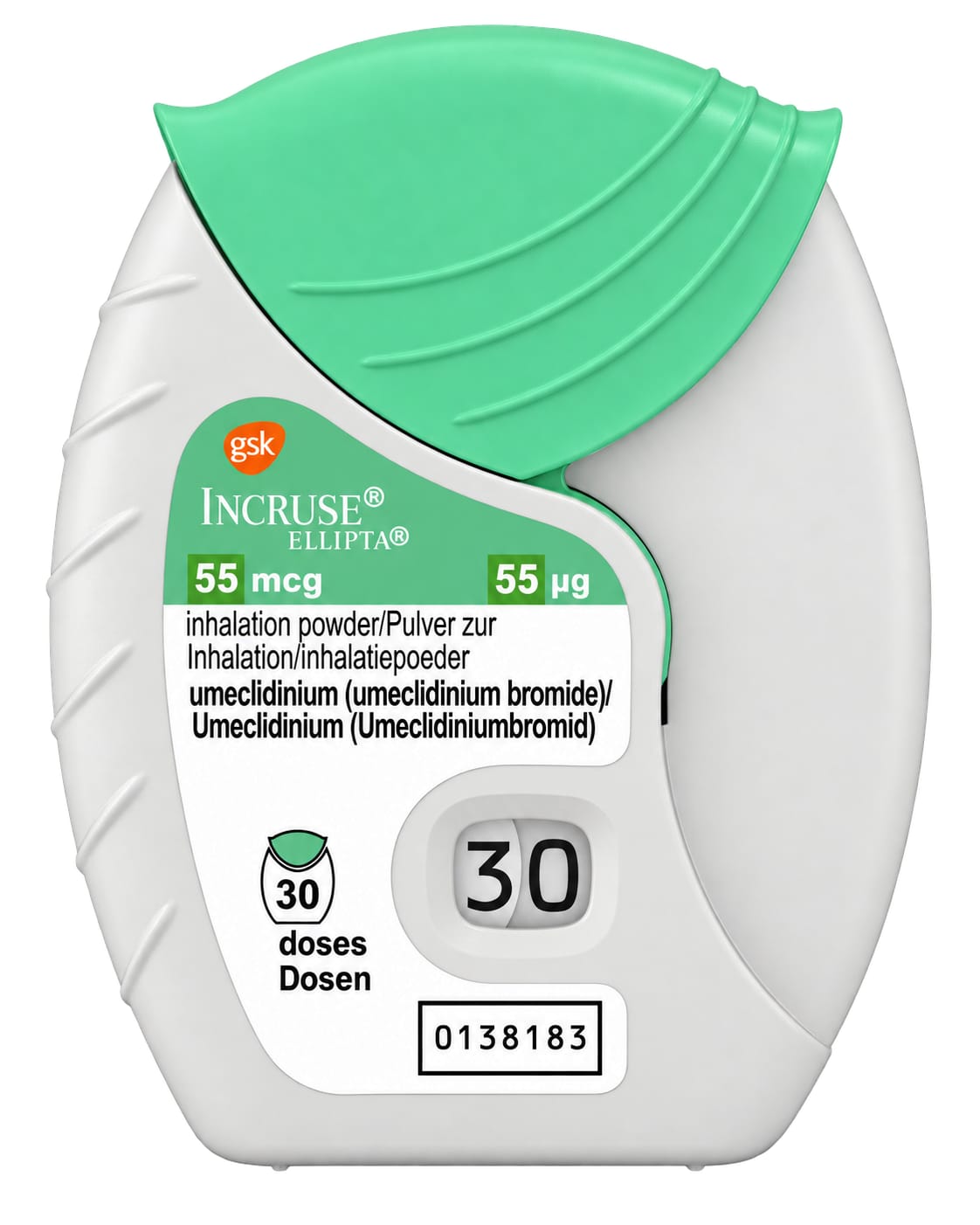
| Forms | Powder for inhalation (Ellipta inhaler), available as 7-dose or 30-dose inhalers |
Quick overview
Incruse Ellipta Inhaler contains umeclidinium bromide, a long-acting muscarinic antagonist (anticholinergic bronchodilator). It is an inhaled powder medicine used once daily as a long-term maintenance treatment to help control breathing problems caused by chronic obstructive pulmonary disease (COPD) in adults. It works by relaxing the muscles around the airways, making it easier to breathe, but it is not a rescue medicine for sudden breathing attacks.
What is Incruse Ellipta Inhaler
Incruse Ellipta is an inhaled powder medicine containing umeclidinium bromide. It belongs to a group of medicines called bronchodilators and is used daily to help control breathing problems caused by COPD.
Incruse Ellipta Inhaler uses
- Long-term, once-daily maintenance treatment to relieve symptoms in adults with chronic obstructive pulmonary disease (COPD)
Benefits of Incruse Ellipta Inhaler
- Helps improve airflow
- Reduces shortness of breath
- Helps control COPD symptoms
- Provides 24-hour bronchodilation
- Requires only once-daily inhalation
How Incruse Ellipta Inhaler works
Umeclidinium blocks a natural chemical (acetylcholine) that causes the muscles around your airways to tighten. By blocking this chemical, the medicine helps keep the airway muscles relaxed, making it easier for air to move in and out of the lungs.
Incruse Ellipta Inhaler dosage
Take one inhalation once a day by mouth using the inhaler. Use the inhaler at the same time every day. Do not use more than one inhalation in any 24-hour period. This medicine must be used regularly, even when you are not having symptoms, for it to work properly.
This is not a rescue medicine - it will not work fast enough to treat a sudden attack of breathlessness or wheezing; use a fast-acting reliever inhaler for sudden symptoms. Do not shake the inhaler before use. Breathe out fully before placing the mouthpiece in your mouth, but do not breathe out into the inhaler. Take one long, steady, deep breath in and hold it for a few seconds before removing the inhaler from your mouth.
If you forget a dose, take it as soon as you remember, but do not take an extra dose to make up for a missed one; just take your next dose at the usual time. If people who have been using short-acting inhaled muscarinic antagonist medicines regularly are starting this medicine, they should be told to stop using those medicines regularly.
| Age group | Dose |
|---|---|
| 18–64 years | 1 inhalation of 62.5 mcg once daily |
| 65 years and older | 1 inhalation of 62.5 mcg once daily |
Available forms and strengths
- Powder for inhalation (Ellipta inhaler), available as 7-dose or 30-dose inhalers
Side effects of Incruse Ellipta Inhaler
Common
- Cough
- Sore throat, common cold symptoms, or infection of the nose or throat
- Joint pain
- Headache
- Constipation
- Fast or irregular heartbeat
- Painful or frequent urination (possible sign of urinary tract infection)
- Altered sense of taste
- Sinus pain or pressure (sinusitis)
Serious
- Severe allergic reaction (swelling of face, lips, mouth, tongue, or throat; hives; itching; trouble breathing or swallowing)
- Sudden worsening of breathing, wheezing, or chest tightness right after using the inhaler (paradoxical bronchospasm)
- Signs of narrow-angle glaucoma (eye pain or redness, blurred vision, seeing halos or colored rings around lights, severe headache or vomiting)
- Difficulty or pain passing urine, weak urine stream, or urinary retention
- Irregular heartbeat (such as atrial fibrillation or fast heart rate)
Warnings and precautions
- Do not use this medicine to treat asthma, since it has not been studied for that use. This medicine is only for long-term control of COPD. It should not be used to treat sudden worsening of COPD or as a rescue medicine for sudden breathing attacks.
- Using this inhaler can rarely cause sudden tightening of the airways (paradoxical bronchospasm), which can be life-threatening. Stop using it right away if this happens. Use this medicine carefully if you have severe heart problems, especially irregular heartbeat, because it may cause heart rhythm changes. Use with caution if you have narrow-angle glaucoma or difficulty passing urine, since this medicine can worsen these conditions.
- Do not use this medicine if you have a rare hereditary sugar intolerance problem, because it contains lactose which has milk protein. This medicine should not be used in children or adolescents under 18 years old.
- This medicine should only be used during pregnancy if your doctor decides the benefit to you outweighs any possible risk to the baby. There is limited information on its use in pregnant women. It is not known whether this medicine passes into breast milk, and a risk to a breastfed baby cannot be ruled out. You and your doctor should decide whether you should breastfeed or use this medicine.
- No dose change is needed for people with kidney problems, including severe kidney impairment. No dose change is needed for mild or moderate liver problems. This medicine has not been studied in people with severe liver problems, so it should be used with caution in that case.
- It is not known whether drinking alcohol affects this medicine. This medicine is unlikely to affect your ability to drive or use machines.
Storage
- Store below 30°C
- If stored in the refrigerator, allow the inhaler to return to room temperature for at least 1 hour before use
- Keep the inhaler inside the sealed tray to protect it from moisture; do not remove it until you are ready to use it for the first time
- After opening the tray, the inhaler can be used for a maximum of 6 weeks; write the discard-by date on the label as soon as you open the tray
- After this date, the inhaler should no longer be used
- Keep out of the sight and reach of children
- Any unused medicine or waste material should be disposed of by taking it to your local pharmacy
When to see a doctor
- Get medical help right away if you have chest tightness, coughing, wheezing, or breathlessness immediately after using the inhaler, as this may be a serious condition called paradoxical bronchospasm
- Get medical help right away if you develop eye pain, blurred vision, seeing halos or colored rings around lights, or red eyes, as these may be signs of a sudden glaucoma attack
- Contact your doctor as soon as possible if your COPD symptoms (breathlessness, wheezing, cough) do not improve, get worse, or if you need to use your quick-acting inhaler more often
- Seek medical help right away if you accidentally use too much of this medicine, as you may notice a faster heartbeat, visual disturbances, or dry mouth
- Call your doctor right away if you have trouble or pain passing urine, a weak urine stream, or are urinating more often, as these may signal a bladder blockage or urinary retention
Alternatives
- Tiotropium
- Aclidinium
- Glycopyrrolate
Watch the video
FAQs
What is Incruse Ellipta Inhaler used for?
It is used as a long-term, once-daily maintenance treatment to help control breathing problems and relieve symptoms in adults with chronic obstructive pulmonary disease (COPD).
How do you use Incruse Ellipta Inhaler?
Take one inhalation once a day by mouth at the same time every day. Do not use more than one inhalation in any 24-hour period, and use it regularly even when you have no symptoms.
Can Incruse Ellipta Inhaler be used for sudden breathing attacks?
No, it is not a rescue medicine. It will not work fast enough to treat sudden breathlessness or wheezing; a fast-acting reliever inhaler should be used for sudden symptoms.
What are the common side effects of Incruse Ellipta Inhaler?
Common side effects include cough, sore throat or cold symptoms, joint pain, headache, constipation, fast or irregular heartbeat, painful or frequent urination, altered taste, and sinus pain or pressure.
Who should avoid using Incruse Ellipta Inhaler?
It should not be used in children or adolescents under 18, for asthma treatment, or in people with a rare hereditary sugar intolerance, since it contains lactose with milk protein. It should also be used cautiously in people with severe heart problems, narrow-angle glaucoma, or difficulty passing urine.
General information, not medical advice
Your prescriber and the leaflet in your pack know your situation. This page does not.
- Follow your prescriber and the leaflet
- Don't start, stop, or change a dose on your own
- Doses and warnings differ by country and product
Sources
- Australian Product Information - INCRUSE ELLIPTA (umeclidinium bromide) powder for inhalation, GlaxoSmithKline Australia Pty Ltd, 16 June 2023
- EU Summary of Product Characteristics - Incruse Ellipta 55 micrograms inhalation powder, GlaxoSmithKline (Ireland) Limited
- WebMD - Incruse Ellipta (Umeclidinium) Uses, Side Effects, and More
- Drugs.com - Incruse Ellipta (umeclidinium) prescribing and patient information, last updated 23 Aug 2023
Video
Related medicines
Seebri Breezhaler Inhaler: Uses, Dosage, Side Effects, Precautions and Alternates
Long-acting muscarinic antagonist (anticholinergic bronchodilator)
Seebri Breezhaler contains glycopyrronium bromide, a once-daily inhaled bronchodilator for COPD maintenance treatment. Learn uses, dosage, side effects and

Injectafer Injection: Uses, Dosage, Side Effects, Precautions and Alternates
Iron products
Injectafer (ferric carboxymaltose) treats iron deficiency anemia and heart failure-related iron deficiency via IV. Learn uses, dosage, side effects, and