
Safety
General information, not medical advice
Your prescriber and the leaflet in your pack know your situation. This page does not.
- Follow your prescriber and the leaflet
- Don't start, stop, or change a dose on your own
- Doses and warnings differ by country and product
Irinotecan Injection: Uses, Dosage, Side Effects, Precautions and Alternates

| Generic name | Irinotecan hydrochloride |
|---|---|
| Drug class | Topoisomerase I inhibitor (antineoplastic agent) |
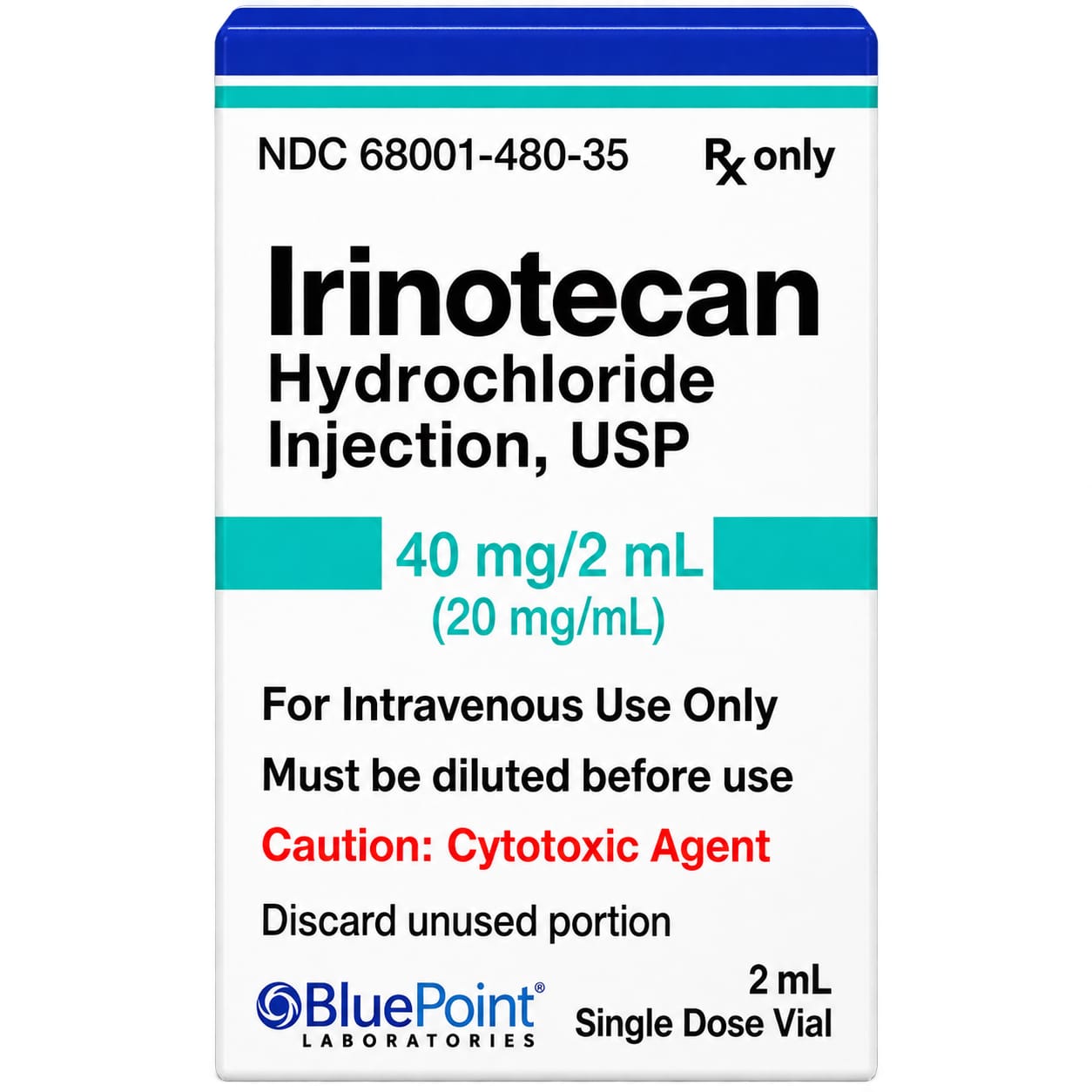
| Forms | Solution for intravenous infusion, supplied in single-dose vials (2 mL, 5 mL, and 15 mL/25 mL fill sizes) |
Quick overview
Irinotecan Injection (irinotecan hydrochloride) is a topoisomerase I inhibitor chemotherapy medicine given as an intravenous infusion to treat metastatic colon or rectal cancer. It is used both as first-line therapy in combination with 5-fluorouracil and leucovorin, and alone for cancer that has returned or worsened after prior fluorouracil-based treatment. It works by blocking an enzyme cancer cells need to copy their DNA, leading to cancer cell death. It can cause serious side effects, including severe diarrhea and low blood cell counts, and must be given under close medical supervision.
What is Irinotecan Injection
Irinotecan is a chemotherapy (cancer) medicine given as an intravenous infusion. It is made from a plant-derived compound and works by blocking an enzyme that cancer cells need to copy their DNA, causing cancer cell death.
Irinotecan Injection uses
- First-line therapy in combination with 5-fluorouracil and leucovorin for metastatic cancer of the colon or rectum
- Treatment of metastatic colon or rectal cancer that has come back or gotten worse after treatment with fluorouracil-based therapy
Benefits of Irinotecan Injection
- Combination therapy with 5-FU/LV improved tumor response rates, delayed tumor progression, and extended survival compared with 5-FU/LV alone in clinical trials
- As second-line single-agent therapy, significantly improved survival compared with best supportive care or infusional 5-FU therapy in patients whose cancer had progressed
How Irinotecan Injection works
Irinotecan and its active byproduct (SN-38) attach to a complex formed by a DNA-unwinding enzyme called topoisomerase I and DNA, stopping the DNA strand breaks from being resealed. This leads to DNA damage that cancer cells cannot repair, causing them to die.
Irinotecan Injection dosage
Irinotecan is given only as an intravenous infusion by a healthcare professional experienced with cancer chemotherapy drugs; it is not a pill or injection you give yourself. Infusions are typically given over 90 minutes, as part of a repeating cycle with rest periods between doses so your body can recover.
You will usually be given anti-nausea medicine before treatment, starting at least 30 minutes before the infusion begins. Your doctor may have you keep loperamide (anti-diarrhea medicine) on hand and start taking it at the very first sign of loose or more frequent stools; do not use it to prevent diarrhea before it starts, and do not use it for more than 48 hours in a row.
People 65 years and older should be closely monitored because they have a greater risk of diarrhea with this medicine, and may need adjusted dosing. Blood counts (white cells, platelets, hemoglobin) and liver function should be checked before each treatment and periodically during treatment. Avoid laxatives and diuretics (water pills) while being treated, since they can worsen dehydration or diarrhea risk. Avoid grapefruit juice and St. John's Wort during treatment, as they can change how this medicine works.
| Age group | Dose |
|---|---|
| 18–64 years, combination regimen | Common regimens use 125 mg/m² IV on specified weekly treatment days or 180 mg/m² IV on specified every-2-week treatment days |
| 18–64 years, single-agent regimen | 125 mg/m² IV on Days 1, 8, 15, and 22 followed by a 2-week rest, or 350 mg/m² IV every 3 weeks |
Available forms and strengths
- Solution for intravenous infusion, supplied in single-dose vials (2 mL, 5 mL, and 15 mL/25 mL fill sizes)
Side effects of Irinotecan Injection
Common
- Nausea and vomiting
- Diarrhea (early and late forms)
- Abdominal pain or cramping
- Constipation
- Loss of appetite
- Low white blood cell count (neutropenia, leukopenia)
- Low red blood cell count (anemia)
- Weakness/fatigue (asthenia)
- Fever
- Hair loss (alopecia)
- Mouth sores (mucositis)
Serious
- Severe, life-threatening diarrhea leading to dehydration, electrolyte imbalance, or sepsis
- Severe myelosuppression (dangerously low blood cell counts) that can lead to infection or sepsis
- Neutropenic fever
- Severe allergic/anaphylactic reactions
- Interstitial lung disease (pulmonary toxicity), including fatal cases
- Kidney impairment or acute renal failure
- Intestinal blockage (ileus), bowel perforation, or colitis
- Blood clots (thromboembolic events) including heart attack and stroke
Warnings and precautions
- This medicine can cause severe diarrhea, which can be life-threatening. Early diarrhea occurring during or shortly after the infusion may be treated with atropine, while late diarrhea (occurring more than 24 hours after treatment) must be treated promptly with loperamide and monitored closely for dehydration.
- This medicine can severely lower blood cell counts, which can be life-threatening.
- People who have a certain genetic trait (reduced activity of an enzyme called UGT1A1) are at higher risk for severe low blood cell counts with this medicine.
- Serious allergic reactions, including severe anaphylactic reactions, have occurred with this medicine and treatment should be stopped if this happens.
- Kidney problems, including rare cases of kidney failure, have occurred, usually in patients who became dehydrated from severe vomiting or diarrhea.
- Serious, sometimes fatal lung problems have occurred. New or worsening shortness of breath, cough, or fever should be reported immediately.
- This medicine should not be combined with certain other chemotherapy schedules (a 5-day 5-FU/leucovorin regimen) outside of a research study, due to increased toxicity and deaths.
- This medicine can cause serious harm to an unborn baby.
- This medicine can harm an unborn baby and should be avoided during pregnancy. Women who could become pregnant should use effective birth control during treatment.
- It is not known if this medicine passes into human breast milk, but because of potential harm to a nursing baby, breastfeeding should be stopped during treatment.
- This medicine has not been well studied in people with kidney problems, so caution is needed, and it should not be used in patients on dialysis.
- Caution is needed in patients with liver problems, since this medicine has not been well studied in people with significant liver impairment and may increase side effects.
- This medicine can cause dizziness or vision problems within a day of treatment, so patients should be careful about driving or operating machinery if these symptoms occur.
Storage
- Store at controlled room temperature 15° to 30°C (59° to 86°F)
- Protect from light
- Keep the vial in the carton until the time of use
- Inspect the vial for damage and visible signs of leaks before removing from the carton; if damaged, incinerate the unopened package
When to see a doctor
- Contact your doctor right away if you have diarrhea for the first time during treatment, black or bloody stools, signs of dehydration (such as lightheadedness, dizziness, or faintness), cannot keep fluids down due to nausea or vomiting, or cannot get diarrhea under control within 24 hours.
- Report any fever or signs of infection to your doctor immediately, as low blood counts from this medicine can make infections dangerous.
- Seek medical help if you develop new or worsening shortness of breath, cough, and fever, as this could indicate a serious lung problem.
- Seek immediate medical attention for signs of a severe allergic reaction.
- Tell your doctor right away if you become pregnant or think you might be pregnant while receiving this medicine.
Alternatives
- Oxaliplatin
- Fluorouracil (5-FU)
- Capecitabine
Watch the video
FAQs
What is Irinotecan Injection used for?
It is used as first-line therapy with 5-fluorouracil and leucovorin for metastatic colon or rectal cancer, and alone for such cancer that has returned or worsened after prior fluorouracil-based treatment.
How does Irinotecan Injection work?
Irinotecan and its active byproduct SN-38 bind to a complex of topoisomerase I and DNA, preventing DNA strand breaks from being resealed, which causes DNA damage that cancer cells cannot repair, leading to cell death.
What are the serious side effects of Irinotecan Injection?
Serious side effects include severe, life-threatening diarrhea, severe low blood cell counts, neutropenic fever, severe allergic reactions, interstitial lung disease, kidney impairment, intestinal blockage or bowel perforation, and blood clots including heart attack and stroke.
How should diarrhea from Irinotecan Injection be managed?
Early diarrhea during or shortly after infusion may be treated with atropine, while late diarrhea occurring more than 24 hours after treatment should be treated promptly with loperamide at the first sign of loose stools, used for no more than 48 hours in a row, with close monitoring for dehydration.
Can Irinotecan Injection be used during pregnancy?
No, it can cause serious harm to an unborn baby, so it should be avoided during pregnancy, and women who could become pregnant should use effective birth control during treatment.
General information, not medical advice
Your prescriber and the leaflet in your pack know your situation. This page does not.
- Follow your prescriber and the leaflet
- Don't start, stop, or change a dose on your own
- Doses and warnings differ by country and product
Sources
Video
Related medicines

Injectafer Injection: Uses, Dosage, Side Effects, Precautions and Alternates
Iron products
Injectafer (ferric carboxymaltose) treats iron deficiency anemia and heart failure-related iron deficiency via IV. Learn uses, dosage, side effects, and

Gliclazide Tablet: Uses, Dosage, Side Effects, Precautions and Alternates
Sulfonylurea (hypoglycemic/antidiabetic agent)
Gliclazide Tablet is a sulfonylurea for type 2 diabetes that boosts insulin release. Learn about dosage, side effects, warnings, and precautions.