
Safety
General information, not medical advice
Your prescriber and the leaflet in your pack know your situation. This page does not.
- Follow your prescriber and the leaflet
- Don't start, stop, or change a dose on your own
- Doses and warnings differ by country and product
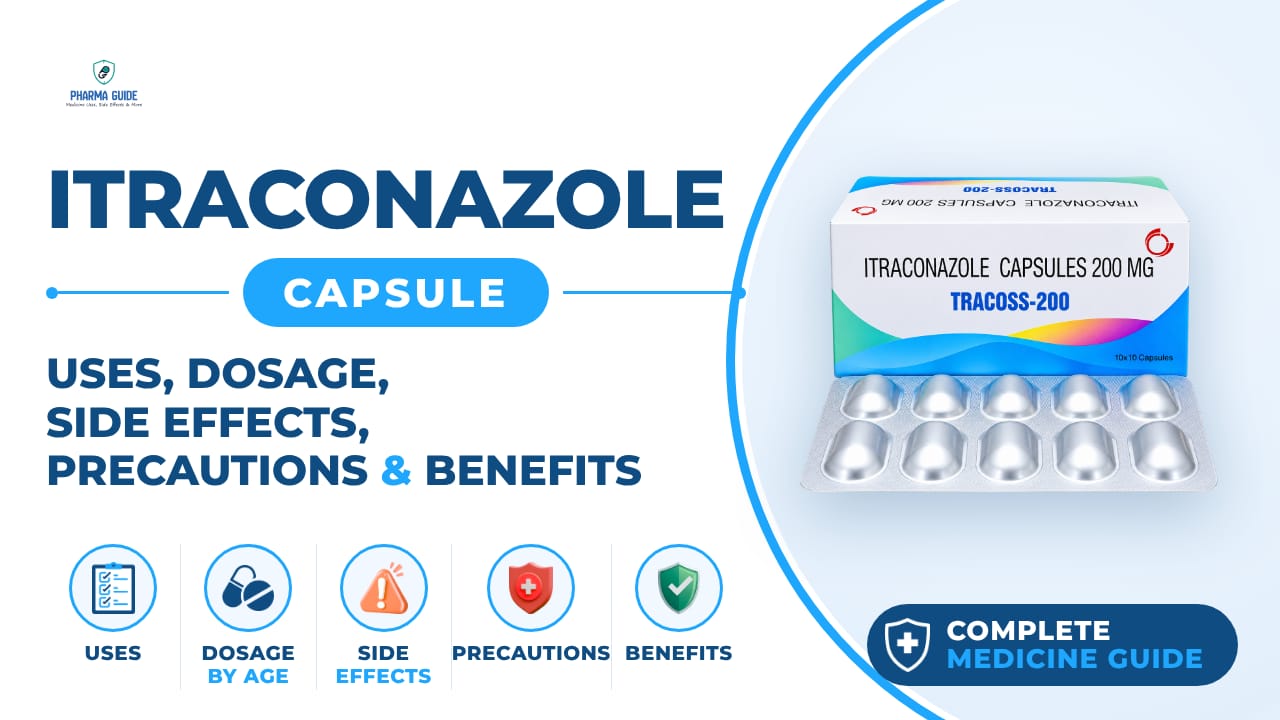
Itraconazole Capsule: Uses, Dosage, Side Effects, Precautions and Alternates
| Generic name | Itraconazole |
|---|---|
| Drug class | Antifungal (triazole/azole antifungal) |
| Forms | Capsule, Tablet, Oral solution/liquid |
Quick overview
Itraconazole Capsule is an antifungal medicine from the triazole (azole) antifungal class, used to treat certain yeast and fungal infections. It is taken by mouth with water and works by slowing the growth of the fungus causing the infection. It will not treat colds, the flu, or infections caused by bacteria or viruses.
What is Itraconazole Capsule
Itraconazole is an antifungal medicine used to treat certain types of yeast and fungal infections. It comes in capsule form and is taken by mouth with water. It will not treat colds, the flu, or infections caused by bacteria or viruses.
Itraconazole Capsule uses
- Fungal infection of the fingernail or toenail (onychomycosis)
- Fungal infections usually affecting the lungs, such as aspergillosis, histoplasmosis, or blastomycosis
- Yeast infection of the mouth, throat, or esophagus (candidiasis)
- Preventing fungal infections in people with HIV or AIDS
Benefits of Itraconazole Capsule
- Treats certain types of fungal and yeast infections
- Slows the growth of fungi that cause infection
How Itraconazole Capsule works
Itraconazole works by slowing down the growth of the fungus that is causing the infection.
Itraconazole Capsule dosage
Take this medication by mouth with a glass of water at the same time every day, as directed on your prescription label. Do not cut, crush, or chew the capsule; swallow it whole. Take it with food, ideally a full meal, to help your body absorb it.
If you take antacids or acid reducers, take them 2 hours before or 2 hours after this medication. Keep taking it for the full course, even if you feel better, unless your care team tells you to stop.
Talk to your care team about use in children, since special care may be needed. People 65 and older may be at greater risk for some side effects, so talk to your healthcare provider about this.
If you miss a dose, take it as soon as you remember; if it is almost time for your next dose, skip the missed dose and only take the next one; do not double up doses. Do not switch between different forms of itraconazole without talking to your healthcare provider.
| Age group | Dose |
|---|---|
| Under 18 years | Specialist dosing only; routine capsule dosing is not established |
| 18–64 years | Usually 100–200 mg once or twice daily, depending on infection |
| 65+ years | Adult dosing may be used, but careful medical assessment is recommended |
Available forms and strengths
- Capsule
- Tablet
- Oral solution/liquid
Side effects of Itraconazole Capsule
Common
- Nausea, vomiting, stomach pain, diarrhea, or constipation
- Headache
- Rash, itching
- Loss of appetite
- Swelling
- Fever
- Menstrual disorder
- Dizziness
- Muscle or joint pain
- Unpleasant taste
- Hair loss
- High blood pressure
- Low potassium levels
- Feeling unwell, tired, sleepy, or low on energy
- Low sex drive or trouble getting or maintaining an erection
- Protein in urine
- Blurry vision
Serious
- Severe allergic reactions, including skin rash, itching, hives, swelling of the face, lips, tongue, or throat, trouble breathing or swallowing
- Liver damage, with signs like right upper belly pain, loss of appetite, nausea, light-colored stool, dark yellow or brown urine, yellowing skin or eyes, unusual weakness or fatigue
- Nerve problems, such as pain, burning, tingling, numbness, or weakness in the hands, feet, arms, or legs
- Hearing loss or ringing/roaring sounds in the ears
- Heart failure, with signs like shortness of breath, swelling of the ankles, feet, or hands, sudden weight gain, unusual weakness or fatigue, fast heartbeat, coughing up pink or white mucus
Warnings and precautions
- Itraconazole can cause heart failure. Tell your doctor if you have or have ever had heart failure, and stop taking the medicine and call your doctor right away if you notice shortness of breath, coughing up white or pink phlegm, extreme tiredness, fast heartbeat, swelling of the feet, ankles, or legs, waking up at night, or sudden weight gain.
- Some medicines should not be taken together with itraconazole.
- Make sure your doctor and pharmacist know about all medicines you take or plan to take before you start this medicine, and check with them before starting, stopping, or changing any medicines while on itraconazole.
- You should not take itraconazole for fungal nail infections if you have or have had heart failure.
- If you have had heart failure, discuss with your doctor whether it is safe to take itraconazole for other infections.
- One of the ingredients in the itraconazole oral solution caused cancer in some laboratory animals.
- It is not known if this increases cancer risk in people who take the solution, so talk to your doctor about the risks.
- Itraconazole may harm an unborn baby.
- Tell your doctor if you are pregnant, plan to become pregnant, or could become pregnant, since effective birth control may be needed during and after treatment.
- Itraconazole passes into breast milk. Tell your healthcare provider if you are breastfeeding or plan to breastfeed so they can advise you.
- Tell your doctor if you have kidney problems before taking this medicine.
- This medicine can cause liver damage. Tell your doctor if you have liver problems, and watch for signs like tiredness, loss of appetite, nausea, yellowing skin or eyes, dark urine, or pale stools.
- It is not known for sure if alcohol affects this medicine, but heavy drinking can weaken your immune response and may increase the risk of dizziness, tiredness, and liver damage while taking it.
- This medicine may cause dizziness or blurred vision, or affect your coordination and reaction time. Do not drive or operate machinery until you know how it affects you.
Storage
- Store at room temperature between 20 and 25 degrees C (68 and 77 degrees F)
- Can be exposed to temperatures between 59 F to 86 F (15 C to 30 C) for shorter periods, such as when transporting it
- Protect from light and moisture
- Keep the container tightly closed
- Store in a cool, dry place, away from excess heat, light, and moisture (not in the bathroom)
- Keep out of the reach of children and pets
- Get rid of any unused medication after the expiration date
- Take the medication to a medication take-back program; check with your pharmacy or law enforcement to find a location
- Do not flush this medication down the toilet unless the label or package insert says it is safe to do so
- If it is safe to put in the trash, take the medication out of its container, mix it with cat litter, dirt, coffee grounds, or another unwanted substance, seal it in a bag or container, and put it in the trash
When to see a doctor
Stop taking itraconazole and get emergency help right away if you have signs of a severe allergic reaction, such as trouble breathing or wheezing, racing heart, fever, swollen lymph nodes, swelling of the face, lips, mouth, tongue, or throat, trouble swallowing, or hives.
Stop taking itraconazole and call your doctor right away if you notice signs of liver damage, such as nausea, stomach pain, fever, weakness, itching, loss of appetite, light-colored stools, dark urine, or yellowing of the skin or eyes.
Stop taking itraconazole and call your doctor if you develop pain, burning, tingling, numbness, or weakness in your arms, hands, legs, or feet, which may be a sign of nerve damage.
Stop taking itraconazole and tell your doctor right away if you have hearing loss or hear ringing or roaring sounds in your ears.
Stop taking itraconazole and tell your doctor right away if you have signs of heart failure, such as shortness of breath, swelling in your feet, ankles, or legs, fast weight gain, unusual tiredness, coughing up pink or white mucus, or fast heartbeat.
If you think you have taken too much of this medicine, contact a poison control center or emergency room right away.
Alternatives
- Posaconazole
- Isavuconazole
- Ketoconazole
- Griseofulvin
- Nystatin
- Amphotericin B
- Caspofungin
Watch the video
FAQs
What is Itraconazole Capsule used for?
It is used to treat fungal infections of the fingernail or toenail, lung infections such as aspergillosis, histoplasmosis, or blastomycosis, yeast infections of the mouth, throat, or esophagus, and to prevent fungal infections in people with HIV or AIDS.
How should I take Itraconazole Capsule?
Take it by mouth with a glass of water at the same time every day, with food such as a full meal to help absorption. Swallow the capsule whole without cutting, crushing, or chewing it, and continue the full course as prescribed.
What should I do if I take antacids with Itraconazole Capsule?
If you take antacids or acid reducers, take them 2 hours before or 2 hours after this medication.
What are the serious side effects of Itraconazole Capsule?
Serious side effects include severe allergic reactions, liver damage, nerve problems like pain or numbness in the limbs, hearing loss or ringing in the ears, and heart failure with symptoms like shortness of breath and swelling.
Can I take Itraconazole Capsule if I have heart failure?
You should not take itraconazole for fungal nail infections if you have or have had heart failure. If you have had heart failure, discuss with your doctor whether it is safe to take it for other infections.
General information, not medical advice
Your prescriber and the leaflet in your pack know your situation. This page does not.
- Follow your prescriber and the leaflet
- Don't start, stop, or change a dose on your own
- Doses and warnings differ by country and product
Sources
Video
Related medicines

Injectafer Injection: Uses, Dosage, Side Effects, Precautions and Alternates
Iron products
Injectafer (ferric carboxymaltose) treats iron deficiency anemia and heart failure-related iron deficiency via IV. Learn uses, dosage, side effects, and

Gliclazide Tablet: Uses, Dosage, Side Effects, Precautions and Alternates
Sulfonylurea (hypoglycemic/antidiabetic agent)
Gliclazide Tablet is a sulfonylurea for type 2 diabetes that boosts insulin release. Learn about dosage, side effects, warnings, and precautions.