
Safety
General information, not medical advice
Your prescriber and the leaflet in your pack know your situation. This page does not.
- Follow your prescriber and the leaflet
- Don't start, stop, or change a dose on your own
- Doses and warnings differ by country and product
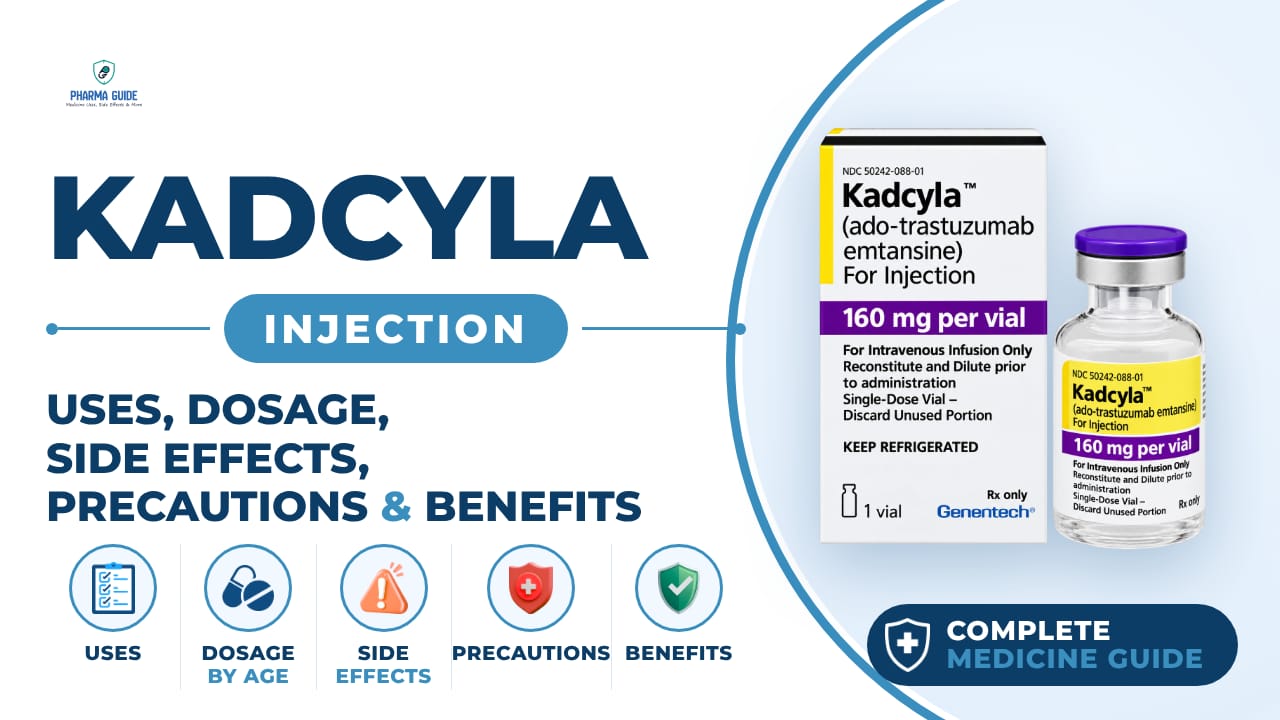
Kadcyla Injection: Uses, Dosage, Side Effects, Precautions and Alternates
| Generic name | trastuzumab emtansine (ado-trastuzumab emtansine) |
|---|---|
| Drug class | Antineoplastic Agent (HER2-targeted antibody-drug conjugate) |
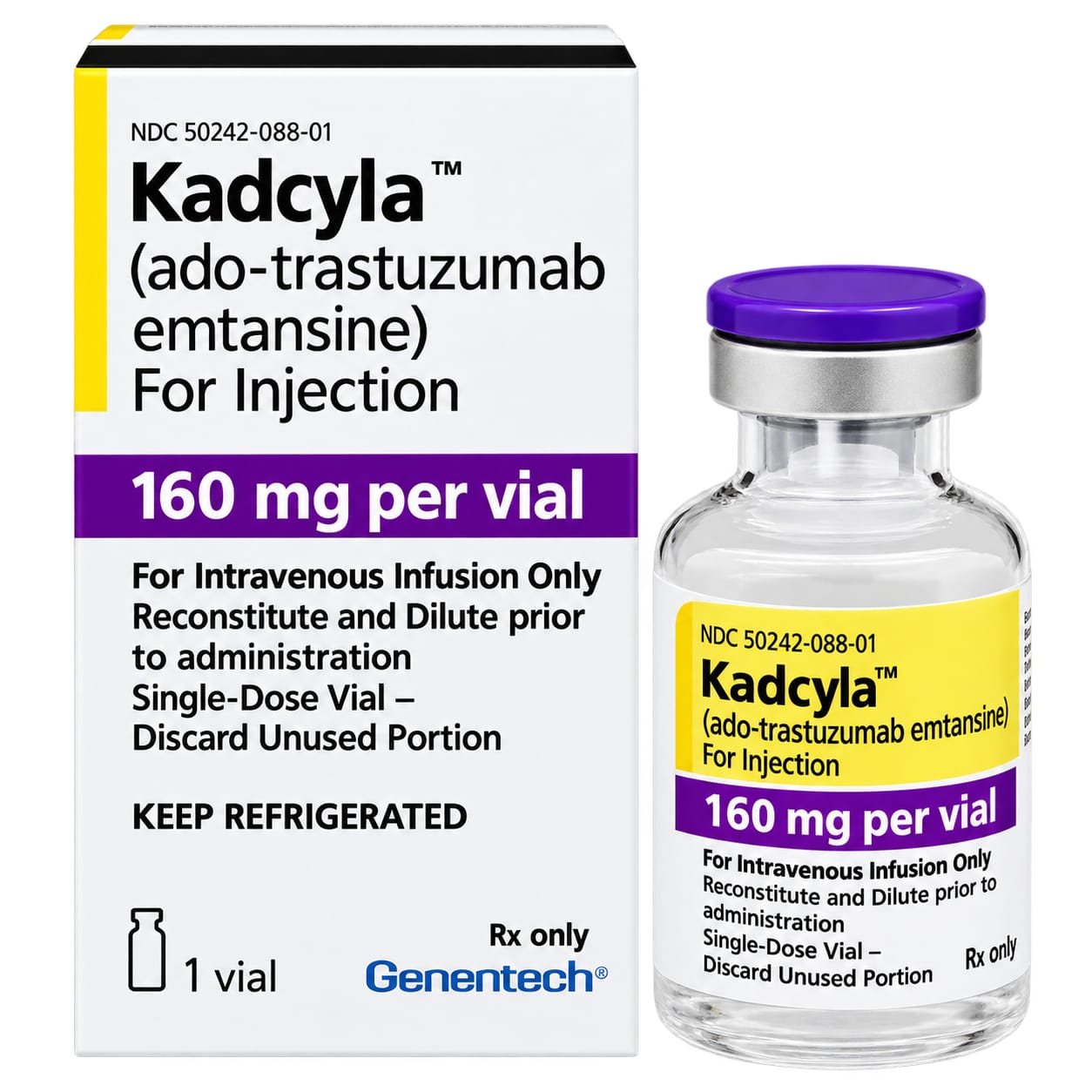
| Forms | Single-use vial containing 100 mg sterile powder for intravenous infusion, Single-use vial containing 160 mg sterile powder for intravenous infusion |
Quick overview
Kadcyla Injection (trastuzumab emtansine) is an antineoplastic agent used to treat certain HER2-positive breast cancers. It combines a monoclonal antibody with a chemotherapy component and is given by intravenous infusion once every 3 weeks by a healthcare professional. It carries important warnings regarding liver damage, heart problems, bleeding, and use during pregnancy.
What is Kadcyla Injection
Kadcyla is a cancer medicine made of two parts joined together: a monoclonal antibody called trastuzumab and a chemotherapy drug called DM1. It is given by IV infusion to treat HER2-positive breast cancer.
Kadcyla Injection uses
- Treatment of HER2-positive metastatic breast cancer in patients who already received trastuzumab and a taxane chemotherapy, either separately or together
- Treatment of HER2-positive metastatic breast cancer in patients who had prior therapy for metastatic disease, or whose disease came back during or within 6 months of finishing adjuvant therapy
- Adjuvant (after surgery) treatment of HER2-positive early breast cancer in patients who still have invasive disease remaining after neoadjuvant treatment with a taxane and trastuzumab
Benefits of Kadcyla Injection
- Treats certain HER2-positive breast cancers
- Used for HER2-positive metastatic breast cancer
- Used for selected HER2-positive early breast cancer
- Combines HER2-targeted therapy with a cytotoxic agent
- Can help slow tumor progression in eligible patients
How Kadcyla Injection works
Kadcyla is designed to find and attach to cancer cells that have too much of a protein called HER2. Once attached, it signals the cancer cell to stop growing and tells the body's immune system to help destroy it. Kadcyla also enters the cell, where it releases its chemotherapy component (DM1), which goes to work inside the cell and causes the cancer cell to die.
Kadcyla Injection dosage
Kadcyla is given by intravenous infusion (through a vein) by a healthcare professional in a hospital, clinic, or infusion center, once every 3 weeks. The first infusion is given over 90 minutes, and you will be watched for at least 90 minutes afterward for signs of an infusion reaction. If the first infusion is well tolerated, later infusions may be given over 30 minutes, with monitoring for at least 30 minutes afterward.
Do not substitute this medicine for or with trastuzumab alone — always check that the correct drug is being used. People with early breast cancer usually receive a set number of cycles (14), while people with metastatic breast cancer continue treatment until the disease progresses or side effects become unmanageable.
Tell your doctor about all other medicines, vitamins, and herbal supplements you are taking. If a dose is missed or delayed, contact your healthcare professional right away to reschedule rather than waiting for the next cycle. Do not stop this medicine without talking to your healthcare professional first.
| Age group | Dose |
|---|---|
| 18–64 years | 3.6 mg/kg IV once every 3 weeks |
| 65 years and older | 3.6 mg/kg IV once every 3 weeks, with individualized oncology monitoring |
Available forms and strengths
- Single-use vial containing 100 mg sterile powder for intravenous infusion
- Single-use vial containing 160 mg sterile powder for intravenous infusion
Side effects of Kadcyla Injection
Common
- Tiredness (fatigue)
- Nausea and vomiting
- Headache
- Muscle, bone, or joint pain
- Abdominal pain
- Constipation or diarrhea
- Dry mouth
- Nerve damage (numbness, tingling, pain in hands and feet)
- Nosebleeds
- Unexpected bleeding or bruising
- Low platelet counts (shown in blood tests)
- Decreased red blood cells (anemia)
- Low potassium levels (shown in blood tests)
- Chills or flu-like symptoms
- Difficulty sleeping
- Increased liver enzymes (shown in blood tests)
Serious
- Severe liver damage, which can lead to liver failure and death
- Heart problems, including weakening of the heart muscle and heart failure
- Serious or life-threatening bleeding
- Severe allergic (infusion-related) reactions, including anaphylactic-like reactions
- Lung problems, including inflammation of lung tissue that can be life-threatening
- Severe low platelet counts leading to bleeding risk
- Severe nerve damage (peripheral neuropathy)
- Nodular regenerative hyperplasia of the liver, which can cause abdominal swelling, fluid buildup, or bleeding from abnormal blood vessels
- Harm to an unborn baby, including death of the fetus, if used during pregnancy
- Reactions at the infusion site if the drug leaks from the vein (extravasation), including skin irritation, pain, or swelling
Warnings and precautions
- There is a risk of mixing up Kadcyla with plain trastuzumab, which can lead to overdose. Healthcare providers must check vial labels carefully to make sure the correct drug and dose are given.
- Kadcyla can cause serious liver damage, including liver failure and death. Liver function will be checked before treatment starts and before every dose.
- Kadcyla can weaken the heart's pumping ability. Heart function will be checked before treatment and regularly during treatment.
- Serious, sometimes fatal, bleeding has occurred with Kadcyla, even in people without known risk factors. The risk is higher in people with low platelets or those taking blood thinners.
- Kadcyla can cause lung inflammation that may be life-threatening. Treatment is usually stopped permanently if this happens.
- Kadcyla can cause serious harm to an unborn baby, including death of the fetus.
- Kadcyla should not be used during pregnancy because it can cause serious harm or death to an unborn baby. Women who could become pregnant must use effective birth control during treatment and for 7 months after the last dose.
- Women should not breastfeed during treatment with Kadcyla and for 7 months after the last dose, because it is not known if the medicine passes into breast milk and it could harm a nursing infant.
- No dose adjustment is needed for people with mild or moderate kidney problems. There isn't enough information to know if a dose change is needed for severe kidney impairment.
- People with liver problems should be treated carefully, with extra monitoring of liver function, because Kadcyla is known to cause liver damage. It has not been studied in people with severe liver impairment.
- Kadcyla may affect your ability to drive or use machines because it can cause tiredness, headache, dizziness, and blurred vision. If you have an infusion-related reaction such as flushing, chills, trouble breathing, low blood pressure, or rapid heartbeat, do not drive or use machines until these symptoms go away completely.
Storage
- Store unopened vials in a refrigerator at 2-8°C
- Do not freeze or shake the vials
- Do not use this medicine after the expiry date shown on the pack
- This medicine will be stored and handled by healthcare professionals at the hospital or clinic
- Do not throw away any medicines via wastewater or household waste; ask your pharmacist how to dispose of medicines you no longer use
When to see a doctor
- Get immediate medical help if you have unexpected bleeding from the nose or gums, as this can be a sign of a serious bleeding problem.
- Get immediate medical help if your skin or the whites of your eyes turn yellow, which can be a sign of serious liver damage.
- Seek immediate medical help for shortness of breath at rest, chest pain, swollen ankles or arms, or a sensation of rapid or irregular heartbeats, which can indicate a heart problem.
- Seek medical attention for signs of an infusion reaction such as flushing, shivering, fever, trouble breathing, low blood pressure, rapid heartbeat, or sudden swelling of the face or tongue, or trouble swallowing.
- Tell your healthcare professional about new or worsening tingling, pain, numbness, itching, or a crawling or pins-and-needles sensation in your hands and feet, which can be signs of nerve damage.
- Seek medical help for shortness of breath or cough with fever, which could indicate a lung problem.
- Seek medical attention for blood in your stools or swelling of your abdomen, which can be signs of a rare liver condition called nodular regenerative hyperplasia.
- Tell your doctor right away if you become pregnant while being treated with this medicine.
- Seek immediate medical attention if you experience symptoms of severe liver injury such as nausea, vomiting, abdominal pain, yellowing of the skin, dark urine, generalized itching, or loss of appetite.
Alternatives
- Enhertu
- Herceptin
- Perjeta
Watch the video
FAQs
What is Kadcyla Injection used for?
Kadcyla is used to treat HER2-positive metastatic breast cancer in patients previously treated with trastuzumab and a taxane, and as adjuvant treatment for HER2-positive early breast cancer in patients with residual invasive disease after neoadjuvant therapy.
How is Kadcyla Injection given?
Kadcyla is given by intravenous infusion by a healthcare professional once every 3 weeks. The first infusion is given over 90 minutes with monitoring afterward; later infusions may be given over 30 minutes if well tolerated.
What are the serious side effects of Kadcyla Injection?
Serious side effects include severe liver damage, heart problems like heart failure, serious bleeding, severe allergic infusion reactions, lung inflammation, severe nerve damage, and harm to an unborn baby.
Can Kadcyla Injection be used during pregnancy?
No, Kadcyla should not be used during pregnancy because it can cause serious harm or death to an unborn baby. Women who could become pregnant must use effective birth control during treatment and for 7 months after the last dose.
How should Kadcyla Injection be stored?
Unopened vials should be stored in a refrigerator at 2-8°C, must not be frozen or shaken, and should not be used after the expiry date. It is stored and handled by healthcare professionals at the hospital or clinic.
General information, not medical advice
Your prescriber and the leaflet in your pack know your situation. This page does not.
- Follow your prescriber and the leaflet
- Don't start, stop, or change a dose on your own
- Doses and warnings differ by country and product
Sources
Video
Related medicines

Injectafer Injection: Uses, Dosage, Side Effects, Precautions and Alternates
Iron products
Injectafer (ferric carboxymaltose) treats iron deficiency anemia and heart failure-related iron deficiency via IV. Learn uses, dosage, side effects, and

Gliclazide Tablet: Uses, Dosage, Side Effects, Precautions and Alternates
Sulfonylurea (hypoglycemic/antidiabetic agent)
Gliclazide Tablet is a sulfonylurea for type 2 diabetes that boosts insulin release. Learn about dosage, side effects, warnings, and precautions.