
Safety
General information, not medical advice
Your prescriber and the leaflet in your pack know your situation. This page does not.
- Follow your prescriber and the leaflet
- Don't start, stop, or change a dose on your own
- Doses and warnings differ by country and product
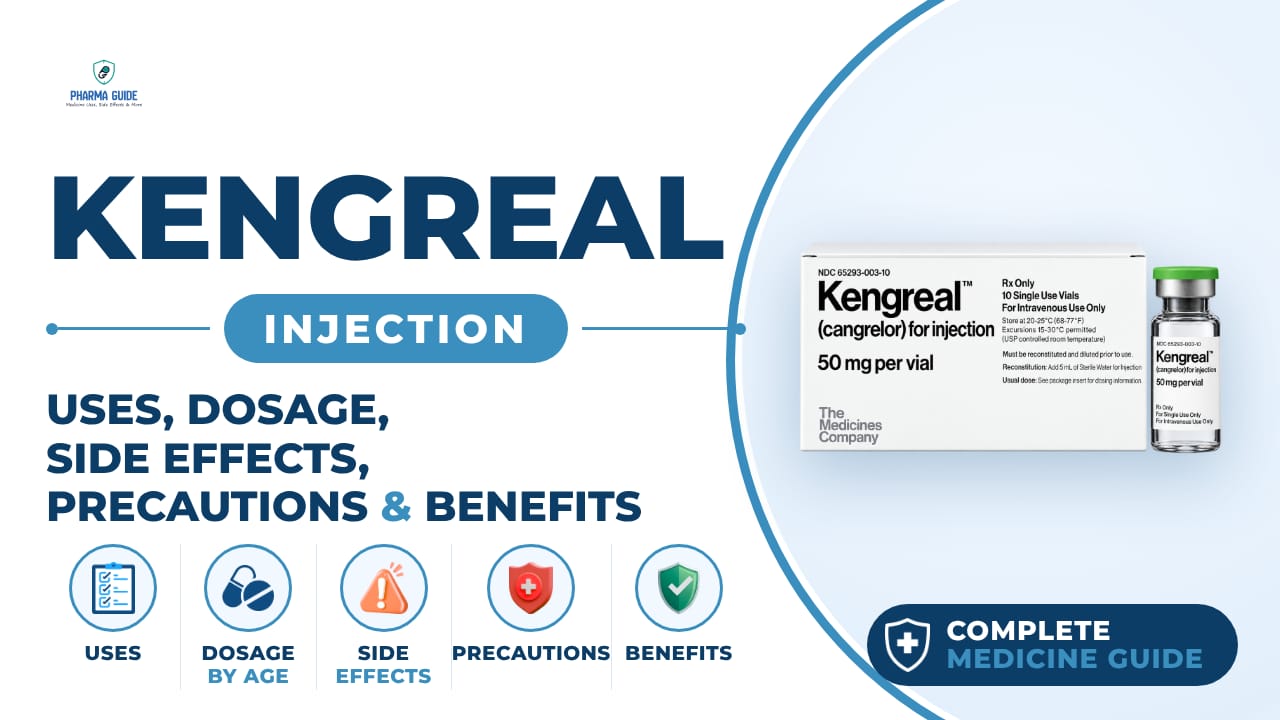
Kengreal Injection: Uses, Dosage, Side Effects, Precautions and Alternates
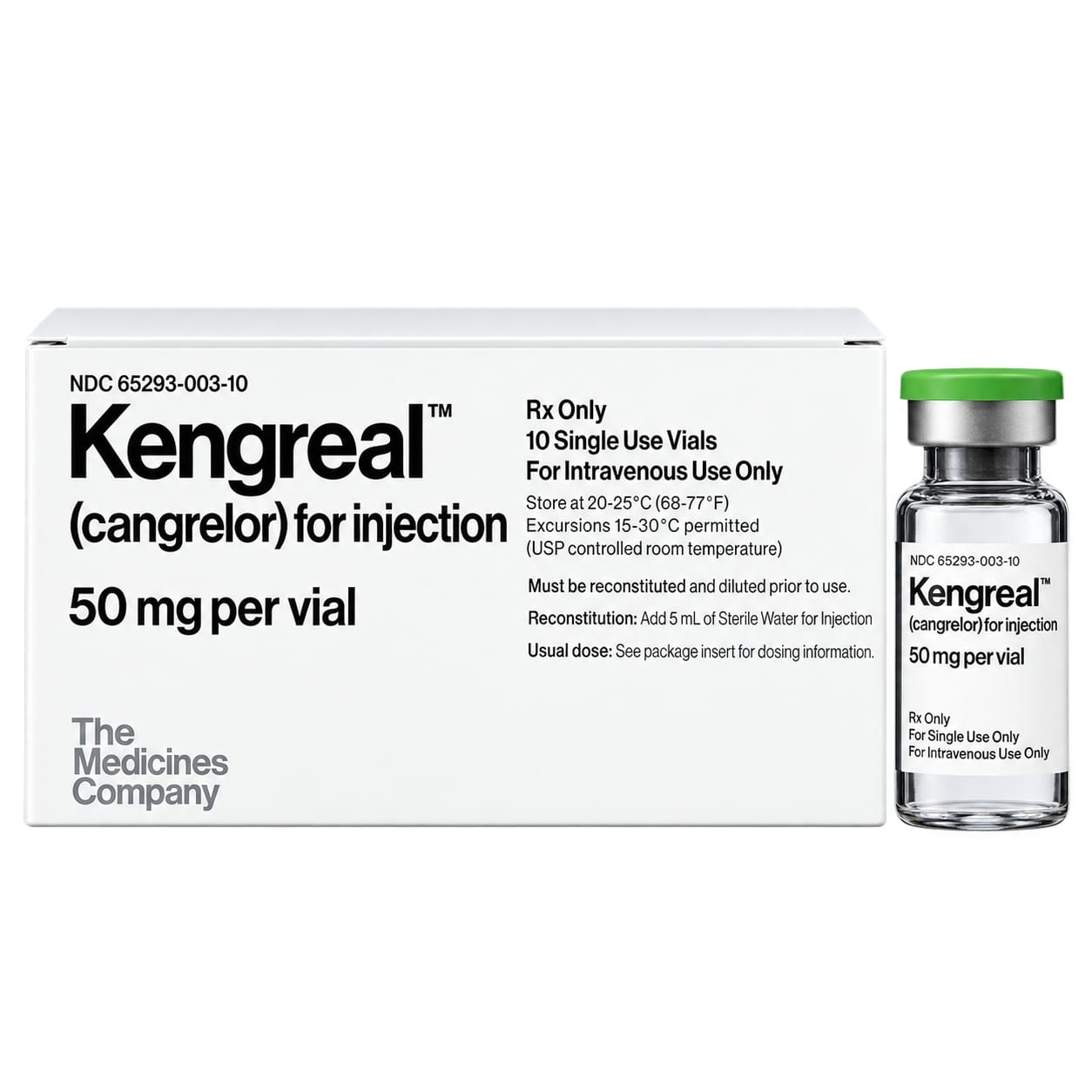
| Generic name | cangrelor |
|---|---|
| Drug class | Anticoagulants, Cardiovascular / platelet aggregation inhibitor |
| Forms | Lyophilized powder for injection, reconstituted and diluted before IV use (single-use 10 mL vial containing 50 mg) |
Quick overview
Kengreal Injection (cangrelor) is an antiplatelet medicine from the anticoagulant / cardiovascular platelet aggregation inhibitor class. It is given through an IV during a heart artery procedure called percutaneous coronary intervention (PCI) to help prevent blood clots. It works quickly to stop platelets from clumping together and is administered only by a healthcare provider.
What is Kengreal Injection
Kengreal is an antiplatelet medicine given through an IV. It is used during a heart artery procedure called percutaneous coronary intervention (PCI) to help prevent blood clots.
Kengreal Injection uses
- Used alongside percutaneous coronary intervention (PCI) to lower the risk of a heart attack happening during or shortly after the procedure
- Used to lower the risk of needing a repeat artery-opening procedure
- Used to lower the risk of a blood clot forming in a stent (stent thrombosis)
- Given to patients who have not already been treated with a P2Y12 platelet inhibitor and who are not receiving a glycoprotein IIb/IIIa inhibitor
Benefits of Kengreal Injection
- In a large clinical trial, Kengreal lowered the combined rate of death, heart attack, repeat artery procedures, and stent clots compared with clopidogrel
- Platelet inhibition starts very quickly after the dose is given
- Provides rapid platelet inhibition
- Helps reduce blood clot formation during PCI
- Has a very rapid onset of action
How Kengreal Injection works
Kengreal blocks a receptor on platelets called P2Y12, which stops a substance called ADP from activating platelets. This keeps platelets from clumping together and forming clots.
Kengreal Injection dosage
Kengreal is given only as an intravenous (IV) infusion through a dedicated IV line by a healthcare provider. It is given as a rapid injection first, then followed right away by a continuous IV drip. The IV drip is usually continued for at least 2 hours or for as long as the procedure lasts, whichever is longer. After the Kengreal infusion is stopped, a patient is usually switched to a pill form of a similar blood-thinning medicine to keep protecting against clots. This medicine must be mixed and diluted by a healthcare professional before it is given; it is not self-administered.
| Age group | Dose |
|---|---|
| Under 18 years | Safety and effectiveness have not been established |
| 18–64 years | 30 mcg/kg IV bolus, followed immediately by 4 mcg/kg/min IV infusion during PCI |
Available forms and strengths
- Lyophilized powder for injection, reconstituted and diluted before IV use (single-use 10 mL vial containing 50 mg)
Side effects of Kengreal Injection
Common
- Bleeding (most common side effect)
- Bruising
- Nosebleeds
- Blood in urine or stool
- Black, tarry stools
- Coughing up blood
- Blood in the eyes
- Headache
- Dizziness
- Abdominal or stomach pain or swelling
- Back pain
- Joint pain or swelling
- Decreased alertness
- Shortness of breath (dyspnea)
Serious
- Severe or life-threatening bleeding, including bleeding in the brain
- Serious allergic reactions such as hives, swelling of the face, lips, tongue, or throat, difficulty breathing, wheezing, or noisy breathing
- Anaphylactic shock
- Worsening kidney function, especially in people with severe kidney impairment
- Chest tightness or difficulty breathing
- Fast or irregular heartbeat
Warnings and precautions
- This medicine increases the risk of bleeding, including serious bleeding. Bleeding of all kinds was more common with Kengreal than with clopidogrel in clinical studies.
- Do not use this medicine if you have significant active bleeding or if you are allergic to it or any of its ingredients.
- Taking clopidogrel or prasugrel at the same time as a Kengreal infusion stops those medicines from working until the next dose is given after the infusion ends. These medicines should only be given after the Kengreal infusion is stopped.
- Once the Kengreal infusion is stopped, its blood-thinning effect goes away within about an hour.
- There isn't enough information on how this medicine affects pregnant women or their babies. Because an untreated heart attack can be life-threatening to both mother and baby, doctors should not withhold this treatment during pregnancy out of concern for the fetus. Using it during labor or delivery may raise the risk of bleeding.
- It isn't known whether this medicine passes into breast milk, but because it leaves the body quickly, very little is expected to reach a breastfeeding infant.
- No dose change is needed for people with mild, moderate, or severe kidney problems, though kidney function may worsen in some patients with severe impairment.
- This medicine hasn't been specifically studied in people with liver problems, but because it isn't processed by the liver, no dose change is expected to be needed.
- Alcohol may increase bleeding risk and should be discussed with the treating clinician.
- Usually administered during a hospital procedure; follow the cardiology team's advice before driving afterward.
Storage
Vials of KENGREAL should be stored at USP Controlled Room Temperature, 20°C to 25°C (68°F to 77°F) with excursions between 15°C and 30°C (59°F and 86°F) permitted.
When to see a doctor
- Get medical help right away if you notice hives, trouble breathing, or swelling of your face, lips, tongue, or throat — these can be signs of a serious allergic reaction.
- Seek emergency care for any sign of severe bleeding, such as black or tarry stools, blood in urine or stool, coughing up blood, or unusual bruising.
- Get emergency help for sudden vision changes, eye pain, or seeing halos around lights.
- Seek emergency care for fast, irregular, or pounding heartbeat, fluttering in the chest, shortness of breath, or sudden dizziness or fainting.
- Get emergency help right away for severe headache, confusion, slurred speech, weakness in an arm or leg, trouble walking, loss of coordination, very stiff muscles, high fever, heavy sweating, or tremors — these may be signs of a serious reaction.
Alternatives
- Clopidogrel
- Ticagrelor
- Prasugrel
Watch the video
FAQs
What is Kengreal Injection used for?
Kengreal is used alongside percutaneous coronary intervention (PCI) to lower the risk of heart attack during or shortly after the procedure, reduce the need for repeat artery-opening procedures, and lower the risk of stent thrombosis.
How is Kengreal Injection given?
Kengreal is given only as an IV infusion by a healthcare provider, starting with a rapid bolus followed immediately by a continuous IV drip, usually continued for at least 2 hours or for the duration of the procedure.
How does Kengreal work?
Kengreal blocks the P2Y12 receptor on platelets, preventing ADP from activating platelets, which stops them from clumping together and forming clots.
What are the common side effects of Kengreal Injection?
The most common side effect is bleeding, along with bruising, nosebleeds, headache, dizziness, abdominal pain, back pain, joint pain, and shortness of breath.
How long does Kengreal's effect last after stopping the infusion?
Once the Kengreal infusion is stopped, its blood-thinning effect goes away within about an hour.
General information, not medical advice
Your prescriber and the leaflet in your pack know your situation. This page does not.
- Follow your prescriber and the leaflet
- Don't start, stop, or change a dose on your own
- Doses and warnings differ by country and product
Sources
Video
Related medicines

Injectafer Injection: Uses, Dosage, Side Effects, Precautions and Alternates
Iron products
Injectafer (ferric carboxymaltose) treats iron deficiency anemia and heart failure-related iron deficiency via IV. Learn uses, dosage, side effects, and

Gliclazide Tablet: Uses, Dosage, Side Effects, Precautions and Alternates
Sulfonylurea (hypoglycemic/antidiabetic agent)
Gliclazide Tablet is a sulfonylurea for type 2 diabetes that boosts insulin release. Learn about dosage, side effects, warnings, and precautions.