
Safety
General information, not medical advice
Your prescriber and the leaflet in your pack know your situation. This page does not.
- Follow your prescriber and the leaflet
- Don't start, stop, or change a dose on your own
- Doses and warnings differ by country and product
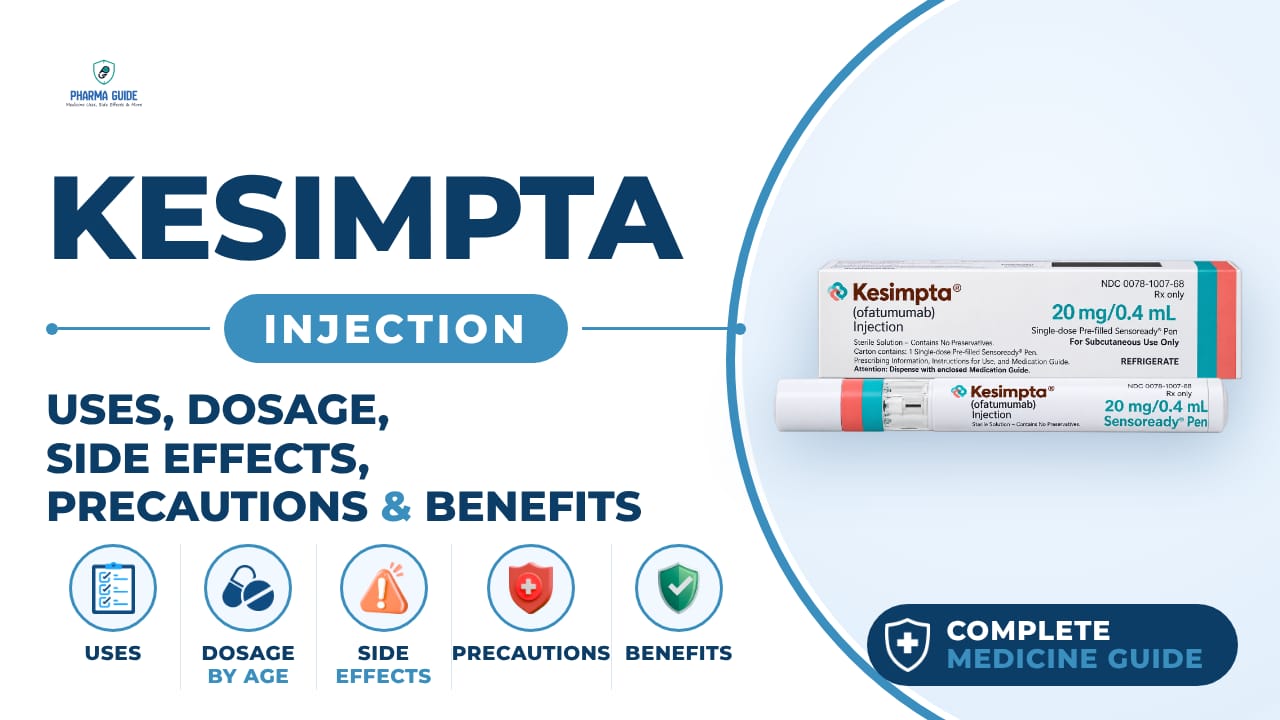
Kesimpta Injection: Uses, Dosage, Side Effects, Precautions and Alternates
| Generic name | ofatumumab |
|---|---|
| Drug class | CD20-directed cytolytic antibody (monoclonal antibody); also called a selective immunosuppressant |
| Forms | Injection |
Quick overview
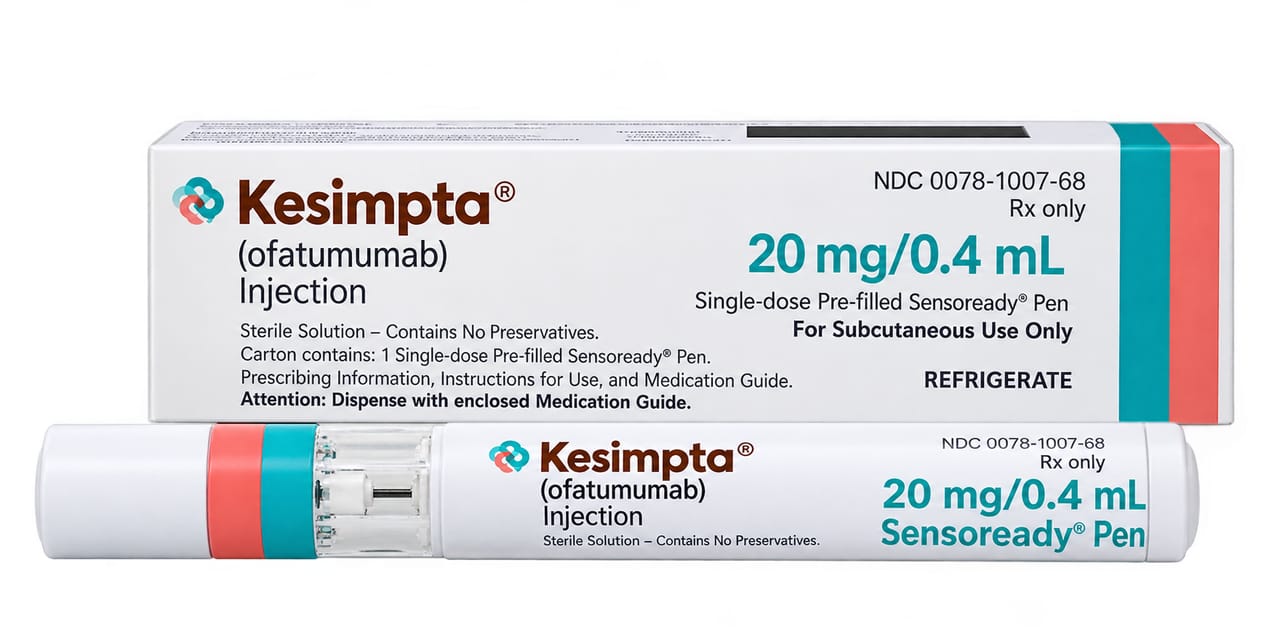
Kesimpta Injection (ofatumumab) is a prescription CD20-directed cytolytic antibody, also called a selective immunosuppressant, used to treat relapsing forms of multiple sclerosis in adults. It is given as a self-injection under the skin, typically once a month after the starting doses. Common side effects include upper respiratory infections, headache, and injection-site reactions, while serious risks include infections, hepatitis B reactivation, and PML. It should be used exactly as prescribed by a healthcare provider.
What is Kesimpta Injection
Kesimpta is a prescription medicine given by injection under the skin. It contains the active ingredient ofatumumab, a lab-made antibody that targets B-cells, a type of white blood cell involved in multiple sclerosis.
Kesimpta Injection uses
- Treatment of relapsing forms of multiple sclerosis (MS), including clinically isolated syndrome, relapsing-remitting disease, and active secondary progressive disease, in adults
Benefits of Kesimpta Injection
- Significantly lowers the annual relapse rate compared to teriflunomide in clinical studies
- Reduces the risk of confirmed disability progression compared to teriflunomide
- Reduces the number of brain lesions seen on MRI scans compared to teriflunomide
- Can be self-injected at home once a month after the starting doses
How Kesimpta Injection works
Kesimpta attaches to a protein called CD20 found on the surface of B-cells, a type of white blood cell that attacks the protective covering around nerves in MS. By binding to B-cells, the drug causes them to be destroyed, which lowers immune system activity and reduces nerve inflammation. It does not cure MS but can slow its progression and reduce relapses.
Kesimpta Injection dosage
Use Kesimpta exactly as your healthcare provider tells you to use it. It is given as an injection under the skin in the thigh or stomach area; a caregiver may also inject it into the upper outer arm. Your healthcare provider will show you how to prepare and inject it correctly before you use it for the first time. Do not inject into skin that is tender, bruised, red, scaly, or hard, and avoid areas with moles, scars, or stretch marks. The first injection should be given under the guidance of a healthcare professional.
Before injecting, let the pen or syringe sit out to reach room temperature for about 15 to 30 minutes; do not remove the needle cover while it warms up. Do not shake the pen or syringe. Pens and prefilled syringes are for one-time use only and must be thrown away after use.
If you miss an injection during the first three weekly doses, contact your healthcare provider for instructions. If you miss a monthly dose, give it as soon as possible without waiting for the next scheduled dose, then continue dosing a month apart. Kesimpta is approved for use in adults only; it has not been studied for safety and effectiveness in children.
| Age group | Dose |
|---|---|
| Under 18 years | Not recommended |
| 18–64 years | 20 mg, once/day |
| 65+ years | 20 mg, once/day |
Available forms and strengths
- Injection
Side effects of Kesimpta Injection
Common
- Upper respiratory tract infection (sore throat, runny nose, cold-like symptoms)
- Headache
- Injection-related reactions
- Injection-site reactions such as redness, swelling, itching, and pain
- Urinary tract infection
Serious
- Severe allergic reactions (breathing problems, swelling of face/lips/mouth/tongue/throat, hives, dizziness, fainting)
- Serious infections
- Hepatitis B virus reactivation, which can cause serious liver problems including liver failure or death
- Progressive Multifocal Leukoencephalopathy (PML), a rare, serious brain infection that can cause death or severe disability
- Low immunoglobulin (antibody) levels, which can increase infection risk
- Liver damage (hepatotoxicity)
Warnings and precautions
- Kesimpta can increase the risk of infections, including serious ones that can be life-threatening. Treatment may need to be delayed if you have an active infection.
- Kesimpta can cause hepatitis B virus to become active again, which may lead to serious liver problems including liver failure or death. It should not be used by people with active hepatitis B infection.
- A rare but serious brain infection called PML can occur with Kesimpta and may lead to death or severe disability.
- Do not receive live or live-attenuated vaccines while being treated with Kesimpta and until your immune system recovers; live vaccines should be given at least 4 weeks before starting treatment.
- Using Kesimpta together with other medicines that weaken the immune system, such as steroids or cancer medicines, may further increase infection risk.
- Kesimpta may harm an unborn baby. People who can become pregnant should use effective birth control during treatment and for 6 months after the last dose. Tell your healthcare provider if you become pregnant.
- It is not known if Kesimpta passes into breast milk. Talk to your healthcare provider about the best way to feed your baby if you are breastfeeding.
- People with active hepatitis B infection should not take Kesimpta, and it can cause the virus to become active again in those who have had it before, which may lead to serious liver problems. Kesimpta can also cause liver damage, so liver function may be checked before and during treatment.
- It is not known whether drinking alcohol affects Kesimpta.
Storage
- Store in a refrigerator between 36°F to 46°F (2°C to 8°C)
- Keep in the original carton to protect from light until ready to use
- If needed, the medicine may be stored at room temperature up to 86°F (30°C) for up to 7 days
- If returned to the refrigerator after being at room temperature, it must be used within 7 days; if not used within those 7 days, it should be thrown away
- Do not freeze
- Do not shake
- Keep out of the reach of children
- Dispose of used pens or syringes in a puncture-resistant sharps container right away; do not throw them in household trash
When to see a doctor
- Get help right away if you have signs of a serious allergic reaction, such as trouble breathing, swelling of the face/lips/mouth/throat, hives, dizziness, or fainting.
- Call your healthcare provider right away if you have signs of an infection, such as burning when you urinate, cough, fever, chills, muscle aches, shortness of breath, or diarrhea.
- Call your healthcare provider right away if you notice unusual tiredness, yellowing of your skin or eyes, nausea, vomiting, dark urine, or pale stools, which can be signs of hepatitis or liver problems.
- Stop using Kesimpta and call your healthcare provider right away if you notice new or worsening problems with coordination, walking, speaking, vision, thinking, memory, or weakness on one side of the body, which could be signs of PML.
- Call your healthcare provider right away if you have new or worsening symptoms after an injection, such as fever, chills, rash, trouble breathing, swelling of the face, or feeling faint.
Alternatives
- Ocrevus
- Briumvi
Watch the video
FAQs
What is Kesimpta Injection used for?
Kesimpta is used to treat relapsing forms of multiple sclerosis, including clinically isolated syndrome, relapsing-remitting disease, and active secondary progressive disease, in adults.
How is Kesimpta Injection given?
It is given as an injection under the skin in the thigh or stomach area, or the upper outer arm if given by a caregiver. It is typically self-injected once a month after the starting doses, following training from a healthcare provider.
What are the common side effects of Kesimpta Injection?
Common side effects include upper respiratory tract infection, headache, injection-related reactions, injection-site reactions like redness and swelling, and urinary tract infection.
What are the serious risks of Kesimpta Injection?
Serious risks include severe allergic reactions, serious infections, hepatitis B virus reactivation, progressive multifocal leukoencephalopathy (PML), low immunoglobulin levels, and liver damage.
What should I do if I miss a dose of Kesimpta Injection?
If you miss an injection during the first three weekly doses, contact your healthcare provider for instructions. If you miss a monthly dose, give it as soon as possible and then continue dosing a month apart.
General information, not medical advice
Your prescriber and the leaflet in your pack know your situation. This page does not.
- Follow your prescriber and the leaflet
- Don't start, stop, or change a dose on your own
- Doses and warnings differ by country and product
Sources
Video
Related medicines

Injectafer Injection: Uses, Dosage, Side Effects, Precautions and Alternates
Iron products
Injectafer (ferric carboxymaltose) treats iron deficiency anemia and heart failure-related iron deficiency via IV. Learn uses, dosage, side effects, and

Gliclazide Tablet: Uses, Dosage, Side Effects, Precautions and Alternates
Sulfonylurea (hypoglycemic/antidiabetic agent)
Gliclazide Tablet is a sulfonylurea for type 2 diabetes that boosts insulin release. Learn about dosage, side effects, warnings, and precautions.