
Safety
General information, not medical advice
Your prescriber and the leaflet in your pack know your situation. This page does not.
- Follow your prescriber and the leaflet
- Don't start, stop, or change a dose on your own
- Doses and warnings differ by country and product
Klisyri Ointment: Uses, Dosage, Side Effects, Precautions and Alternates
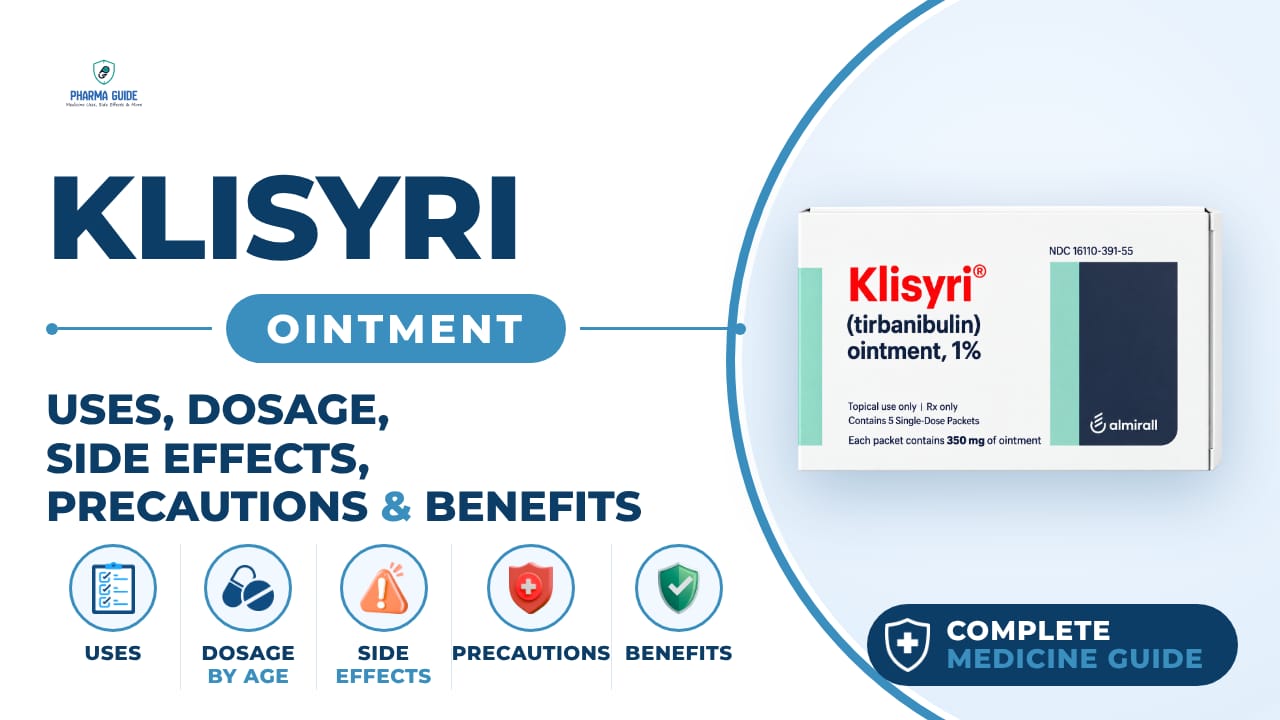
| Generic name | tirbanibulin |
|---|---|
| Drug class | microtubule inhibitor (topical antineoplastic) |
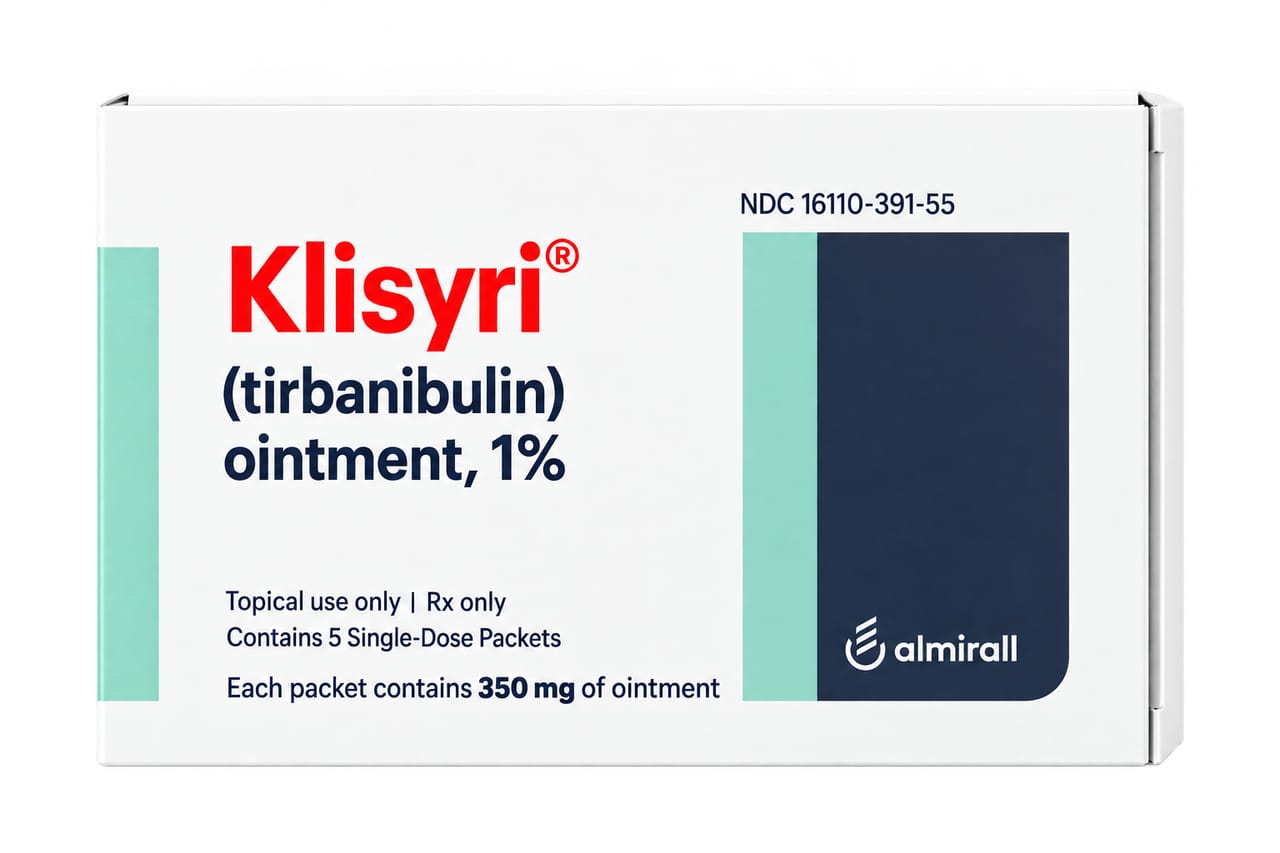
| Forms | 1% topical ointment supplied in single-dose packets |
Quick overview
Klisyri Ointment contains tirbanibulin 1%, a microtubule inhibitor used to treat actinic keratosis, a precancerous skin condition caused by sun damage, on the face or scalp. It is applied once daily for 5 consecutive days using single-dose packets. Common side effects include itching, redness, and irritation at the application site, while serious reactions may include severe skin breakdown or allergic reactions.
What is Klisyri Ointment
Klisyri is a prescription ointment containing tirbanibulin 1%. It is applied to the skin to treat actinic keratosis, a precancerous skin condition caused by sun damage, on the face or scalp.
Klisyri Ointment uses
- Treats actinic keratosis on the face or scalp.
- Helps clear visible precancerous skin lesions.
- Targets abnormal skin cells associated with sun damage.
- Reduces the number of actinic keratosis lesions in treated areas.
Benefits of Klisyri Ointment
- Provides a short, five-day treatment course.
- Helps clear actinic keratosis lesions.
- Targets abnormal skin cells through microtubule inhibition.
- Offers a noninvasive topical treatment.
How Klisyri Ointment works
Klisyri contains tirbanibulin, which blocks tiny structures inside cells called microtubules that are needed for cell growth and division. By stopping this process in the damaged skin cells, it seems to reduce the growth of actinic keratosis cells, leading the abnormal cells to die off.
Klisyri Ointment dosage
Apply to the treatment area on the face or scalp once a day for 5 days in a row, using one single-dose packet with each application. Apply only enough ointment to cover the treatment area; do not use more than needed. Do not apply to areas other than the prescribed treatment area.
Do not cover the treated area with a bandage or dressing after applying. Avoid washing or touching the treated area for about 8 hours after applying; after that, you may wash with mild soap and water. Wash your hands right away with soap and water after applying.
Avoid getting the ointment in, around, or near the eyes, mouth, or lips, and avoid touching your eyes while applying it. Throw away each single-use packet after applying, even if some ointment is left inside.
Do not start using this medicine until your skin has healed from any other actinic keratosis treatment (such as another medicine, procedure, or surgery).
If you miss a dose, apply it as soon as you remember, but skip it if it is almost time for your next dose; do not apply two doses at once.
Safety and effectiveness have not been established in children under 18 years old. In clinical trials, most people treated were 65 years of age or older, and no overall differences in safety or effectiveness were seen between older and younger adults, though some older individuals may be more sensitive.
| Age group | Dose |
|---|---|
| Under 18 years | Safety and effectiveness not established; no approved pediatric dosage |
| 18–74 years | 1% ointment once daily for 5 consecutive days; maximum treatment area 100 cm² |
| 75 years and older | 1% ointment once daily for 5 consecutive days; maximum treatment area 100 cm², with careful monitoring of skin reactions |
Available forms and strengths
- 1% topical ointment supplied in single-dose packets
Side effects of Klisyri Ointment
Common
- Itching (pruritus) at the application site
- Pain, tenderness, stinging, or burning at the application site
- Redness (erythema)
- Flaking or scaling
- Crusting
- Swelling
Serious
- Severe local skin reactions such as blisters, peeling, pus, ulcers, or breakdown of the skin
- Eye irritation if the ointment gets into the eyes
- Severe allergic reactions including trouble breathing or wheezing, racing heart, fever or feeling generally unwell, swollen lymph nodes, swelling of the face, lips, mouth, tongue, or throat, trouble swallowing or throat tightness, hives, nausea or vomiting, dizziness or fainting, stomach cramps, or joint pain
Warnings and precautions
- Do not start using Klisyri until your skin has healed from any other actinic keratosis treatment, such as another medicine, procedure, or surgery.
- Do not use more ointment than needed to cover the treatment area. Using too much, too often, or for too long raises the risk of a severe skin reaction or other side effects.
- Do not cover the treated area with a bandage or dressing, as this can irritate the skin.
- Avoid getting the ointment in, around, or near the eyes, mouth, or lips. Do not touch your eyes while applying it.
- If the ointment accidentally gets into your eyes, flush them with water and get medical care as soon as possible.
- Klisyri is for use on the skin only. Do not use it on areas other than where your healthcare provider tells you to.
- Do not share this medicine with other people, even if they have the same condition, as it may harm them.
- Safety and effectiveness have not been established in children under 18 years of age.
- It is not known if Klisyri can harm an unborn baby. Animal studies using much higher doses than the recommended human dose showed an increased risk of fetal death and birth defects. Tell your healthcare provider if you are or plan to become pregnant.
- It is not known if Klisyri passes into breast milk or how it might affect a breastfeeding baby.
- Talk to your healthcare provider about the best way to feed your baby if you are breastfeeding.
- No specific renal dosage adjustment is established. Patients with significant kidney impairment should receive individualized medical assessment.
- No standard hepatic dose adjustment is established. Patients with severe hepatic disease require appropriate clinical evaluation.
- It is not known whether drinking alcohol affects this medicine.
- Klisyri is not generally associated with sedation or impaired alertness.
Storage
- Store at room temperature between 68°F and 77°F (20°C and 25°C)
- Can be exposed to temperatures between 59°F and 86°F (15°C and 30°C) for shorter periods, such as when transporting it
- Store in a cool, dry place away from moisture and heat
- Do not refrigerate or freeze
- Safely throw away used packets in household trash
- Keep out of the reach of children
When to see a doctor
- Stop using Klisyri and get help right away if you have signs of a serious allergic reaction, such as trouble breathing or wheezing, racing heart, fever or feeling generally unwell, swollen lymph nodes, swelling of the face, lips, mouth, tongue, or throat, trouble swallowing or throat tightness, hives or rash, nausea or vomiting, dizziness or fainting, stomach cramps, or joint pain.
- Call your healthcare provider if you develop severe skin reactions, such as more intense redness, flaking, scaling, crusting, or swelling, or if you get blisters, peeling, pus, ulcers, or skin breakdown.
- If the ointment accidentally gets into your eyes, flush them with water right away and get medical care as soon as possible.
- If you or someone else has used too much Klisyri, get medical help right away or contact a poison control center.
Alternatives
- Photodynamic Therapy
- Diclofenac Sodium Gel
- Imiquimod Cream
- Fluorouracil Cream
Watch the video
FAQs
What is Klisyri Ointment used for?
Klisyri is a prescription ointment containing tirbanibulin 1% used to treat actinic keratosis, a precancerous skin condition caused by sun damage, on the face or scalp.
How is Klisyri Ointment applied?
Apply it to the treatment area on the face or scalp once a day for 5 consecutive days, using one single-dose packet with each application. Use only enough to cover the treatment area, and do not cover it with a bandage or dressing.
What are the common side effects of Klisyri Ointment?
Common side effects include itching, pain, tenderness, stinging or burning, redness, flaking or scaling, crusting, and swelling at the application site.
Can I wash the treated area after applying Klisyri?
Avoid washing or touching the treated area for about 8 hours after applying; after that, you may wash with mild soap and water.
What should I do if Klisyri gets in my eyes?
If the ointment accidentally gets into your eyes, flush them with water right away and get medical care as soon as possible.
General information, not medical advice
Your prescriber and the leaflet in your pack know your situation. This page does not.
- Follow your prescriber and the leaflet
- Don't start, stop, or change a dose on your own
- Doses and warnings differ by country and product
Sources
Video
Related medicines

Injectafer Injection: Uses, Dosage, Side Effects, Precautions and Alternates
Iron products
Injectafer (ferric carboxymaltose) treats iron deficiency anemia and heart failure-related iron deficiency via IV. Learn uses, dosage, side effects, and

Gliclazide Tablet: Uses, Dosage, Side Effects, Precautions and Alternates
Sulfonylurea (hypoglycemic/antidiabetic agent)
Gliclazide Tablet is a sulfonylurea for type 2 diabetes that boosts insulin release. Learn about dosage, side effects, warnings, and precautions.