
Safety
General information, not medical advice
Your prescriber and the leaflet in your pack know your situation. This page does not.
- Follow your prescriber and the leaflet
- Don't start, stop, or change a dose on your own
- Doses and warnings differ by country and product
Kynmobi Sublingual Tablet: Uses, Dosage, Side Effects, Precautions and Alternates
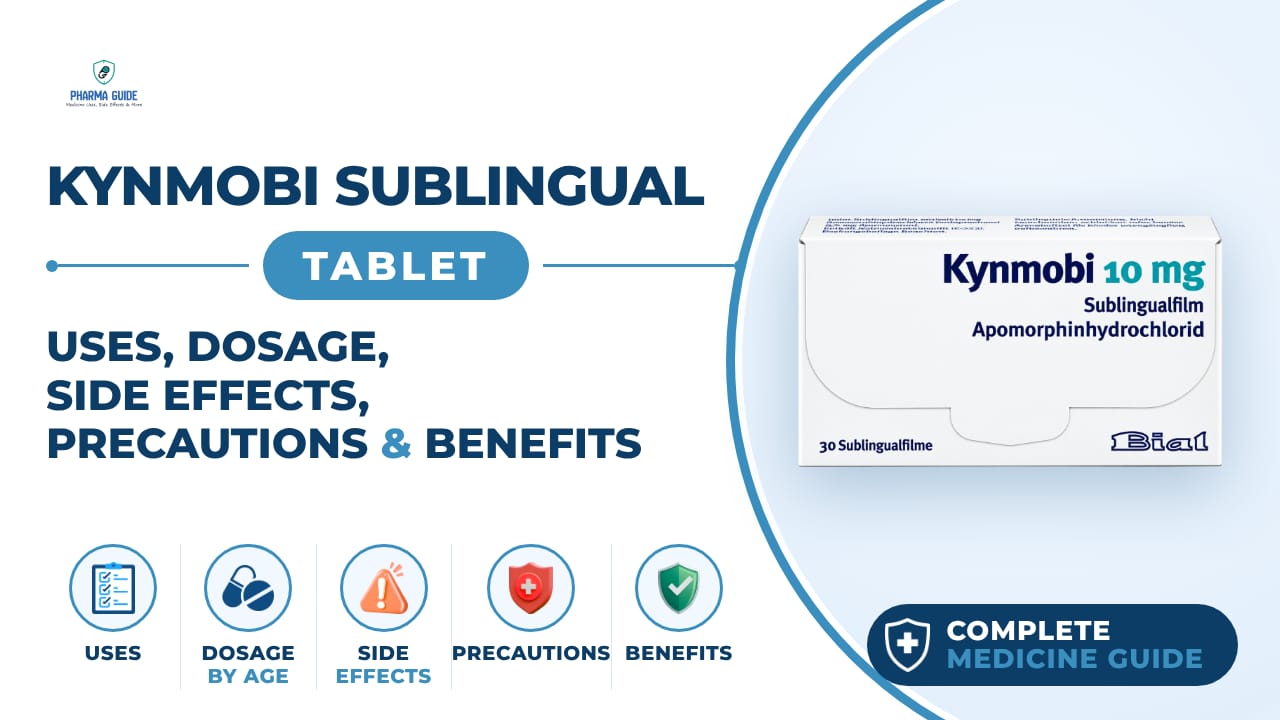
| Generic name | apomorphine hydrochloride |
|---|---|
| Drug class | Dopaminergic antiparkinsonism agents (dopamine agonist) |
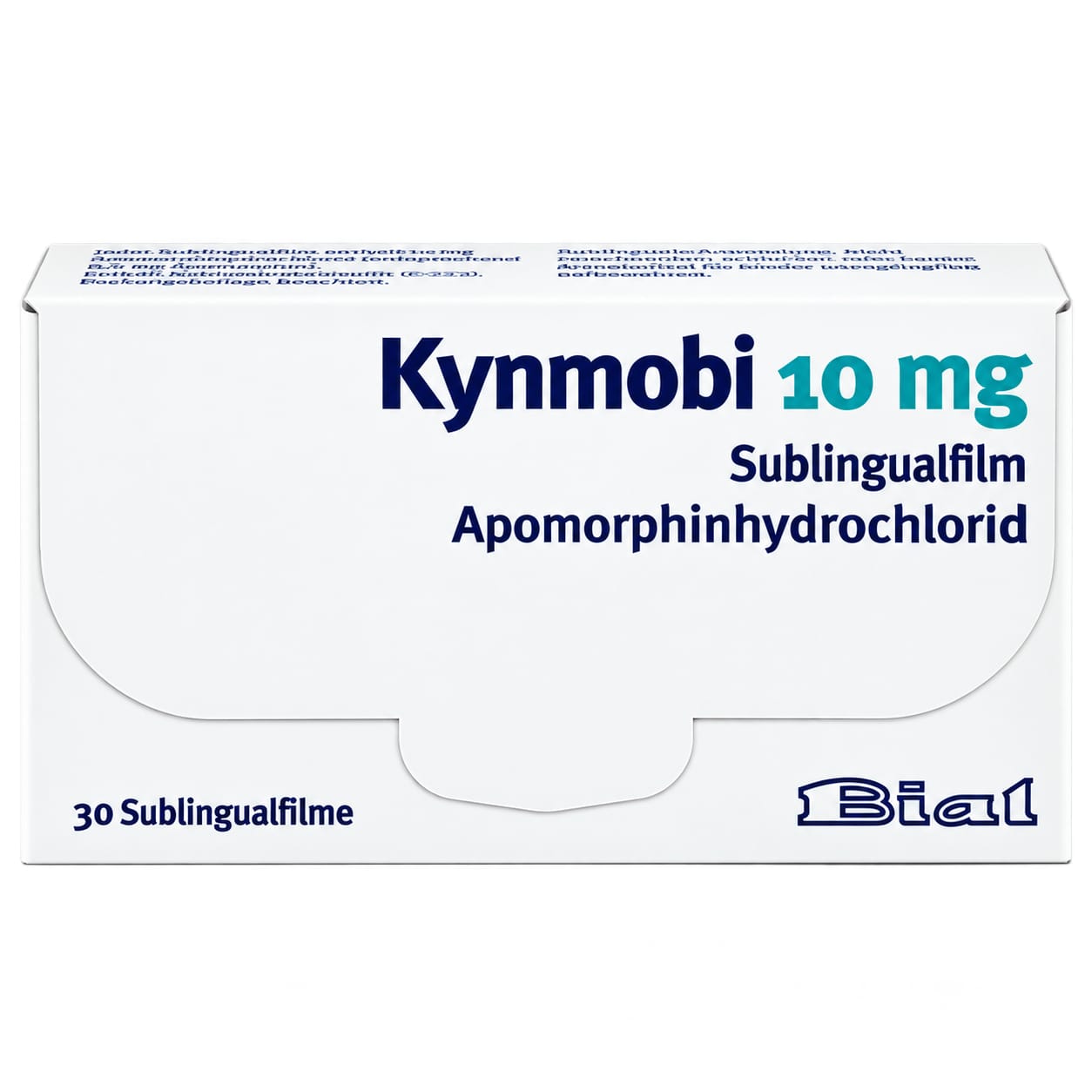
| Forms | Sublingual film |
Quick overview
Kynmobi Sublingual Tablet contains apomorphine hydrochloride, a dopaminergic antiparkinsonism agent (dopamine agonist). It is a prescription sublingual film used for the short-term, as-needed treatment of 'OFF' episodes in adults with Parkinson's disease, when symptoms like stiffness, slow movement, or trouble walking return as regular Parkinson's medicine wears off. It works by activating dopamine receptors in the brain to help restore normal movement.
What is Kynmobi Sublingual Tablet
Kynmobi is a prescription sublingual film (dissolved under the tongue) used for the short-term, as-needed treatment of 'OFF' episodes in adults with Parkinson's disease. 'OFF' episodes are times when Parkinson's symptoms like stiffness, slow movement, or trouble walking come back because regular Parkinson's medicine is wearing off.
Kynmobi Sublingual Tablet uses
- Short-term, intermittent treatment of 'OFF' episodes in adults with Parkinson's disease
- Treats sudden OFF episodes associated with Parkinson's disease
- Helps improve movement during temporary mobility difficulties
- Reduces muscle stiffness and slowness
- Helps manage unpredictable motor fluctuations
- Provides intermittent treatment for symptoms that occur when regular Parkinson's medications wear off
Benefits of Kynmobi Sublingual Tablet
- Acts quickly to help transition patients from an 'OFF' to an 'ON' state
- Given as a soluble film placed under the tongue, avoiding injections or infusion devices
- Available in multiple strengths so patients take only a single film per dose
- Can be used in people with mild-to-moderate kidney or liver disease
- May provide relatively rapid improvement in Parkinson's OFF symptoms
- Helps restore mobility during temporary movement difficulties
How Kynmobi Sublingual Tablet works
Kynmobi is a dopamine agonist. It isn't exactly known how it helps with Parkinson's movement problems, but it is thought to work by turning on dopamine receptors in the part of the brain that controls movement. By improving muscle control and reducing stiffness, it allows more normal body movements as symptoms are reduced.
Kynmobi Sublingual Tablet dosage
Read the step-by-step Instructions for Use that comes with your prescription and take the medicine exactly as your healthcare provider tells you. Drink water before taking each film to moisten your mouth, which helps the film dissolve more easily. Open the foil pouch and hold the film by its edges; do not remove it from the pouch until you are ready to use it. Place the entire film as far back under your tongue as possible and close your mouth. Do not cut, chew, or swallow the film; it must dissolve completely, which takes about 3 minutes. Do not swallow your saliva or talk while the film is dissolving, as this can affect how well the medicine is absorbed. You may swallow once the film has completely dissolved; no liquid is needed to take the dose.
Do not use more than one dose to treat a single 'OFF' episode. Wait at least 2 hours before taking another dose, and do not use more than 5 doses in a day. Do not change your dose or stop taking it suddenly without talking to your doctor first. If you also use sublingual nitroglycerin, lie down before and after taking it. Your doctor may have you take an anti-nausea medicine before and during treatment to help prevent nausea and vomiting. Safety and effectiveness have not been established in children.
| Age group | Dose |
|---|---|
| 18–39 years | Starting dose: 10 mg; maintenance 10–30 mg per dose |
| 40–64 years | Starting dose: 10 mg; maintenance 10–30 mg per dose |
| 65–74 years | Starting dose: 10 mg; maintenance 10–30 mg per dose, with closer monitoring |
| 75 years and older | Starting dose: 10 mg; maintenance 10–30 mg per dose, with careful monitoring of tolerability |
Available forms and strengths
- Sublingual film
Side effects of Kynmobi Sublingual Tablet
Common
- Nausea and vomiting
- Mouth or tongue irritation, redness, swelling, pain, numbness, ulcers, or dry mouth
- Dizziness
- Sleepiness (somnolence) or falling asleep during the day
- Fatigue, headache, yawning, and runny nose
- Falls and injuries from falling
- Dyskinesia (involuntary, uncontrolled movements)
- Orthostatic hypotension (dizziness, lightheadedness, or fainting when standing up)
- Excessive sweating
Serious
- Severe allergic reactions: hives, itching, rash, swelling of lips/tongue/mouth, facial flushing, throat tightness, trouble breathing or swallowing
- Sudden daytime sleepiness or falling asleep without warning during activities like talking, eating, or driving
- Hallucinations or psychotic-like behavior: seeing or hearing things that aren't real, confusion, excessive suspicion, aggressive behavior, agitation, delusions, disorganized thinking
- New or intense urges such as gambling, hypersexuality, compulsive shopping, or binge eating
- High fever, stiff muscles, confusion, and changes in breathing or heartbeat if the dose is suddenly lowered or stopped
- Heart problems: shortness of breath, fast heartbeat, chest pain, or feeling faint
- Tissue changes (fibrotic complications) in the pelvis, lungs, or heart valves
- Prolonged, painful erections (priapism) lasting more than 4 hours
- Abnormal heart rhythm (QT prolongation), especially with risk factors like low heart rate or low potassium/magnesium
- Hemolytic anemia symptoms: back/leg/stomach pain, bleeding gums, chills, dark urine, fever, loss of appetite, nosebleeds, pale skin, sore throat, yellowing of eyes or skin
Warnings and precautions
- Do not take Kynmobi with 5HT3 antagonist anti-nausea medicines like ondansetron, granisetron, dolasetron, palonosetron, or alosetron, as this combination can cause dangerously low blood pressure and loss of consciousness
- Kynmobi contains a sulfite (sodium metabisulfite) that can cause severe, life-threatening allergic reactions in some people, especially those with asthma
- Do not stop taking Kynmobi or change your dose suddenly without your doctor's guidance, as this can cause a serious reaction with high fever, stiff muscles, confusion, and changes in breathing and heartbeat
- The film must be placed whole under the tongue and allowed to dissolve completely — never cut, chew, or swallow it
- If you take sublingual nitroglycerin while using Kynmobi, your blood pressure may drop and cause dizziness; lie down before and after taking the nitroglycerin
- Kynmobi can cause hallucinations or worsen psychotic-like behavior, including confusion, suspicion, aggression, agitation, delusions, and disorganized thinking
- Some people develop strong, uncontrollable urges such as gambling, increased sexual urges, or compulsive spending while taking Kynmobi
- It is not known if Kynmobi will harm an unborn baby. Discuss with your healthcare provider if you are pregnant or planning to become pregnant.
- It is not known if Kynmobi passes into breast milk. You and your healthcare provider should decide together whether you should take Kynmobi or breastfeed.
- Use with caution if you have kidney disease. In mild or moderate kidney disease, the medicine may stay in the body longer, increasing effects; in severe kidney disease, caution is advised due to greater risk of side effects.
- Use with caution if you have liver disease. In mild to moderate liver disease, the medicine may stay in the body longer; in severe liver disease, there may be an increased risk of side effects.
- Do not drink alcohol while taking Kynmobi, as it can increase the chance of serious side effects.
- Do not drive, operate machinery, or do other dangerous activities until you know how Kynmobi affects you, since it can cause sudden sleepiness or falling asleep without warning.
Storage
- Store at room temperature between 68°F to 77°F (20°C to 25°C)
- Store the film in the foil pouch until you are ready to take it
- Keep from freezing
- Keep medicines out of the reach of children and pets
- Do not keep outdated medicine or medicine no longer needed
- Ask your healthcare professional how to dispose of any medicine you do not use
When to see a doctor
- Get emergency help right away for signs of a severe allergic reaction, such as hives, itching, rash, swelling of the lips/tongue/mouth, facial flushing, throat tightness, or trouble breathing or swallowing
- Get emergency help right away if you have shortness of breath, fast heartbeat, chest pain, or feel like you might pass out
- Call your healthcare provider or go to the nearest emergency room right away if you have a prolonged, painful erection
- Stop treatment and call your healthcare provider right away before taking another dose if you experience any of the serious symptoms listed, such as hallucinations, high fever and confusion, or heart problems
- Call your doctor right away if you notice mouth redness, swelling, sores, pain, or dryness that is bothersome
- Check with your doctor right away if you have chest pain or discomfort, pain in the arms, jaw, back, or neck, trouble breathing, nausea, sweating, or vomiting, as these may signal a heart problem
- Check with your doctor right away if you notice signs of a possible blood problem, including back, leg, or stomach pain, bleeding gums, chills, dark urine, fever, loss of appetite, nosebleeds, pale skin, sore throat, or yellowing of the eyes or skin
Alternatives
- Rotigotine
- Inhaled Levodopa
- Levodopa
- Apomorphine Injection
Watch the video
FAQs
What is Kynmobi Sublingual Tablet used for?
Kynmobi is used for the short-term, as-needed treatment of 'OFF' episodes in adults with Parkinson's disease, when symptoms like stiffness, slow movement, or trouble walking return as regular Parkinson's medicine wears off.
How do you take Kynmobi Sublingual Tablet?
Drink water to moisten your mouth, then place the whole film as far back under your tongue as possible. Do not cut, chew, or swallow it; let it dissolve completely, which takes about 3 minutes, without talking or swallowing saliva during this time.
How many doses of Kynmobi can be taken in a day?
Only one dose should be used per 'OFF' episode. Wait at least 2 hours before taking another dose, and do not use more than 5 doses in a day.
What are the common side effects of Kynmobi?
Common side effects include nausea and vomiting, mouth or tongue irritation, dizziness, sleepiness, fatigue, headache, yawning, runny nose, falls, dyskinesia, orthostatic hypotension, and excessive sweating.
Can Kynmobi be taken with certain anti-nausea medicines?
No, Kynmobi should not be taken with 5HT3 antagonist anti-nausea medicines like ondansetron, granisetron, dolasetron, palonosetron, or alosetron, as this combination can cause dangerously low blood pressure and loss of consciousness.
General information, not medical advice
Your prescriber and the leaflet in your pack know your situation. This page does not.
- Follow your prescriber and the leaflet
- Don't start, stop, or change a dose on your own
- Doses and warnings differ by country and product
Sources
Video
Related medicines

Injectafer Injection: Uses, Dosage, Side Effects, Precautions and Alternates
Iron products
Injectafer (ferric carboxymaltose) treats iron deficiency anemia and heart failure-related iron deficiency via IV. Learn uses, dosage, side effects, and

Gliclazide Tablet: Uses, Dosage, Side Effects, Precautions and Alternates
Sulfonylurea (hypoglycemic/antidiabetic agent)
Gliclazide Tablet is a sulfonylurea for type 2 diabetes that boosts insulin release. Learn about dosage, side effects, warnings, and precautions.