
Safety
General information, not medical advice
Your prescriber and the leaflet in your pack know your situation. This page does not.
- Follow your prescriber and the leaflet
- Don't start, stop, or change a dose on your own
- Doses and warnings differ by country and product
Lasix Injection: Uses, Dosage, Side Effects, Precautions and Alternates

| Generic name | furosemide (frusemide) |
|---|---|
| Drug class | Loop diuretic |
| Forms | Injection (ampoules), Tablets, Oral solution |
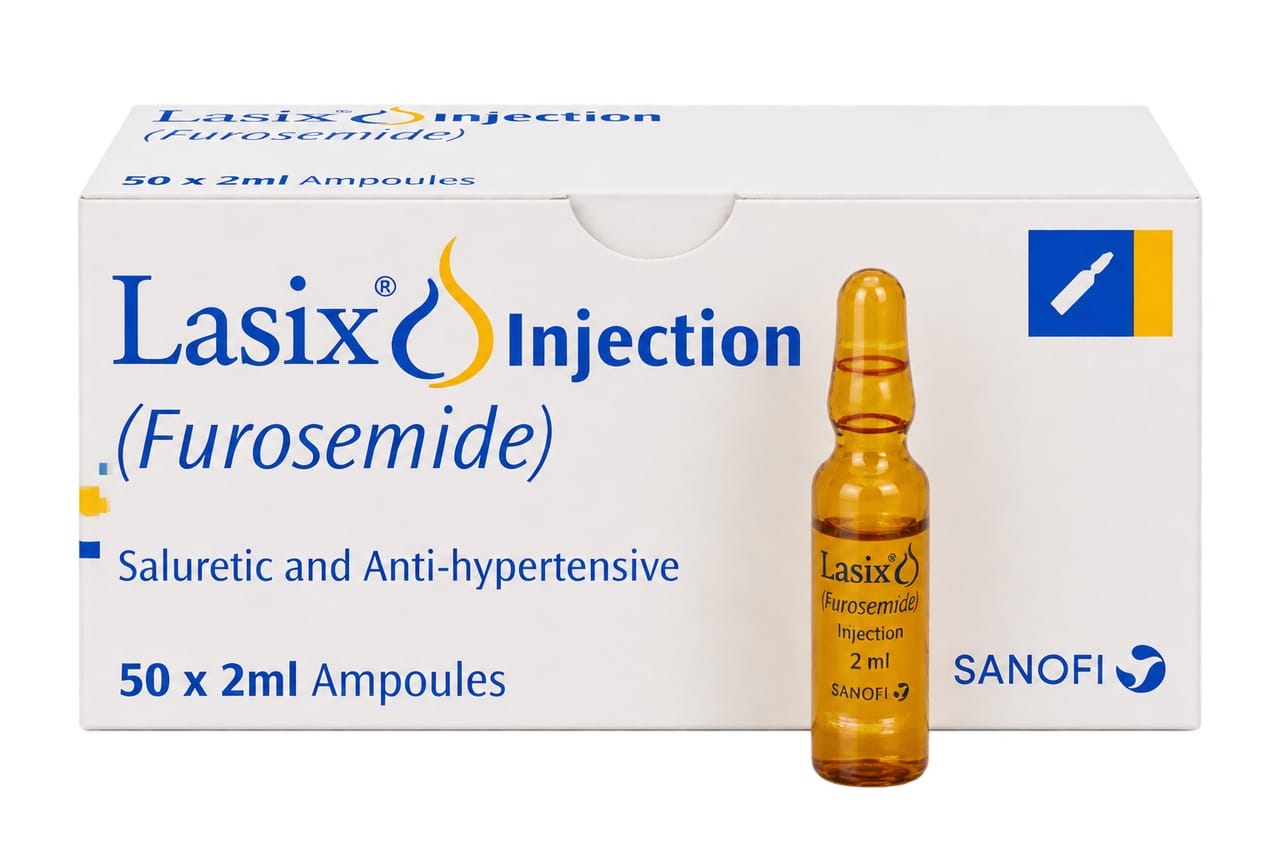
Quick overview
Lasix Injection (furosemide) is a strong water pill, or loop diuretic, that helps the body get rid of extra fluid by increasing urine production. It is normally given by a doctor or nurse in a hospital setting to treat fluid buildup caused by conditions such as heart failure, liver disease, or kidney problems, and to help manage high blood pressure.
What is Lasix Injection
Lasix is a strong water pill (diuretic) that helps your body get rid of extra fluid by increasing the amount of urine you produce. The injection form is normally given to you by a doctor or nurse in a hospital.
Lasix Injection uses
- Treating fluid buildup (edema) in the ankles, feet, legs, lungs, or brain caused by heart failure, liver disease (like cirrhosis), or kidney problems including nephrotic syndrome
- Treating high blood pressure (hypertension), alone or together with other blood pressure medicines
Benefits of Lasix Injection
- Fluid Removal: Helps remove excess fluid from the body.
- Edema Relief: Helps reduce swelling caused by fluid retention.
- Heart Failure Support: Helps manage fluid overload in heart failure.
- Blood Pressure Control: Helps lower blood pressure in some patients.
- Kidney Support: Helps manage fluid balance in certain kidney conditions.
How Lasix Injection works
Lasix works by stopping the kidneys from reabsorbing too much salt, so the extra salt and water are passed out in your urine, reducing fluid buildup in the body.
Lasix Injection dosage
Lasix injections are normally given by doctors or nurses in hospital, who will tell you how long the injection will take and how many doses you may need. Your doctor will decide the dose and schedule that is most suitable for you based on your condition and response.
If you are being treated for high blood pressure, keep using Lasix even if you feel well, since high blood pressure often has no symptoms. Continue treatment for as long as your doctor tells you; do not stop suddenly or change the dose without checking with your doctor.
Tell your surgeon or dentist ahead of time if you are using Lasix, especially before any surgery needing general anaesthesia, because your blood pressure may drop suddenly.
| Age group | Dose |
|---|---|
| Children | 1 mg/kg IV/IM (dose adjusted according to response and medical condition) |
| Adults (18–64 Years) | 20–40 mg IV/IM initially, adjusted as needed |
| Older Adults (65+ Years) | 20 mg IV/IM initially, adjusted based on response and kidney function |
Available forms and strengths
- Injection (ampoules)
- Tablets
- Oral solution
Side effects of Lasix Injection
Common
- Headache
- Dizziness or light-headedness
- Drowsiness or lack of energy
- Restlessness
- Confusion
- Fever
- Ringing or buzzing in the ears
- Blurred or impaired vision
- Very dry mouth or unusual thirst
- Vomiting or feeling sick (nausea)
- Diarrhoea
- Unusual bleeding or bruising under the skin
- Calf muscle spasms
- Weakness or tiredness
- Muscle pains or cramps
- Numbness or tingling in the hands and/or feet
- Weight loss
- Constipation
Serious
- Increased urination
- Dizziness
- Low blood pressure
- Dehydration
- Low potassium levels
- Low sodium levels
Warnings and precautions
- Do not take Lasix if you are pregnant. It is not recommended during pregnancy, but if there is a strong need, your doctor will discuss the risks and benefits with you.
- Do not take Lasix if you are breastfeeding or planning to breastfeed, because the drug passes into breast milk and may affect your baby. It may also reduce your milk supply.
- Tell your doctor if you have kidney problems, are passing little or no urine, or have difficulty passing urine, since Lasix may not be safe or may need close monitoring in these cases.
- Tell your doctor about any liver problems, cirrhosis, jaundice, or hepatic coma, as these can affect whether Lasix is safe for you.
- It is not recommended to drink alcohol while taking Lasix, since alcohol can worsen dizziness or light-headedness.
- Lasix can cause dizziness or light-headedness, so be careful driving or using machinery until you know how the medicine affects you, and do not drive if this happens.
- Do not use Lasix if you are unable to urinate or produce urine, as this is a contraindication.
- Taking more than the recommended dose will not make the medicine work better, and high doses can cause permanent hearing loss.
- If you are having any imaging scan with an injected contrast dye, tell your doctor, since combining Lasix with the dye can harm your kidneys.
- Do not eat large amounts of liquorice or take large amounts of laxatives while using Lasix, as this can worsen electrolyte loss.
- Excessive fluid loss from Lasix can cause dehydration and low blood volume, which may lead to circulatory collapse, especially in elderly patients.
Storage
- Lasix injection is usually stored in the pharmacy or on the ward in a cool dry place, protected from light, where the temperature stays below 25°C
- Keep medicines where children cannot reach them
- If your doctor tells you to stop taking Lasix or the medicine has passed its expiry date, ask your pharmacist what to do with any that is left over
- Return any unused medicine to your pharmacist for safe disposal
- Do not use the medicine if the packaging is torn or shows signs of tampering, or after the expiry date
When to see a doctor
- Get emergency help right away if you have signs of a serious allergic reaction such as rash, itching, hives, swelling of the face, lips, tongue, or difficulty breathing.
- Go to the emergency department right away if you have chest pain, fainting, a rapid weak pulse, lockjaw, or yellowing of the skin or eyes.
- Call your doctor straight away if you become pregnant while taking this medicine.
- Call your doctor straight away if you have excessive vomiting or diarrhea, or symptoms of dehydration such as dry mouth, thirst, fainting, weakness, muscle cramps, fast heartbeat, or passing less urine than normal.
- If you think you have taken too much Lasix, seek urgent medical attention even if you feel fine, as overdose can cause confusion, dehydration, and dizziness.
Alternatives
- Bumetanide
- Metolazone
- Hydrochlorothiazide
Watch the video
FAQs
What is Lasix Injection used for?
It is used to treat fluid buildup (edema) caused by heart failure, liver disease like cirrhosis, or kidney problems including nephrotic syndrome, and to treat high blood pressure alone or with other blood pressure medicines.
How does Lasix Injection work?
It works by stopping the kidneys from reabsorbing too much salt, so the extra salt and water are passed out in urine, reducing fluid buildup in the body.
What is the dosage of Lasix Injection for adults?
Adults aged 18-64 years typically receive 20-40 mg IV/IM initially, which is adjusted as needed by the doctor based on condition and response.
What are the common side effects of Lasix Injection?
Common side effects include headache, dizziness, drowsiness, confusion, dry mouth, nausea, diarrhoea, muscle cramps, weakness, and numbness or tingling in the hands or feet.
Can I take Lasix Injection while pregnant or breastfeeding?
Lasix is not recommended during pregnancy unless there is a strong need, and it should not be used while breastfeeding since it passes into breast milk and may affect the baby or reduce milk supply.
General information, not medical advice
Your prescriber and the leaflet in your pack know your situation. This page does not.
- Follow your prescriber and the leaflet
- Don't start, stop, or change a dose on your own
- Doses and warnings differ by country and product
Sources
Video
Related medicines

Bumetanide Tablet: Uses, Dosage, Side Effects, Precautions and Alternates
loop diuretic
Bumetanide Tablet is a loop diuretic that treats fluid buildup from heart, liver, or kidney problems. Learn uses, dosage, side effects, and precautions.

Furosemide Injection: Uses, Dosage, Side Effects, Precautions and Alternates
Loop diuretic
Furosemide Injection is a loop diuretic for rapid treatment of edema and high blood pressure when oral medicine isn't possible. Learn dosage, uses, and side