
Safety
General information, not medical advice
Your prescriber and the leaflet in your pack know your situation. This page does not.
- Follow your prescriber and the leaflet
- Don't start, stop, or change a dose on your own
- Doses and warnings differ by country and product
Lunsumio Injection: Uses, Dosage, Side Effects, Precautions and Alternates
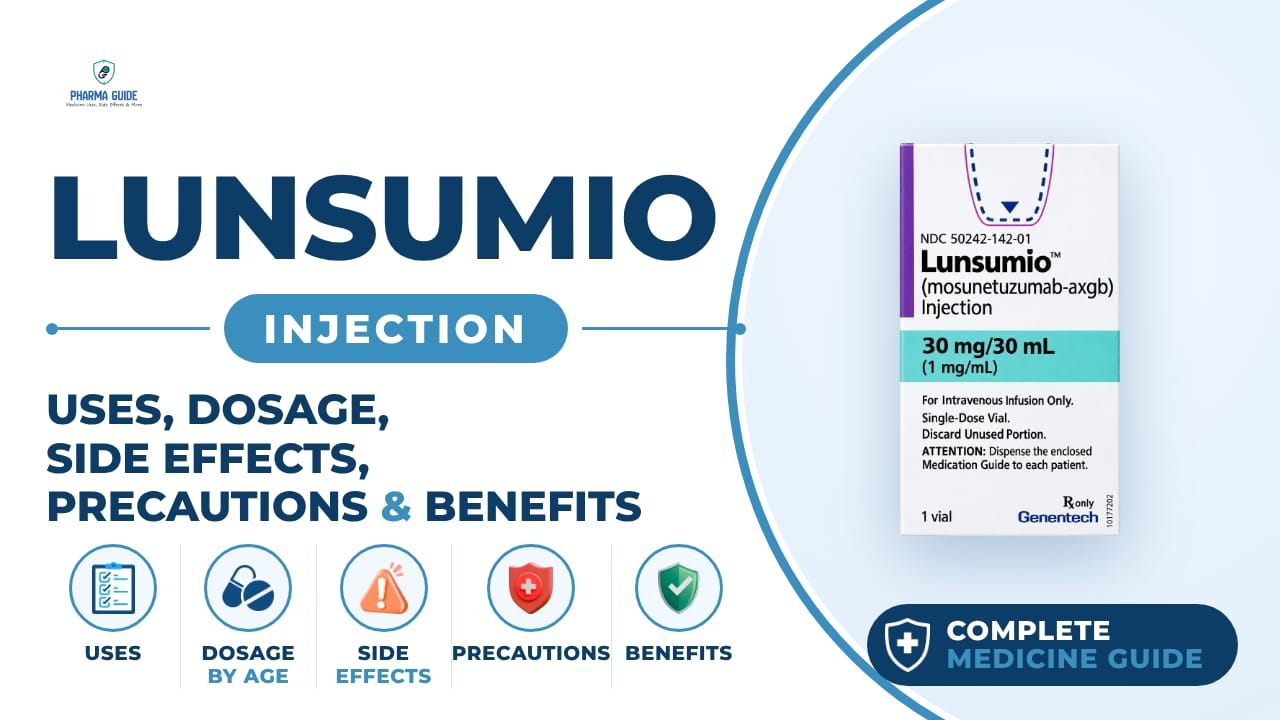
| Generic name | mosunetuzumab |
|---|---|
| Drug class | Bispecific T-cell engager (BiTE); monoclonal antibody |
| Forms | Injection |
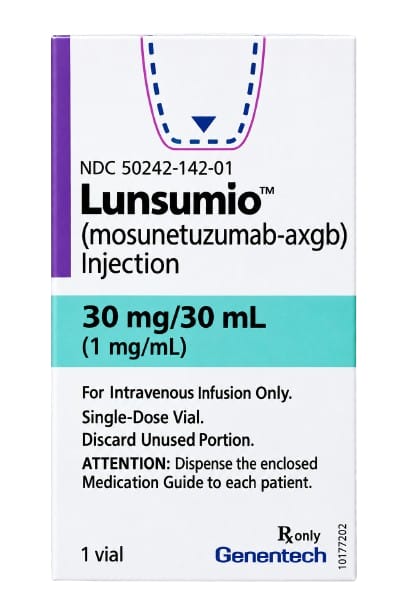
Quick overview
Lunsumio Injection (mosunetuzumab) is a bispecific T-cell engager, a type of monoclonal antibody, used to treat adults with follicular lymphoma that has returned or did not respond to previous treatment. It is given as an infusion into a vein by a healthcare professional in a hospital or clinic. It works by bringing cancerous B cells and the body's immune T cells together so the T cells can attack the cancer. Treatment carries risks such as cytokine release syndrome and serious infections, which require close monitoring.
What is Lunsumio Injection
Lunsumio contains mosunetuzumab, a type of antibody medicine used to treat cancer. It is given as a drip (infusion) into a vein by a healthcare professional in a hospital or clinic.
Lunsumio Injection uses
- Treatment of adults with follicular lymphoma (FL) whose cancer has come back or did not respond to previous treatment, after at least two prior treatments
Benefits of Lunsumio Injection
- Can produce a complete response (cancer no longer detected) in many patients
- Can shrink or control the cancer (objective response) in most patients treated
- Responses can last many months to years in some patients
How Lunsumio Injection works
Lunsumio is a bispecific antibody that attaches to two types of cells at once: cancerous B cells (via a marker called CD20) and the body's own immune T cells (via a marker called CD3). By bringing these two cells together, it activates the T cells to attack and destroy the cancerous B cells.
Lunsumio Injection dosage
Lunsumio is given as a drip (infusion) into a vein by a healthcare professional. You will be well-hydrated before each infusion. You may be given other medicines 30 to 60 minutes before each infusion to help prevent infusion reactions and fever, which may include corticosteroids, paracetamol, and an antihistamine.
Treatment is given in repeating 21-day cycles. The first cycle is given over a longer infusion time; later infusions may be given faster if earlier ones were well tolerated.
If you miss an appointment, make another one as soon as possible, since missing a dose could make treatment less effective. Do not stop treatment on your own without discussing it with your doctor, as stopping may make your condition worse. This medicine is not for use in children or adolescents under 18.
| Age group | Dose |
|---|---|
| Under 18 years | Not recommended |
| 18–64 years | 30 mg, once days |
| 65+ years | 30 mg, once days |
Available forms and strengths
- Injection
Side effects of Lunsumio Injection
Common
- Rash
- Itchy skin
- Dry skin
- Diarrhea
- Headache
- Fever
- Chills
- Tiredness
- Muscle and joint pain
- Cough
- Nausea
- Low levels of white blood cells (neutropenia)
- Low red blood cell counts (anaemia)
- Low platelet counts (thrombocytopenia)
- Low levels of phosphate, potassium or magnesium
- Upper respiratory tract infection
- Urinary tract infection
- Numbness, tingling, or pain in hands or feet (peripheral neuropathy)
Serious
- Cytokine release syndrome (CRS)
- Neurologic problems, including immune effector cell-associated neurotoxicity syndrome (ICANS)
- Serious infections, including pneumonia and sepsis
- Hemophagocytic lymphohistiocytosis (HLH), a rare overactive immune reaction
- Tumour lysis syndrome
- Tumour flare (worsening of tumour-related symptoms)
- Severe low blood cell counts
- Severe allergic reactions
Warnings and precautions
- This medicine can cause cytokine release syndrome (CRS), a serious reaction to treatment that can be life-threatening. Signs include fever, chills, low blood pressure, fast heartbeat, and difficulty breathing. You will be given medicines beforehand to help lower this risk, and your doctor will monitor you closely, especially during the first cycle.
- Serious infections, including life-threatening ones like pneumonia and sepsis, can occur during treatment. Do not receive this medicine if you currently have an active infection.
- As the cancer breaks down, you may experience tumour flare, where tumour sites become painful or swollen, or tumour lysis syndrome, where fast breakdown of cancer cells changes your blood chemistry and can affect your kidneys, heart or liver.
- Serious and sometimes life-threatening nervous system problems can occur, including confusion, seizures, tremors, and loss of consciousness.
- A rare but serious condition called hemophagocytic lymphohistiocytosis (HLH), involving extreme overactivity of the immune system, has occurred and has led to death in some patients.
- Live or live-attenuated vaccines should not be given at the same time as this medicine.
- Lunsumio is not recommended during pregnancy, as it may harm an unborn baby. Women who could become pregnant should use effective birth control during treatment and for 3 months after the last dose.
- Breastfeeding should be stopped during treatment and for at least 3 months after the last dose, since it is not known if the medicine passes into breast milk.
- No dose changes are needed for mild to moderate kidney problems. The medicine has not been studied in people with severe kidney impairment.
- No dose changes are considered necessary based on available data, though the medicine has not been specifically studied in people with liver impairment.
- This medicine has a minor effect on your ability to drive or use machines. If you feel dizzy, confused, shaky, or sleepy, or have any symptoms that affect your alertness, do not drive or use machines until these symptoms go away.
Storage
- Store in a refrigerator (2°C – 8°C)
- Do not freeze
- Keep the vial in the outer carton to protect from light
- The diluted solution should not be kept more than 24 hours at 2°C – 8°C or 24 hours at room temperature (9°C – 30°C)
- This medicine is stored and handled by healthcare professionals at the hospital or clinic; you will not store it at home
- Any unused medicine will be disposed of appropriately by your healthcare provider to help protect the environment
When to see a doctor
- Get medical help right away if you develop a fever, chills, low blood pressure, a fast or irregular heartbeat, tiredness, difficulty breathing, headache, confusion, anxiety, dizziness, or nausea and vomiting — these may be signs of cytokine release syndrome.
- Tell your doctor right away if you have signs of a nervous system problem, such as headache, numbness or tingling, confusion, trouble speaking or understanding, memory problems, tremors, seizures, loss of balance, or loss of consciousness.
- Tell your doctor right away if you have signs of an infection, such as fever, cough, chest pain, tiredness, shortness of breath, a painful rash, sore throat, or pain when passing urine.
- Tell your doctor if you notice tender or swollen lymph nodes, chest pain, cough, trouble breathing, or pain or swelling at a tumour site, as these can be signs of tumour flare.
- Seek emergency help for signs of a severe allergic reaction, such as hives, trouble breathing, or swelling of the face, lips, mouth, tongue, or throat.
Alternatives
- Epkinly
- Columvi
Watch the video
FAQs
What is Lunsumio Injection used for?
Lunsumio is used to treat adults with follicular lymphoma that has come back or did not respond to previous treatment, after at least two prior treatments.
How does Lunsumio Injection work?
Lunsumio is a bispecific antibody that attaches to cancerous B cells (via CD20) and immune T cells (via CD3) at the same time, bringing them together so the T cells can attack and destroy the cancer cells.
How is Lunsumio Injection given?
It is given as an infusion into a vein by a healthcare professional in a hospital or clinic, in repeating 21-day cycles. You will be hydrated and may receive medicines like corticosteroids, paracetamol, and an antihistamine before each infusion to help prevent reactions.
What are the serious side effects of Lunsumio Injection?
Serious side effects include cytokine release syndrome, neurologic problems such as ICANS, serious infections like pneumonia and sepsis, hemophagocytic lymphohistiocytosis, tumour lysis syndrome, tumour flare, severe low blood cell counts, and severe allergic reactions.
Can Lunsumio Injection be used during pregnancy?
Lunsumio is not recommended during pregnancy as it may harm an unborn baby. Women who could become pregnant should use effective birth control during treatment and for 3 months after the last dose.
General information, not medical advice
Your prescriber and the leaflet in your pack know your situation. This page does not.
- Follow your prescriber and the leaflet
- Don't start, stop, or change a dose on your own
- Doses and warnings differ by country and product
Sources
Video
Related medicines

Injectafer Injection: Uses, Dosage, Side Effects, Precautions and Alternates
Iron products
Injectafer (ferric carboxymaltose) treats iron deficiency anemia and heart failure-related iron deficiency via IV. Learn uses, dosage, side effects, and

Gliclazide Tablet: Uses, Dosage, Side Effects, Precautions and Alternates
Sulfonylurea (hypoglycemic/antidiabetic agent)
Gliclazide Tablet is a sulfonylurea for type 2 diabetes that boosts insulin release. Learn about dosage, side effects, warnings, and precautions.