
Safety
General information, not medical advice
Your prescriber and the leaflet in your pack know your situation. This page does not.
- Follow your prescriber and the leaflet
- Don't start, stop, or change a dose on your own
- Doses and warnings differ by country and product
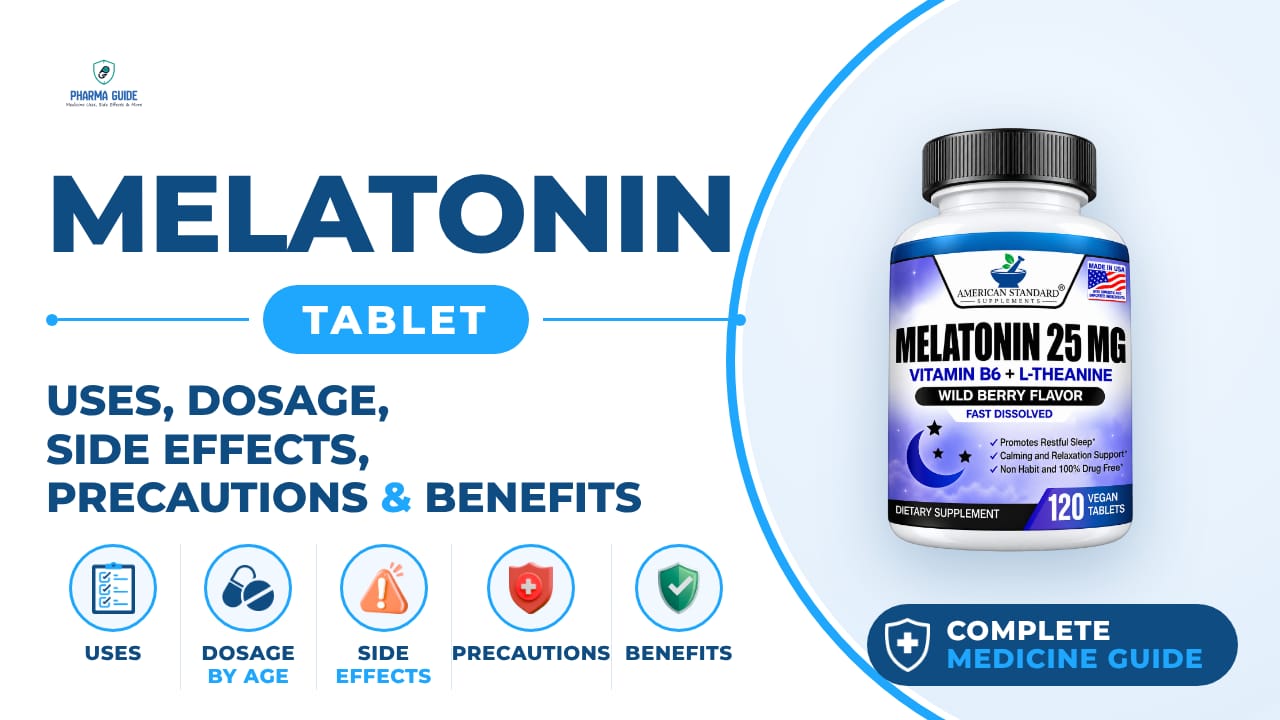
Melatonin Tablet: Uses, Dosage, Side Effects, Precautions and Alternates
| Generic name | melatonin |
|---|---|
| Drug class | Melatonin Receptor Agonist |
| Forms | Prolonged release tablets, Film-coated tablets, Tablets, Capsules, Gummies, Liquids |
Quick overview
Melatonin Tablet (generic name: melatonin) is a Melatonin Receptor Agonist used for short-term treatment of jet lag, insomnia in certain children and adolescents, and for improving sleep quality in older adults. It works by acting on brain receptors that regulate the body's internal clock. Dosing is based on age group, and the medicine carries specific warnings, precautions, and possible side effects that should be reviewed before use.
What is Melatonin Tablet
Melatonin is a hormone made naturally by the body's pineal gland that helps control your sleep-wake cycle. Melatonin tablets contain a man-made version of this hormone and are used to help with sleep problems.
Melatonin Tablet uses
- Short-term treatment of jet lag in adults
- Insomnia in children and adolescents (6 to 17 years old) with ADHD, where other healthy sleeping routines have not worked well enough
- Treatment of insomnia in children and adolescents aged 2-18 with Autism Spectrum Disorder (ASD) and/or Smith-Magenis syndrome, where sleep hygiene measures have been insufficient
- Improving sleep quality and morning alertness in patients over 55 years of age with poor quality of sleep
Benefits of Melatonin Tablet
- Helps improve sleep disorders in blind children and adults
- Appears to reduce the length of time needed to fall asleep in young adults and children who have trouble falling asleep
- Helpful for disturbed sleep-wake cycles in children and adolescents with intellectual disabilities, autism, and other central nervous system disorders
- Appears to shorten the time it takes for children with developmental disabilities to fall asleep
- May improve sleep quality in people with reduced rapid-eye movement (REM) sleep
How Melatonin Tablet works
Melatonin works by acting on receptors in the brain that control the body's internal clock, helping to regulate the sleep-wake cycle and increase the tendency to fall asleep.
Melatonin Tablet dosage
| Age group | Dose |
|---|---|
| Under 18 Years | Use only if recommended by a healthcare professional |
| Adults (18–64 Years) | 1–3 mg at bedtime; follow product or medical advice |
| Older Adults (65+ years) | 1–2 mg at bedtime; dose individualized by a healthcare professional |
Available forms and strengths
- Prolonged release tablets
- Film-coated tablets
- Tablets
- Capsules
- Gummies
- Liquids
Side effects of Melatonin Tablet
Common
- Headache
- Sleepiness/drowsiness
- Daytime drowsiness
- Dizziness
- Nausea
- Vivid dreams
- Irritability
- Stomach cramps or discomfort
- Short-term feelings of depression
Serious
- Hypersensitivity reaction with swelling of face, mouth, or tongue
- Chest pain
- Changes in the composition of blood which can cause yellowing of the skin and eyes
- Shingles
- Reduced number of white blood cells
- Reduced number of blood platelets
- Low calcium or sodium levels in the blood
- High level of blood fats
- Aggression, depression, or disorientation
- Fainting, memory impairment, or restless legs syndrome
- Visual impairment or blurred vision
- Chest pain due to angina or feeling your heartbeat
- Prolonged, possibly painful erection without sexual stimulation
Warnings and precautions
- Melatonin is not recommended for use during pregnancy or by women trying to become pregnant, as there is not enough information about its safety for the unborn baby.
- Melatonin is not recommended while breastfeeding because it passes into breast milk and the effects on the nursing baby are not known.
- People with kidney problems should use caution with melatonin, and your doctor may need to lower your dose.
- Melatonin is not recommended for people with liver problems because the liver breaks down melatonin, and impaired liver function can lead to higher levels of the drug in the body.
- Do not drink alcohol while taking melatonin, since it can reduce how well melatonin works for sleep and may also change how the tablet releases its dose.
- Melatonin can cause drowsiness, so you should avoid driving or using machinery until you know how it affects you.
- Melatonin is not recommended for people with autoimmune diseases because there is no clinical information on its use in this group.
- Combining melatonin with certain sleep medicines such as zaleplon, zolpidem, or zopiclone should be avoided because it can increase sedation and impair attention, memory, and coordination.
- Taking melatonin with fluvoxamine should be avoided, as it can greatly increase melatonin levels in the body.
- Using melatonin might increase the risk of having a seizure in some people.
- Melatonin can raise blood pressure in people who are already taking certain blood pressure medicines, so caution is needed.
- Melatonin can increase immune activity and may interfere with medicines that suppress the immune system, such as those used after organ transplants.
Storage
- Keep this medicine out of the sight and reach of children.
- Do not use this medicine after the expiry date which is stated on the carton and label after EXP.
- Store in the original package in order to protect from light.
- Do not throw away any medicines via wastewater or household waste. Ask your pharmacist how to throw away medicines you no longer use.
- Keep your tablets in the blister pack until it is time to take them.
- Keep MELATONIN away from sunlight.
- Keep the medicine in a cool dry place where the temperature stays below 25°C.
- Do not store it or any other medicine in the bathroom, near a sink, or on a window-sill.
- Do not leave it in the car.
- Store below 30ºC.
When to see a doctor
- Stop taking melatonin and contact a doctor right away if you have signs of an allergic reaction, such as swelling of the face, mouth, or tongue.
- Get medical help right away if you develop chest pain while taking melatonin.
- If you or your child has taken too much melatonin, contact a doctor, hospital, or pharmacist as soon as possible, even if there are no signs of discomfort.
- Talk to your doctor if you become pregnant while taking melatonin and stop taking the tablets.
Alternatives
- Doxylamine
- Diphenhydramine
- Ramelteon
Watch the video
FAQs
What is Melatonin Tablet used for?
It is used for short-term treatment of jet lag in adults, insomnia in children and adolescents with ADHD, ASD, or Smith-Magenis syndrome, and for improving sleep quality and morning alertness in people over 55 with poor sleep quality.
How does Melatonin Tablet work?
Melatonin works by acting on receptors in the brain that control the body's internal clock, helping to regulate the sleep-wake cycle and increase the tendency to fall asleep.
What is the dosage of Melatonin Tablet for adults?
Adults aged 18-64 years typically take 1-3 mg at bedtime, following product or medical advice. Older adults (65+) usually take 1-2 mg at bedtime, with the dose individualized by a healthcare professional.
What are the common side effects of Melatonin Tablet?
Common side effects include headache, sleepiness or drowsiness, daytime drowsiness, dizziness, nausea, vivid dreams, irritability, stomach cramps or discomfort, and short-term feelings of depression.
Can I drink alcohol while taking Melatonin Tablet?
No, you should not drink alcohol while taking melatonin, as it can reduce how well melatonin works for sleep and may also change how the tablet releases its dose.
General information, not medical advice
Your prescriber and the leaflet in your pack know your situation. This page does not.
- Follow your prescriber and the leaflet
- Don't start, stop, or change a dose on your own
- Doses and warnings differ by country and product
Sources
Video
Related medicines

Injectafer Injection: Uses, Dosage, Side Effects, Precautions and Alternates
Iron products
Injectafer (ferric carboxymaltose) treats iron deficiency anemia and heart failure-related iron deficiency via IV. Learn uses, dosage, side effects, and

Gliclazide Tablet: Uses, Dosage, Side Effects, Precautions and Alternates
Sulfonylurea (hypoglycemic/antidiabetic agent)
Gliclazide Tablet is a sulfonylurea for type 2 diabetes that boosts insulin release. Learn about dosage, side effects, warnings, and precautions.