
Safety
General information, not medical advice
Your prescriber and the leaflet in your pack know your situation. This page does not.
- Follow your prescriber and the leaflet
- Don't start, stop, or change a dose on your own
- Doses and warnings differ by country and product
Migranal Nasal Spray: Uses, Dosage, Side Effects, Precautions and Alternates

| Generic name | dihydroergotamine mesylate |
|---|---|
| Drug class | Ergot alkaloid / 5-HT1 receptor agonist (antimigraine agent) |
| Forms | Nasal Spray |
Quick overview
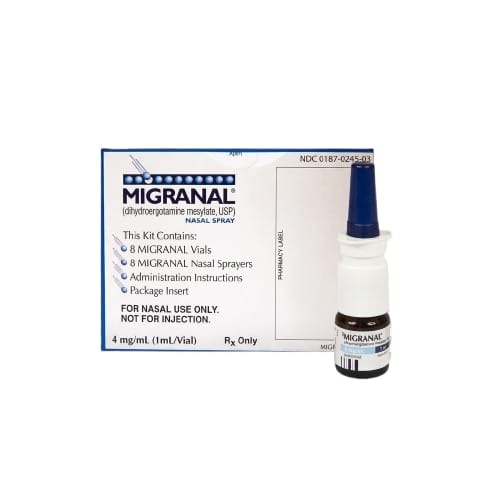
Migranal Nasal Spray contains dihydroergotamine mesylate, an ergot alkaloid that works as a 5-HT1 receptor agonist. It is a prescription nasal spray used to stop a migraine headache that has already started, and it is not used to prevent migraines or reduce how many attacks occur. It is intended for adults between 18 and 64 years of age.
What is Migranal Nasal Spray
Migranal is a prescription nasal spray used to stop a migraine headache that has already started. It is not used to prevent migraines and will not reduce how many attacks you have.
Migranal Nasal Spray uses
- Acute migraine with aura.
- Acute migraine without aura.
- Migraine-related headache.
- Migraine attacks with visual symptoms.
- Migraine attacks with sensitivity to light or sound.
Benefits of Migranal Nasal Spray
- Relieves migraine pain.
- Helps reduce headache severity.
- May relieve migraine-related discomfort.
- Helps manage migraine attacks.
- May improve daily functioning after migraine relief.
How Migranal Nasal Spray works
Migranal attaches to certain serotonin receptors on blood vessels in the brain, causing them to narrow (constrict), and it may also reduce inflammation-related pain signals from nerves. This narrowing of blood vessels is thought to relieve migraine pain.
Migranal Nasal Spray dosage
Use only in the nose; the spray solution must never be injected. Start treatment as soon as you notice the first signs of a migraine, but it can be used at any stage of an attack. Prime the sprayer by pumping it into the air (away from your face) before the first use of a new unit.
Spray once into each nostril, then wait 15 minutes, then spray once again into each nostril if needed. Do not tilt your head back or sniff through your nose while spraying or right after, so the medicine stays in the nose and is absorbed.
Each vial/bottle is for one treatment of one migraine attack only; do not save or reuse an opened vial or sprayer. An opened vial must be thrown away 8 hours after it was opened, even if not fully used.
This medicine can be used even if you have a stuffy nose, cold, or allergies, but check with your doctor if you are also taking cold or allergy medicine. It is not established as safe and effective for children, and it has not been studied in people over 65.
| Age group | Dose |
|---|---|
| Under 18 years | Not recommended |
| 18–64 years | 2 mg, once/day |
| 65+ years | Not recommended |
Available forms and strengths
- Nasal Spray
Side effects of Migranal Nasal Spray
Common
- Nasal congestion, irritation, burning, dryness, or soreness
- Altered sense of taste
- Sore throat
- Nausea, vomiting, diarrhea
- Dizziness
- Drowsiness/fatigue
- Runny nose
- Application site reactions
Serious
- Numbness, tingling, coldness, or pale appearance of fingers or toes
- Chest pain, pressure, or tightness, possibly spreading to jaw or shoulder, with nausea or sweating (possible heart attack)
- Muscle pain or cramps in arms and legs
- Weakness in the legs
- Temporary speeding or slowing of heart rate
- Swelling or itching
- Signs of a blood clot or stroke: sudden numbness or weakness on one side of the body, problems with vision or speech, pain or swelling in one leg
- Signs of an allergic reaction: hives, difficulty breathing, swelling of face, lips, tongue, or throat
- Severe stomach pain, weight loss, vomiting, constipation, bloody diarrhea, fever (possible bowel ischemia)
- Severe headache, blurred vision, pounding in neck or ears (possible blood pressure increase)
Warnings and precautions
- This medicine should not be used during pregnancy because it can harm the baby. Tell your doctor right away if you become pregnant while using it.
- Breastfeeding is not recommended while using this medicine, because it may pass into breast milk and cause serious problems in a nursing baby.
- This medicine should not be used by people with severely reduced kidney function or severely reduced liver function.
- This medicine can cause drowsiness or reduced alertness, so avoid driving or operating machinery until you know how it affects you.
- Using this medicine together with certain strong CYP3A4-inhibiting medicines (like some antibiotics and anti-HIV drugs) can cause serious, life-threatening reduced blood flow to the brain or limbs. Taking these combinations together is not allowed.
- This medicine should not be given to people with heart disease, including angina or a past heart attack, or to those with uncontrolled high blood pressure.
- Do not use this medicine together with triptan migraine medicines (like sumatriptan) or other ergot-type medicines within 24 hours of each other, because of the risk of additive blood vessel narrowing.
- Long-term daily use of ergot medicines (especially the injected form) has been linked to scarring (fibrosis) of the lungs, areas around the kidneys, or heart valves. This medicine should not be used for chronic daily treatment.
- This medicine should not be used for migraine with weakness on one side of the body (hemiplegic migraine) or migraine starting at the back of the head (basilar migraine).
- Do not use more medicine than directed, and never inject the nasal spray solution into the body.
Storage
- Store below 25°C (77°F)
- Do not refrigerate or freeze
- Keep medication in a safe place away from children
- Keep away from heat and light
- Once a vial has been opened, it must be thrown away after 8 hours
- Check the expiration date printed on the vial; do not use if it has passed
When to see a doctor
- Get emergency help right away if you have signs of a serious allergic reaction, such as hives, trouble breathing, or swelling of the face, lips, tongue, or throat.
- Call your doctor immediately if you notice numbness, tingling, or a cold or pale appearance in your fingers or toes, muscle pain or weakness in your arms or legs, chest pain or tightness, a change in heart rate, or swelling or itching.
- If you think you have used too much of this medicine, contact your doctor, go to a hospital emergency department, or contact your local poison control center right away.
- Seek medical attention for chest pain or pressure, pain spreading to the jaw or shoulder, nausea, or sweating, which may be signs of a heart attack.
Alternatives
- Eletriptan
- Rizatriptan
- Sumatriptan
Watch the video
FAQs
What is Migranal Nasal Spray used for?
It is a prescription nasal spray used to stop a migraine headache that has already started, including migraine with or without aura. It does not prevent migraines or reduce how many attacks occur.
How do you use Migranal Nasal Spray?
Spray once into each nostril, wait 15 minutes, then spray once again into each nostril if needed. Do not tilt your head back or sniff while spraying so the medicine stays in the nose.
How long can an opened vial of Migranal be used?
Each vial is for one treatment of one migraine attack only. An opened vial must be thrown away 8 hours after opening, even if not fully used.
Who should not use Migranal Nasal Spray?
It should not be used by people with severely reduced kidney or liver function, uncontrolled high blood pressure, or heart disease, and it is not recommended for those under 18 or over 65.
Can Migranal Nasal Spray be used with triptans like sumatriptan?
No, it should not be used with triptan migraine medicines or other ergot-type medicines within 24 hours of each other due to the risk of additive blood vessel narrowing.
General information, not medical advice
Your prescriber and the leaflet in your pack know your situation. This page does not.
- Follow your prescriber and the leaflet
- Don't start, stop, or change a dose on your own
- Doses and warnings differ by country and product
Sources
Video
Related medicines

Injectafer Injection: Uses, Dosage, Side Effects, Precautions and Alternates
Iron products
Injectafer (ferric carboxymaltose) treats iron deficiency anemia and heart failure-related iron deficiency via IV. Learn uses, dosage, side effects, and

Gliclazide Tablet: Uses, Dosage, Side Effects, Precautions and Alternates
Sulfonylurea (hypoglycemic/antidiabetic agent)
Gliclazide Tablet is a sulfonylurea for type 2 diabetes that boosts insulin release. Learn about dosage, side effects, warnings, and precautions.