
Safety
General information, not medical advice
Your prescriber and the leaflet in your pack know your situation. This page does not.
- Follow your prescriber and the leaflet
- Don't start, stop, or change a dose on your own
- Doses and warnings differ by country and product
Minitran Patch: Uses, Dosage, Side Effects, Precautions and Alternates
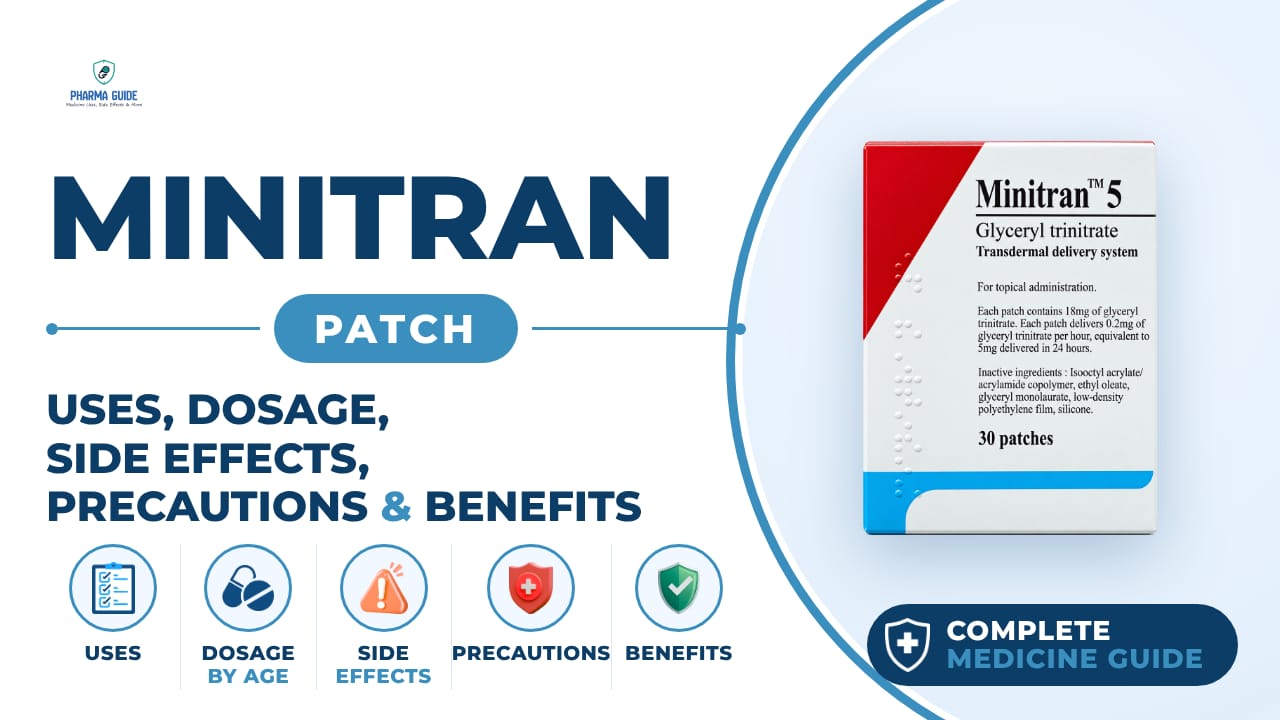
| Generic name | Nitroglycerin (glyceryl trinitrate) |
|---|---|
| Drug class | Antianginal agent (nitrate/vasodilator) |
| Forms | Transdermal patch (skin patch) in 0.2 mg/hr, 0.4 mg/hr, and 0.6 mg/hr strengths |
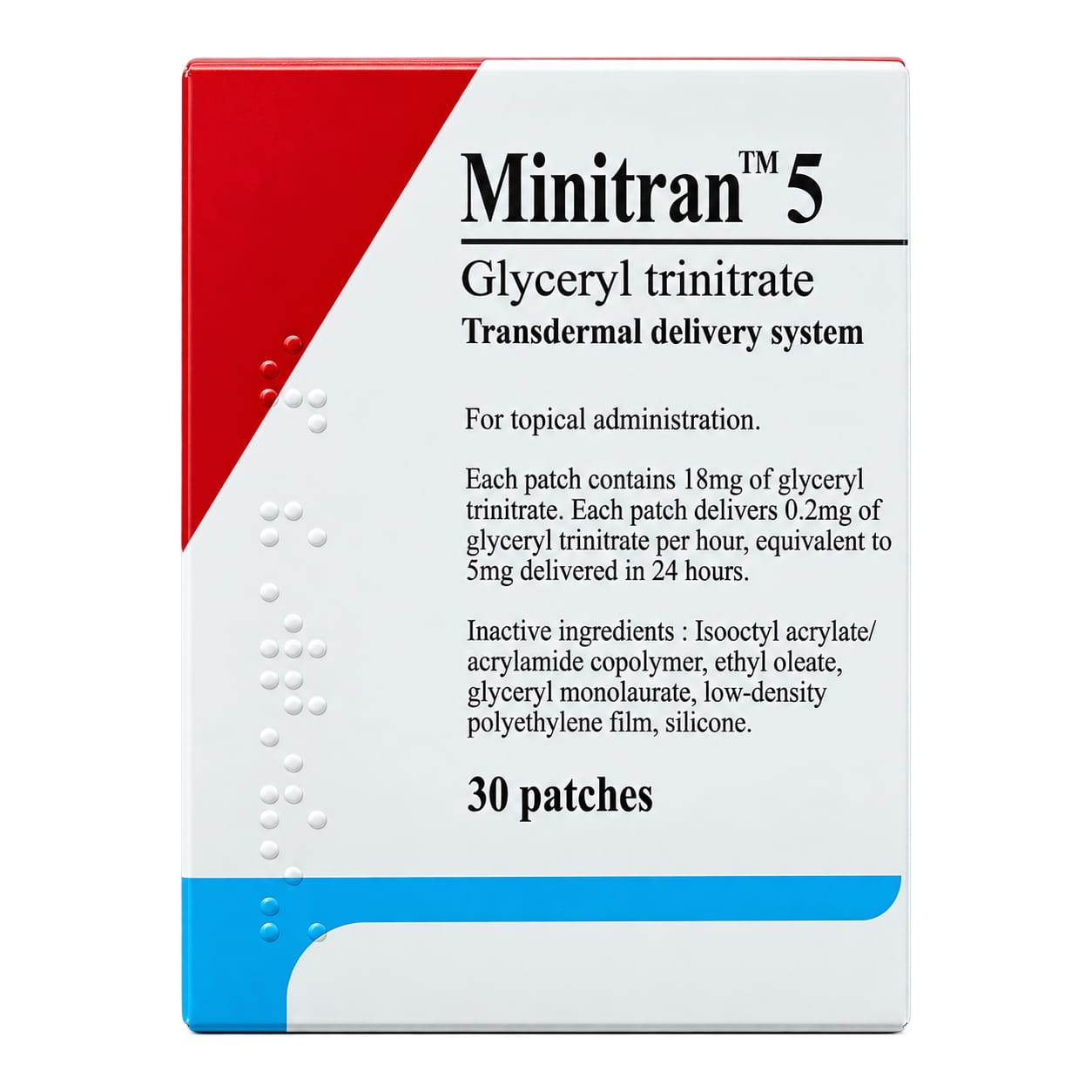
Quick overview
Minitran Patch contains nitroglycerin (glyceryl trinitrate), a nitrate and vasodilator applied to the skin to help prevent angina attacks in adults with coronary artery disease. It delivers medicine continuously through the skin over many hours and may be used alongside other antianginal medicines. It is not intended to treat an angina attack that has already started. Common side effects include headache, flushing, and dizziness, while serious risks involve heart rhythm changes and low blood pressure.
What is Minitran Patch
Minitran is a skin patch that contains nitroglycerin, a medicine used to help prevent chest pain (angina) in adults with coronary artery disease.
Minitran Patch uses
- Prevention of angina attacks in patients with stable angina pectoris associated with coronary artery disease
- Can be used together with other antianginal medicines such as beta-blockers and/or calcium channel blockers
- Not intended for treating an angina attack that has already started — a fast-acting sublingual nitroglycerin product should be used for that
Benefits of Minitran Patch
- Provides continuous, controlled release of medicine through the skin over many hours
- Reduces the heart's workload
- Improves coronary blood flow
- Useful for long-term angina prevention
How Minitran Patch works
When you apply the patch, nitroglycerin is absorbed slowly and continuously through the skin into the bloodstream. It relaxes the smooth muscle in blood vessel walls, widening both arteries and veins. This reduces the workload on the heart and increases blood and oxygen supply to the heart muscle, making angina attacks less likely.
Minitran Patch dosage
Apply the patch to the chest, shoulders, upper arm or back — do not apply to the lower arm or lower leg. Choose a clean, dry area of skin free of cuts or irritation; if hair is in the way, the area may be lightly shaved or clipped rather than shaved closely. Use a different skin site each time you apply a new patch, waiting several days before reusing the same spot.
Do not apply the patch right after a shower or bath — wait until the skin is completely dry. Do not cut the patch; it is designed as a complete unit and should not be reused once removed. Apply a new patch at the same time every day, usually in the morning.
The patch is normally worn for about 12 to 14 hours and then removed for a patch-free period of about 10 to 12 hours, often overnight, as directed by your doctor. If the patch falls off, discard it and apply a new one to a different skin site; do not resume the original schedule change. If you forget to remove the patch at the scheduled time, remove it as soon as you remember and continue your usual schedule.
Do not use more than one patch at a time unless told to by your doctor. Do not stop using this medicine suddenly, even if you feel well, as this may bring on more angina attacks. You can bathe, shower, and swim normally while wearing the patch. Wash your hands after applying or removing a patch.
| Age group | Dose |
|---|---|
| Under 18 years | Safety and effectiveness are not established |
| 18–64 years | Common starting delivery rate: 0.2–0.4 mg/hour, usually worn for about 12–14 hours daily with a nitrate-free interval |
Available forms and strengths
Transdermal patch (skin patch) in 0.2 mg/hr, 0.4 mg/hr, and 0.6 mg/hr strengths.
Side effects of Minitran Patch
Common
- Headache
- Flushing of the face / hot flushes
- Nausea and vomiting
- Rash, redness, itching, and/or burning where the patch was applied
- Dizziness or light-headedness
- Low blood pressure
Serious
- Fast or pounding heartbeats, or fluttering in the chest
- Slow heart rate
- Feeling like you might faint or pass out
- Worsening or unstable chest pain (unstable angina), possibly with nausea, anxiety, sweating, shortness of breath, dizziness, or fatigue
- Signs of high blood pressure: headache, vision problems, irregular heartbeat
- Severe redness, swelling, or blisters under the patch
- Allergic reaction: rash, hives, swelling of the face, lips, tongue or throat, difficulty swallowing or breathing
- Increased methemoglobin levels: shortness of breath, blue or purple coloring of lips, fingers or toes, headache, fatigue, dizziness, loss of consciousness
Warnings and precautions
- Never use erectile dysfunction medicines such as sildenafil (Viagra), tadalafil (Cialis), or vardenafil (Levitra, Staxyn) while using this patch — combining them can cause a dangerous, life-threatening drop in blood pressure.
- Do not use this medicine together with riociguat (Adempas), a medicine for lung blood pressure problems, as this combination can cause dangerously low blood pressure.
- Used patches still contain enough medicine to seriously harm or even kill a child or pet if accidentally swallowed or applied to their skin, so dispose of them carefully.
- Do not stop using this medicine suddenly, as this can trigger more frequent or severe angina attacks.
- This patch must be removed before having a heart procedure called cardioversion/defibrillation or before diathermy treatment, since it may cause equipment damage or burns.
- Daily headaches can happen with this medicine. Don't change your dosing schedule to avoid them, because losing the headache may mean the medicine is no longer working as well against angina.
- It is not known whether this medicine is safe in pregnancy. Talk to your doctor if you are pregnant, think you might be, or are trying to become pregnant.
- It is not known whether this medicine passes into breast milk. Talk to your doctor about the benefits and risks if you are breastfeeding.
- No routine renal dose adjustment is generally required.
- Significant liver disease should be clinically reviewed.
- Drinking alcohol while using this medicine is not recommended, as it can increase the blood-pressure-lowering effects and raise the risk of dizziness, light-headedness, or fainting.
- Be careful when driving or operating machinery until you know how this medicine affects you, since it may cause dizziness, light-headedness, or fainting, especially when you first start treatment.
Storage
- Store at controlled room temperature (15°-30°C / 59°-86°F)
- Avoid extremes of temperature and humidity
- Do not refrigerate
- Keep each patch in its sealed pouch until ready to use
- After removing a patch, fold it in half with the sticky side in and discard it where children or pets cannot reach it
- Keep both used and unused patches out of the reach of children and pets
When to see a doctor
- Get emergency help right away if you have signs of an allergic reaction, such as hives, difficulty breathing, or swelling of your face, lips, tongue, or throat.
- Call your doctor immediately or go to the emergency department if you have worsening or new chest pain not relieved by your usual angina medicine, pounding or fluttering heartbeats, a slow heart rate, feeling like you might pass out, or symptoms of a heart attack (chest pain or pressure spreading to jaw or shoulder, nausea, sweating).
- Seek immediate medical help for severe redness, swelling or blisters under the patch, chest pain not relieved by your usual angina treatment, or a severe headache.
- If you think you have used too much of this medicine, get urgent medical help right away, even if you feel fine — contact a doctor, hospital emergency department, or your local poison control center.
- If you are taking erectile dysfunction medicines and develop chest pain from a sudden angina attack while using this patch, seek emergency medical help immediately rather than taking those medicines together.
Alternatives
- Nitrostat (sublingual nitroglycerin)
- Nitroglycerin spray
- Isosorbide mononitrate
Watch the video
FAQs
What is Minitran Patch used for?
It is used to prevent angina attacks in adults with coronary artery disease and stable angina pectoris. It can be used with other antianginal medicines like beta-blockers or calcium channel blockers, but it is not meant to treat an angina attack that has already started.
Where should I apply the Minitran Patch?
Apply it to the chest, shoulders, upper arm, or back on a clean, dry area of skin free of cuts or irritation. Avoid the lower arm or lower leg, and use a different site each time, waiting several days before reusing the same spot.
How long do you wear the Minitran Patch?
The patch is normally worn for about 12 to 14 hours and then removed for a patch-free period of about 10 to 12 hours, often overnight, as directed by your doctor.
Can I use erectile dysfunction medicines with Minitran Patch?
No. Medicines such as sildenafil, tadalafil, or vardenafil should never be used with this patch, as combining them can cause a dangerous, life-threatening drop in blood pressure.
What are the common side effects of Minitran Patch?
Common side effects include headache, flushing, nausea and vomiting, skin reactions where the patch is applied, dizziness or light-headedness, and low blood pressure.
General information, not medical advice
Your prescriber and the leaflet in your pack know your situation. This page does not.
- Follow your prescriber and the leaflet
- Don't start, stop, or change a dose on your own
- Doses and warnings differ by country and product
Sources
Video
Related medicines

Injectafer Injection: Uses, Dosage, Side Effects, Precautions and Alternates
Iron products
Injectafer (ferric carboxymaltose) treats iron deficiency anemia and heart failure-related iron deficiency via IV. Learn uses, dosage, side effects, and

Gliclazide Tablet: Uses, Dosage, Side Effects, Precautions and Alternates
Sulfonylurea (hypoglycemic/antidiabetic agent)
Gliclazide Tablet is a sulfonylurea for type 2 diabetes that boosts insulin release. Learn about dosage, side effects, warnings, and precautions.