
Safety
General information, not medical advice
Your prescriber and the leaflet in your pack know your situation. This page does not.
- Follow your prescriber and the leaflet
- Don't start, stop, or change a dose on your own
- Doses and warnings differ by country and product
Monotrate Tablet: Uses, Dosage, Side Effects, Precautions and Alternates
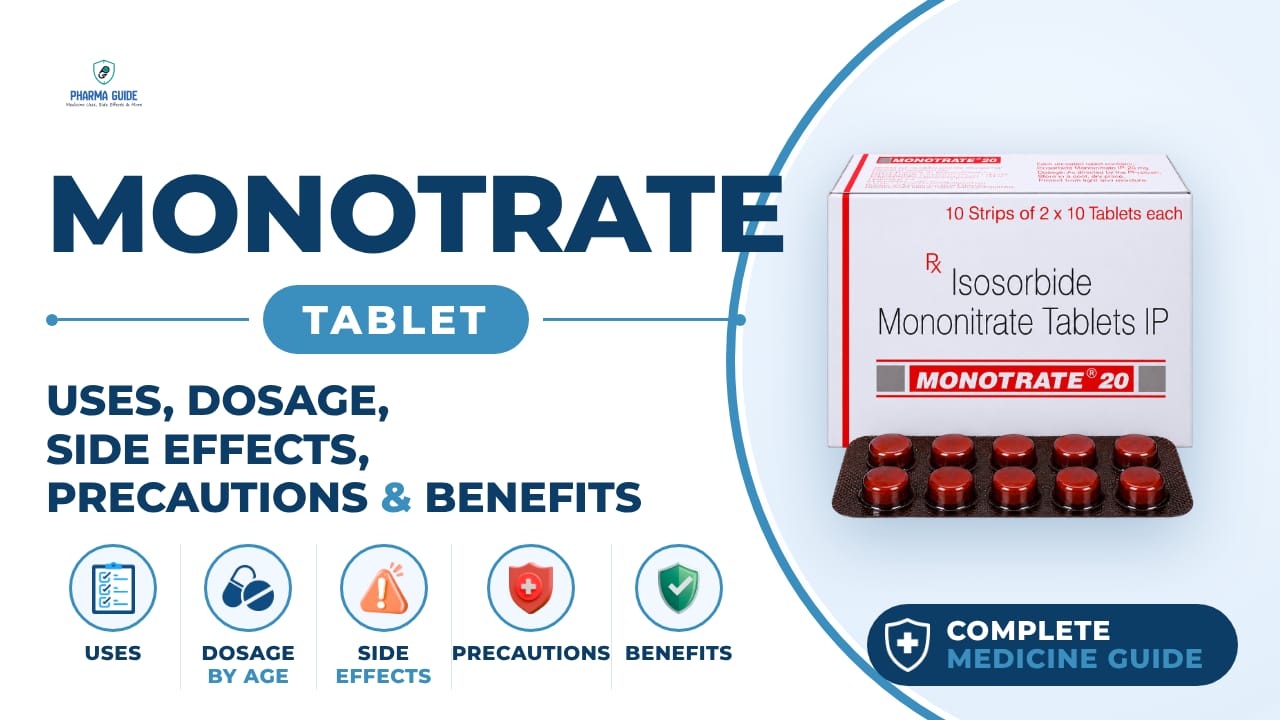
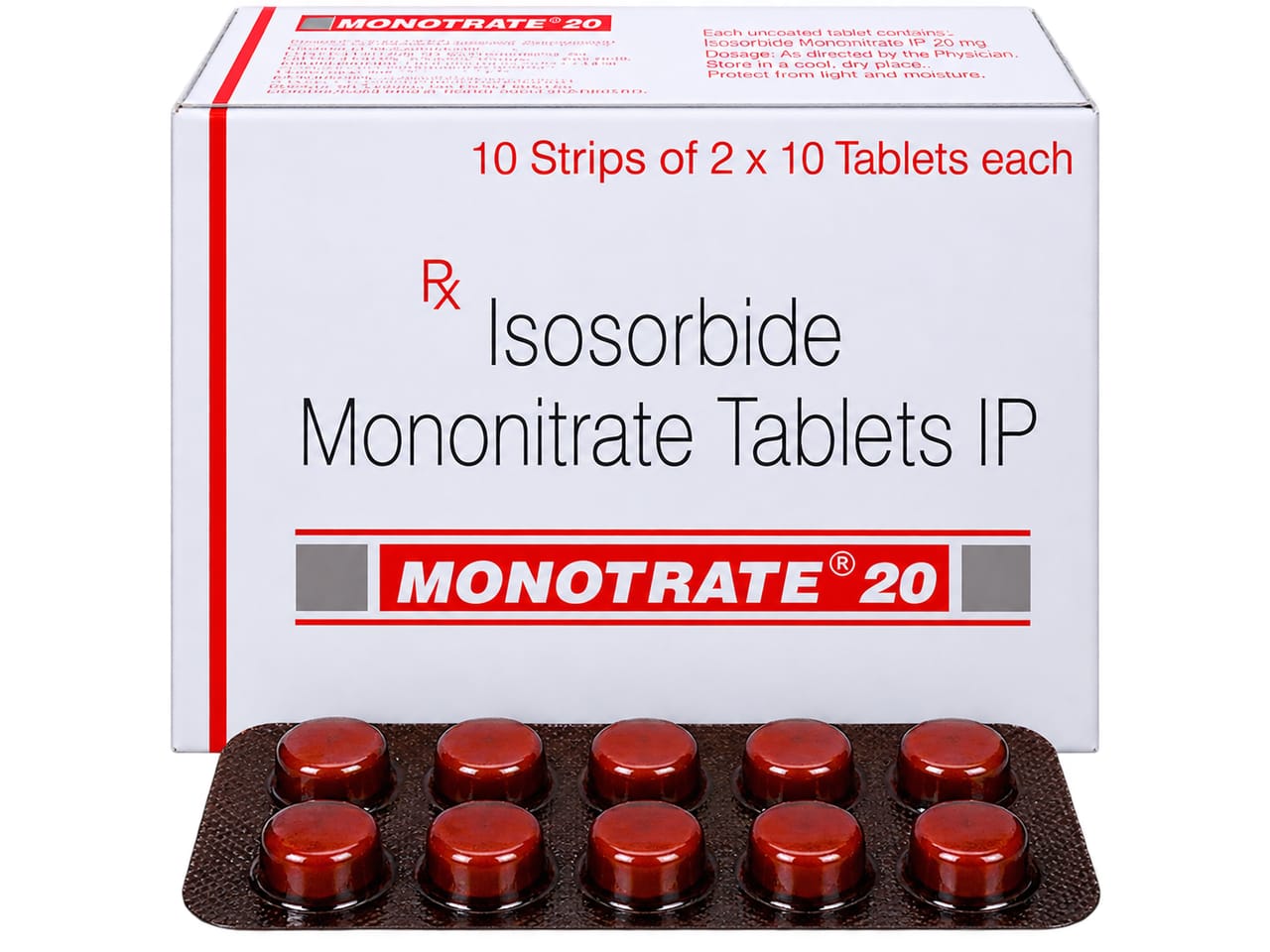
| Generic name | Isosorbide Mononitrate |
|---|---|
| Drug class | Nitrate vasodilator |
| Forms | Tablet |
Quick overview
Monotrate Tablet contains isosorbide mononitrate, a nitrate vasodilator used to prevent and manage angina (chest pain) caused by heart-related conditions. It works by relaxing and widening blood vessels, improving blood flow to the heart and reducing the heart's workload. It is taken daily as prescribed and is not meant to relieve an angina attack that has already started.
What is Monotrate Tablet
Monotrate is a prescription medicine containing isosorbide mononitrate, used to prevent and manage chest pain (angina) caused by heart-related conditions.
Monotrate Tablet uses
- Prevents and treats angina (chest pain caused by reduced blood flow to the heart)
- Improves exercise tolerance in people with heart-related conditions
- Helps manage symptoms of heart failure in some cases, as advised by a doctor
Benefits of Monotrate Tablet
- Prevents episodes of chest pain (angina)
- Improves blood flow and oxygen delivery to the heart
- Reduces the heart's workload, lowering the risk of complications
- Enhances quality of life in people with chronic heart conditions
How Monotrate Tablet works
Monotrate contains isosorbide mononitrate, a nitrate that relaxes and widens blood vessels. This improves blood flow to the heart and reduces how hard the heart has to work, which helps prevent chest pain from happening as often.
Monotrate Tablet dosage
Monotrate can be taken with or without food. Swallow the tablet whole; do not break, chew, or crush it. Take it at the same time every day to help you remember. It does not relieve an angina attack that has already started, so keep your fast-acting spray or tablet on hand for attacks. Take it daily as prescribed, even if you feel better, and do not stop without talking to your doctor.
If you miss a dose, take it as soon as you remember, but skip it if it is almost time for your next dose; do not double up. This medicine is not recommended for use in children under 18 years as safety has not been established. Older patients may be more sensitive to side effects, so doctors may adjust the dose.
| Age group | Dose |
|---|---|
| Under 18 years | Not recommended |
| 18–60 years | 20 mg, 1–2 times/day |
| 60+ years | 20 mg, 1–2 times/day |
Available forms and strengths
- Tablet
Side effects of Monotrate Tablet
Common
- Headache, especially at the start of treatment
- Dizziness, especially on standing up
- Flushing (redness or warmth of the face or neck)
- Nausea or vomiting
- Fast heartbeat
Serious
- Irregular heartbeat
- Severe low blood pressure
- Fainting or severe dizziness
- Chest pain
- Difficulty breathing
- Hives and skin redness
- Burning, numbness, or tingling in the arms and feet
- Anxiety
Warnings and precautions
- Do not take this medicine together with medicines for erectile dysfunction such as sildenafil, tadalafil, or vardenafil, because the combination can cause a dangerous, severe drop in blood pressure.
- Avoid this medicine if you have severe anemia, severe low blood pressure, a thickened heart muscle condition (hypertrophic cardiomyopathy), or severely reduced blood flow to the brain, as it can worsen these conditions.
- Use this medicine with caution if you have low blood pressure, glaucoma, kidney problems, or have had a head injury.
- Do not stop taking this medicine suddenly without talking to your doctor, as this can make your angina worse.
- This medicine should not be used if you recently had a severe head injury or have increased pressure around the brain, since it may raise pressure inside the skull further.
- This medicine is not meant to relieve an angina attack that has already started. Keep a fast-acting nitrate spray or tablet for that purpose instead.
- Pregnant women may have mild side effects from this medicine. It should only be used in pregnancy if your doctor recommends it, after discussing the risks and benefits.
- It isn't known for certain whether this medicine passes into breast milk, so check with your doctor before taking it while breastfeeding.
- People with kidney problems should use this medicine carefully, as the doctor may need to adjust the dose.
- People with liver problems should use this medicine carefully, as the doctor may need to adjust the dose.
- Avoid drinking alcohol while taking this medicine, as it can increase the risk of dizziness and lightheadedness.
- This medicine can make you feel dizzy, so avoid driving or operating heavy machinery until you know how it affects you.
Storage
- Store at room temperature, below 30°C
- Protect it from light and moisture
- Keep the tablets away from children and pets
- Do not use this medicine after the expiry date has passed
When to see a doctor
- Get medical help right away if you notice signs of an allergic reaction such as skin rash, itching or swelling of the face, tongue, or throat, severe dizziness, or difficulty breathing.
- Do not use this medicine if you have early signs of a heart attack, such as chest pain spreading to the jaw, neck, shoulder, arm, or back, along with sweating, nausea, tiredness, or sudden dizziness — seek medical help instead.
- Get medical help right away if you think you have taken too much of this medicine, or if you notice a severe drop in blood pressure or fainting.
- Seek medical help if your chest pain gets worse or lasts longer than usual.
Alternatives
- Monit
- Isotrate
- Isonitrate
Watch the video
FAQs
What is Monotrate Tablet used for?
Monotrate Tablet is used to prevent and treat angina (chest pain caused by reduced blood flow to the heart), improve exercise tolerance, and help manage heart failure symptoms in some cases as advised by a doctor.
How does Monotrate Tablet work?
It contains isosorbide mononitrate, a nitrate that relaxes and widens blood vessels, improving blood flow to the heart and reducing the heart's workload, which helps prevent chest pain.
Can Monotrate Tablet stop an angina attack that has already started?
No, Monotrate Tablet does not relieve an angina attack that has already started. A fast-acting nitrate spray or tablet should be kept on hand for that purpose.
Can Monotrate Tablet be taken with erectile dysfunction medicines?
No, it should not be taken with medicines like sildenafil, tadalafil, or vardenafil, as the combination can cause a dangerous, severe drop in blood pressure.
What are the common side effects of Monotrate Tablet?
Common side effects include headache, dizziness especially on standing up, flushing, nausea or vomiting, and fast heartbeat.
General information, not medical advice
Your prescriber and the leaflet in your pack know your situation. This page does not.
- Follow your prescriber and the leaflet
- Don't start, stop, or change a dose on your own
- Doses and warnings differ by country and product
Sources
- US Food and Drug Administration (FDA) - Package leaflet information for the user; monoket (isosorbide mononitrate)
- KD Tripathi, Essentials of Medical Pharmacology, Seventh Edition, Jaypee Brothers Medical Publishers, 2013
- April Hazard Vallerand, Cynthia A. Sanoski, Sixteenth Edition, F. A. Davis Company, 2019
- Isosorbide mononitrate tablets 10 MG - Patient Information Leaflet (EMC)
- NHS - NHS choices
- McDermott Laboratories Limited trading as Gerard Laboratories, Health Products Regulatory Authority (HPRA)
Video
Related medicines

Injectafer Injection: Uses, Dosage, Side Effects, Precautions and Alternates
Iron products
Injectafer (ferric carboxymaltose) treats iron deficiency anemia and heart failure-related iron deficiency via IV. Learn uses, dosage, side effects, and

Gliclazide Tablet: Uses, Dosage, Side Effects, Precautions and Alternates
Sulfonylurea (hypoglycemic/antidiabetic agent)
Gliclazide Tablet is a sulfonylurea for type 2 diabetes that boosts insulin release. Learn about dosage, side effects, warnings, and precautions.