
Safety
General information, not medical advice
Your prescriber and the leaflet in your pack know your situation. This page does not.
- Follow your prescriber and the leaflet
- Don't start, stop, or change a dose on your own
- Doses and warnings differ by country and product
Movicol Sachet: Uses, Dosage, Side Effects, Precautions and Alternates
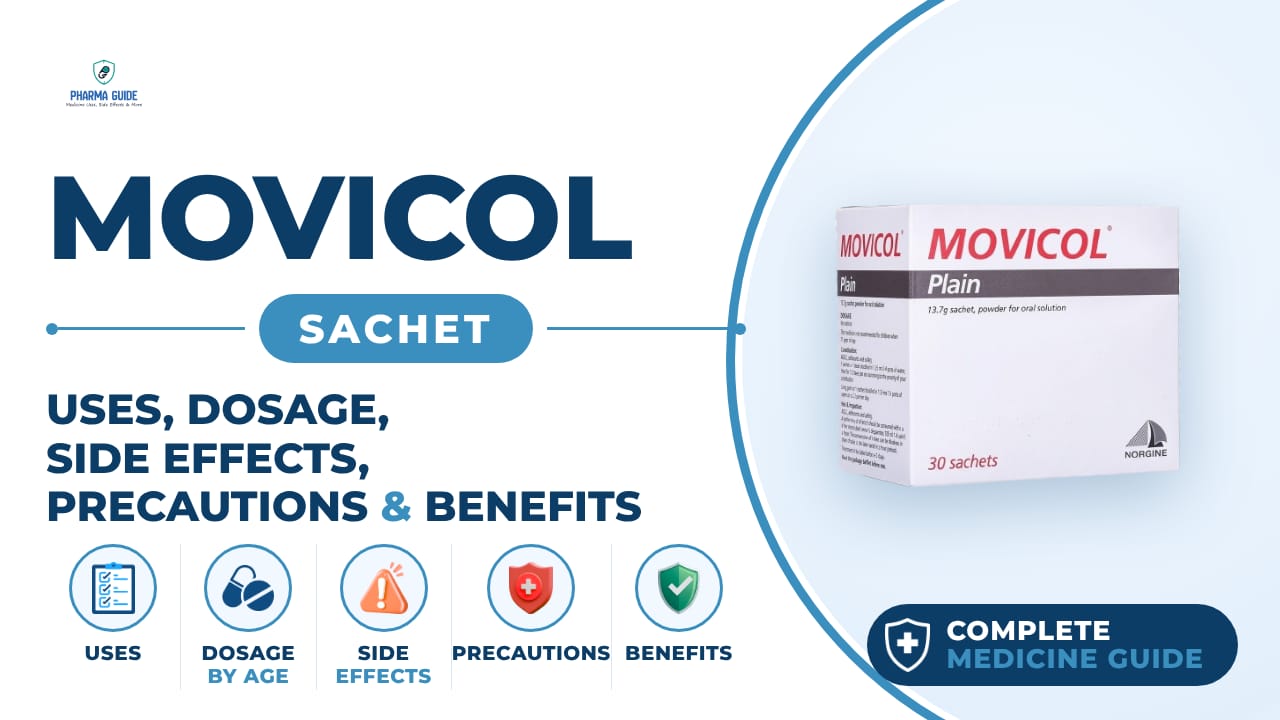
| Generic name | Macrogol 3350 + Electrolytes (Polyethylene glycol 3350 / Potassium Chloride / Sodium Bicarbonate / Sodium Chloride) |
|---|---|
| Drug class | Osmotic Laxative |
| Forms | Sachet (powder for oral solution) |
Quick overview
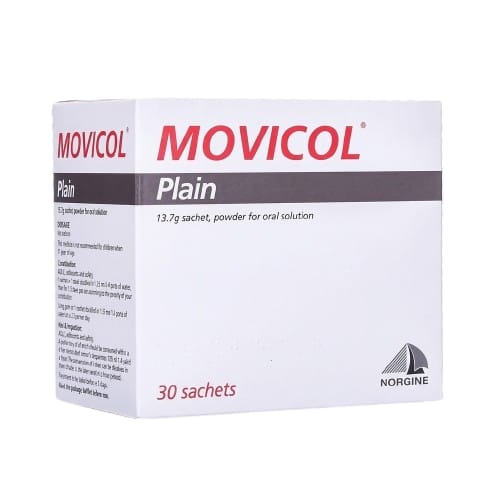
Movicol Sachet contains Macrogol 3350 with Electrolytes, an osmotic laxative mixed with water to form a drink. It is used to treat constipation and faecal impaction in adults, adolescents, and older people, and is not recommended for children under 12 years old. It works by drawing water into the gut to soften stool and trigger a natural bowel movement.
What is Movicol Sachet
Movicol is a laxative powder that you mix with water to make a drink. It is used to treat constipation in adults, adolescents, and older people, and is not recommended for children under 12 years old, as a different paediatric version is used for younger children.
Movicol Sachet uses
- Treating constipation in adults, adolescents, and the elderly
- Treating faecal impaction (severe constipation where stool becomes hard and stuck)
- Bowel preparation before surgery or colonoscopy
- Constipation caused by opioid pain medicines
- Long-term management of constipation, including constipation caused by conditions such as Parkinson's disease or multiple sclerosis
Benefits of Movicol Sachet
- Helps you have a comfortable bowel movement even if you have been constipated for a long time
- Can relieve severe constipation (faecal impaction)
- Does not usually cause cramps or urgency
How Movicol Sachet works
Movicol works by binding to water in the gut. This extra water softens the stool and helps trigger a natural bowel movement, sometimes within about a day. It passes through the body largely unabsorbed.
Movicol Sachet dosage
Movicol can be taken at any time, with or without food. Open the sachet and pour the powder into a glass of water, then stir well until it is fully dissolved and the drink looks clear or slightly hazy, then drink it. If you are taking it for faecal impaction, it may be easier to dissolve several sachets together in a larger amount of water.
If you miss a dose, take it as soon as you remember. If you have a heart condition, do not take more than two sachets within any one-hour period when treating faecal impaction.
Children should always be given the mixture with the full amount of water recommended for each sachet, and should drink the whole glass, taking it over about 30 minutes if needed. If a child vomits within 30 minutes of a dose, give the same dose again; if they vomit after 30 minutes, wait until the next normal dose.
Try to take other medicines by mouth at least one hour apart from Movicol, since it may affect how well they are absorbed.
| Age group | Dose |
|---|---|
| Under 12 years | Not recommended |
| 12–17 years | 1 sachet, once/day |
| 18–60 years | 1 sachet, once/day |
| 60+ years | 1 sachet, once/day |
Available forms and strengths
- Sachet (powder for oral solution)
Side effects of Movicol Sachet
Common
- Indigestion, stomach ache, or stomach rumbling
- Bloating
- Wind
- Feeling or being sick
- Soreness around the bottom (anus)
- Mild diarrhoea when starting treatment
Serious
- Serious allergic reaction causing difficulty breathing or swelling of the face, lips, tongue, or throat
- Signs of electrolyte imbalance such as weakness or irregular heartbeat
- Feeling weak, very thirsty, with a headache, or puffy ankles
- Skin rash, itching, reddening of the skin, or nettle rash
- Swollen hands, feet, or ankles
- Headaches
Warnings and precautions
- Do not take Movicol if you have a blockage or perforation in your gut, severe inflammatory bowel disease such as ulcerative colitis, Crohn's disease, or toxic megacolon, or an allergy to its ingredients.
- Keep drinking plenty of fluids while taking Movicol; the liquid in the medicine should not replace your normal fluid intake.
- If you have a heart condition and are treating faecal impaction, do not take more than two sachets in any one hour.
- Some medicines, such as anti-epileptic drugs, may not work as well when taken with Movicol.
- Do not give Movicol powder to a child without water, as it will not work properly and may cause dehydration.
- Movicol can be taken during pregnancy, but you should check with your doctor or pharmacist before taking it. Movicol can be taken while breastfeeding. Talk to your doctor before use if you have kidney problems. Movicol does not affect your ability to drive or use machines.
Storage
- Keep out of the sight and reach of children
- Do not use after the expiry date on the label
- Do not store above 25°C; store in the original package to protect from moisture
- After mixing with water, store covered in a refrigerator (2°C–8°C) and discard any solution not used within 6 hours
- Do not throw away medicines via wastewater or household waste; ask your pharmacist how to dispose of medicines you no longer need
- If the powder becomes discoloured or shows other signs of deterioration, consult your pharmacist
When to see a doctor
- Stop taking Movicol and tell your doctor right away if you have a serious allergic reaction with difficulty breathing or swelling of the face, lips, tongue, or throat.
- Get medical advice if you feel weak, very thirsty, have a headache, or notice puffy ankles, as these can be signs of dehydration or mineral imbalance.
- For children, stop giving Movicol and contact the doctor straight away if they vomit often or the vomit is dark green or brown, as this may mean a blockage in the gut.
- If you take too much Movicol and develop bad diarrhoea, stop taking it and contact your doctor or pharmacist if you are worried, since this can lead to dehydration.
Alternatives
- Dulcolax
- Lactulose
- Macrogol
Watch the video
FAQs
What is Movicol Sachet used for?
It is used to treat constipation and faecal impaction in adults, adolescents, and older people, including constipation caused by opioids or conditions like Parkinson's disease, and for bowel preparation before surgery or colonoscopy.
How does Movicol Sachet work?
It works by binding to water in the gut, which softens the stool and helps trigger a natural bowel movement, sometimes within about a day, passing through the body largely unabsorbed.
How do you take Movicol Sachet?
Open the sachet and pour the powder into a glass of water, stir well until fully dissolved, and drink it; it can be taken any time with or without food, and for faecal impaction several sachets may be dissolved together.
Can Movicol Sachet be taken during pregnancy or breastfeeding?
Movicol can be taken during pregnancy but you should check with your doctor or pharmacist first, and it can be taken while breastfeeding.
What are the common side effects of Movicol Sachet?
Common side effects include indigestion, stomach ache or rumbling, bloating, wind, feeling or being sick, soreness around the bottom, and mild diarrhoea when starting treatment.
General information, not medical advice
Your prescriber and the leaflet in your pack know your situation. This page does not.
- Follow your prescriber and the leaflet
- Don't start, stop, or change a dose on your own
- Doses and warnings differ by country and product
Sources
Video
Related medicines
CosmoCol Sachet: Uses, Dosage, Side Effects, Precautions and Alternates
Osmotic laxative
CosmoCol Sachet is an osmotic laxative with macrogol 3350 and electrolytes, used for constipation and faecal impaction. Learn dosage, side effects, and

Injectafer Injection: Uses, Dosage, Side Effects, Precautions and Alternates
Iron products
Injectafer (ferric carboxymaltose) treats iron deficiency anemia and heart failure-related iron deficiency via IV. Learn uses, dosage, side effects, and