
Safety
General information, not medical advice
Your prescriber and the leaflet in your pack know your situation. This page does not.
- Follow your prescriber and the leaflet
- Don't start, stop, or change a dose on your own
- Doses and warnings differ by country and product
Multivitamin Tablet: Uses, Dosage, Side Effects, Precautions and Alternates
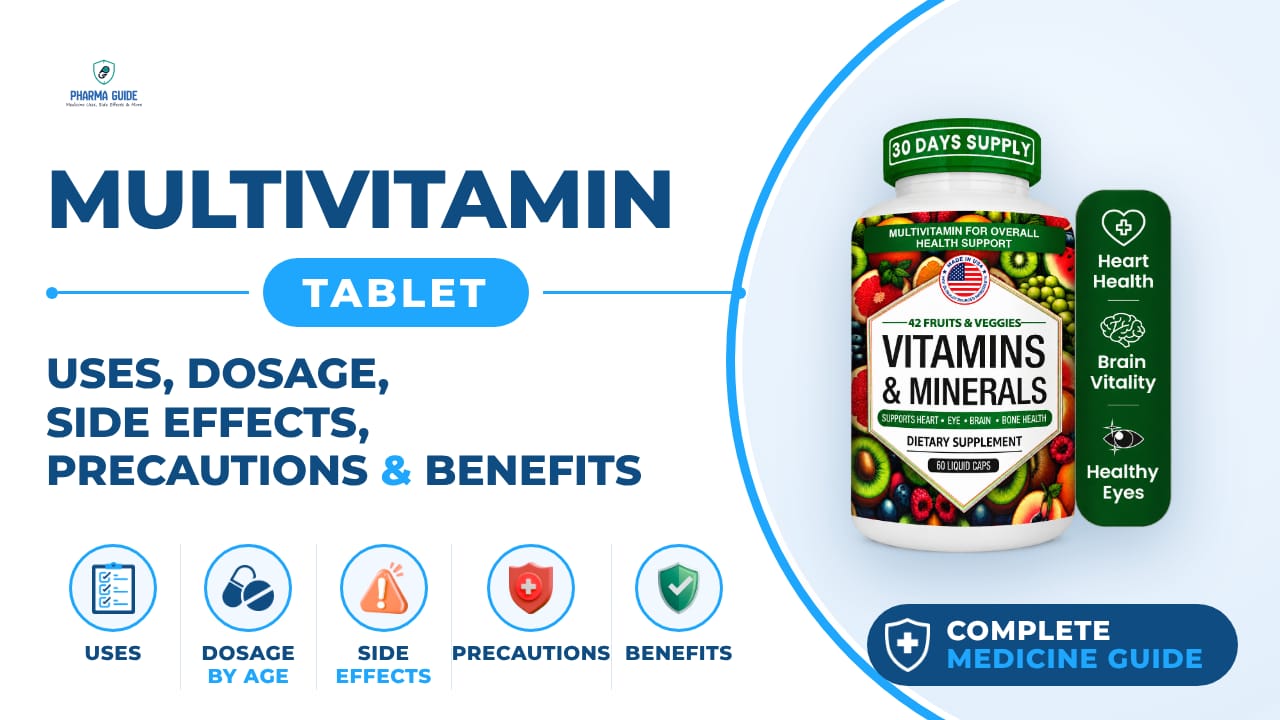
| Forms | Tablet, Chewable tablet, Extended-release tablet, Liquid, Capsule, Powder |
|---|

Quick overview
Multivitamin Tablet is a supplement that combines many vitamins and minerals into one product to help fill gaps in your diet. It supports general health, pregnancy nutrition, and the needs of people who do not get enough nutrients from food alone. Formulations vary by brand, and it comes in several forms including tablets, chewables, extended-release tablets, and liquids.
What is Multivitamin Tablet
A multivitamin is a supplement that combines many vitamins and minerals into one product. It is meant to help fill gaps in your diet when you do not get enough nutrients from food alone. There is no single standard recipe for what a multivitamin must contain, so different brands can have very different combinations and amounts of nutrients.
Multivitamin Tablet uses
- Help growth and good health
- Increase nutrient intakes when a person does not get enough vitamins and minerals from food alone
- Provide extra nutrients for women who are pregnant or planning pregnancy, especially folic acid, iron, iodine, and vitamin D
- Support people who eat low-calorie diets, avoid certain food groups (such as strict vegetarians and vegans), or have conditions that affect digestion or nutrient absorption
Benefits of Multivitamin Tablet
- Helps the body obtain recommended amounts of vitamins and minerals when diet alone falls short
- May support immune function through nutrients like vitamins C, D, and E
- May support skin health through vitamins A, C, and E
- May support muscle maintenance and energy levels
- In some studies, multivitamin use in older adults was linked to better memory and overall thinking skills over time
How Multivitamin Tablet works
A multivitamin supplies vitamins and minerals your body needs. For example, folic acid is changed by the body into a form used to help make DNA and support the normal formation of blood cells, and taking enough folic acid before and during early pregnancy helps lower the chance of certain birth defects of the brain and spine.
Multivitamin Tablet dosage
Multivitamin Tablet can be taken with or without food; taking it with food may help if it upsets your stomach. Some products may be absorbed best when taken at bedtime — ask your doctor or pharmacist if you're unsure. Extended-release tablets should be swallowed whole and not chewed, broken, or crushed. Chewable tablets should be chewed well before swallowing. Liquid forms should be measured carefully using the measuring device provided, not a regular kitchen spoon. Some prenatal multivitamin products use two separate tablets (a morning tablet and an evening tablet) taken several hours apart to help the body absorb iron, calcium, and folic acid better.
If a dose is missed, take it as soon as you remember, but skip it if it's almost time for the next dose — do not double up. Different brands may be intended for different age groups (children, adults, pregnant women, older adults), so choose one meant for your age and life stage.
| Age group | Dose |
|---|---|
| Children Under 2 Years | Only use if prescribed by a doctor |
| 2–12 Years | Usually 1 tablet daily (based on product formulation) |
| 13 Years and Above (Adults) | Usually 1 tablet daily |
| Older Adults (65+ years) | Usually 1 tablet daily; adjusted based on nutritional needs |
Available forms and strengths
- Tablet
- Chewable tablet
- Extended-release tablet
- Liquid
- Capsule
- Powder
Side effects of Multivitamin Tablet
Common
- Nausea or throwing up
- Upset stomach
- Constipation or diarrhea
- Stomach pain or cramps
- Gas and bloating
- Headache
- Dizziness
- Change in stool color to green
Serious
- Signs of an allergic reaction, such as rash, hives, itching, or swelling of the mouth, face, lips, or tongue
- Trouble breathing, swallowing, or talking, or wheezing/tightness in the chest or throat
- Black, tarry, or bloody stools (for products containing iron)
- Throwing up blood or vomit that looks like coffee grounds (for products containing iron)
- Fever with stomach symptoms (for products containing iron)
- Signs of vitamin A toxicity, including headaches, blurred vision, and liver damage
- Signs of vitamin D toxicity, including high calcium levels that can affect the kidneys
- Tingling or numbness in the hands and feet from long-term high doses of vitamin B6
Warnings and precautions
- Keep multivitamins, especially those containing iron, out of reach of children. Accidental overdose of iron-containing products is a leading cause of fatal poisoning in young children.
- Do not take more than the recommended dose.
- If you have a vitamin B12 deficiency, talk to your doctor before taking high-dose folic acid, since folic acid can hide the blood-related signs of B12 deficiency.
- People with seizure disorders controlled by certain medications may have more seizures if they take folic acid, so this should be discussed with a doctor.
- Smokers and former smokers should avoid multivitamins with large amounts of beta-carotene or vitamin A, since studies have linked these to a higher risk of lung cancer in smokers.
- Taking too much vitamin A during pregnancy can raise the risk of birth defects.
- If you take blood thinners such as warfarin, talk to your doctor before taking any multivitamin containing vitamin K, since it can reduce how well the blood thinner works.
- Multivitamins can interact with certain medications, including thyroid medication, and may need to be taken several hours apart from them.
- Pregnant women are commonly advised to take a daily prenatal multivitamin, especially for folate/folic acid, iron, iodine, and vitamin D, but talk to your doctor about what dose and product is right for you.
- Vitamins and minerals from a multivitamin can pass into breast milk. The decision to keep taking a prenatal multivitamin while breastfeeding should be made with your healthcare provider.
- People with kidney disease should be cautious with multivitamins because their body may not process nutrients normally, which can raise the risk of side effects.
- People with liver disease should be cautious with multivitamins because their body may not process nutrients normally, which can raise the risk of side effects.
- Avoid taking more than the recommended dose, and inform your doctor if you have kidney or liver problems.
- Check ingredients to avoid duplicate vitamin intake, and keep multivitamins away from children to prevent accidental overdose.
Storage
- Store at room temperature in a dry place
- Do not store in a bathroom
- Protect from heat and light
- Keep all drugs in a safe place out of the reach of children and pets
- Throw away unused or expired drugs; do not flush down a toilet or pour down a drain unless told to do so; check with your pharmacist about drug take-back programs
- Protect from moisture; contact with moisture may cause surface discoloration or erosion of the tablet
When to see a doctor
- Get medical help right away if you notice signs of a serious allergic reaction, such as rash, hives, swelling of the face or throat, or trouble breathing or swallowing.
- For iron-containing products, seek medical help right away for black or bloody stools, vomiting blood or material that looks like coffee grounds, fever, or severe stomach cramps.
- If you think there has been an overdose, contact your local poison control service or get medical care right away, even if there are no symptoms yet.
Alternatives
- Centrum
- Wellwoman
- Opti-Men
Watch the video
FAQs
What is Multivitamin Tablet used for?
It helps fill dietary gaps, supports growth and general health, provides extra nutrients during pregnancy (like folic acid, iron, iodine, and vitamin D), and helps people on restricted diets or with absorption issues.
How should Multivitamin Tablet be taken?
It can be taken with or without food, though food may help with stomach upset. Extended-release tablets should be swallowed whole, chewables chewed well, and liquids measured with the provided device. Some prenatal products use separate morning and evening tablets.
What should I do if I miss a dose?
Take it as soon as you remember, but skip it if it's almost time for the next dose. Do not double up.
What are the serious side effects of Multivitamin Tablet?
Serious effects include allergic reactions, trouble breathing or swallowing, black or bloody stools and vomiting blood (for iron-containing products), signs of vitamin A or D toxicity, and tingling or numbness from long-term high-dose vitamin B6.
Are there special warnings for pregnant women or children?
Pregnant women are often advised to take a prenatal multivitamin for folate, iron, iodine, and vitamin D, but should consult their doctor. Iron-containing multivitamins must be kept out of reach of children, as accidental overdose can be fatal.
General information, not medical advice
Your prescriber and the leaflet in your pack know your situation. This page does not.
- Follow your prescriber and the leaflet
- Don't start, stop, or change a dose on your own
- Doses and warnings differ by country and product
Sources
Video
Related medicines

Injectafer Injection: Uses, Dosage, Side Effects, Precautions and Alternates
Iron products
Injectafer (ferric carboxymaltose) treats iron deficiency anemia and heart failure-related iron deficiency via IV. Learn uses, dosage, side effects, and

Gliclazide Tablet: Uses, Dosage, Side Effects, Precautions and Alternates
Sulfonylurea (hypoglycemic/antidiabetic agent)
Gliclazide Tablet is a sulfonylurea for type 2 diabetes that boosts insulin release. Learn about dosage, side effects, warnings, and precautions.