
Safety
General information, not medical advice
Your prescriber and the leaflet in your pack know your situation. This page does not.
- Follow your prescriber and the leaflet
- Don't start, stop, or change a dose on your own
- Doses and warnings differ by country and product
Mycamine Injection: Uses, Dosage, Side Effects, Precautions and Alternates
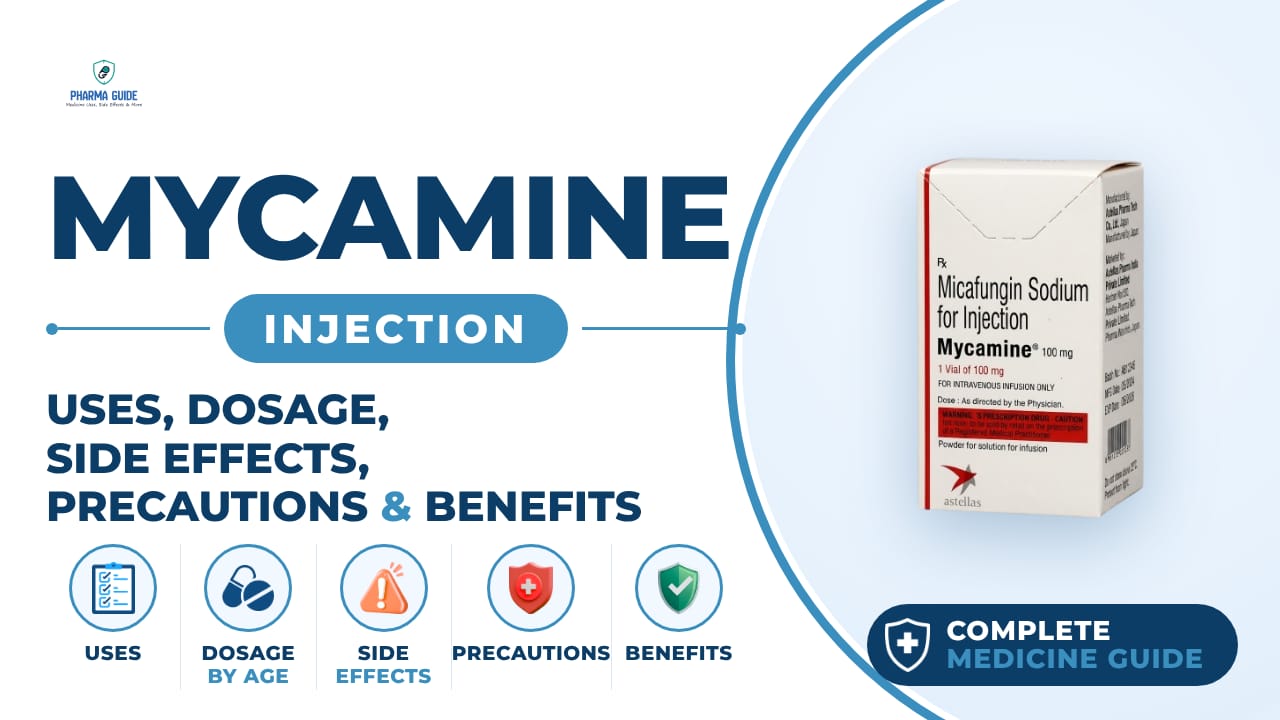
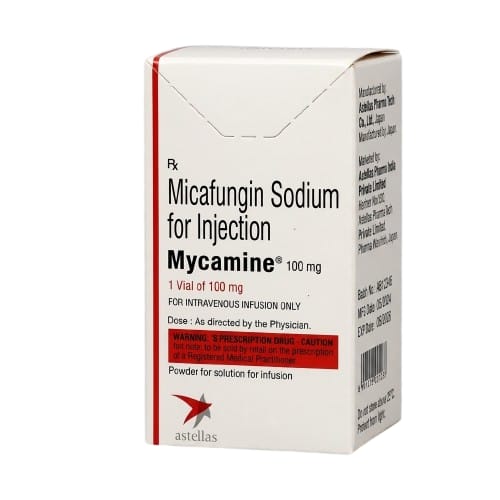
| Generic name | micafungin sodium |
|---|---|
| Drug class | Echinocandin |
| Forms | Injection |
Quick overview
Mycamine Injection (micafungin sodium) is an echinocandin antifungal given by IV infusion to treat serious Candida infections, including candidemia, disseminated candidiasis, Candida peritonitis and abscesses, and esophageal candidiasis. It is also used to help prevent Candida infections in people undergoing hematopoietic stem cell transplantation. It works by weakening the fungal cell wall, which causes the fungus to die. It is given only by slow IV infusion, typically over about one hour.
What is Mycamine Injection
Mycamine is an antifungal medicine given through a vein (IV). It belongs to a group of medicines called echinocandins and is used to fight serious fungal infections caused by Candida.
Mycamine Injection uses
- Treatment of candidemia, acute disseminated candidiasis, Candida peritonitis and abscesses in adults and children 4 months and older
- Treatment of candidemia and related infections without brain or eye involvement in infants younger than 4 months
- Treatment of esophageal candidiasis (yeast infection of the esophagus/food pipe) in adults and children 4 months and older
- Prevention of Candida infections in adults and children 4 months and older undergoing hematopoietic stem cell transplantation (bone marrow transplant)
Benefits of Mycamine Injection
- Treats Candida bloodstream infections.
- Treats certain deep Candida infections.
- Treats esophageal candidiasis.
- Helps prevent Candida infections after stem-cell transplantation.
- Provides an IV treatment option for serious fungal infections.
How Mycamine Injection works
Mycamine works by blocking the fungus from building a key part of its cell wall. Without this wall component, the fungal cells become weak, cannot grow properly, and die. This cell wall material isn't found in human cells, so it specifically targets the fungus.
Mycamine Injection dosage
Mycamine is given only by slow infusion into a vein, usually over about one hour; infusing it too quickly can increase the chance of certain reactions. It should not be mixed or given at the same time with other medications through the same IV line. The prepared (mixed) solution should be protected from light during and after preparation. Do not shake the vial vigorously when mixing — gently swirl it to dissolve the powder. For children, the dose is calculated based on body weight, so tell your doctor about any weight changes. A line used for this medicine should be flushed with saline before the infusion begins. No loading dose is needed before starting regular daily dosing.
| Age group | Dose |
|---|---|
| Under 18 years | Not recommended |
| 18–64 years | 100 mg, once/day |
| 65+ years | 100 mg, once/day |
Available forms and strengths
- Injection
Side effects of Mycamine Injection
Common
- Diarrhea
- Nausea
- Vomiting
- Fever (pyrexia)
- Headache
- Low platelet count (thrombocytopenia)
- Low white blood cell count (neutropenia)
- Abdominal pain
- Rash
- Itching
- Flushing (warmth, redness, or tingly feeling)
- Phlebitis (vein inflammation at infusion site)
- Low potassium, magnesium, or calcium levels
- Changes in liver blood test results
Serious
- Severe allergic reactions (anaphylaxis), including shock
- Serious blood problems such as sudden breakdown of red blood cells (hemolysis) or hemolytic anemia
- Liver problems including hepatitis or liver failure
- Kidney problems including acute kidney failure
- Severe skin reactions (Stevens-Johnson syndrome, toxic epidermal necrolysis)
- Blood clotting disorders (disseminated intravascular coagulation)
Warnings and precautions
- Severe allergic reactions, including anaphylaxis and shock, have happened with this medicine. If this occurs, the infusion must be stopped right away and treated immediately.
- This medicine can cause serious blood problems, such as destruction of red blood cells or hemolytic anemia. Your doctor should monitor you closely if this happens.
- Liver problems, including abnormal liver tests, hepatitis, or liver failure, have occurred with this medicine, especially in patients with other serious conditions taking multiple medications.
- Kidney problems, including serious kidney impairment or sudden kidney failure, have been reported.
- Because of a possible risk of liver tumors seen in animal studies, this medicine should only be used when other antifungal medicines are not suitable.
- Infusing this medicine too quickly can cause histamine-related reactions like rash, itching, facial swelling, or flushing; slowing the infusion rate can help if this happens.
- Animal studies showed this medicine may harm an unborn baby, so it should only be used in pregnancy if the potential benefit outweighs the potential risk. There isn't enough information from human use to know the exact risk.
- It isn't known if this medicine passes into human breast milk. It was found in the milk of nursing rats. Your doctor will weigh the benefits of breastfeeding against your need for this medicine.
- No dose change is needed for people with kidney problems, including severe kidney impairment. Extra doses are not needed after dialysis.
- No dose change is needed for mild, moderate, or severe liver impairment, though your doctor should watch your liver function closely during treatment because of the risk of liver problems.
- It isn't known how this medicine interacts with alcohol, so check with your doctor before drinking.
- This medicine can cause drowsiness, so avoid driving or operating machinery after receiving it.
Storage
- Unopened vials of the lyophilized (freeze-dried) powder must be stored at room temperature, 25°C (77°F); brief changes to 15°-30°C (59°-86°F) are permitted
- The reconstituted (mixed) product may be stored in the original vial for up to 24 hours at room temperature, 25°C (77°F)
- The diluted infusion solution should be protected from light and may be stored for up to 24 hours at room temperature, 25°C (77°F)
- Discard any unused portion of the vial; each vial is for single use only
When to see a doctor
- Get emergency help right away if you have signs of a severe allergic reaction, such as hives, trouble breathing, feeling like you might pass out, or swelling of your face, lips, tongue, or throat.
- Call your doctor right away if you notice pale or yellowed skin, dark-colored urine, fever, confusion, or weakness — these can be signs of a serious blood or liver problem.
- Call your doctor right away if you have swelling, rapid weight gain, or little to no urination, which may signal kidney problems.
- Call your doctor right away if you have upper stomach pain, itching, loss of appetite, clay-colored stools, or yellowing of the skin or eyes, which can be signs of liver injury.
- Tell your health care provider right away if you develop any unusual symptom, or if an existing symptom persists or gets worse.
Alternatives
- Fluconazole
- Anidulafungin
- Caspofungin
Watch the video
FAQs
What is Mycamine Injection used for?
Mycamine is used to treat candidemia, acute disseminated candidiasis, Candida peritonitis and abscesses, and esophageal candidiasis. It is also used to prevent Candida infections in people undergoing hematopoietic stem cell transplantation.
How is Mycamine Injection given?
Mycamine is given only by slow IV infusion, usually over about one hour. It should not be mixed or given at the same time with other medications through the same IV line, and the line should be flushed with saline before infusion begins.
How does Mycamine work?
Mycamine works by blocking the fungus from building a key part of its cell wall. Without this wall component, fungal cells become weak, cannot grow properly, and die. This cell wall material isn't found in human cells, so it specifically targets the fungus.
What are the common side effects of Mycamine Injection?
Common side effects include diarrhea, nausea, vomiting, fever, headache, low platelet count, low white blood cell count, abdominal pain, rash, itching, flushing, vein inflammation at the infusion site, and electrolyte or liver test changes.
Is Mycamine Injection safe during pregnancy?
Animal studies showed this medicine may harm an unborn baby, so it should only be used in pregnancy if the potential benefit outweighs the potential risk. There isn't enough information from human use to know the exact risk.
General information, not medical advice
Your prescriber and the leaflet in your pack know your situation. This page does not.
- Follow your prescriber and the leaflet
- Don't start, stop, or change a dose on your own
- Doses and warnings differ by country and product
Sources
Video
Related medicines

Injectafer Injection: Uses, Dosage, Side Effects, Precautions and Alternates
Iron products
Injectafer (ferric carboxymaltose) treats iron deficiency anemia and heart failure-related iron deficiency via IV. Learn uses, dosage, side effects, and

Gliclazide Tablet: Uses, Dosage, Side Effects, Precautions and Alternates
Sulfonylurea (hypoglycemic/antidiabetic agent)
Gliclazide Tablet is a sulfonylurea for type 2 diabetes that boosts insulin release. Learn about dosage, side effects, warnings, and precautions.