
Safety
General information, not medical advice
Your prescriber and the leaflet in your pack know your situation. This page does not.
- Follow your prescriber and the leaflet
- Don't start, stop, or change a dose on your own
- Doses and warnings differ by country and product
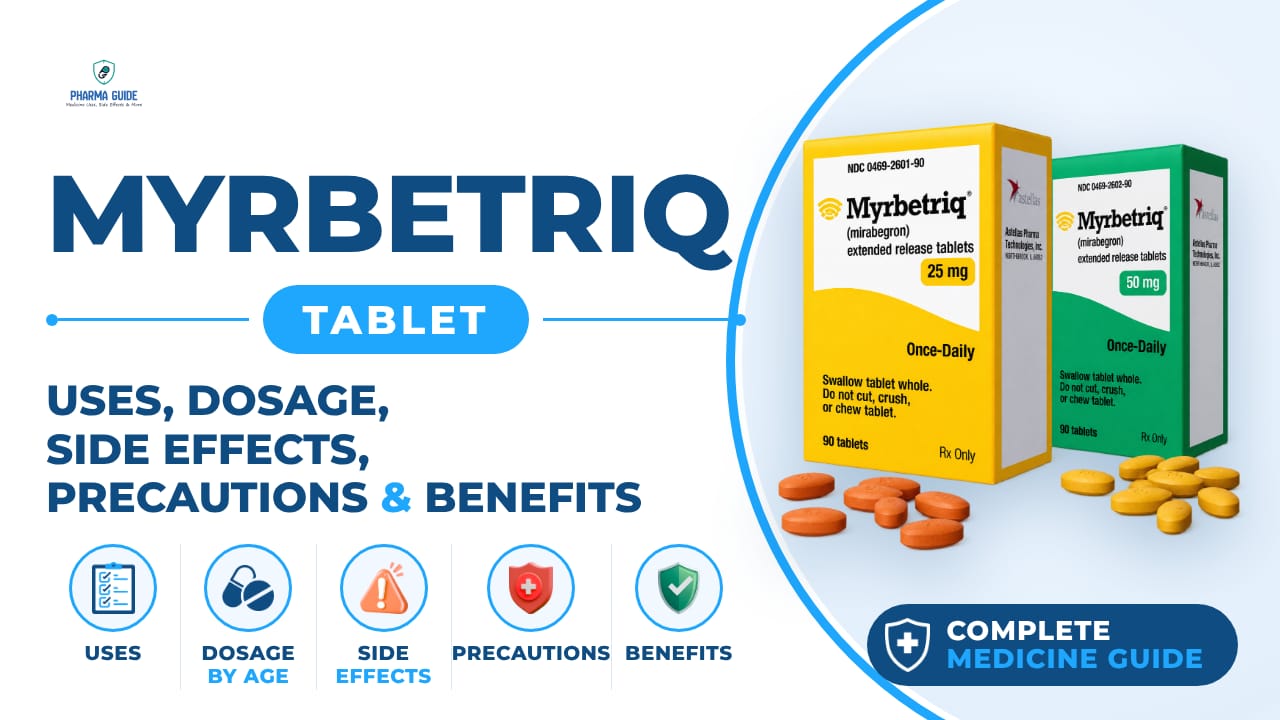
Myrbetriq Tablet: Uses, Dosage, Side Effects, Precautions and Alternates
| Generic name | mirabegron |
|---|---|
| Drug class | Beta-3 adrenoceptor agonist (urinary antispasmodic) |
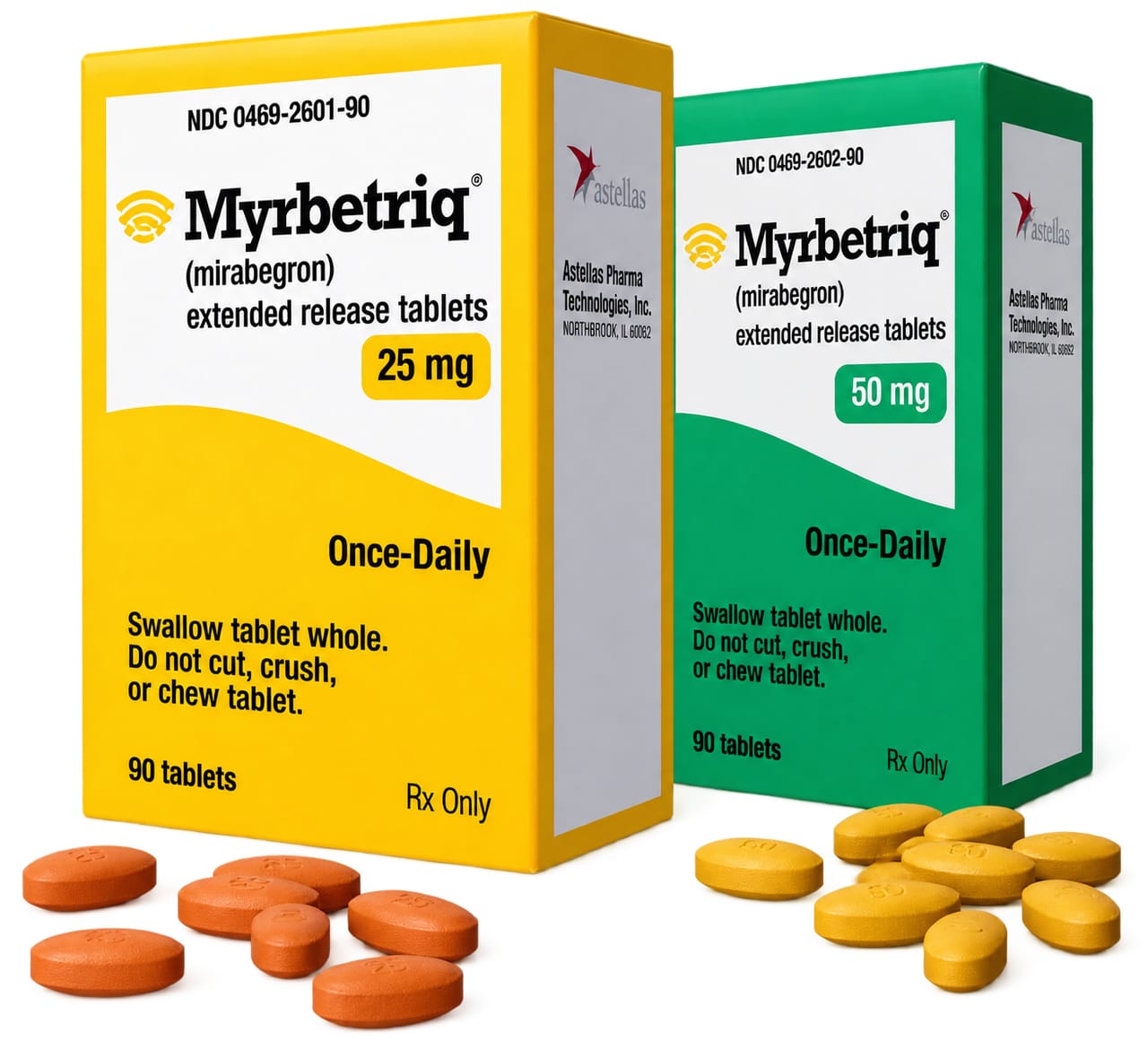
| Forms | Extended-release tablet (25 mg and 50 mg), Extended-release granules for oral suspension |
Quick overview
Myrbetriq Tablet (mirabegron) is a prescription beta-3 adrenoceptor agonist that relaxes the bladder muscle to treat overactive bladder in adults and neurogenic detrusor overactivity in children aged 3 and older. It may be used alone or together with solifenacin. It is available as extended-release tablets and as extended-release granules for oral suspension, with dosing that depends on age and weight.
What is Myrbetriq Tablet
Myrbetriq is a prescription medicine that relaxes the muscles of the urinary bladder, reducing bladder spasms. It is used alone or with another medicine called solifenacin to treat overactive bladder symptoms.
Myrbetriq Tablet uses
- Treats overactive bladder (OAB) in adults with symptoms of frequent or urgent urination and urinary incontinence
- Used sometimes together with solifenacin (Vesicare) for OAB in adults
- Treats neurogenic detrusor overactivity (NDO) in children at least 3 years old, a type of bladder overactivity caused by nerve damage from conditions such as multiple sclerosis or spinal injury
Benefits of Myrbetriq Tablet
- Reduces the number of times you need to urinate per day
- Reduces episodes of urinary incontinence (leaking urine)
- Increases the amount of urine the bladder can hold
How Myrbetriq Tablet works
Myrbetriq attaches to special receptors on the bladder muscle called beta-3 receptors, which causes the bladder muscle to relax. This lets the bladder hold more urine and reduces how often you feel the urge to urinate.
Myrbetriq Tablet dosage
Take exactly as prescribed and follow all directions on the prescription label. If taking with solifenacin, take both medicines at the same time each day. Swallow the tablet whole with a full glass of water; do not crush, chew, or break it. Adults may take the tablet with or without food, while children should take it with food. If using the granules (suspension), both adults and children should take it with food.
Shake the suspension vigorously for 1 minute, then let it stand until the foam disappears before measuring a dose. Use the dosing syringe or a medicine dose-measuring device provided, not a kitchen spoon, to measure the suspension. Take the suspension within 1 hour after preparing the dose; do not save it for later. If the suspension won't be used for 2 days or more, shake the bottle vigorously for 1 minute each day to keep it mixed. Do not switch between tablets and granules, and do not combine both forms to make up a dose.
Your blood pressure will need to be checked often while taking this medicine. It may take up to 8 weeks before symptoms improve; keep taking the medicine as directed and tell your doctor if symptoms don't improve. If you miss a dose, take it as soon as you remember, but skip it if it's more than 12 hours late; do not take two doses at once.
| Age group | Dose |
|---|---|
| Under 3 years | Not recommended |
| 3–11 years | Tablet use is not suitable for all children; pediatric NDO dosing depends on weight and specialist advice |
| 12–17 years | For pediatric NDO, if 35 kg or more: 25 mg once daily, may increase to 50 mg once daily after 4–8 weeks |
| 18–64 years | 25 mg once daily; may increase to 50 mg once daily after 4–8 weeks |
| 65+ years | 25 mg once daily; may increase to 50 mg once daily if appropriate |
Available forms and strengths
- Extended-release tablet (25 mg and 50 mg)
- Extended-release granules for oral suspension
Side effects of Myrbetriq Tablet
Common
- Painful or burning urination
- Increased blood pressure
- Sinus pain, sore throat, or cold-like symptoms (nasopharyngitis)
- Constipation
- Headache
- Dry mouth or fast heartbeats (especially when taken with solifenacin)
- Diarrhea
- Dizziness
- Joint pain, back pain, flu symptoms, or urinary tract infection
- Nausea
- Fatigue
Serious
- Allergic reaction: hives, difficulty breathing, swelling of face, lips, tongue, or throat
- Angioedema (severe swelling of face, lips, tongue, or throat that can be life-threatening)
- Dangerously high blood pressure: severe headache, blurred vision, pounding in neck or ears
- Fast or irregular heartbeats (including atrial fibrillation)
- Trouble emptying your bladder (urinary retention)
- Kidney problems
- Stroke (cerebrovascular accident)
Warnings and precautions
- Do not use Myrbetriq if you have end stage kidney failure, severe kidney disease, or severe uncontrolled high blood pressure.
- A condition called angioedema, causing swelling of the face, lips, tongue, or throat and difficulty breathing, can occur after taking Myrbetriq and can be fatal. Get emergency help right away if this happens.
- It may take up to 8 weeks before your symptoms improve. Keep taking the medicine as directed and tell your doctor if your symptoms don't improve after 8 weeks.
- Myrbetriq should not be given to a child younger than 3 years old.
- Do not take more than the maximum recommended dose, as this increases the risk of serious side effects.
- It is not known if Myrbetriq is safe during pregnancy; it hasn't been studied in pregnant women, and animal studies showed possible harm to the fetus at high doses. Tell your doctor if you are pregnant.
- It is not known if Myrbetriq passes into human breast milk or if it can affect a breastfed child. In animal studies it did pass into milk. Talk to your doctor before taking it if you are breastfeeding.
- Myrbetriq is removed from the body by the kidneys. If your kidneys don't work well, the drug could build up and raise your risk of side effects. It is not recommended if you have very severe kidney disease or kidney failure, and your doctor may prescribe a lower dose if you have severe kidney problems.
- Myrbetriq is broken down by the liver. If your liver doesn't work well, the drug could build up in your body and raise your risk of side effects. Your doctor may prescribe a lower dose if you have liver problems.
- Myrbetriq isn't known to interact directly with alcohol, but alcohol could worsen side effects like dizziness or headache, irritate the bladder, cause dehydration, and increase urination, which can worsen overactive bladder symptoms.
- Be careful when driving or doing activities that require coordination when you start Myrbetriq, since it can cause dizziness in some people.
Storage
- Store at room temperature away from moisture and heat
- Throw away any unused suspension after the expiration date on the label has passed
- Myrbetriq tablets should be stored at room temperature in a tightly sealed container away from light
- If needed, tablets can be kept for short periods at a wider temperature range
- Granules (before mixing) should be stored at room temperature in the original container away from light
- The mixed suspension should be stored at room temperature for up to 28 days; dispose of any suspension remaining after 28 days
- If the suspension won't be used for 2 or more days, shake the bottle vigorously for 1 minute each day to keep it well mixed
When to see a doctor
- Get emergency medical help right away if you have signs of an allergic reaction, such as hives, difficulty breathing, or swelling of the face, lips, tongue, or throat.
- Call your doctor right away if you have pain or burning when urinating, trouble emptying your bladder, signs of dangerously high blood pressure (severe headache, blurred vision, pounding in the neck or ears), or fast or irregular heartbeats.
- Seek emergency medical attention or contact poison control if you think you have taken too much Myrbetriq.
- If you have symptoms of a urinary tract infection while taking Myrbetriq, contact your doctor right away.
- If you have symptoms of urinary retention, such as trouble starting to urinate, a weak urine stream, or discomfort or fullness in your bladder, contact your doctor right away.
- Call your doctor right away if you have an allergic reaction, and get emergency help if your symptoms feel life-threatening.
Alternatives
- Solifenacin (Vesicare)
- Darifenacin (Enablex)
- Fesoterodine (Toviaz)
- Oxybutynin (Oxytrol)
- Oxybutynin chloride (Gelnique, Ditropan XL)
- Tolterodine (Detrol, Detrol LA)
- Trospium
- OnabotulinumtoxinA (Botox)
- Tamsulosin (Flomax)
Watch the video
FAQs
What is Myrbetriq Tablet used for?
Myrbetriq treats overactive bladder symptoms like frequent or urgent urination and urinary incontinence in adults, sometimes with solifenacin, and treats neurogenic detrusor overactivity in children aged 3 and older.
How does Myrbetriq work?
Myrbetriq attaches to beta-3 receptors on the bladder muscle, causing it to relax so the bladder can hold more urine and reducing how often you feel the urge to urinate.
How long does it take for Myrbetriq to work?
It may take up to 8 weeks before symptoms improve, so you should keep taking the medicine as directed and tell your doctor if symptoms don't improve after that time.
What is the dosage of Myrbetriq for adults?
Adults typically take 25 mg once daily, which may be increased to 50 mg once daily after 4 to 8 weeks.
What are the serious side effects of Myrbetriq?
Serious side effects include allergic reactions, angioedema, dangerously high blood pressure, fast or irregular heartbeats, urinary retention, kidney problems, and stroke.
General information, not medical advice
Your prescriber and the leaflet in your pack know your situation. This page does not.
- Follow your prescriber and the leaflet
- Don't start, stop, or change a dose on your own
- Doses and warnings differ by country and product
Sources
- https://www.drugs.com/myrbetriq.html
- https://www.medicalnewstoday.com/articles/drugs-myrbetriq#side-effects
- https://www.goodrx.com/myrbetriq/common-side-effects
- Myrbetriq (mirabegron extended-release tablets) Product Monograph, Astellas Pharma Canada, Inc.
Video
Related medicines

Injectafer Injection: Uses, Dosage, Side Effects, Precautions and Alternates
Iron products
Injectafer (ferric carboxymaltose) treats iron deficiency anemia and heart failure-related iron deficiency via IV. Learn uses, dosage, side effects, and

Gliclazide Tablet: Uses, Dosage, Side Effects, Precautions and Alternates
Sulfonylurea (hypoglycemic/antidiabetic agent)
Gliclazide Tablet is a sulfonylurea for type 2 diabetes that boosts insulin release. Learn about dosage, side effects, warnings, and precautions.