
Safety
General information, not medical advice
Your prescriber and the leaflet in your pack know your situation. This page does not.
- Follow your prescriber and the leaflet
- Don't start, stop, or change a dose on your own
- Doses and warnings differ by country and product
Nesiritide Injection: Uses, Dosage, Side Effects, Precautions and Alternates
| Generic name | nesiritide |
|---|---|
| Drug class | Natriuretic peptide (vasodilator) |
| Forms | Lyophilized powder for injection (reconstituted into a solution for IV infusion) |
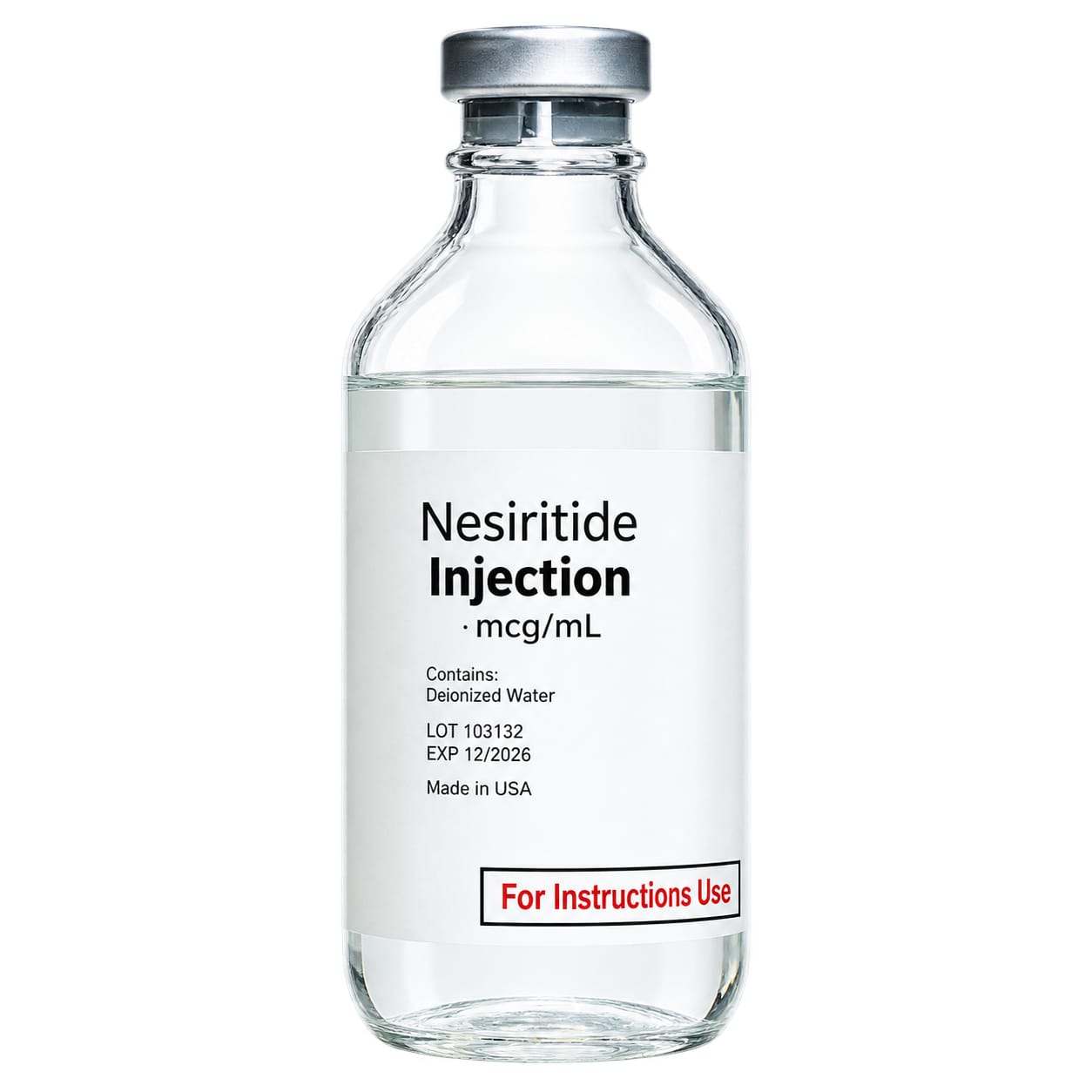
Quick overview
Nesiritide Injection (Natrecor) is a man-made version of a hormone the body naturally produces during heart failure, given intravenously in a hospital setting. It is used to treat hospitalized patients with acute episodes of heart failure who have moderate to severe shortness of breath and did not respond to two hours of intravenous diuretic treatment. It works by relaxing and widening blood vessels to lower pressure in the heart and blood vessels, which helps improve breathing. It belongs to the natriuretic peptide (vasodilator) drug class.
What is Nesiritide Injection
Natrecor is a man-made version of a hormone the body naturally makes during heart failure to help the heart work better. It is given intravenously in a hospital setting.
Nesiritide Injection uses
- Treatment of hospitalized patients with acute episodes of heart failure who have moderate to severe shortness of breath and who did not respond to two hours of treatment with intravenous diuretics.
Benefits of Nesiritide Injection
- Improves the heart's ability to function
- Relieves symptoms of heart failure, including breathlessness
- Used for acute decompensated heart failure
- Helps reduce cardiac filling pressure
- Can improve short-term shortness of breath
- Promotes vasodilation
- Reduces workload on the heart in selected hospitalized patients
How Nesiritide Injection works
The medicine is a copy of a natural heart hormone that relaxes and widens blood vessels, which lowers pressure in the heart and blood vessels and helps improve breathing.
Nesiritide Injection dosage
This medicine is given only as an intravenous infusion in a hospital setting where blood pressure can be closely monitored. It is given as a two-step process: an initial injection (bolus) followed immediately by a continuous infusion. The infusion is usually given over up to 48 hours, since there is limited experience using it longer. Your doctor will decide the amount and duration of treatment based on your body weight and how severe your condition is. The dose should not be adjusted too often, unlike some other intravenous heart medicines that need frequent adjustment. If low blood pressure occurs, the infusion may be stopped or reduced and can sometimes be restarted later at a lower dose once you are stable.
| Age group | Dose |
|---|---|
| Under 18 years | Safety and effectiveness have not been established; specialist-directed only |
| 18–64 years | 2 mcg/kg IV bolus, followed by 0.01 mcg/kg/min continuous IV infusion |
Available forms and strengths
- Lyophilized powder for injection (reconstituted into a solution for IV infusion)
Side effects of Nesiritide Injection
Common
- Low blood pressure (with or without symptoms like light-headedness, dizziness, feeling faint, or blurred vision)
- Headache
- Nausea
- Vomiting
- Dizziness
- Back pain
- Numbness or tingling feeling
- Tremors
- Vision changes
- Sweating
- Itching
- Rash
Serious
- Severe drop in blood pressure
- Fast, slow, or irregular heartbeat
- Chest pain or discomfort
- Shortness of breath or difficulty breathing
- Fainting or feeling like you might faint
- Confusion
- Reduced urination (possible kidney problem)
- Fever
- Unusual weakness or tiredness
- Allergic reaction: hives, swelling of face, lips, tongue, or throat, difficulty breathing
Warnings and precautions
- This medicine should not be used as the main treatment for cardiogenic shock or if systolic blood pressure stays below 100 mmHg before starting treatment, because of a higher risk of symptomatic low blood pressure.
- This medicine should be avoided in people who have, or are suspected of having, low cardiac filling pressures.
- This medicine is not recommended for certain heart conditions where blood-vessel-widening drugs are not suitable, such as significant valve narrowing or certain types of heart muscle or sac disease.
- This medicine can cause low blood pressure that depends on the dose given, and this drop in blood pressure can last longer than with some other similar medicines.
- Taking blood-pressure-lowering drugs, especially ACE inhibitors, together with this medicine may increase the risk of low blood pressure.
- Certain injectable medicines cannot be mixed or given through the same IV line as this medicine because they are chemically incompatible.
- This medicine should not be given through a catheter coated with heparin because it can bind to the heparin lining and reduce the amount of drug delivered.
- Pregnancy: It is not known if this medicine can harm an unborn baby. It should only be used in pregnancy if the possible benefit to the mother is greater than the possible risk to the baby.
- Breastfeeding: It is not known if this medicine passes into breast milk, so caution is advised if used while breastfeeding.
- Kidney: No dose change is usually needed for kidney problems, but this medicine can affect kidney function in some people, so doctors monitor kidney function during treatment.
- Liver: The effect of liver problems on how this medicine is processed by the body has not been specifically studied.
- Alcohol: Alcohol is inappropriate during an acute heart-failure episode requiring IV treatment.
- Driving: Not applicable during active IV therapy because nesiritide is administered in a monitored medical setting.
Storage
- Store NATRECOR® at 2-25°C. Do not freeze.
- Store in the original package.
- Keep the container in the outer carton in order to protect from light.
- Do not use after the expiry date stated on the label and carton.
- Keep out of the reach of children.
When to see a doctor
- Get emergency help right away if you have signs of an allergic reaction, such as hives, trouble breathing, or swelling of the face, lips, tongue, or throat.
- Tell your care team right away if you feel confused, light-headed, or faint, or have a fast, slow, or irregular heartbeat, reduced urination, chest pain, fever, or unusual weakness or tiredness.
- Seek medical help immediately for severe headache, confusion, slurred speech, arm or leg weakness, trouble walking, loss of coordination, stiff muscles, high fever, heavy sweating, or tremors, or for serious eye symptoms like sudden vision loss or eye pain.
- If an overdose is suspected, contact a health care practitioner, hospital emergency department, or your local poison control center immediately, even if there are no symptoms.
Alternatives
- Nitroglycerin
- Dobutamine
- Milrinone
Watch the video
FAQs
What is Nesiritide Injection used for?
It is used to treat hospitalized patients with acute episodes of heart failure who have moderate to severe shortness of breath and who did not respond to two hours of intravenous diuretic treatment.
How does Nesiritide Injection work?
It is a man-made copy of a natural heart hormone that relaxes and widens blood vessels, lowering pressure in the heart and blood vessels, which helps improve breathing.
How is Nesiritide Injection given?
It is given only as an intravenous infusion in a hospital setting where blood pressure can be closely monitored, as an initial bolus injection followed immediately by a continuous infusion, usually over up to 48 hours.
What are the common side effects of Nesiritide Injection?
Common side effects include low blood pressure, headache, nausea, vomiting, dizziness, back pain, numbness or tingling, tremors, vision changes, sweating, itching, and rash.
What are alternatives to Nesiritide Injection?
Alternatives mentioned include nitroglycerin, dobutamine, and milrinone.
General information, not medical advice
Your prescriber and the leaflet in your pack know your situation. This page does not.
- Follow your prescriber and the leaflet
- Don't start, stop, or change a dose on your own
- Doses and warnings differ by country and product
Sources
Video
Related medicines

Injectafer Injection: Uses, Dosage, Side Effects, Precautions and Alternates
Iron products
Injectafer (ferric carboxymaltose) treats iron deficiency anemia and heart failure-related iron deficiency via IV. Learn uses, dosage, side effects, and

Gliclazide Tablet: Uses, Dosage, Side Effects, Precautions and Alternates
Sulfonylurea (hypoglycemic/antidiabetic agent)
Gliclazide Tablet is a sulfonylurea for type 2 diabetes that boosts insulin release. Learn about dosage, side effects, warnings, and precautions.