
Safety
General information, not medical advice
Your prescriber and the leaflet in your pack know your situation. This page does not.
- Follow your prescriber and the leaflet
- Don't start, stop, or change a dose on your own
- Doses and warnings differ by country and product
Ngenla Injection: Uses, Dosage, Side Effects, Precautions and Alternates
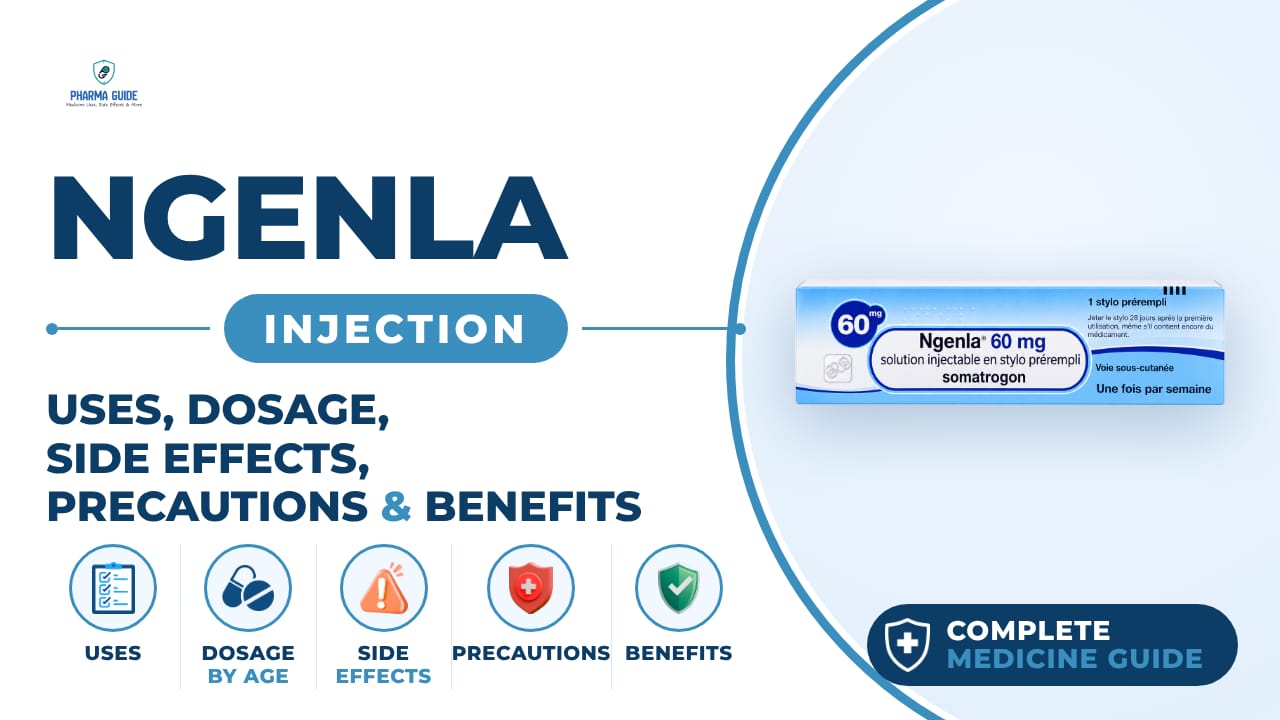
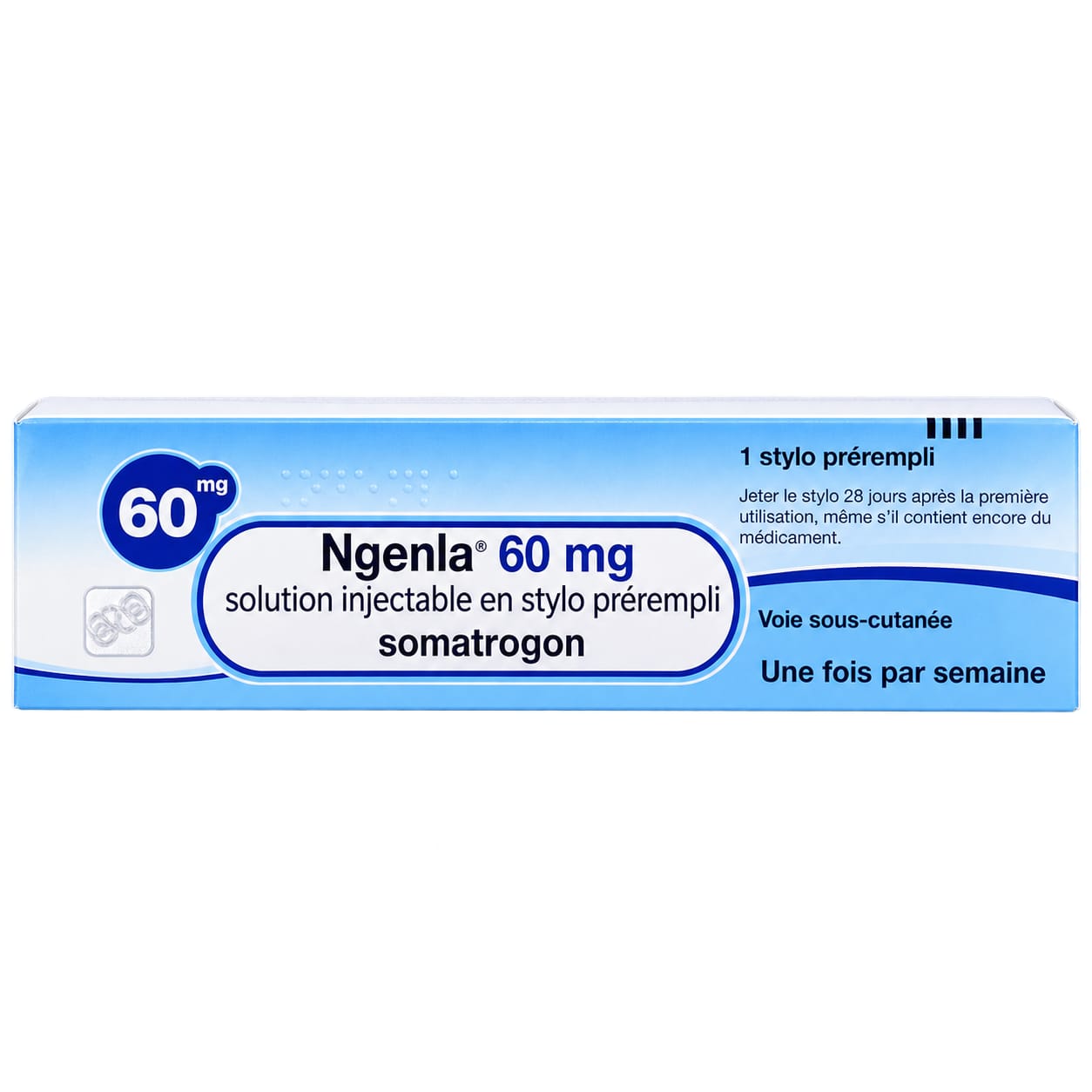
| Generic name | somatrogon |
|---|---|
| Drug class | Growth hormones (human growth hormone analog) |
| Forms | Injection (prefilled pen) 24 mg/1.2 mL, Injection (prefilled pen) 60 mg/1.2 mL |
Quick overview
Ngenla Injection (somatrogon) is a prescription growth hormone medicine given as a once-weekly injection to children aged 3 years and older who are not growing at the expected rate due to low levels of natural growth hormone. It belongs to the growth hormones drug class and works by replacing deficient growth hormone activity to support growth. Common effects include injection site reactions, headache, and fever, while serious risks include allergic reactions and effects on blood sugar, thyroid, and bone growth. It is available as a prefilled pen in two strengths.
What is Ngenla Injection
Ngenla is a prescription medicine that contains a modified form of human growth hormone. It is a long-acting, once-weekly injection given to children aged 3 years and older who are not growing at the expected rate because their bodies do not make enough natural growth hormone.
Ngenla Injection uses
- To improve growth in children who are not growing at the expected rate for their age because they have low levels of growth hormone.
- Treats pediatric growth hormone deficiency
- Promotes linear growth in children with confirmed GH deficiency
- Replaces deficient growth hormone activity
Benefits of Ngenla Injection
- Once-weekly dosing instead of daily injections, which may be more convenient for families
- Produced similar height growth results to daily growth hormone treatment in a year-long study
- Provides once-weekly dosing
- Reduces injection frequency compared with daily growth hormone
- Helps improve growth velocity
- Helps normalize IGF-1 levels
How Ngenla Injection works
Ngenla attaches to growth hormone receptors in the body, which triggers production of a substance called IGF-1. This substance drives bone growth and affects metabolism. Because of its modified structure, Ngenla stays in the body longer than natural growth hormone, so it only needs to be injected once a week instead of daily.
Ngenla Injection dosage
Give the injection under the skin (subcutaneous) in the abdomen, thighs, buttocks, or upper arms. Use it once a week, on the same day each week, at any time of day. Change (rotate) the injection site every week. If more than one injection is needed to complete the full dose, give each injection at a different injection site. Do not inject into a muscle or vein.
Do not shake the pen, because shaking can damage the medicine. Do not use the pen if the liquid looks cloudy, dark yellow, or has flakes or particles in it.
The day of the week for dosing can be changed as long as the previous dose was given at least 3 days before. If switching from daily growth hormone injections, the first weekly injection can be given the day after the last daily injection.
A doctor, nurse, or pharmacist will show you and/or your caregiver how to inject the medicine correctly before you use it for the first time. Do not share pens or needles with another person, even if the needle has been changed.
If a dose is missed, give it as soon as possible within 3 days of the missed dose; if more than 3 days have passed, skip the missed dose and give the next dose on the regular schedule. Do not give a double dose to make up for a missed one.
| Age group | Dose |
|---|---|
| Under 3 years | Safety and effectiveness are not established |
| 3–17 years | 0.66 mg/kg once weekly |
Available forms and strengths
- Injection (prefilled pen) 24 mg/1.2 mL
- Injection (prefilled pen) 60 mg/1.2 mL
Side effects of Ngenla Injection
Common
- Reactions at the injection site (pain, bruising, bleeding, redness, itching, rash, swelling, warmth, thickening or raised skin)
- Headache
- Fever
- Low red blood cell count (anaemia)
- Increased eosinophil (a type of white blood cell) count
- Underactive thyroid (hypothyroidism)
- Allergic conjunctivitis
- Joint pain
- Pain in the arms or legs
- Common cold symptoms (nasopharyngitis)
- Cough
- Vomiting
- Stomach (abdominal) pain
- Rash
- Throat pain
- Generalised rash
- Loss of fat under the skin
Serious
- Severe allergic reactions (swelling of face, lips, tongue, or throat; severe shortness of breath, wheezing, difficulty breathing, severe coughing; swelling of hands, feet, or ankles; hives, itching, or severe skin rash)
- Signs of adrenal insufficiency (fatigue, muscle weakness, decreased appetite, weight loss, abdominal pain)
- Increased pressure in the skull (headaches, vision problems, nausea, vomiting)
- High blood sugar or new/worsening diabetes
- Fluid retention (swelling, joint or muscle pain, nerve pain such as tingling or burning)
- Slipped capital femoral epiphysis (limping, hip or knee pain)
- Worsening curvature of the spine (scoliosis)
- Pancreatitis (persistent severe abdominal pain)
- Growth or return of tumors, especially in those previously treated with radiation to the head
- Sudden death in children with Prader-Willi syndrome who have certain risk factors
- Muscle inflammation or disproportionate pain at the injection site (related to a preservative in the product)
Warnings and precautions
- Do not use this medicine if you have an active tumour, evidence of cancer growth, or are currently being treated for cancer.
- Do not use this medicine if you have a serious illness following open heart or stomach surgery, or due to multiple injuries or respiratory failure, because of an increased risk of death reported with this type of hormone.
- Do not use this medicine if you have Prader-Willi syndrome without a diagnosis of growth hormone deficiency, or if you have Prader-Willi syndrome with severe obesity or breathing problems, due to a risk of sudden death.
- Do not use this medicine if bone growth plates have already closed, since it will no longer help you grow taller.
- This medicine can cause serious allergic reactions. Seek medical help right away if you notice swelling of the face, lips, tongue or throat, severe shortness of breath, wheezing, or a severe skin rash.
- This medicine may cause a tumor to grow or a previously treated cancer to come back, especially in people who received radiation to the brain or head in the past.
- This medicine can affect blood sugar control and may cause new or worsening diabetes. Blood sugar should be monitored regularly.
- This medicine can increase pressure inside the skull. An eye exam is needed before starting treatment, and you should report headaches, vision changes, nausea, or vomiting right away.
- This medicine can cause the body to retain fluid, which may cause swelling, joint or muscle pain, or nerve symptoms such as tingling or numbness.
- This medicine can lower cortisol levels in people who have or are at risk of pituitary hormone problems, and people on steroid replacement may need a dose increase.
- This medicine can cause or worsen an underactive thyroid, which may need to be treated for the medicine to work properly. Thyroid function should be tested periodically.
- Rapid growth from this medicine can cause the top of the thigh bone to slip at the hip. Report any limping or hip or knee pain right away.
- This medicine can cause an existing curve in the spine (scoliosis) to get worse during rapid growth.
- This medicine has been linked with inflammation of the pancreas. Report any new or ongoing severe stomach pain.
- Injecting in the same spot repeatedly can cause loss of fat tissue under the skin there. Rotate injection sites to reduce this risk.
- Do not use this medicine more than once a week.
- Do not share your pens and needles with another person, even if the needle has been changed, because this can pass on infections.
- It is not known if this medicine will harm an unborn baby. Tell your doctor if you are pregnant or planning to become pregnant so they can discuss the risks and benefits.
- It is not known if this medicine passes into breast milk. Talk to your doctor if you are breastfeeding or planning to breastfeed.
- Tell your doctor if your kidneys do not work as well as expected, as this has not been studied with this medicine.
- Tell your doctor if your liver does not work as well as expected, as this has not been studied with this medicine.
- Be careful before you drive or use machines or tools until you know how this medicine affects you.
Storage
- Store NGENLA pens in the refrigerator (2°C to 8°C) and away from direct sunlight.
- Do not freeze your pen or expose it to heat.
- Do not store the pen with the needle attached and keep the pen cap on the pen when it is not in use.
- Do not use this medicine after the expiry date, or if it has been more than 28 days after first use, or if the same pen has been used 5 times, or if the pen has been exposed to temperatures above 32°C, or if the pen has been left out of the refrigerator for more than two hours with each use.
- Keep it where young children cannot reach it.
- When travelling, transport your pen in its original carton in an insulated container with an ice pack. To avoid freezing, make sure your pen does not touch the ice pack. Once you arrive, place your pen in the refrigerator as soon as possible. Do not leave it in a car or other place where it can get too hot or too cold.
- If you no longer need to use this medicine or it is out of date, take it to any pharmacy for safe disposal.
When to see a doctor
- Call your doctor as soon as possible if you have nausea, vomiting, headaches, or problems with your vision, limping, or pain in the hips and/or knees.
- Call your doctor right away, or go straight to the Emergency Department, if you notice signs of a serious allergic reaction, such as severe shortness of breath, severe wheezing, severe difficulty breathing, severe coughing, swelling of the face, lips, tongue or throat, swelling of the hands, feet or ankles, or hives, itching, or severe skin rash.
- Tell your doctor if you have fatigue, muscle weakness, decreased appetite, weight loss, and abdominal pain, which can be signs of low adrenal hormone levels.
- Tell your doctor if you experience muscle pain or unusually severe pain at the injection site.
- If you think you have used too much of this medicine, get urgent medical help immediately, even if you feel fine.
Alternatives
- Skytrofa
- Sogroya
- Norditropin
Watch the video
FAQs
What is Ngenla Injection used for?
Ngenla is used to improve growth in children aged 3 years and older who are not growing at the expected rate because they have low levels of natural growth hormone.
How often is Ngenla injected?
Ngenla is given as a subcutaneous injection once a week, on the same day each week, at any time of day.
What is the dosage of Ngenla for children?
For children aged 3 to 17 years, the dose is 0.66 mg/kg given once weekly. Safety and effectiveness have not been established for children under 3 years.
What should I do if I miss a dose of Ngenla?
If a dose is missed, give it as soon as possible within 3 days of the missed dose. If more than 3 days have passed, skip the missed dose and give the next dose on the regular schedule, without doubling the dose.
What are the common side effects of Ngenla Injection?
Common side effects include injection site reactions, headache, fever, anaemia, increased eosinophil count, hypothyroidism, allergic conjunctivitis, joint pain, and cold-like symptoms.
General information, not medical advice
Your prescriber and the leaflet in your pack know your situation. This page does not.
- Follow your prescriber and the leaflet
- Don't start, stop, or change a dose on your own
- Doses and warnings differ by country and product
Sources
Video
Related medicines

Injectafer Injection: Uses, Dosage, Side Effects, Precautions and Alternates
Iron products
Injectafer (ferric carboxymaltose) treats iron deficiency anemia and heart failure-related iron deficiency via IV. Learn uses, dosage, side effects, and

Gliclazide Tablet: Uses, Dosage, Side Effects, Precautions and Alternates
Sulfonylurea (hypoglycemic/antidiabetic agent)
Gliclazide Tablet is a sulfonylurea for type 2 diabetes that boosts insulin release. Learn about dosage, side effects, warnings, and precautions.