
Safety
General information, not medical advice
Your prescriber and the leaflet in your pack know your situation. This page does not.
- Follow your prescriber and the leaflet
- Don't start, stop, or change a dose on your own
- Doses and warnings differ by country and product
Perampanel Tablet: Uses, Dosage, Side Effects, Precautions and Alternates
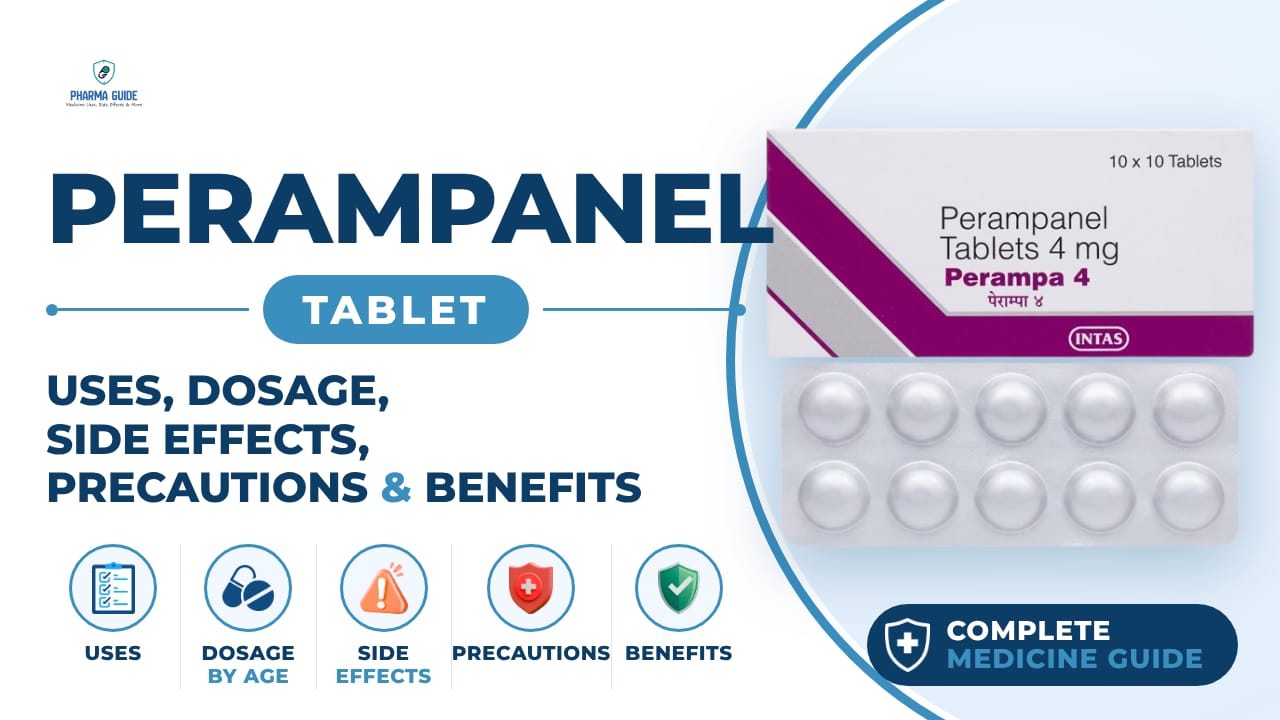
| Generic name | Perampanel |
|---|---|
| Drug class | Anticonvulsant (antiepileptic medication) |
| Forms | Tablet, Film coated tablet, Oral suspension (liquid) |
Quick overview
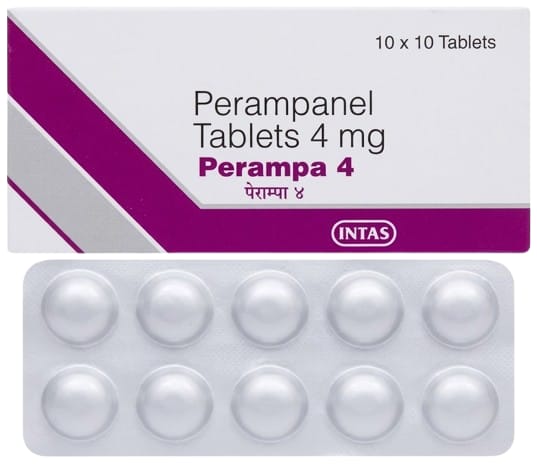
Perampanel Tablet, generic name Perampanel, is an anticonvulsant (antiepileptic) medication used to reduce how often seizures happen. It treats certain partial-onset seizures in adults and children 4 years and older, and is used with other medicines for primary generalized tonic-clonic seizures in adults and children 12 years and older. It works by blocking AMPA receptors in the brain to calm overactive nerve signals. It is available as a tablet, film-coated tablet, and oral suspension.
What is Perampanel Tablet
Perampanel is an anti-seizure medicine used to reduce how often seizures happen.
Perampanel Tablet uses
- Treats certain partial-onset seizures (seizures that involve only one part of the brain) in adults and children 4 years of age and older
- Used together with other medicines to treat primary generalized tonic-clonic seizures (seizures that involve the whole body) in adults and children 12 years of age and older
Benefits of Perampanel Tablet
- Helps control partial-onset seizures
- May reduce seizure frequency
- Helps manage certain generalized seizures
- May improve daily functioning when seizures are controlled
- Supports long-term epilepsy management
How Perampanel Tablet works
Perampanel blocks certain brain receptors (AMPA receptors) that a brain chemical called glutamate uses to overexcite nerve cells. By blocking these receptors, it calms down the overactive electrical signals in the brain that cause seizures.
Perampanel Tablet dosage
This medicine is usually taken once a day at bedtime because it can cause drowsiness. Take it at around the same time every day to help you remember and stay on schedule. It can be taken with or without food. Swallow tablets whole with water; do not break, chew, or crush them. If using the liquid suspension, shake it well before each use and measure the dose with the oral dosing syringe provided, not a household spoon.
Do not take more or less than prescribed, or take it more often than directed. Do not stop taking this medicine suddenly without talking to your doctor, as this can cause seizures to become worse; your doctor will usually lower the dose gradually. If you miss a dose, skip it and continue your regular schedule; do not double up to make up for a missed dose, and contact your doctor if you miss more than one dose.
| Age group | Dose |
|---|---|
| Under 18 years | Not recommended |
| 18–64 years | 2 mg, once/day |
| 65+ years | 2 mg, once/day |
Available forms and strengths
- Tablet
- Film coated tablet
- Oral suspension (liquid)
Side effects of Perampanel Tablet
Common
- Dizziness or a sense of spinning (vertigo)
- Drowsiness or sleepiness
- Tiredness or fatigue
- Headache
- Irritability
- Nausea and vomiting
- Weight gain
- Constipation
- Weakness
- Problems with coordination or balance, including falls
- Muscle, back, or joint pain
- Decreased sense of touch or sensation
- Blurred or double vision
- Anxiety
- Bruising
- Abdominal pain
- Loss of appetite
Serious
- Serious or life-threatening changes in mental health and behavior, including increased hostility or aggression toward others
- Suicidal thoughts or actions
- Confusion, memory problems, or being suspicious or distrustful
- Seeing or hearing things that are not there
- A serious allergic reaction that can affect the skin, liver, kidneys, heart, or blood cells, which can be life-threatening: rash, hives, fever or swollen glands, swelling of the face or legs, shortness of breath, yellowing of skin or eyes, or dark urine
- Increased risk of falls causing serious injury, especially in elderly people
Warnings and precautions
- This medicine can cause serious or life-threatening changes in mental health and behavior, especially increased hostility or aggression toward others. Tell your doctor right away about any changes in mood, behavior, or personality during treatment or for up to a month after stopping.
- Like other seizure medicines, this drug may cause suicidal thoughts or actions in a very small number of people (about 1 in 500). Call your doctor right away if you notice new or worsening depression, anxiety, agitation, trouble sleeping, aggressive or violent behavior, mania, or thoughts of suicide.
- Do not stop taking this medicine suddenly without talking to your doctor, because stopping suddenly can cause seizures to happen more often.
- This medicine can increase the risk of falls that may cause serious injury, and this risk may be higher in elderly people.
- This medicine is a controlled substance and may be habit-forming. Do not take a larger dose, take it more often, or use it longer than prescribed.
- This medicine may lower the effectiveness of hormonal birth control containing levonorgestrel. Use an additional non-hormonal method of birth control while taking this medicine and for one month after the last dose.
- Tell your doctor if you are pregnant or planning to become pregnant. It is not known if perampanel will harm an unborn baby. Talk about registering with a pregnancy registry for antiepileptic drugs.
- It is not known if perampanel passes into breast milk. Talk to your doctor about the best way to feed your baby — you and your doctor should decide whether you will take perampanel or breastfeed, not both.
- Tell your doctor if you have or have ever had kidney disease, since this medicine should be used with caution in people with kidney problems.
- Tell your doctor if you have or have ever had liver disease, since this medicine should be used with caution in people with liver problems due to a higher risk of liver toxicity.
- Ask your doctor about drinking alcohol while taking this medicine, since alcohol can make side effects like dizziness and sleepiness worse and may worsen mood, anger, confusion, and depression.
- Do not drive, operate heavy machinery, or do other activities that require alertness until you know how this medicine affects you, since it may cause dizziness, sleepiness, or problems with coordination and balance.
Storage
- Keep this medication in the container it came in, tightly closed, and out of reach of children.
- Store it at room temperature and away from excess heat and moisture (not in the bathroom).
- Do not freeze the suspension. Discard any unused suspension 90 days after first opening the bottle.
- Dispose of unneeded medications in a way so that pets, children, and other people cannot take them. Do not flush this medication down the toilet. Use a medicine take-back program.
When to see a doctor
- Call your doctor right away if you notice aggression, hostility, anger, anxiety, irritability, being suspicious or distrustful, confusion, memory problems, or thoughts of harming or killing others.
- Call your doctor right away if you have thoughts about suicide or dying, new or worse depression, agitation, trouble sleeping, aggressive or violent behavior, mania, new or worse anxiety, panic attacks, or any other unusual changes in behavior or mood.
- Stop taking this medicine and get medical help immediately if you develop a rash, hives, fever or swollen glands, swelling of the face or legs, shortness of breath, yellowing of the skin or eyes, or dark urine, as these may be signs of a serious allergic reaction.
- If you think you have taken too much of this medicine, contact your local poison control center or go to the nearest hospital emergency room right away. If someone has collapsed, had a seizure, is having trouble breathing, or cannot be woken up, call emergency services immediately.
Alternatives
- Lamotrigine
- Brivaracetam
- Levetiracetam
Watch the video
FAQs
What is Perampanel Tablet used for?
It treats certain partial-onset seizures in adults and children 4 years and older, and is used with other medicines for primary generalized tonic-clonic seizures in adults and children 12 years and older.
How does Perampanel work?
It blocks AMPA receptors that glutamate uses to overexcite nerve cells, calming the overactive electrical signals in the brain that cause seizures.
When should Perampanel Tablet be taken?
It is usually taken once a day at bedtime because it can cause drowsiness, at around the same time every day, with or without food.
What are the serious side effects of Perampanel?
Serious side effects include life-threatening changes in mental health and behavior, increased hostility or aggression, suicidal thoughts, confusion, hallucinations, a serious allergic reaction, and increased risk of falls.
Can I stop taking Perampanel suddenly?
No, you should not stop taking it suddenly without talking to your doctor, as this can cause seizures to become worse; your doctor will usually lower the dose gradually.
General information, not medical advice
Your prescriber and the leaflet in your pack know your situation. This page does not.
- Follow your prescriber and the leaflet
- Don't start, stop, or change a dose on your own
- Doses and warnings differ by country and product
Sources
Video
Related medicines

Injectafer Injection: Uses, Dosage, Side Effects, Precautions and Alternates
Iron products
Injectafer (ferric carboxymaltose) treats iron deficiency anemia and heart failure-related iron deficiency via IV. Learn uses, dosage, side effects, and

Gliclazide Tablet: Uses, Dosage, Side Effects, Precautions and Alternates
Sulfonylurea (hypoglycemic/antidiabetic agent)
Gliclazide Tablet is a sulfonylurea for type 2 diabetes that boosts insulin release. Learn about dosage, side effects, warnings, and precautions.