
Safety
General information, not medical advice
Your prescriber and the leaflet in your pack know your situation. This page does not.
- Follow your prescriber and the leaflet
- Don't start, stop, or change a dose on your own
- Doses and warnings differ by country and product
Picato Gel: Uses, Dosage, Side Effects, Precautions and Alternates
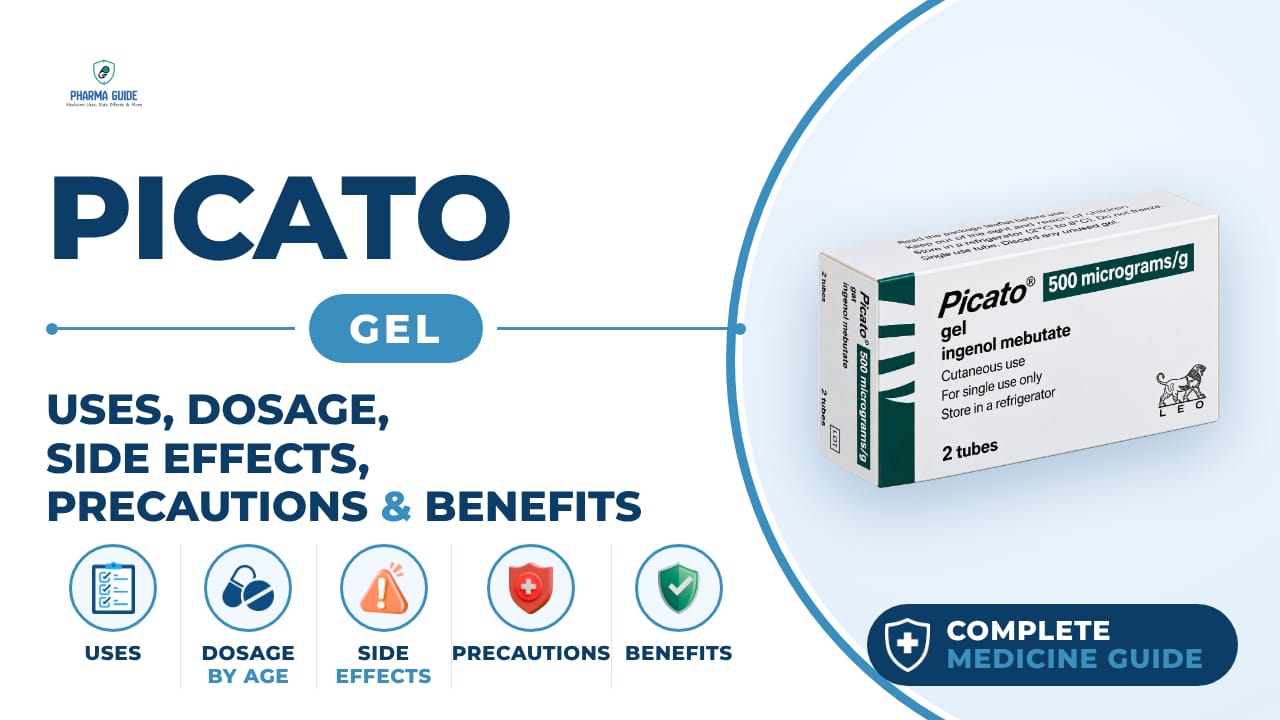
| Generic name | ingenol mebutate |
|---|---|
| Drug class | Antibiotics and chemotherapeutics for dermatological use, other chemotherapeutics |
| Forms | Gel, 0.015%, Gel, 0.05% |
Quick overview
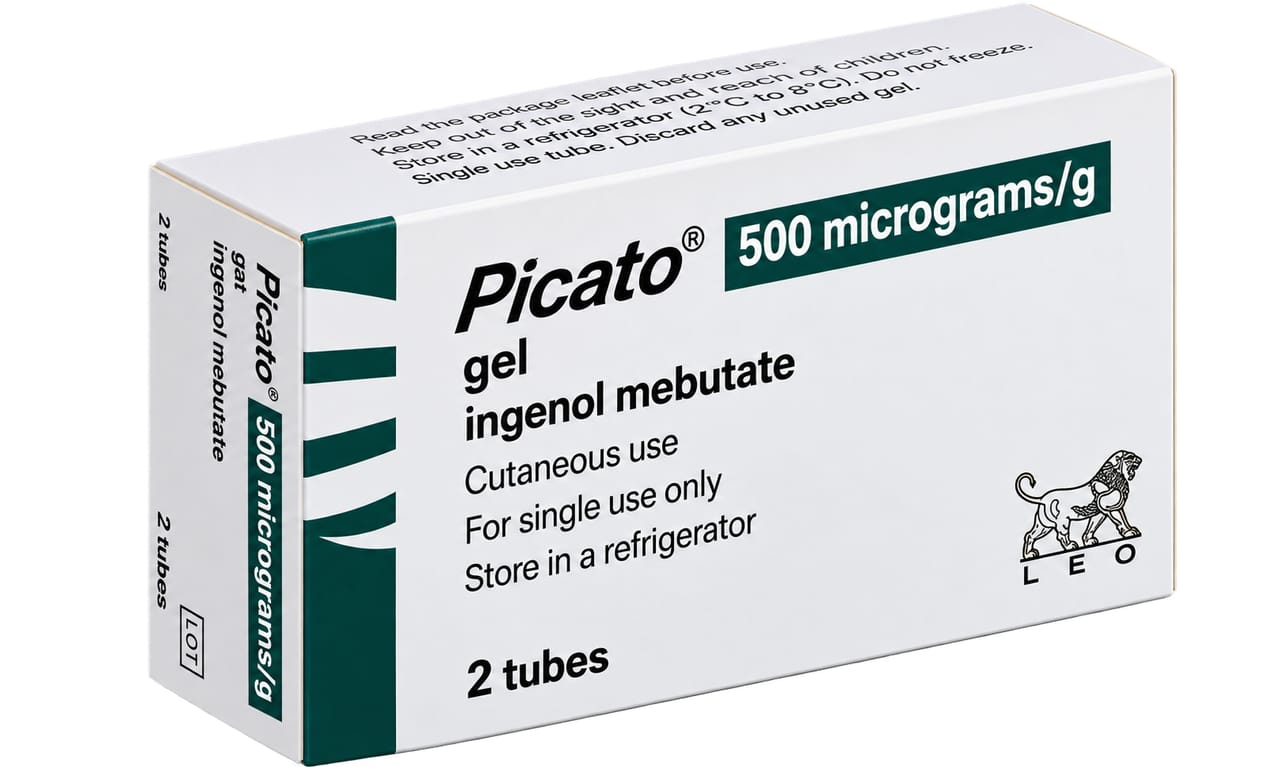
Picato Gel contains the active ingredient ingenol mebutate and belongs to the drug class of antibiotics and chemotherapeutics for dermatological use. It is a prescription gel applied to the skin to treat actinic keratosis (solar keratosis), rough sun-damaged patches of skin. The 0.015% strength is used on the face or scalp, while the 0.05% strength is used on the trunk or extremities. Treatment involves a short course applied once daily for only 2 or 3 days.
What is Picato Gel
Picato gel is a prescription gel that contains ingenol mebutate. It is applied to the skin to treat actinic keratosis (also called solar keratosis), which are rough, sun-damaged patches of skin.
Picato Gel uses
- Topical treatment of actinic keratosis (solar keratosis) on the face or scalp using the 0.015% gel
- Topical treatment of actinic keratosis on the trunk or extremities using the 0.05% gel
Benefits of Picato Gel
- Causes clearance of actinic keratosis lesions in the treated area for many patients by day 57 of follow-up
- Short treatment course: applied once daily for only 2 or 3 days depending on the body area treated
- Most patients reported higher overall satisfaction with treatment compared with the inactive gel
How Picato Gel works
Picato gel works in two ways: it causes abnormal skin cells in the lesion to die, and it triggers an inflammation response that helps the immune system clear the damaged cells. The exact way this leads to clearing of actinic keratosis is not completely understood.
Picato Gel dosage
Apply Picato gel to the skin only; it is not for use in the eyes, mouth, or vagina. Apply the gel to only one affected area as directed by your healthcare provider; do not treat other areas. Spread the gel evenly over the treatment area and let it dry for 15 minutes before doing anything else. Wash your hands with soap and water right away after applying the gel; if treating your hands, wash only the fingertip used to apply the gel.
Avoid touching, washing, or doing activities that cause heavy sweating in the treated area for 6 hours after application; after that, you may wash the area with mild soap and water. Do not apply the gel right after taking a shower or less than 2 hours before going to bed. Do not cover the treated area with air-tight or water-tight bandages after applying the gel.
Use a new, single-use tube for each day of treatment and throw away the tube after one use, even if gel remains inside. Avoid getting the gel in, around, or near your eyes, nostrils, ears, lips, or mouth. Wait until skin has fully healed from any previous treatment or surgery before applying this gel.
Use is not established for children or adolescents under 18 years of age. No dose adjustment is needed for elderly patients.
| Age group | Dose |
|---|---|
| Under 18 years | Safety and effectiveness were not established; no standard pediatric dose |
| 18–39 years | Picato is no longer recommended as a current treatment option |
| 65–74 years | Picato is no longer recommended as a current treatment option |
| 75 years and older | Picato is no longer recommended as a current treatment option |
Available forms and strengths
- Gel, 0.015%
- Gel, 0.05%
Side effects of Picato Gel
Common
- Redness (erythema) at the application site
- Flaking or scaling of the skin
- Crusting or scabbing
- Swelling at the application site
- Blisters or pustules (vesiculation/pustulation)
- Skin erosion or ulceration
- Pain, itching, or irritation at the application site
- Infection at the application site
- Swelling around the eyes (periorbital edema)
- Nose and throat irritation (nasopharyngitis)
- Headache
Serious
- Severe eye pain, chemical conjunctivitis, corneal burn, eyelid swelling or drooping, or swelling around the eyes if the gel gets into or near the eyes
- Serious allergic reactions (including anaphylaxis) such as swelling of the lips or tongue, trouble breathing or wheezing, chest tightness, dizziness, or passing out
- Severe local skin reactions such as deep ulceration, breakdown of skin, or skin that does not heal
- Skin infection with pus, spreading redness, or symptoms that get worse after the first week
- Shingles (herpes zoster) has been reported
- Skin color changes (pigmentation changes) or scarring at the treated area
Warnings and precautions
- Serious eye injuries can happen if the gel gets into the eyes, including severe pain, chemical burns to the eye surface, and swelling. Be careful to avoid any contact with the eyes or the skin around the eyes.
- Serious allergic reactions, including severe whole-body reactions, have occurred with this medicine, sometimes requiring hospital treatment.
- Severe skin reactions such as blistering, open sores, or breakdown of the skin can occur in the treated area. Do not use this gel on skin that has not healed from a previous treatment.
- Do not swallow this medicine. If it is accidentally swallowed, drink plenty of water and get medical help.
- Try to limit sun exposure, including sunlamps and tanning beds, while being treated, because of the nature of the skin condition being treated.
- There isn't enough information to know whether Picato gel is safe to use during pregnancy.
- Because the drug is not expected to be absorbed into the bloodstream, risk is believed to be low, but it is still recommended to avoid use during pregnancy unless your doctor advises otherwise.
- If you are breastfeeding, keep your baby from touching the treated skin for 6 hours after you apply the gel, since the drug does not appear to pass into breast milk in meaningful amounts.
- Systemic absorption was minimal, so kidney-specific dose adjustment was not generally required. No routine liver-specific adjustment was established.
- This medicine does not affect your ability to drive or use machines.
Storage
- Store Picato gel in a refrigerator at 36ºF to 46ºF (2ºC to 8ºC). Do not freeze.
- Picato gel has an expiration date (exp) marked on the end of the tube. Do not use the gel after this date.
- Safely throw away used Picato gel tubes in household trash.
- Keep Picato gel and all medicines out of the reach of children.
- Tubes should be discarded after first opening.
When to see a doctor
- If the gel accidentally gets in your eyes, rinse them with large amounts of water right away and get medical care as soon as possible.
- Get medical help immediately if you notice signs of a serious allergic reaction, such as swelling of the lips or tongue, trouble breathing or wheezing, chest tightness, or dizziness or passing out.
- Call your healthcare provider if the skin redness, flaking, crusting, or swelling in the treated area becomes more severe, or if you develop blisters, pus, ulcers, or skin breakdown.
Alternatives
- Fluorouracil topical
- Imiquimod topical
- Diclofenac topical
- Photodynamic therapy
Watch the video
FAQs
What is Picato Gel used for?
Picato Gel is used for topical treatment of actinic keratosis (solar keratosis), which are rough, sun-damaged patches of skin. The 0.015% strength treats the face or scalp, while the 0.05% strength treats the trunk or extremities.
How long is Picato Gel treatment?
Picato Gel is applied once daily for only 2 or 3 days, depending on the body area being treated.
How should Picato Gel be applied?
Apply the gel to only one affected area as directed, spread it evenly, and let it dry for 15 minutes. Wash your hands with soap and water right away after applying, avoid touching or washing the area for 6 hours, and use a new single-use tube for each day of treatment.
What are the common side effects of Picato Gel?
Common side effects include redness, flaking or scaling, crusting or scabbing, swelling, blisters or pustules, skin erosion, pain or itching at the application site, infection, periorbital swelling, nasopharyngitis, and headache.
Can Picato Gel be used during pregnancy or breastfeeding?
There isn't enough information to confirm safety during pregnancy, so it's recommended to avoid use unless advised by a doctor. If breastfeeding, keep your baby from touching the treated skin for 6 hours after application.
General information, not medical advice
Your prescriber and the leaflet in your pack know your situation. This page does not.
- Follow your prescriber and the leaflet
- Don't start, stop, or change a dose on your own
- Doses and warnings differ by country and product
Sources
Video
Related medicines
Ingenol Mebutate Gel: Uses, Dosage, Side Effects, Precautions and Alternates
Antibiotics and chemotherapeutics for dermatological use, other chemotherapeutics
Ingenol Mebutate Gel (Picato) treats actinic keratosis with a short 2-3 day course. Learn uses, dosage, side effects, warnings, and storage tips.

Injectafer Injection: Uses, Dosage, Side Effects, Precautions and Alternates
Iron products
Injectafer (ferric carboxymaltose) treats iron deficiency anemia and heart failure-related iron deficiency via IV. Learn uses, dosage, side effects, and