
Safety
General information, not medical advice
Your prescriber and the leaflet in your pack know your situation. This page does not.
- Follow your prescriber and the leaflet
- Don't start, stop, or change a dose on your own
- Doses and warnings differ by country and product
Praxbind Injection: Uses, Dosage, Side Effects, Precautions and Alternates
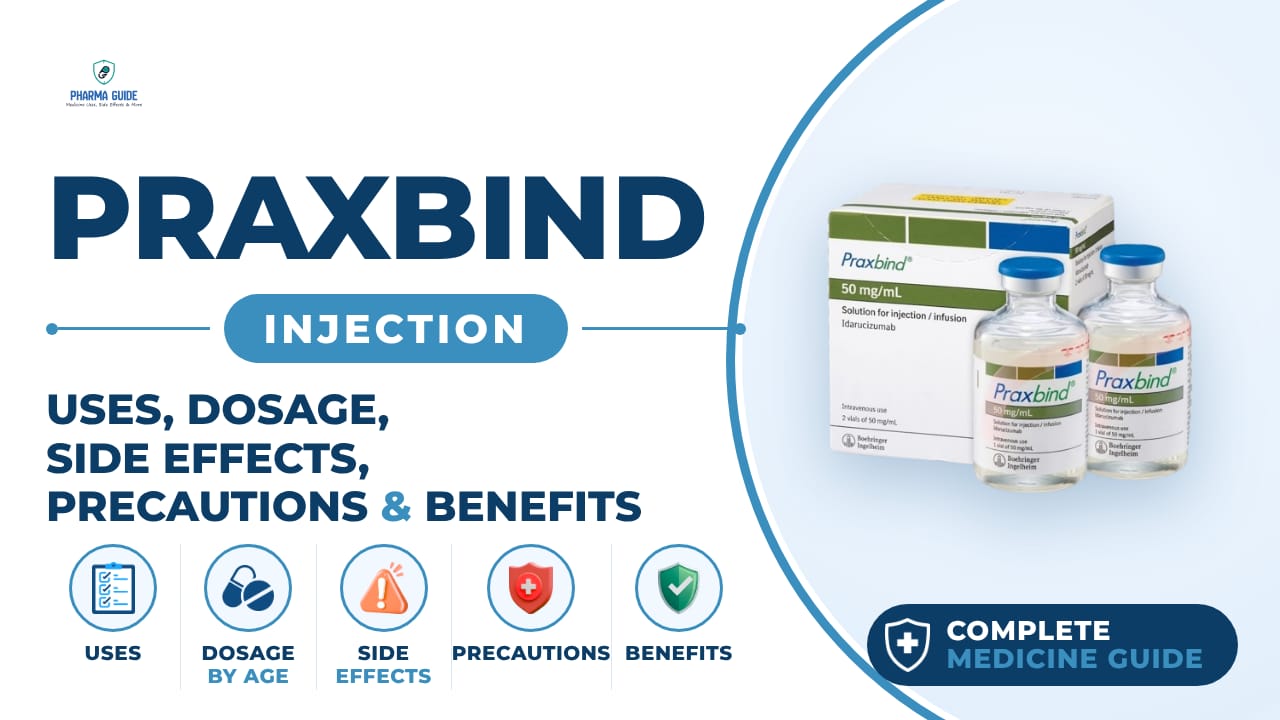
| Generic name | Idarucizumab |
|---|---|
| Drug class | Antidotes/Anticoagulant reversal agent |
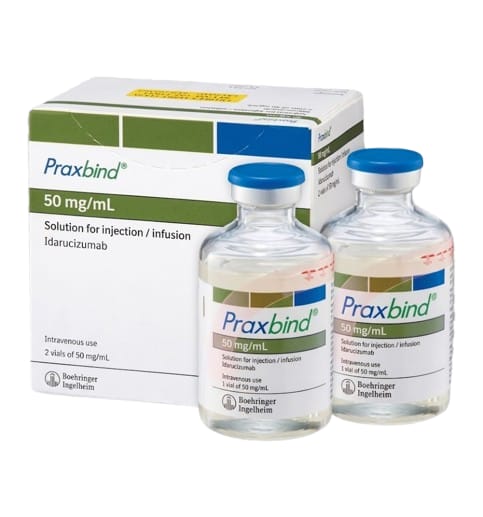
| Forms | Solution for injection/infusion (2.5 g/50 mL in a single-use vial) |
Quick overview
Praxbind Injection (idarucizumab) is an antidote used to reverse the blood-thinning effect of dabigatran (Pradaxa) in emergency situations, such as before urgent surgery or when uncontrolled bleeding occurs. It works by binding tightly to dabigatran in the blood, stopping it from working within minutes. Praxbind is given only by a doctor or nurse as an injection or infusion into a vein.
What is Praxbind Injection
Praxbind is a medicine used to reverse the blood-thinning effect of dabigatran (Pradaxa) in emergency situations. It contains idarucizumab, an antibody fragment that binds to dabigatran and stops it from working.
Praxbind Injection uses
- Used in patients taking dabigatran (Pradaxa) when its blood-thinning effect needs to be reversed quickly for emergency surgery or an urgent procedure
- Used when a person taking dabigatran has life-threatening or uncontrolled bleeding
Benefits of Praxbind Injection
- Rapidly and completely neutralizes the anticlotting effect of dabigatran, often within minutes
- Allows emergency surgery or treatment of serious bleeding to proceed safely in people taking dabigatran
How Praxbind Injection works
Praxbind contains an antibody fragment that attaches tightly to dabigatran in the blood, forming a complex that quickly stops dabigatran from thinning the blood.
Praxbind Injection dosage
Praxbind is given only by a doctor or nurse as an injection or infusion into a vein; it is not for self-administration. It can be given as two infusions one after the other, or as an injection using a syringe. If you already have an IV line, it will be flushed with saline before this medicine is given through it, and no other infusion should run through the same line at the same time. After this medicine is given, your doctor will decide when it is safe to restart dabigatran or other treatment to prevent blood clots, usually about 24 hours later.
| Age group | Dose |
|---|---|
| Under 18 years | Not recommended |
| 18–64 years | 5,000 mg, once/day |
| 65+ years | 5,000 mg, once/day |
Available forms and strengths
- Solution for injection/infusion (2.5 g/50 mL in a single-use vial)
Side effects of Praxbind Injection
Common
- Headache
- Back pain
- Fever
- Wheezing
- Rash and itchy skin
- Low blood potassium levels (hypokalemia)
- Confusion or delirium
- Constipation
- Pneumonia
- Nausea
Serious
- Signs of an allergic reaction: hives, itching, difficulty breathing, swelling of the face, lips, tongue, or throat
- Signs of a blood clot: sudden numbness or weakness especially on one side of the body, problems with vision or speech, chest pain, wheezing, coughing up blood, pain, swelling, warmth, or redness in one or both legs
- Long or excessive bleeding
- Exceptional weakness, tiredness, headaches, dizziness, and looking pale (signs of anaemia)
- Red or dark brown urine, or red or black bowel motions (signs of internal bleeding)
Warnings and precautions
- Stopping the blood-thinning effect of dabigatran means you are no longer protected against blood clots. Treatment to prevent clots should be restarted as soon as your doctor feels it is safe.
- In some patients, blood clotting levels can rise again between 12 and 24 hours after treatment. If bleeding returns along with this, your doctor may consider giving a second dose.
- Serious allergic reactions can occur. If this happens, the medicine will be stopped immediately and treated.
- This medicine contains sorbitol, which can cause serious, even life-threatening reactions in people with a rare inherited condition called hereditary fructose intolerance.
- This medicine contains sodium, which may matter if you are on a low-sodium diet.
- There is no information on using this medicine in children.
- Tell your doctor if you are pregnant or planning to become pregnant. It is not known if this medicine can harm an unborn baby, so it should only be used if clearly needed.
- Tell your doctor if you are breastfeeding. It is not known whether this medicine passes into breast milk, so caution is advised.
- People with kidney problems can still receive this medicine without needing a different dose, though it may stay in the body a bit longer.
- This medicine has not been formally studied in people with liver problems.
Storage
- Store Praxbind vials in the refrigerator between 2°C and 8°C (36°F to 46°F) in the original carton to protect from light
- Do not freeze
- Do not shake
- Vials may be stored at room temperature (25°C/77°F) for up to 48 hours in the original carton, or up to 6 hours if taken out of the carton and exposed to light
- Once the solution is drawn from the vial, it should be used promptly
When to see a doctor
- Tell your doctor or nurse right away if you notice long or excessive bleeding, extreme weakness, tiredness, headaches, dizziness, or looking pale, chest pain or shortness of breath, red or dark brown urine, or red or black bowel motions — these can be signs of bleeding needing urgent medical attention.
- Get emergency medical help if you have signs of an allergic reaction such as hives, itching, difficulty breathing, or swelling of the face, lips, tongue, or throat.
- Watch for signs of blood clots after treatment, such as sudden numbness or weakness on one side of the body, trouble with vision or speech, chest pain, wheezing, coughing up blood, or pain, swelling, warmth, or redness in a leg, and report these right away.
Alternatives
- Feiba
- Kcentra
- Idarucizumab
Watch the video
FAQs
What is Praxbind Injection used for?
Praxbind is used to reverse the blood-thinning effect of dabigatran (Pradaxa) in emergency situations, such as before urgent surgery or when a person taking dabigatran has life-threatening or uncontrolled bleeding.
How does Praxbind Injection work?
Praxbind contains idarucizumab, an antibody fragment that binds tightly to dabigatran in the blood, forming a complex that quickly stops dabigatran from thinning the blood, often within minutes.
How is Praxbind Injection given?
Praxbind is given only by a doctor or nurse as an injection or infusion into a vein. It can be given as two infusions one after the other, or as an injection using a syringe, and is not for self-administration.
What are the common side effects of Praxbind Injection?
Common side effects include headache, back pain, fever, wheezing, rash and itchy skin, low blood potassium levels, confusion or delirium, constipation, pneumonia, and nausea.
Can dabigatran be restarted after Praxbind Injection?
Yes, after Praxbind is given, your doctor will decide when it is safe to restart dabigatran or other treatment to prevent blood clots, usually about 24 hours later.
General information, not medical advice
Your prescriber and the leaflet in your pack know your situation. This page does not.
- Follow your prescriber and the leaflet
- Don't start, stop, or change a dose on your own
- Doses and warnings differ by country and product
Sources
Video
Related medicines

Injectafer Injection: Uses, Dosage, Side Effects, Precautions and Alternates
Iron products
Injectafer (ferric carboxymaltose) treats iron deficiency anemia and heart failure-related iron deficiency via IV. Learn uses, dosage, side effects, and

Gliclazide Tablet: Uses, Dosage, Side Effects, Precautions and Alternates
Sulfonylurea (hypoglycemic/antidiabetic agent)
Gliclazide Tablet is a sulfonylurea for type 2 diabetes that boosts insulin release. Learn about dosage, side effects, warnings, and precautions.