
Safety
General information, not medical advice
Your prescriber and the leaflet in your pack know your situation. This page does not.
- Follow your prescriber and the leaflet
- Don't start, stop, or change a dose on your own
- Doses and warnings differ by country and product
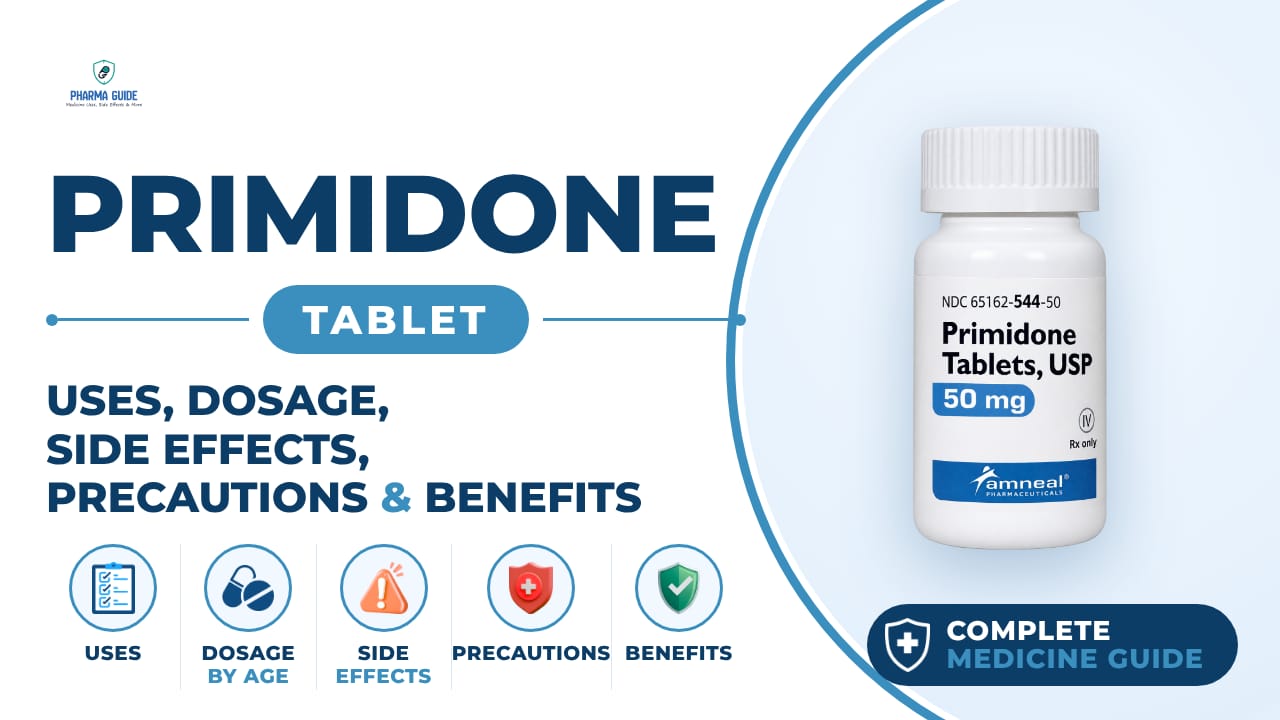
Primidone Tablet: Uses, Dosage, Side Effects, Precautions and Alternates
| Generic name | primidone |
|---|---|
| Drug class | Barbiturate anticonvulsant |
| Forms | Tablet (250 mg) |

Quick overview
Primidone Tablet (primidone) is a prescription barbiturate anticonvulsant used alone or with other medicines to treat seizures in adults and children. It is thought to work by calming brain activity and controlling brain chemicals that send nerve signals, and the body also converts it into phenobarbital, which further helps control seizures. It is available as a 250 mg tablet and is typically taken on a regular daily schedule as directed by a doctor.
What is Primidone Tablet
Primidone is a prescription medicine used alone or with other medicines to treat seizures in adults and children. It belongs to a group of medicines called antiepileptics, also known as barbiturate anticonvulsants.
Primidone Tablet uses
- Generalized tonic-clonic (grand mal) seizures
- Complex partial (psychomotor) seizures
- Focal aware (partial-onset) seizures
- Control of other types of seizures and jerks
Benefits of Primidone Tablet
- Helps control epileptic seizures
- Reduces seizure frequency
- Helps manage focal seizures
- Helps control generalized seizures
- Helps reduce essential tremor
How Primidone Tablet works
Primidone is an antiepileptic medicine. It is thought to work by calming down brain activity and controlling the brain chemicals that send signals to nerves, so that seizures do not happen as easily. The body also breaks primidone down into phenobarbital, which itself helps calm brain nerve activity to control seizures.
Primidone Tablet dosage
Primidone can be taken with or without food. Take it at the same time each day to help it work best and to help you remember. Swallow the tablet with a glass of water. Take it regularly, since skipping doses can mean your seizures are not well controlled.
Only certain tablet strengths can be safely split in half with a pill splitter; do not cut or crush any tablet unless your prescriber says it is okay. Do not change your dose or stop taking this medicine suddenly without talking to your prescriber first, since this can cause seizures to return or worsen.
Doses for children under 8 years old may be based on body weight and can change if the child's weight changes. Lower doses are generally used in elderly patients to avoid excessive sleepiness. You may not feel the full benefit of this medicine for several weeks. Your prescriber may order blood tests to check medication levels and adjust your dose.
| Age group | Dose |
|---|---|
| Under 18 years | Not recommended |
| 18–64 years | 250–1,500 mg/day |
| 65+ years | 250–1,500 mg/day |
Available forms and strengths
- Tablet (250 mg)
Side effects of Primidone Tablet
Common
- Drowsiness and tiredness
- Dizziness
- Feeling like the room is spinning (vertigo)
- Problems with movement, balance, or coordination
- Nausea, vomiting, poor appetite
- Feeling irritable, emotional, or having mood swings
- Sexual problems, including impotence
- Double vision or other vision problems
- Headache
- Shakiness and unsteady walk
- Constipation or diarrhea
- Trouble sleeping
Serious
- Thoughts of suicide or self-harm, or new/worse depression, anxiety, agitation, or unusual mood and behavior changes
- Signs of a serious allergic reaction: hives, difficulty breathing, swelling of the face, lips, tongue, or throat, or trouble swallowing
- Signs of a severe skin reaction: fever, sore throat, burning eyes, skin pain, red or purple skin rash with blistering and peeling (possible Stevens-Johnson syndrome, toxic epidermal necrolysis, or DRESS)
- Signs of blood problems: frequent fevers, chills, sore throat, unusual tiredness or weakness, shortness of breath, unusual bruising or bleeding, pale skin
- Signs of liver problems: dark urine, pale stools, yellowing of the skin or eyes, nausea, vomiting, loss of appetite, stomach pain
- Extreme drowsiness or suddenly falling asleep even after feeling alert
- Signs of worsening seizures or new types of seizures
- Irregular heartbeat
- Dupuytren's contracture (fingers bending toward the palm, lumps in the palm)
- Signs of decreased bone density or osteoporosis with long-term use
Warnings and precautions
- Primidone can increase the risk of suicidal thoughts and behavior, which can start as early as one week after starting the medicine. Family and friends should watch for mood or behavior changes, and you should contact emergency services right away if you have thoughts of self-harm.
- Do not suddenly stop taking primidone, as this can cause serious withdrawal seizures. If you need to stop, your doctor will help you lower the dose gradually.
- Primidone can cause serious, sometimes fatal skin reactions, including Stevens-Johnson syndrome, toxic epidermal necrolysis, and DRESS. Seek medical help right away if you notice a rash, blistering, or peeling skin.
- Primidone may increase problems with concentration and movement, especially when combined with alcohol or other drowsiness-causing medications, which can make driving or operating machinery dangerous.
- Long-term use of primidone may affect vitamin D and bone health, increasing the risk of weakened bones or osteoporosis.
- Primidone may make hormonal birth control, such as the pill, less effective, so additional contraception methods may be needed.
- Talk to your doctor before taking primidone if you are pregnant or planning to become pregnant. It is not clear if this medicine is safe in pregnancy, and it may cause birth defects or affect how the baby develops. However, do not stop taking primidone on your own, because uncontrolled seizures can also be dangerous for both mother and baby. If you become pregnant while taking primidone, your doctor may suggest joining a pregnancy registry to track its effects.
- Primidone can pass into breast milk and may make a breastfeeding baby very sleepy. Talk to your doctor about the risks and benefits before breastfeeding while taking this medicine, and watch your baby for unusual drowsiness.
- Primidone should be used with caution if you have kidney problems, and your doctor may need to adjust your dose.
- Primidone should be used with caution if you have liver problems, and a lower dose may be needed.
- Drinking alcohol while taking primidone can increase side effects like drowsiness and dizziness, and may worsen feelings of anger, confusion, or sadness.
- Do not drive or operate machinery until you know how primidone affects you, since it can cause drowsiness, dizziness, and slow your thinking and reactions.
Storage
- Store at controlled room temperature, between 15°C to 30°C, in a tightly closed, light-resistant container, away from moisture and heat
- Keep in a cool, dry place away from direct sunlight
- Do not store in the bathroom or near a sink
- Keep out of the reach and sight of children
- Dispose of any unused or expired medicine safely, such as through your pharmacist, following local requirements
When to see a doctor
- Get emergency help right away if you notice signs of a severe allergic reaction, such as hives, trouble breathing, or swelling of the face or throat, or signs of a severe skin reaction like fever, sore throat, burning eyes, or a rash with blistering and peeling
- Tell your doctor right away if you notice new or sudden changes in mood or behavior, including worse depression, anxiety, panic attacks, trouble sleeping, feeling impulsive, irritable, agitated, hostile, aggressive, restless, or if you have thoughts about suicide or hurting yourself
- Call your doctor right away if you have extreme drowsiness or suddenly fall asleep even after feeling alert, or if you notice signs of infection such as fever, swollen glands, shortness of breath, chills, sore throat, body aches, unusual tiredness, loss of appetite, bruising, or bleeding
- If you think you or someone else has taken too much primidone, get emergency medical help or contact a poison control center right away, even if there are no symptoms
- Stop taking primidone and get medical help right away if you or your child develop symptoms of a serious skin reaction such as SJS, TEN, or DRESS
Alternatives
- Valproate
- Levetiracetam
- Phenobarbital
Watch the video
FAQs
What is Primidone Tablet used for?
Primidone is used alone or with other medicines to treat seizures in adults and children, including generalized tonic-clonic seizures, complex partial seizures, and focal aware seizures.
How does Primidone Tablet work?
Primidone is thought to work by calming brain activity and controlling brain chemicals that send nerve signals so seizures do not happen as easily. The body also converts it into phenobarbital, which further helps control seizures.
Can I stop taking Primidone Tablet suddenly?
No, you should not suddenly stop taking primidone or change your dose without talking to your prescriber, as this can cause withdrawal seizures or make seizures return or worsen.
What are the common side effects of Primidone Tablet?
Common side effects include drowsiness, dizziness, vertigo, problems with movement or coordination, nausea, mood swings, sexual problems, vision problems, headache, and trouble sleeping.
Is Primidone Tablet safe during pregnancy?
It is not clear if primidone is safe during pregnancy, and it may cause birth defects or affect the baby's development, but you should not stop taking it on your own since uncontrolled seizures can also be dangerous. Talk to your doctor if you are pregnant or planning pregnancy.
General information, not medical advice
Your prescriber and the leaflet in your pack know your situation. This page does not.
- Follow your prescriber and the leaflet
- Don't start, stop, or change a dose on your own
- Doses and warnings differ by country and product
Sources
Video
Related medicines

Injectafer Injection: Uses, Dosage, Side Effects, Precautions and Alternates
Iron products
Injectafer (ferric carboxymaltose) treats iron deficiency anemia and heart failure-related iron deficiency via IV. Learn uses, dosage, side effects, and

Gliclazide Tablet: Uses, Dosage, Side Effects, Precautions and Alternates
Sulfonylurea (hypoglycemic/antidiabetic agent)
Gliclazide Tablet is a sulfonylurea for type 2 diabetes that boosts insulin release. Learn about dosage, side effects, warnings, and precautions.