
Safety
General information, not medical advice
Your prescriber and the leaflet in your pack know your situation. This page does not.
- Follow your prescriber and the leaflet
- Don't start, stop, or change a dose on your own
- Doses and warnings differ by country and product
Pulmozyme Inhaler: Uses, Dosage, Side Effects, Precautions and Alternates
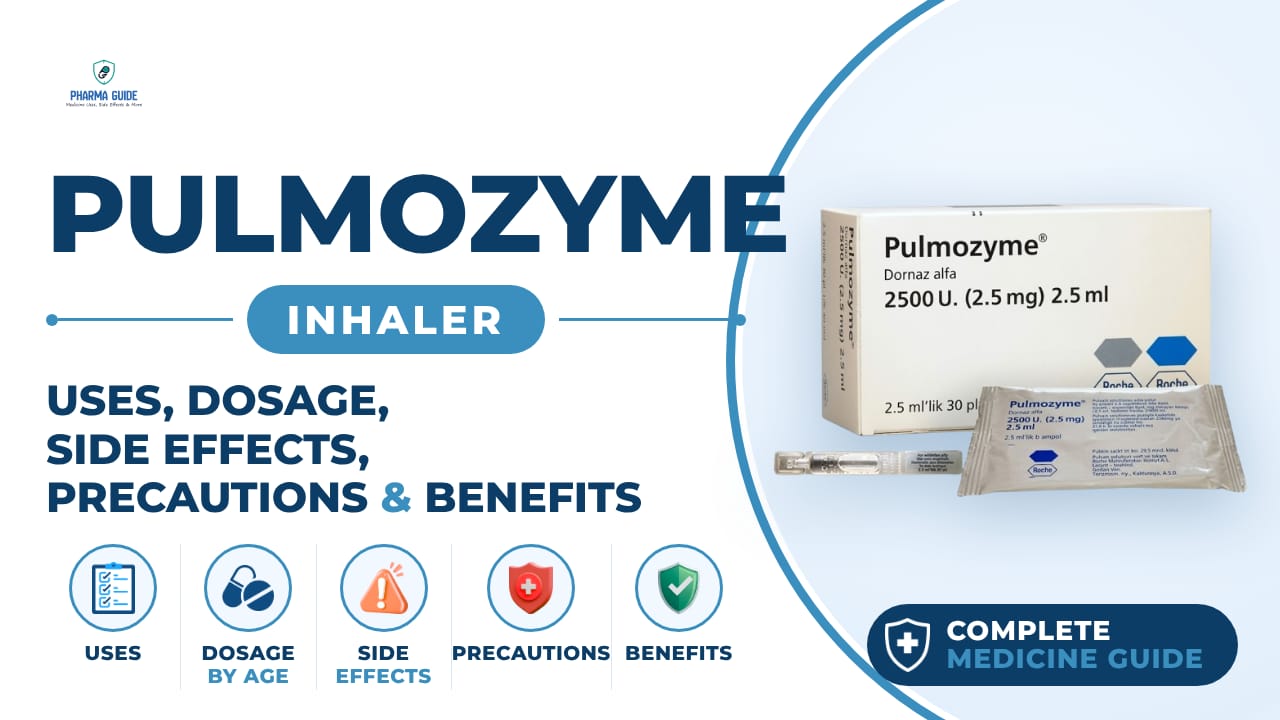
| Generic name | dornase alfa |
|---|---|
| Drug class | pulmonary agent, recombinant deoxyribonuclease (DNase) enzyme (also called mucolytic enzyme) |
| Forms | Inhaler |
Quick overview
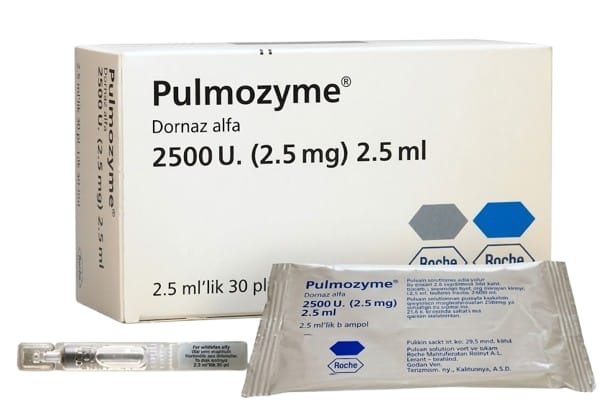
Pulmozyme Inhaler contains dornase alfa, a pulmonary agent and recombinant DNase enzyme (also called a mucolytic enzyme). It is an inhaled medicine used for cystic fibrosis, where it helps thin thick lung mucus so it is easier to clear and breathing improves. It is given daily through a nebuliser and is not recommended for children under 5 years of age.
What is Pulmozyme Inhaler
Pulmozyme is an inhaled medicine used for cystic fibrosis. It contains dornase alfa, a man-made version of a protein found naturally in the body called DNase. It makes the thick mucus in the lungs thinner and easier to clear, helping people breathe better.
Pulmozyme Inhaler uses
- Cystic fibrosis, an inherited condition where thick mucus builds up in the lungs and other organs, to improve lung function
- In people with cystic fibrosis and better lung function (FVC 40% of predicted or more), daily use may also reduce the risk of lung infections that need antibiotics given by injection
Benefits of Pulmozyme Inhaler
- Makes mucus in the lungs thinner and easier to clear
- Can help you breathe better
- May reduce the risk of respiratory tract infections requiring antibiotics by injection in certain patients
- Does not usually cause serious side effects
How Pulmozyme Inhaler works
In cystic fibrosis, thick mucus builds up in the lungs, partly because dead white blood cells leave behind DNA that makes the mucus thicker. Pulmozyme contains an enzyme that breaks down this DNA in the mucus, making the mucus thinner and easier to clear from the lungs.
Pulmozyme Inhaler dosage
Pulmozyme is taken by inhaling a mist produced by a nebuliser connected to a compressor, or by a vibrating mesh nebuliser, through a mouthpiece or face mask. It should be used every day as prescribed. People over 21 may be told by their doctor to use it twice a day instead of once a day. It is not recommended for children under 5 years of age.
Do not mix Pulmozyme with any other liquid medicines in the nebuliser; keep other inhaled medicines completely separate. Squeeze each ampule before opening to check for leaks; do not use if leaking, cloudy, or an unusual color. Pour the entire contents of the ampule into the nebuliser cup and use right away; throw away any unused medicine.
Keep having your usual chest physiotherapy while using this medicine. Continue your other cystic fibrosis treatments (such as antibiotics, pancreatic enzymes, bronchodilators, and painkillers) unless your doctor tells you otherwise. Ultrasonic nebulisers must not be used, as they may stop the medicine from working properly.
If you miss a dose, use it as soon as you remember; if it is almost time for the next dose, skip the missed one and do not double up.
| Age group | Dose |
|---|---|
| Under 18 years | Not recommended |
| 18–64 years | 2.5 mg, once/day |
| 65+ years | 2.5 mg, once/day |
Available forms and strengths
- Inhaler
Side effects of Pulmozyme Inhaler
Common
- Voice changes or hoarseness, including loss of voice (laryngitis)
- Sore or dry throat
- Rash
- Chest pain
- Pink eye/eye irritation or inflammation (conjunctivitis)
- Runny or stuffy nose (rhinitis)
- Decrease in how much air you can breathe out after a deep breath
- Fever
- Shortness of breath
- Upset stomach (indigestion)
- When starting treatment, lung function may temporarily get worse and you may produce more mucus than normal; this usually improves with time
Serious
- Signs of a severe allergic reaction: breathing problems or wheezing, racing heart, fever or feeling generally unwell, swollen lymph nodes, swelling of the face, lips, mouth, tongue, or throat, trouble swallowing or throat tightness, itching or skin rash, hives, nausea or vomiting, dizziness, feeling lightheaded or fainting, stomach cramps, joint pain
- Increasing difficulty breathing
- Chest pain
- Fever
Warnings and precautions
- Do not use this medicine if you are allergic to dornase alfa, to Pulmozyme, to other products made using Chinese hamster ovary cells, or to any ingredient in the specific product.
- This medicine is not recommended for children under 5 years of age; check with your doctor or pharmacist first if it has been prescribed for a child under 5.
- Do not mix this medicine with other nebuliser medicines in the same nebuliser, as this could cause unwanted chemical or functional changes.
- Do not use this medicine unless it has been prescribed for you, and do not share it with others, even if they have the same condition, as it may harm them.
- Keep this medicine out of the reach of children, taking extra care since it is stored in the refrigerator where children may also access food.
- If your chest symptoms get worse after stopping this medicine, talk to your doctor; do not stop without discussing it first.
- It is not known if or how this medicine could affect pregnancy or harm an unborn baby. Do not use it during pregnancy or if you are trying to become pregnant unless your doctor has told you to; tell your health care provider if you are pregnant or planning to become pregnant.
- It is not known if this medicine passes into breast milk. Do not use it while breastfeeding unless your doctor has told you to.
- No routine kidney-specific dose adjustment is established. No routine liver-specific dose adjustment is established. It is not known whether drinking alcohol affects this medicine. This medicine is not likely to affect your ability to drive or use tools or machines.
Storage
- Store in the refrigerator, at temperatures between 36 F and 46 F (2 C and 8 C)
- Protect the medicine from light by keeping it in its foil pouch/original carton
- Do not use if it has been exposed to temperatures between 72 F and 82 F (22 C and 28 C) for more than 60 hours total
- An ampoule can still be used if left out of the refrigerator only once, for no longer than 24 hours, at temperatures up to 30°C
- Do not use past the expiry date printed on the pack
- Keep out of the sight and reach of children
- Do not throw away leftover ampoules in wastewater or household trash; return them to your pharmacist for safe disposal
When to see a doctor
- Stop using this medicine and get help right away if you notice signs of a serious allergic reaction, such as breathing problems or wheezing, a racing heart, fever or feeling generally unwell, swollen lymph nodes, swelling of the face, lips, mouth, tongue or throat, trouble swallowing or throat tightness, itching, skin rash or hives, nausea or vomiting, dizziness or fainting, stomach cramps, or joint pain.
- If you think you have used too much of this medicine, contact a doctor right away.
- If someone else accidentally uses your medicine, they should talk to a doctor straight away.
Alternatives
- N-acetylcysteine (NAC)
- Bronchitol (Mannitol)
- Hypertonic Saline 7%
Watch the video
FAQs
What is Pulmozyme Inhaler used for?
It is used for cystic fibrosis to thin thick lung mucus, making it easier to clear and improving lung function. In patients with better lung function, daily use may also reduce the risk of lung infections needing injectable antibiotics.
How is Pulmozyme Inhaler taken?
It is inhaled as a mist from a nebuliser connected to a compressor, or a vibrating mesh nebuliser, through a mouthpiece or face mask, used daily as prescribed. People over 21 may be told to use it twice a day.
Can children use Pulmozyme Inhaler?
No, it is not recommended for children under 5 years of age.
What are the common side effects of Pulmozyme Inhaler?
Common side effects include voice changes or hoarseness, sore or dry throat, rash, chest pain, conjunctivitis, runny or stuffy nose, fever, shortness of breath, and indigestion.
Can Pulmozyme Inhaler be mixed with other nebuliser medicines?
No, it should not be mixed with other liquid medicines in the nebuliser, and other inhaled medicines should be kept completely separate.
General information, not medical advice
Your prescriber and the leaflet in your pack know your situation. This page does not.
- Follow your prescriber and the leaflet
- Don't start, stop, or change a dose on your own
- Doses and warnings differ by country and product
Sources
Video
Related medicines

Injectafer Injection: Uses, Dosage, Side Effects, Precautions and Alternates
Iron products
Injectafer (ferric carboxymaltose) treats iron deficiency anemia and heart failure-related iron deficiency via IV. Learn uses, dosage, side effects, and

Gliclazide Tablet: Uses, Dosage, Side Effects, Precautions and Alternates
Sulfonylurea (hypoglycemic/antidiabetic agent)
Gliclazide Tablet is a sulfonylurea for type 2 diabetes that boosts insulin release. Learn about dosage, side effects, warnings, and precautions.