
Safety
General information, not medical advice
Your prescriber and the leaflet in your pack know your situation. This page does not.
- Follow your prescriber and the leaflet
- Don't start, stop, or change a dose on your own
- Doses and warnings differ by country and product
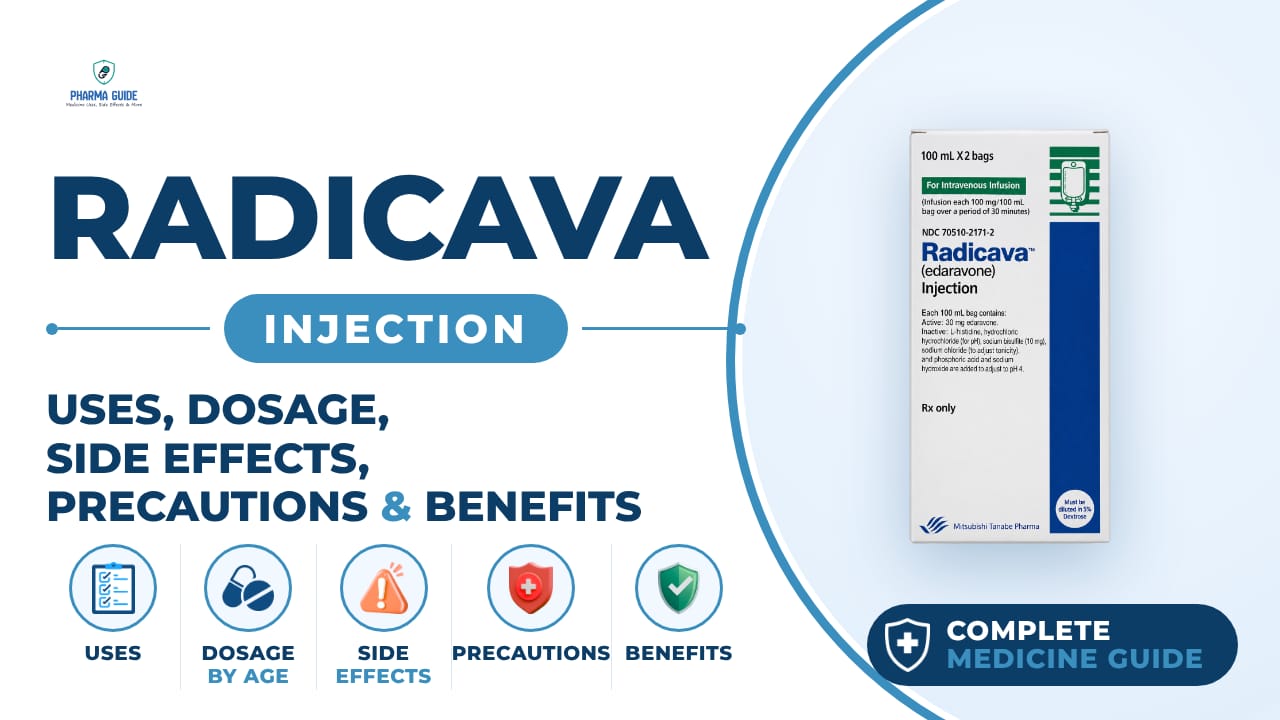
Radicava Injection: Uses, Dosage, Side Effects, Precautions and Alternates
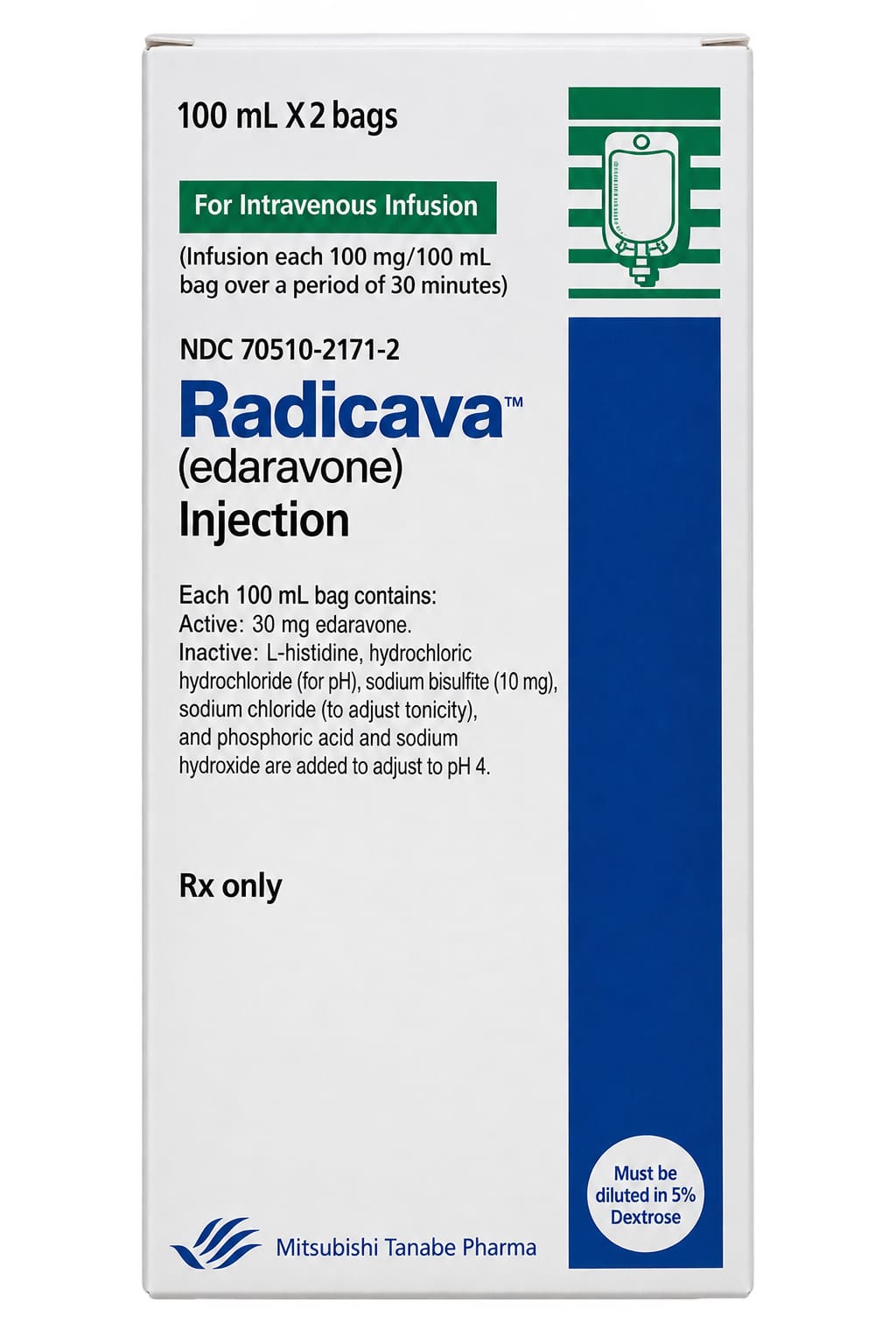
| Generic name | edaravone |
|---|---|
| Drug class | Miscellaneous central nervous system agents (antioxidant) |
| Forms | Injection |
Quick overview
Radicava Injection contains the active ingredient edaravone and belongs to the miscellaneous central nervous system agent (antioxidant) drug class. It is a prescription medicine given through a vein (IV) to treat amyotrophic lateral sclerosis (ALS), also known as Lou Gehrig's disease. It may help slow the decline in physical function and support daily activities and mobility in people with ALS. It is given as an IV infusion by a healthcare provider according to a specific treatment schedule.
What is Radicava Injection
Radicava is a prescription medicine given through a vein (IV) to treat amyotrophic lateral sclerosis (ALS), also known as Lou Gehrig's disease.
Radicava Injection uses
- Amyotrophic lateral sclerosis (ALS)
- Slowing the decline in physical function in ALS
- Supporting mobility in patients with ALS
- Helping maintain daily activities in ALS
- Managing disease progression in ALS
Benefits of Radicava Injection
- Helps treat amyotrophic lateral sclerosis (ALS).
- May slow the decline in physical function.
- Helps preserve daily activity abilities.
- May help maintain mobility for longer.
- Supports ALS disease management.
How Radicava Injection works
Radicava is thought to protect nerve cells by clearing out harmful substances called free radicals, which can damage cells and may contribute to ALS getting worse. However, the exact way it helps ALS patients is not fully known.
Radicava Injection dosage
Radicava is given by a healthcare provider as an intravenous (IV) infusion into a vein. Each full dose takes about 1 hour to be given. Your doctor will tell you how often you will receive treatment. You may have an initial cycle of daily treatment for 14 days followed by 14 days with no treatment, then later cycles of daily treatment for part of each 14-day period followed by a drug-free period. Other medicines should not be mixed with this infusion or injected into the same infusion bag.
| Age group | Dose |
|---|---|
| Under 18 years | Not recommended |
| 18–64 years | 60 mg, once/day |
| 65+ years | 60 mg, once/day |
Available forms and strengths
- Injection
Side effects of Radicava Injection
Common
- Bruising
- Problems walking (gait disturbance)
- Headache
- Skin inflammation or rash (dermatitis)
- Eczema
- Respiratory failure or respiratory disorder
- Low oxygen levels
- Glucose (sugar) found in urine on tests
- Fungal skin infections such as ringworm, jock itch, or athlete's foot
Serious
- Hives
- Swelling of the lips, tongue, or face
- Breathing problems or wheezing
- Dizziness or fainting
- Itching
- Signs of a sulfite allergic reaction, including asthma attacks in people with asthma, trouble breathing or swallowing
Warnings and precautions
- Do not use this medicine if you have ever had an allergic reaction to edaravone or any of its ingredients, including sulfites.
- This medicine contains sodium bisulfite, a sulfite that can cause serious or life-threatening allergic reactions, including asthma attacks, especially in people with asthma.
- Allergic reactions such as skin redness, hives, swelling, or low blood pressure with difficulty breathing have been reported and can occur even after the infusion has finished.
- This medicine has not been studied in children and adolescents under 18, and its safety and effectiveness in children have not been established.
- People on a controlled sodium diet should discuss this medicine with their doctor, since it contains sodium chloride.
- Tell your doctor if you are pregnant or plan to become pregnant, since it is not known if this medicine will harm an unborn baby. Animal studies showed harmful effects on the developing fetus.
- Tell your doctor if you are breastfeeding or plan to breastfeed, because it is not known if this medicine passes into breast milk.
- People with severe kidney problems should check with their doctor before using this medicine. Mild to moderate kidney problems do not require a dose change.
- No dose adjustment is needed for mild to moderate liver problems. There is no specific dosing guidance for people with severe liver impairment.
- It is not known whether drinking alcohol affects this medicine.
- This medicine is not expected to affect your ability to drive, cycle, or use tools or machines.
Storage
- Store at room temperature up to 77°F (25°F), with brief excursions allowed between 59°F and 86°F
- Protect from light
- Keep in the overwrapped package to protect from oxygen exposure until ready to use
- The oxygen indicator should stay pink; do not use if it has turned blue or purple before opening
- Once the outer package is opened, use within 24 hours
- If dilution and storage before use is needed, hold at 36°F to 46°F (2°C to 8°C) for no more than 24 hours
- This medicine is stored and handled by pharmacy or hospital staff, not at home
When to see a doctor
- Get medical help right away if you have signs of an allergic reaction, such as hives, swelling of the lips, tongue, or face, breathing problems, itching, wheezing, dizziness, or fainting.
- Seek emergency care if you have signs of a sulfite allergic reaction, including hives, trouble breathing or swallowing, swelling, dizziness, an asthma attack, wheezing, or fainting.
- Seek urgent medical attention if you think you have been given too much of this medicine.
- Tell your doctor or nurse as soon as possible if you do not feel well during the infusion.
Alternatives
- Edaravone generic
- Tofersen
- Riluzole
Watch the video
FAQs
What is Radicava Injection used for?
Radicava is a prescription medicine given through a vein (IV) to treat amyotrophic lateral sclerosis (ALS), also known as Lou Gehrig's disease. It may help slow the decline in physical function and support daily activities and mobility.
How is Radicava given?
Radicava is given by a healthcare provider as an IV infusion into a vein, with each full dose taking about 1 hour. Treatment follows cycles, such as an initial 14 days of daily treatment followed by 14 days off, then later cycles of daily treatment for part of each 14-day period followed by a drug-free period.
What is the dosage of Radicava for adults?
For adults aged 18-64 and those 65 and older, the dose is 60 mg once a day, given as an IV infusion. It is not recommended for use in people under 18 years old.
What are the common side effects of Radicava?
Common side effects include bruising, problems walking (gait disturbance), headache, skin inflammation or rash, eczema, respiratory failure or disorder, low oxygen levels, glucose in urine on tests, and fungal skin infections.
Does Radicava contain sulfites?
Yes, Radicava contains sodium bisulfite, a sulfite that can cause serious or life-threatening allergic reactions, including asthma attacks, especially in people with asthma.
General information, not medical advice
Your prescriber and the leaflet in your pack know your situation. This page does not.
- Follow your prescriber and the leaflet
- Don't start, stop, or change a dose on your own
- Doses and warnings differ by country and product
Sources
Video
Related medicines

Injectafer Injection: Uses, Dosage, Side Effects, Precautions and Alternates
Iron products
Injectafer (ferric carboxymaltose) treats iron deficiency anemia and heart failure-related iron deficiency via IV. Learn uses, dosage, side effects, and

Gliclazide Tablet: Uses, Dosage, Side Effects, Precautions and Alternates
Sulfonylurea (hypoglycemic/antidiabetic agent)
Gliclazide Tablet is a sulfonylurea for type 2 diabetes that boosts insulin release. Learn about dosage, side effects, warnings, and precautions.