
Safety
General information, not medical advice
Your prescriber and the leaflet in your pack know your situation. This page does not.
- Follow your prescriber and the leaflet
- Don't start, stop, or change a dose on your own
- Doses and warnings differ by country and product
Repatha Injection: Uses, Dosage, Side Effects, Precautions and Alternates
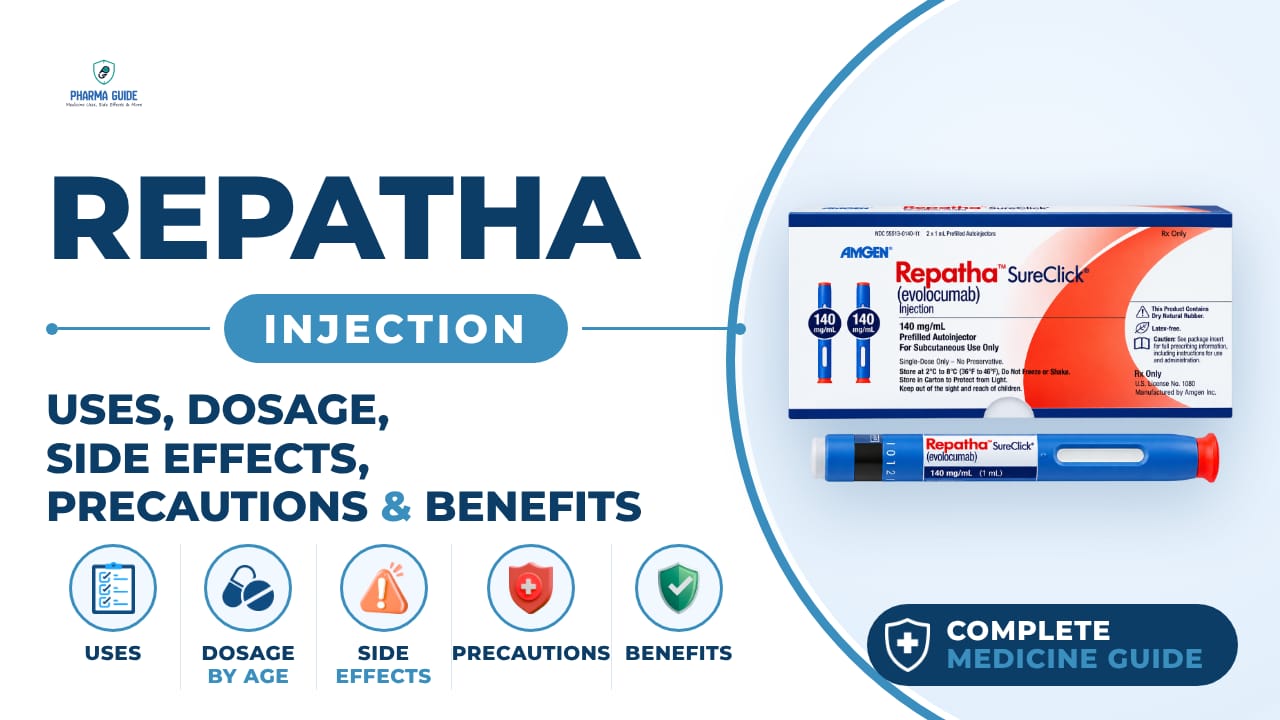
| Generic name | evolocumab |
|---|---|
| Drug class | PCSK9 inhibitors |
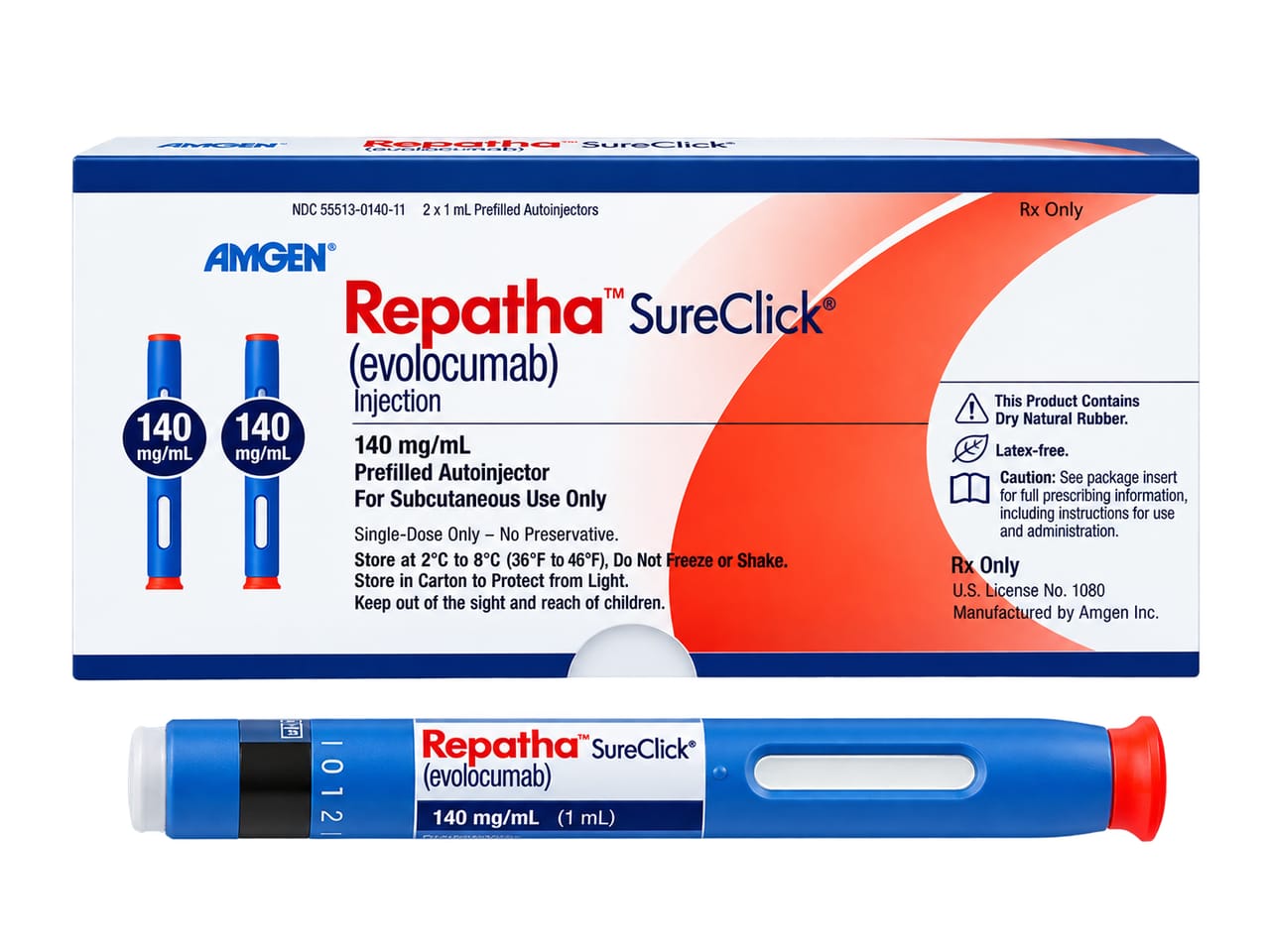
| Forms | Prefilled single-dose pen (140 mg/mL), Prefilled single-dose SureClick autoinjector (140 mg/mL), Prefilled single-dose syringe (140 mg/mL), Single-dose Pushtronex system (420 mg/3.5mL; on-body infusor with prefilled cartridge) |
Quick overview
Repatha Injection (evolocumab) is a brand-name injectable medicine belonging to the PCSK9 inhibitor class, used to lower high cholesterol and reduce the risk of serious heart problems. It is given as an injection under the skin, either every 2 weeks or once a month, depending on the indication. Repatha is used in adults and certain children for high cholesterol and inherited cholesterol disorders, and to reduce the risk of heart attack and stroke in adults at increased risk.
What is Repatha Injection
Repatha is a brand-name injectable medicine used to lower high cholesterol and reduce the risk of serious heart problems. It contains the active ingredient evolocumab and is given as an injection under the skin.
Repatha Injection uses
- Lowering LDL (bad) cholesterol in adults with high cholesterol, along with diet changes
- Treating heterozygous familial hypercholesterolemia (HeFH) in adults and children 10 years and older
- Treating homozygous familial hypercholesterolemia (HoFH) in adults and children 10 years and older
- Reducing the risk of heart attack, stroke, chest pain needing hospital care, or certain heart surgeries in adults at increased risk for these problems
Benefits of Repatha Injection
- LDL Cholesterol Reduction: Significantly lowers LDL ("bad") cholesterol
- Familial Hypercholesterolemia Support: Used for certain inherited cholesterol disorders
- Cardiovascular Risk Reduction: Helps reduce the risk of heart attack and stroke in appropriate patients
- PCSK9 Inhibition: Helps the liver remove more LDL cholesterol from the bloodstream
- Additional Lipid Control: Can be used with statins or other lipid-lowering therapy when additional LDL reduction is needed
How Repatha Injection works
Repatha blocks a protein called PCSK9 that normally destroys the liver's LDL receptors. By blocking PCSK9, more receptors stay available to pull LDL cholesterol out of the blood, which lowers LDL levels.
Repatha Injection dosage
Use Repatha exactly as your healthcare provider tells you or your child to use it. It is given as an injection under the skin every 2 weeks or once a month. You can inject into the thigh, upper arm, or stomach area, but avoid a two-inch area around the belly button. Do not choose an area where the skin is tender, bruised, red, or hard, and avoid scars or stretch marks.
Always check the label before each injection to make sure you have the correct medicine and dose. Do not shake the medicine before use. If more than one injection is needed for a dose, finish all injections within 30 minutes. Each single-use pen, syringe, or cartridge is for one use only and should be thrown away after use, even if some medicine is left.
Do not stop using Repatha without talking to your healthcare provider, since cholesterol levels can rise again. If using the Pushtronex on-body infusor, you need to wear it for about 9 minutes to get the full dose, and you can do light activities like walking while wearing it. You can inject it at any time of day. Rotate the injection site each time you use it. If injecting into the upper arm, you will need someone else to give you the injection.
| Age group | Dose |
|---|---|
| 10–17 Years | 140 mg every 2 weeks or 420 mg once monthly, depending on the indication |
| Adults (18–64 Years) | 140 mg every 2 weeks or 420 mg once monthly |
| Older Adults (65+ Years) | 140 mg every 2 weeks or 420 mg once monthly; individualized by the healthcare professional |
Available forms and strengths
- Prefilled single-dose pen (140 mg/mL)
- Prefilled single-dose SureClick autoinjector (140 mg/mL)
- Prefilled single-dose syringe (140 mg/mL)
- Single-dose Pushtronex system (420 mg/3.5mL; on-body infusor with prefilled cartridge)
Side effects of Repatha Injection
Common
- Runny nose
- Sore throat
- Cold, flu, or flu-like symptoms
- Back pain
- High blood sugar levels
- Redness, pain, or bruising at the injection site
- Urinary tract infection
- Joint pain
- Muscle spasm
- High blood pressure
Serious
- Serious allergic reactions, including trouble breathing or swallowing, hives, rash or itching, and swelling of the face, lips, tongue, throat, or arms
- Reactions related to latex sensitivity in some forms of the device
Warnings and precautions
- Do not use Repatha if you are allergic to evolocumab, Repatha, Repatha SureClick, or any of its ingredients
- Some forms of Repatha's autoinjector or syringe contain dry natural rubber latex in the needle cover; if you are sensitive to latex, ask your healthcare provider for a form that does not contain rubber latex
- Do not use an injection device that has been dropped onto a hard surface, even if you can't see any damage; call your pharmacist for a new one
- Do not stop using Repatha without talking to your healthcare provider first, because your cholesterol levels can increase again
- It isn't known if Repatha is safe for an unborn baby. Tell your healthcare provider right away if you become pregnant while using this medicine.
- It may not be safe to breastfeed while using Repatha. Ask your doctor about any risks before breastfeeding.
- Tell your healthcare provider if you have kidney disease before starting Repatha.
- Tell your healthcare provider if you have liver disease before starting Repatha. Repatha itself is not known to cause liver problems, but your doctor may also prescribe a statin, which can affect the liver.
- There are no known interactions between Repatha and alcohol, but heavy drinking can damage your liver over time, especially if you also take a statin with Repatha. Talk to your doctor about whether drinking alcohol is safe for you during treatment.
Storage
- Store Repatha in the refrigerator in its original carton and protect it from light and heat
- Do not freeze. Throw away any medicine that has been frozen
- Take the medicine out of the refrigerator and let it reach room temperature for 30 to 45 minutes before injecting your dose
- Do not heat a syringe or injection device
- You may also store Repatha in the original carton at cool room temperature, away from light and heat, and use it within 30 days if kept at room temperature
- Handle this medicine carefully; do not use an injection device that has been dropped onto a hard surface, even if you cannot see a break in it
- Do not shake Repatha. Do not use if the medicine has changed colors or has particles in it
When to see a doctor
- Stop using Repatha and get emergency medical help right away if you or your child have trouble breathing or swallowing, hives, rash or itching, or swelling of the face, lips, tongue, throat, or arms
- Call your doctor if you think you have used too much Repatha, or get emergency help right away if your symptoms feel severe or life-threatening
- Tell your healthcare provider about any side effect that does not go away
Alternatives
- Alirocumab
- Atorvastatin
- Rosuvastatin
Watch the video
FAQs
How often is Repatha Injection given?
Repatha is given as an injection under the skin every 2 weeks or once a month, depending on the indication.
How does Repatha Injection work?
Repatha blocks a protein called PCSK9 that normally destroys the liver's LDL receptors. By blocking PCSK9, more receptors stay available to pull LDL cholesterol out of the blood, lowering LDL levels.
What are the common side effects of Repatha Injection?
Common side effects include runny nose, sore throat, cold or flu-like symptoms, back pain, high blood sugar levels, redness or pain at the injection site, urinary tract infection, joint pain, muscle spasm, and high blood pressure.
Where can I inject Repatha?
You can inject Repatha into the thigh, upper arm, or stomach area, avoiding a two-inch area around the belly button, tender or damaged skin, and scars or stretch marks.
How should Repatha Injection be stored?
Store Repatha in the refrigerator in its original carton, protected from light and heat, and do not freeze it. It can also be stored at cool room temperature and used within 30 days.
General information, not medical advice
Your prescriber and the leaflet in your pack know your situation. This page does not.
- Follow your prescriber and the leaflet
- Don't start, stop, or change a dose on your own
- Doses and warnings differ by country and product
Sources
Video
Related medicines

Injectafer Injection: Uses, Dosage, Side Effects, Precautions and Alternates
Iron products
Injectafer (ferric carboxymaltose) treats iron deficiency anemia and heart failure-related iron deficiency via IV. Learn uses, dosage, side effects, and

Gliclazide Tablet: Uses, Dosage, Side Effects, Precautions and Alternates
Sulfonylurea (hypoglycemic/antidiabetic agent)
Gliclazide Tablet is a sulfonylurea for type 2 diabetes that boosts insulin release. Learn about dosage, side effects, warnings, and precautions.