
Safety
General information, not medical advice
Your prescriber and the leaflet in your pack know your situation. This page does not.
- Follow your prescriber and the leaflet
- Don't start, stop, or change a dose on your own
- Doses and warnings differ by country and product
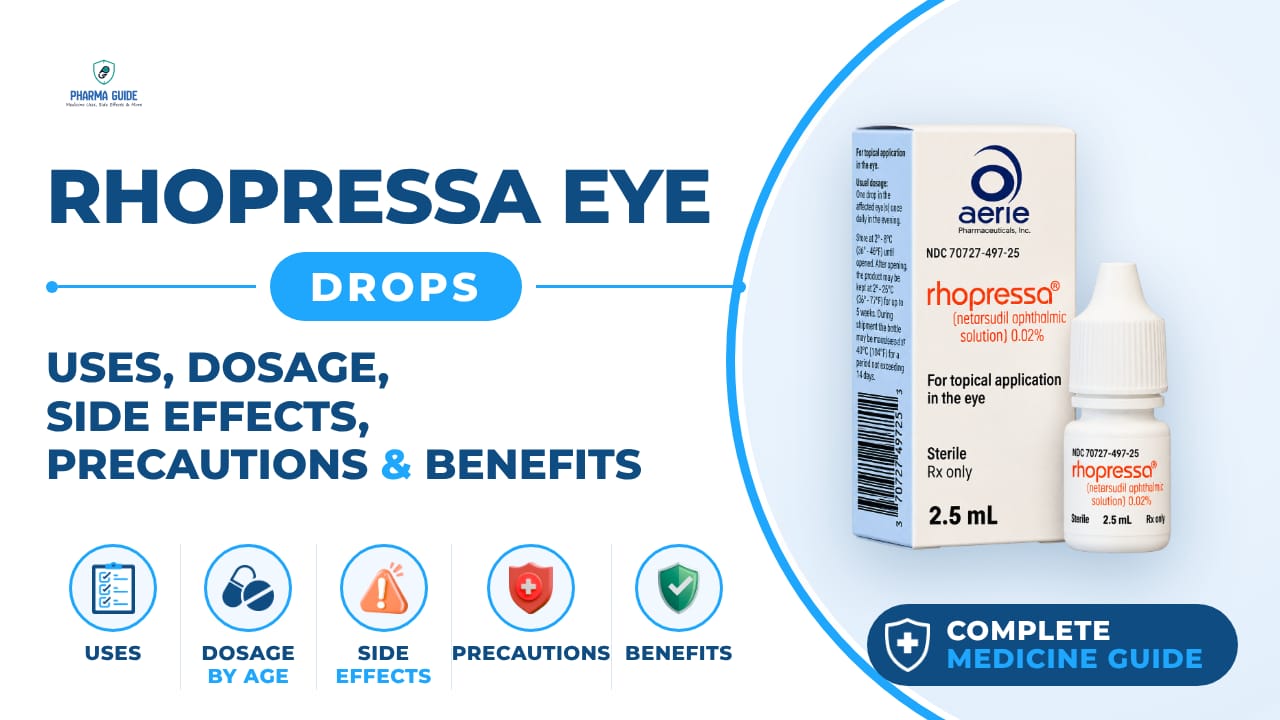
Rhopressa Eye Drops: Uses, Dosage, Side Effects, Precautions and Alternates
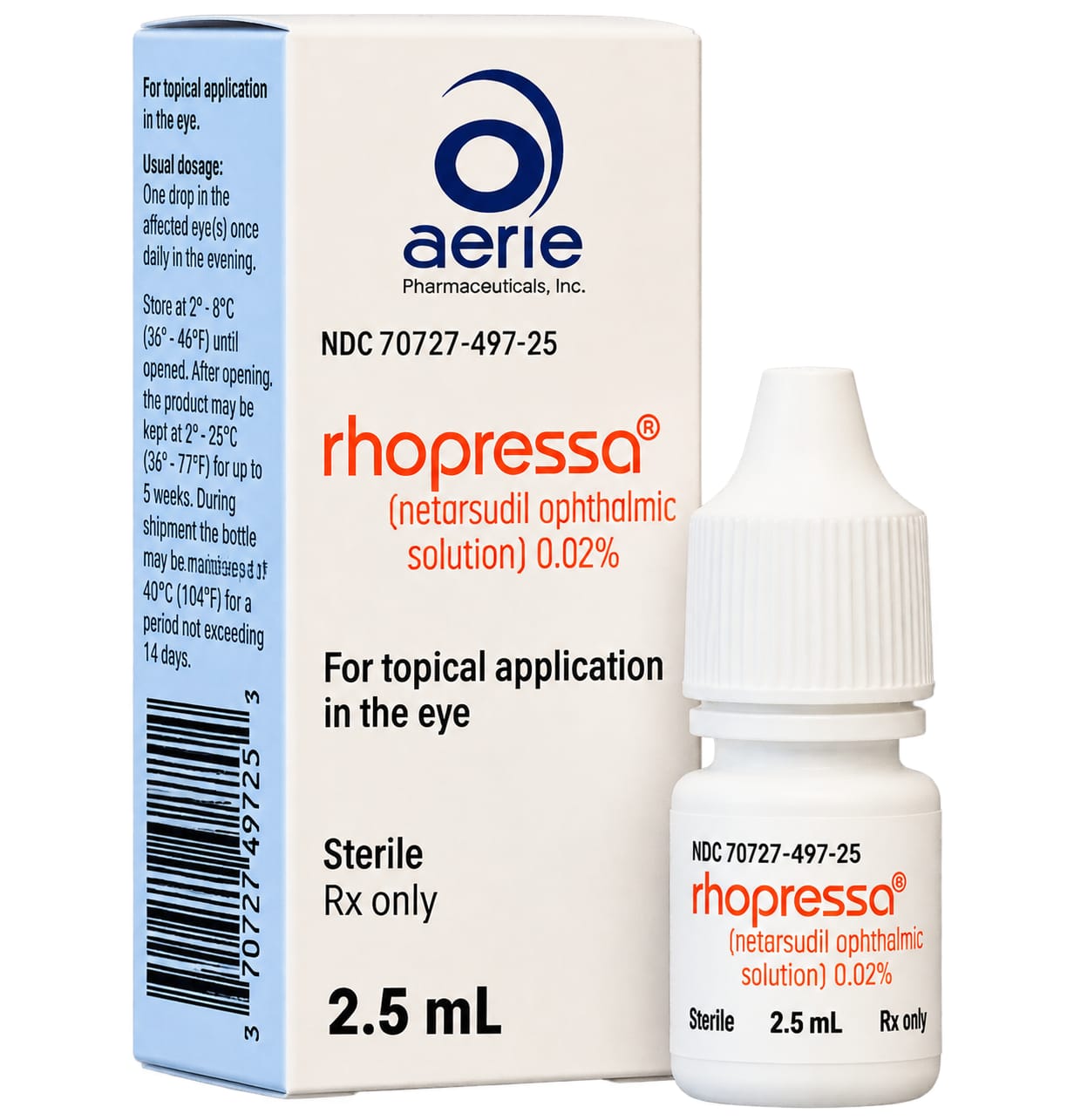
| Generic name | netarsudil ophthalmic |
|---|---|
| Drug class | Ophthalmic glaucoma agents (Rho kinase inhibitor) |
| Forms | Ophthalmic solution (eye drops) |
Quick overview
Rhopressa Eye Drops (netarsudil ophthalmic) is a prescription Rho kinase inhibitor eye drop used to lower high pressure inside the eye in people with open-angle glaucoma or ocular hypertension. It is applied once daily in the evening and works by helping fluid drain more easily out of the eye. It is available as an ophthalmic solution and is not approved for use in anyone younger than 18 years old.
What is Rhopressa Eye Drops
Rhopressa is a prescription eye drop that reduces high pressure inside the eye. It is used in people with open-angle glaucoma or ocular hypertension.
Rhopressa Eye Drops uses
- Treats open-angle glaucoma
- Treats other causes of high pressure inside the eye (ocular hypertension)
Benefits of Rhopressa Eye Drops
- Lowers eye pressure by helping fluid drain out of the eye
- Can reduce eye pressure by up to 5 mmHg with once-daily use
How Rhopressa Eye Drops works
Rhopressa is a Rho kinase inhibitor. It is believed to lower eye pressure by helping fluid (aqueous humor) drain more easily out of the eye through a tissue called the trabecular meshwork.
Rhopressa Eye Drops dosage
Use the eye drops exactly as your doctor tells you, following your prescription label and any instructions given with the medicine. Wash your hands before using the eye drops. Do not wear soft contact lenses while using this medicine; remove contacts before using the drops and wait at least 15 minutes before putting them back in.
Tilt your head back, pull down your lower eyelid to make a small pocket, look up and away from the dropper, and place a drop in the pocket. After using a drop, close your eyes for a couple of minutes with your head tipped down, without blinking, and gently press a finger to the inner corner of your eye to keep the liquid from draining away.
Use only the number of drops your doctor has prescribed. If you use other eye drops too, wait at least 5 minutes between different eye medicines. Do not let the dropper tip touch your eye, fingers, or any other surface, to avoid contaminating the medicine. Do not use the drops if the liquid has changed color or has particles in it; contact your pharmacist for new medicine.
This medicine is meant to be used once daily in the evening; using it twice a day is not well tolerated and is not recommended. If you miss a dose, skip it and use your next dose at the regular time; do not use two doses at once. This medicine is not approved for use in anyone younger than 18 years old.
| Age group | Dose |
|---|---|
| Under 18 years | Safety and effectiveness not established; use only if specifically prescribed by an ophthalmologist |
| 18–64 years | 1 drop in the affected eye(s) once daily in the evening |
| 65 years and older | 1 drop in the affected eye(s) once daily in the evening |
Available forms and strengths
- Ophthalmic solution (eye drops)
Side effects of Rhopressa Eye Drops
Common
- Eye redness
- Blurred vision
- Pain after using the eye drops
- Small deposits on the surface of the eye (corneal verticillata)
- Broken blood vessels in the white of the eye
- Redness at the site where the drop was placed
- Watery eyes
- Change in eye, eyelash, or eyelid color
- Eye irritation or itching
- Reduced sharpness of vision
Serious
- Signs of an allergic reaction: hives, difficulty breathing, swelling of the face, lips, tongue, or throat
- Severe eye pain, redness, or irritation
- Sudden vision loss, blurred vision, tunnel vision, eye pain or swelling, or seeing halos around lights
- Fast, irregular, or pounding heartbeats, fluttering in the chest, shortness of breath, or sudden dizziness or passing out
- Severe headache, confusion, slurred speech, arm or leg weakness, trouble walking, loss of coordination, feeling unsteady, very stiff muscles, high fever, heavy sweating, or tremors
Warnings and precautions
Do not use Rhopressa if you are allergic to it. Tell your doctor if you have ever had damage to the surface of your eye (the cornea). Do not touch the dropper tip to your eye or any other surface, since a contaminated dropper can infect your eye and cause serious vision problems.
Do not wear soft contact lenses while using this medicine, since a preservative in the drops could discolor the lenses. Wait at least 15 minutes after using the drops before putting your contacts back in. Avoid letting the bottle tip touch your eye or any surface, since using contaminated eye drops can cause serious eye damage or loss of vision.
There have been reports of eye infections (bacterial keratitis) linked to contamination of multi-dose eye drop bottles, often in people who already had eye disease or a damaged eye surface. Rhopressa is not approved for use in anyone younger than 18 years old. Using this medicine twice a day instead of once is not well tolerated and is not recommended.
Use caution in patients with pre-existing corneal problems or after eye procedures that may affect the corneal endothelium. Contact an ophthalmologist promptly if eye pain or decreased vision occurs, as these may indicate corneal edema.
Avoid contaminating the bottle tip with the eye, fingers, or other surfaces to reduce the risk of bacterial keratitis. Remove contact lenses before applying Rhopressa and follow your ophthalmologist's instructions regarding when to reinsert them. If using other glaucoma or ophthalmic medicines, separate them by at least 5 minutes.
Do not use more than once daily, as twice-daily dosing is not recommended and is less well tolerated. It is not known whether Rhopressa will harm an unborn baby; tell your doctor if you are pregnant or plan to become pregnant. It may not be safe to breastfeed while using this medicine; ask your doctor about any risk. Safety and effectiveness in patients under 18 have not been established.
Storage
- Store an unopened bottle in the refrigerator; do not freeze
- After opening, the product may be kept at room temperature away from moisture and heat for up to 6 weeks
- If kept refrigerated after opening, it can be used until the expiration date on the bottle
- Keep the bottle tightly closed when not in use
- Throw away any unused eye drops after 6 weeks
- During shipping, the bottle may be exposed to higher temperatures for a short period, but this does not affect normal home storage
When to see a doctor
Get emergency medical help right away if you have signs of an allergic reaction such as hives, difficulty breathing, or swelling of your face, lips, tongue, or throat. Call your doctor right away if you have severe eye pain, redness, or irritation.
If you develop a new eye problem such as injury or infection, notice decreased vision with or without eye pain, have eye surgery, or develop eye reactions like conjunctivitis or eyelid problems, contact your doctor right away about whether to keep using Rhopressa.
Seek medical care right away for serious eye symptoms such as sudden vision loss, blurred vision, tunnel vision, eye pain or swelling, or seeing halos around lights. Seek medical care right away for serious heart symptoms such as fast, irregular, or pounding heartbeat, fluttering in the chest, shortness of breath, or sudden dizziness or passing out.
Seek medical care right away for a severe headache, confusion, slurred speech, arm or leg weakness, trouble walking, loss of coordination, feeling unsteady, very stiff muscles, high fever, heavy sweating, or tremors. Notify your physician right away if you experience eye pain or decreased vision while using Rhopressa, as this can be a sign of corneal swelling.
Alternatives
- Latanoprost eye drops
- Travoprost eye drops
- Tafluprost (Zioptan) eye drops
- Dorzolamide eye drops
Watch the video
FAQs
What is Rhopressa Eye Drops used for?
Rhopressa is a prescription eye drop used to treat open-angle glaucoma and other causes of high pressure inside the eye (ocular hypertension).
How often should Rhopressa Eye Drops be used?
Rhopressa is used once daily in the evening, with 1 drop in the affected eye(s). Using it twice a day is not well tolerated and is not recommended.
Can I wear contact lenses while using Rhopressa?
No, you should not wear soft contact lenses while using Rhopressa. Remove contacts before applying the drops and wait at least 15 minutes before putting them back in.
What are the common side effects of Rhopressa Eye Drops?
Common side effects include eye redness, blurred vision, pain after using the drops, small deposits on the eye surface, broken blood vessels in the white of the eye, watery eyes, and eye irritation or itching.
How should Rhopressa Eye Drops be stored?
Store an unopened bottle in the refrigerator without freezing. After opening, it may be kept at room temperature for up to 6 weeks, after which any unused drops should be discarded.
General information, not medical advice
Your prescriber and the leaflet in your pack know your situation. This page does not.
- Follow your prescriber and the leaflet
- Don't start, stop, or change a dose on your own
- Doses and warnings differ by country and product
Sources
Video
Related medicines

Injectafer Injection: Uses, Dosage, Side Effects, Precautions and Alternates
Iron products
Injectafer (ferric carboxymaltose) treats iron deficiency anemia and heart failure-related iron deficiency via IV. Learn uses, dosage, side effects, and

Gliclazide Tablet: Uses, Dosage, Side Effects, Precautions and Alternates
Sulfonylurea (hypoglycemic/antidiabetic agent)
Gliclazide Tablet is a sulfonylurea for type 2 diabetes that boosts insulin release. Learn about dosage, side effects, warnings, and precautions.