
Safety
General information, not medical advice
Your prescriber and the leaflet in your pack know your situation. This page does not.
- Follow your prescriber and the leaflet
- Don't start, stop, or change a dose on your own
- Doses and warnings differ by country and product
Ruxolitinib Cream: Uses, Dosage, Side Effects, Precautions and Alternates
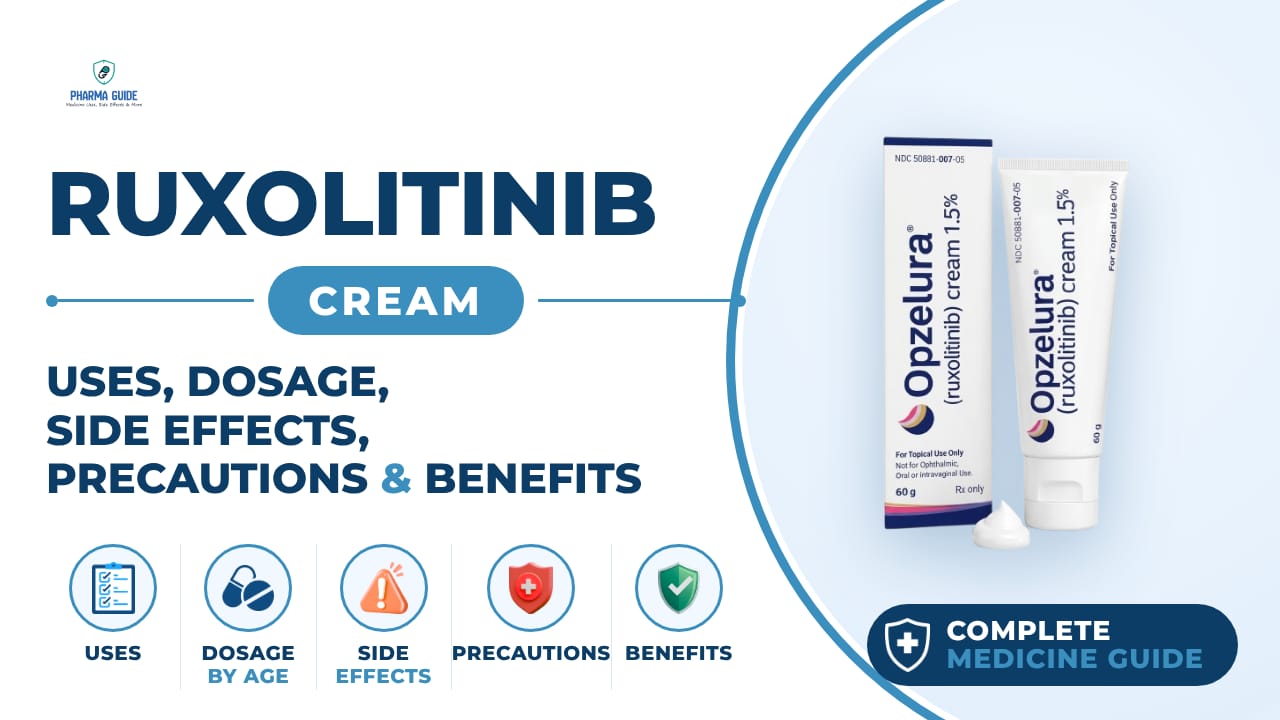
| Generic name | ruxolitinib topical 1.5% |
|---|---|
| Drug class | Janus kinase (JAK) inhibitor (kinase inhibitor) |
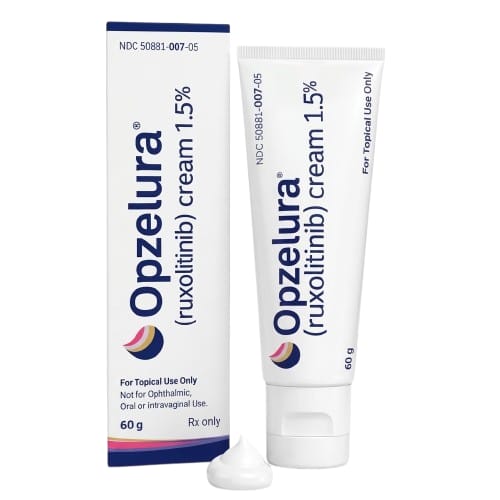
| Forms | Cream (60 g and 100 g tubes) |
Quick overview
Ruxolitinib Cream (Opzelura) is a prescription topical medicine containing ruxolitinib 1.5%, a Janus kinase (JAK) inhibitor. It is used for short-term and non-continuous chronic treatment of mild to moderate atopic dermatitis in non-immunocompromised adults and children 2 years and older, and for treatment of nonsegmental vitiligo in adults and children 12 years and older. It works by reducing immune system activity that causes skin inflammation. It is applied to the skin twice a day as directed by a doctor.
What is Ruxolitinib Cream
Opzelura is a prescription cream containing ruxolitinib, a Janus kinase (JAK) inhibitor. It is applied to the skin to treat certain skin conditions by reducing immune system activity that causes inflammation.
Ruxolitinib Cream uses
- Short-term and non-continuous chronic treatment of mild to moderate atopic dermatitis (eczema) in non-immunocompromised adults and children 2 years of age and older whose disease is not adequately controlled with topical prescription therapies or when those therapies are not advisable
- Treatment of nonsegmental vitiligo in adults and children 12 years of age and older
Benefits of Ruxolitinib Cream
- Helps reduce eczema itching and redness
- Helps treat mild to moderate atopic dermatitis
- Helps restore skin color in nonsegmental vitiligo
- Helps reduce skin inflammation
How Ruxolitinib Cream works
Ruxolitinib blocks proteins called JAK1 and JAK2 that send signals telling immune cells to multiply and cause inflammation. By blocking these signals, the cream reduces inflammation in the skin.
Ruxolitinib Cream dosage
For use on the skin only; do not use in the eyes, mouth, or vagina. Apply a thin layer twice a day to the affected areas, at around the same times each day. Do not use with tight bandages or dressings that cover and seal the skin (occlusive dressings). Wash your hands after applying, unless the hands are the area being treated; if someone else applies it for you, they should wash their hands afterward.
For atopic dermatitis, stop using when itching, rash, and redness go away, or as directed by your doctor; tell your doctor if symptoms do not improve within 8 weeks. For nonsegmental vitiligo, tell your doctor if your skin does not improve within 24 weeks. Use exactly as your doctor tells you; do not use more or less than prescribed.
| Age group | Dose |
|---|---|
| Under 18 years | Not recommended |
| 18–64 years | 1.5% cream, twice/day |
| 65+ years | 1.5% cream, twice/day |
Available forms and strengths
- Cream, 1.5% (60 g and 100 g tubes)
Side effects of Ruxolitinib Cream
Common
- Common cold symptoms (nasopharyngitis)
- Diarrhea
- Bronchitis
- Ear infection
- Increase in eosinophil count or decrease in neutrophil count
- Hives (urticaria)
- Inflamed hair pores (folliculitis)
- Swelling of the tonsils (tonsillitis)
- Runny nose (rhinorrhea)
- Upper respiratory tract infection
- COVID-19
- Pain, irritation, discomfort, or itching at the application site
- Fever
- Acne at the application site (vitiligo)
- Itching at the application site (vitiligo)
- Headache (vitiligo)
- Urinary tract infection (vitiligo)
- Redness at the application site (vitiligo)
Serious
- Serious infections, including tuberculosis and infections that can spread through the body
- Increased risk of death from any cause
- Lymphoma and other cancers, including skin cancer
- Major cardiovascular events such as heart attack or stroke
- Blood clots (deep vein thrombosis or pulmonary embolism)
- Low blood cell counts (low platelets, low red blood cells, low white blood cells)
- Unusual bleeding or bruising
- Increases in cholesterol
Warnings and precautions
- This medicine can lower your body's ability to fight infection, increasing the risk of serious infections like tuberculosis or infections that spread through the body, which can require hospitalization or lead to death
- People 50 years of age and older with at least one heart disease risk factor who take a JAK inhibitor by mouth have a higher risk of death from any cause
- This medicine may raise the risk of certain cancers, including lymphoma and skin cancer, especially in current or past smokers. Your doctor will check your skin regularly during treatment
- There is a higher risk of serious heart-related events like heart attack or stroke, especially in people 50 and older with heart disease risk factors or who smoke
- Blood clots in the legs or lungs can occur and may be life-threatening
- Do not use this medicine together with other strong immune-suppressing medicines, biologic therapies, or other JAK inhibitors
- This medicine should not be used by people who have an active, serious infection
- It is not known if this medicine will harm an unborn baby. Tell your doctor if you are pregnant or plan to become pregnant. There is a pregnancy registry that tracks outcomes for people exposed to this medicine during pregnancy.
- It is not known if this medicine passes into breast milk. Do not breastfeed during treatment and for about 4 weeks after the last dose.
- Tell your doctor if you have or have had hepatitis B or C, since this medicine has not been well studied in people with these conditions and starting it is not recommended if the infection is active.
Storage
- Store at room temperature between 68°F to 77°F (20°C to 25°C)
- Keep this medication in the container it came in, tightly closed, and out of reach of children
- Store it at room temperature and away from excess heat and moisture (not in the bathroom)
- Dispose of unneeded medications in a way so that pets, children, and other people cannot take them. Do not flush this medication down the toilet. Use a medicine take-back program
When to see a doctor
- Get emergency help right away if you have symptoms of a heart attack or stroke, such as chest discomfort or pressure, pain spreading to your arm, back, neck or jaw, shortness of breath, cold sweat, nausea, lightheadedness, weakness on one side of the body, or slurred speech
- Tell your healthcare provider right away if you notice signs of a blood clot, such as swelling, pain, or tenderness in one or both legs, sudden unexplained chest or upper back pain, or shortness of breath
- Call your healthcare provider right away if you have any symptoms of an infection, such as fever, chills, cough, shortness of breath, weight loss, warm or red skin, sores, diarrhea, stomach pain, or feeling very tired
- Tell your doctor right away if you notice unusual bleeding, bruising, tiredness, shortness of breath, or fever, which may be signs of low blood cell counts
- If you use too much of this medicine, contact your healthcare provider or go to the nearest emergency room right away
Alternatives
- Tacrolimus ointment
- Pimecrolimus cream
- Crisaborole cream
- Topical corticosteroids
Watch the video
FAQs
What is Ruxolitinib Cream used for?
It is used for short-term and non-continuous chronic treatment of mild to moderate atopic dermatitis in non-immunocompromised adults and children 2 years and older, and for treatment of nonsegmental vitiligo in adults and children 12 years and older.
How do you apply Ruxolitinib Cream?
Apply a thin layer to the affected skin areas twice a day at around the same times each day. It is for use on the skin only and should not be used in the eyes, mouth, or vagina, or with occlusive dressings.
How long does it take for Ruxolitinib Cream to work?
For atopic dermatitis, tell your doctor if symptoms do not improve within 8 weeks. For nonsegmental vitiligo, tell your doctor if your skin does not improve within 24 weeks.
What are the serious side effects of Ruxolitinib Cream?
Serious risks include serious infections such as tuberculosis, increased risk of death, lymphoma and other cancers including skin cancer, major cardiovascular events like heart attack or stroke, blood clots, low blood cell counts, and increases in cholesterol.
What are the alternatives to Ruxolitinib Cream?
Alternatives mentioned include tacrolimus ointment, pimecrolimus cream, crisaborole cream, and topical corticosteroids.
General information, not medical advice
Your prescriber and the leaflet in your pack know your situation. This page does not.
- Follow your prescriber and the leaflet
- Don't start, stop, or change a dose on your own
- Doses and warnings differ by country and product
Sources
Video
Related medicines

Injectafer Injection: Uses, Dosage, Side Effects, Precautions and Alternates
Iron products
Injectafer (ferric carboxymaltose) treats iron deficiency anemia and heart failure-related iron deficiency via IV. Learn uses, dosage, side effects, and

Gliclazide Tablet: Uses, Dosage, Side Effects, Precautions and Alternates
Sulfonylurea (hypoglycemic/antidiabetic agent)
Gliclazide Tablet is a sulfonylurea for type 2 diabetes that boosts insulin release. Learn about dosage, side effects, warnings, and precautions.